About the neighborhood
Place in Lombardy, Italy
45°28′47.6″N 9°11′33.23″E / 45.479889°N 9.1925639°E / 45.479889; 9.1925639
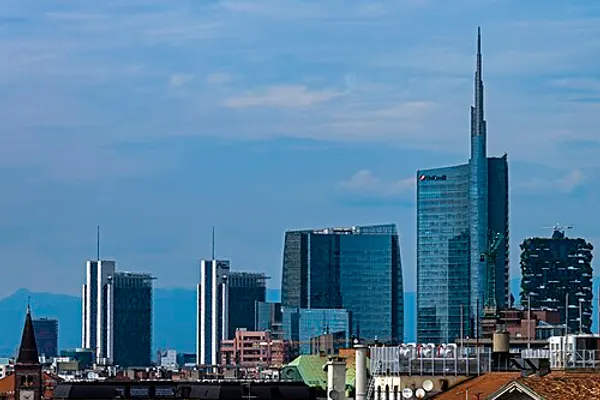
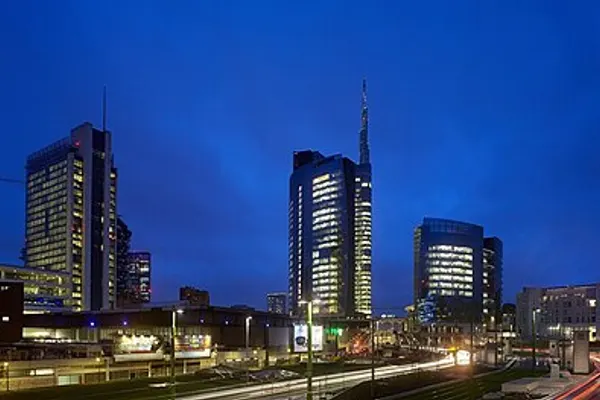
Porta Nuova is one of the main business districts of Milan, Italy in terms of economy, and part of the Zone 2 administrative division. Named after the well-preserved Neoclassic gate built in 1810 on this site, it is now one of Italy's most high-tech and international districts, containing the country's tallest skyscraper: the Unicredit Tower.
Porta Nuova has a 2017 city GDP of €400 billion, which makes it Europe's richest district within any city. A concentration of companies are based in Porta Nuova, with 4% of all institutions and conglomerates found in Italy, while Milan has 40% of all these business, and Milan's Lombardy Region has 53% of it.
Industrialization is also profusely increasing within the district. A total of three Fortune 500 companies are located in it, namely Alfa Romeo, Pirelli and Techint, with a lot of other significant companies, including luxury fashion house Versace and italian football giants Internazionale. Geographical Porta Nuova was the main engine of the global invention of "polypropylene" by Giulio Natta, or in other terms, plastic, popularized by several companies within the city during the 1950s. Porta Nuova began manufacturing trams, buses, and trains, as part of Milan's public transport system which now gave Milan Europe's most advanced light rail system.
In 2019, Milan is on course to have several tax-free or flat tax services, as part of attracting domestic and international businesses which will be initiated in the area of Porta Nuova. It is also an integrated response to gain several European Union agencies from United Kingdom following Brexit and to prevent a possible economic fallout.
History
Porta Nuova is named after the Napoleonic gate which was erected in 1810 from a design by Giuseppe Zanoia.
In the 1990s Milan, a former heavy-industry powerhouse, was filled with about 6 million square metres of industrial wastelands and unused railroad tracks; transforming such places following the example set by London and other post-industrial cities had become a primary objective for the municipal administration.
The Porta Nuova business district project was born in 1997 in collaboration with American real estate developer Gerald D. Hines and his partners, Micheal Topham and Riccardo Catella; the new district took fourteen years to develop and has been built on a large area of central Milan affected by decades of urban decay, after a series of failed development plans in the 1970s.
The 290,000 square metres (later increased to 346,500), US$2.5bn mixed use project was definitively approved in 2005 and was designed by three masterplanners, Pelli Clarke Pelli, Boeri Studio and Kohn Pedersen Fox.
In 2013 Qatar Holding LLC, a unit of the Persian Gulf emirate's sovereign wealth fund, agreed to buy a 40 percent stake in Milan's newly built Porta Nuova business district to expand its Italian real estate holdings. In 2015 Qatar Investment Authority agreed to buy the 60 percent of Porta Nuova it did not already own.
At the end of 2017 construction works began for "Gioia 22", a new 26-story, 120 metres high tower designed by architect Gregg E. Jones of Pelli Clarke Pelli and scheduled to be completed by 2020.
Area specifications
Pelli Clarke Pelli designed the largest part of the development, the "Garibaldi" area (near Garibaldi railway station), with office and retail compounds extending over 230,500 square metres. It is centered on the Unicredit Tower complex, that features three office towers, of which the largest, a 31-story, 231 metres high asymmetrical tower culminating in a sculptural, 80m stainless steel spire, is currently (as of 2017) the tallest building in Italy.
The "Varesine" area, named after a now demolished railway station that once connected Milan to Varese, has been designed by Kohn Pedersen Fox Associated and occupies 85,000 square metres. The main building of this area is Torre Diamante, a 130 metres high, diamond-shaped tower that is Italy's tallest skyscraper with a steel structure.
The "Isola" area ("island" in Italian, owing its name to the fact that it was once encircled by railway lines), designed by Boeri Studio, extends over 31,500 square metres. Its most distinctive feature is Bosco Verticale, a pair of residential towers covered in trees and vegetation.
Buildings
Towers and other buildings
Luxury residences
Other buildings
See also
Tallest buildings in Italy
Economy of Milan
References
Wikimedia Commons has media related to Porta Nuova business district.
Encyclopedic content adapted from the Wikipedia article on Porta Nuova, used under CC BY-SA 4.0.
What makes Porta Nuova special
Porta Nuova stands out among Milan’s neighborhoods for its distinctive character: milan's sleek new skyline. Ranked #3 in Milan, it offers the kind of experience that defines a great city trip — a place where the streets themselves tell a story and every block rewards curiosity.
Best for
Our take on Porta Nuova
Porta Nuova is one of the strongest neighborhoods in Milan, and it consistently appears in our editors' personal favorites lists. It may not always get the same attention as the city's most famous district, but among travelers who know Milan well, Porta Nuova is often the first recommendation.
What makes Porta Nuova worth the visit is the texture of daily life here. It is a neighborhood that functions for the people who live in it — not just for the visitors who pass through. The shops serve local needs, the restaurants feed local appetites, and the streets have a rhythm that reflects genuine community rather than tourism infrastructure. That is the quality our editors prize most, and Porta Nuova has it in abundance.
Our editors recommend budgeting at least half a day here — enough time to walk the main streets, sit down for coffee, and discover the side streets where Porta Nuova's real character lives.
Living in Porta Nuova
Porta Nuova is connected to the rest of Milan by public transit, and most visitors find it straightforward to reach from the city center or airport. Once you arrive, the neighborhood is best explored on foot — the scale is human and the streets reward wandering.
Day-to-day life in Porta Nuova has the rhythm of a genuine residential neighborhood. You will find grocery stores, pharmacies, cafés with morning regulars, and the kind of small independent shops that only survive where locals support them. For visitors, this means the infrastructure you need — good coffee, a decent meal, a quiet place to sit — is always within a short walk.
Accommodation in Porta Nuova ranges from boutique hotels to short-term rentals. We generally recommend staying within the neighborhood itself rather than commuting from a hotel elsewhere in Milan — the experience of waking up inside a great neighborhood is fundamentally different from visiting one as a day trip.
What locals say about Porta Nuova
Long-term residents of Porta Nuova tend to describe their neighborhood with a mix of pride and protectiveness. Like any district with genuine character, Porta Nuova inspires loyalty — the kind of place people move to and never quite leave, or leave and spend years trying to get back to.
What locals appreciate most about Porta Nuova is its consistency — the feeling that the neighborhood works the same way on a Tuesday morning as it does on a Saturday night. It is not a place that performs for visitors and then goes quiet. The rhythm is genuine, the community is real, and the daily experience of living here is what draws people and keeps them.
Compared to the more famous districts in Milan, Porta Nuova has maintained a lower profile, which many residents consider an advantage. The neighborhood evolves gradually rather than being reshaped by sudden attention, and the result is a community that still feels organic rather than curated.
Visitor tips
- Porta Nuova is located in Milan, Italy. The neighborhood is accessible by public transport, taxi, or rideshare from most parts of the city.
- Morning is often the best time to explore — the streets are quieter, the light is better for photography, and cafes are at their most welcoming.
- Wear comfortable walking shoes — the best way to experience Porta Nuova is on foot, wandering the side streets and discovering what lies around each corner.
- Save the neighborhood's location on your phone before you arrive. Offline maps are especially useful for navigating the smaller side streets.