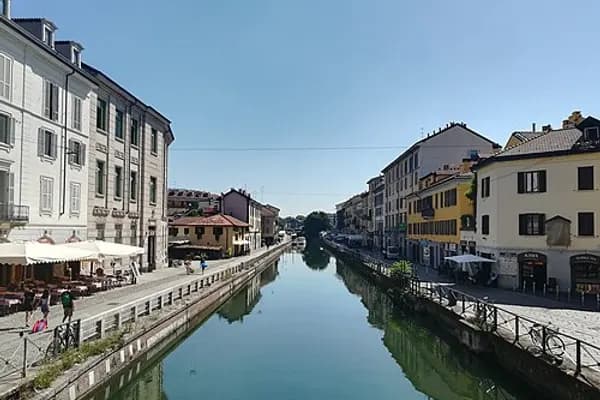
About the neighborhood
System of navigable canals in Milan
The navigli (Italian pronunciation: naˈviʎʎi; Lombard: Navili naˈʋiːli, singular and plural) are a system of interconnected canals in and around Milan, in the Italian region of Lombardy, dating back as far as the Middle Ages.
The system consists of five canals: Naviglio Grande, Naviglio Pavese, Naviglio Martesana, Naviglio di Paderno, Naviglio di Bereguardo. The first three were connected through Milan via the Fossa Interna, also known as the Inner Ring. The urban section of the Naviglio Martesana was covered over at the beginning of the 1930s, together with the entire Inner Ring, thus sounding the death knell for the north-eastern canals. Commercial carrying continued on the Naviglio Grande, but the decline was steady and by the 1960s a project of a fluvial port to reach the Po River and consequentially the Adriatic Sea through the canals was shelved for good.
History
The ancient Celtic settlement that gave rise to Milan was later replaced by a Roman one; the latter, which was called by the ancient Romans "Mediolanum", was then in turn replaced by a medieval settlement. But the urban center of Milan has steadily grown, until modern times, around the first Celtic nucleus.
The Celtic settlement had only one river namely the Nirone, and a fountain, the Molia (or Mollia). The Nirone lapped the ancient Mediolanum, while the Molia flowed near the settlement, collecting some irrigation from the north. Both of these were within the region of the Olona, which flowed further west, and the Seveso, whose natural bed was located further east.
The three major rivers (Lambro, Seveso and Olona) flow in their natural beds, the Lambro and the Olona furthest from the city, with the Seveso being closer. Of the three, the only one that has not changed over the centuries is the Lambro, which still flows in its ancient natural bed, while the Olona and Seveso were diverted by the ancient Romans.
The territory as a whole had plenty of water given that the settlement was located on the "line of fountains", between geological layers with different permeability, which allows deep waters to resurface on the surface. To perform agriculture the Celts had to regulate the flow of water by resorting to canalization and drainage.
In 222 BC the ancient Romans conquered Milan. Roman cities were large consumers of water, both for public and domestic uses, and Romans studied hydraulic engineering in depth. But Mediolanum did not need aqueducts, given that water was abundant and easily accessible because it emerged from the ground from the resurgences and flowed nearby in rivers and streams, and this fully met the needs of the city's daily life.
Modern usage
Today, the canals are mostly used for irrigation. Some tourist navigation options are also available along certain sections.
Modern life around the Navigli
In the 21st century the Navigli region of Milan is a highly active area with a large number of residential units, bars and restaurants. It is also a well known center for artists.
References
Sources
Bricchetti, Edo; Codara, Giuseppe (2017). Navigli del Milanese: ieri e oggi Milanese Navigli: yesterday and today (in Italian). Milano: Meravigli. ISBN978-88-7955-397-1. OCLC1110598606.
Celona, Toti; Beltrame, Gianni (1988) . I Navigli Milanesi: storia e prospettive The Milanese Navigli: history and perspectives (in Italian). Milano: Silvana editoriale. ISBN978-88-366-0001-4. OCLC1294309117.
Poggi, Felice; Masera, Giovanni; Milano Ufficio porto e navigazione (1921). Linea navigabile da Milano per Lodi e Pizzighettone alla foce dell'Adda: relazione tecnica sul progetto di canale navigabile Milano per Lodi-Pizzighettone a foce Adda e programma dei lavori elaborato dall'Ufficio Porto e navigazione del Comune di Milano Navigable line from Milan to Lodi and Pizzighettone at the mouth of the Adda: technical report on the project for a navigable canal from Milan to Lodi-Pizzighettone at the mouth of the Adda and work programme drawn up by the Port and Navigation Office of the Municipality of Milan (in Italian). Milano: Cooperativa grafica degli operai. OCLC934099177.
See also
River valley civilization
External links
Martesana Canal - Historic and present pictures
Inner ring - Historic and present pictures
Darsena - Historic and present pictures
Wikimedia Commons has media related to Navigli di Milano.
Museums and galleries Alfa Romeo Museum
Armani/Silos
Bagatti Valsecchi Museum
Castello Sforzesco Antique Furniture & Wooden Sculpture Museum
Applied Arts Collection
Archaeological Museum
Egyptian Museum
Museum of Musical Instruments
Museo d'Arte Antica
Pinacoteca
Civic Aquarium
Galleria d'Arte Moderna
Gallerie di Piazza Scala Art collection of Fondazione Cariplo
Palazzo Anguissola Antona Traversi
Palazzo Brentani
Museo Civico di Storia Naturale di Milano
Museo del Novecento
Museo del Risorgimento
Museo della Scienza e della Tecnologia "Leonardo da Vinci"
Museo Diocesano
Museo Poldi Pezzoli
Museo Teatrale alla Scala
Contemporary Art Pavilion
Pinacoteca di Brera
Triennale di Milano
Villas and palaces Casa Campanini
Casa degli Omenoni
Casa di Riposo per Musicisti
Casa Manzoni
Casa Panigarola
Cascina Pozzobonelli
Castello Cova
Palazzina Appiani
Palazzo dell'Arengario
Palazzo della Banca Commerciale Italiana
Palazzo Belgioioso
Palazzo Borromeo
Palazzo Carminati
Palazzo Castiglioni
Palazzo dei Giureconsulti
Palazzo Mezzanotte
Palazzo della Ragione
Palazzo delle Scuole Palatine
Palazzo del Senato (State Archives of Milan)
Royal Palace of Milan
Villa Belgiojoso Bonaparte
Restaurants Antica trattoria Bagutto
Libraries Biblioteca Ambrosiana
Biblioteca di Brera
Theatres La Scala
Piccolo Teatro
Teatro degli Arcimboldi
Teatro Dal Verme
Teatro Lirico
Squares and public spaces Galleria Vittorio Emanuele II
Piazza Cordusio
Piazza del Duomo
Piazza della Scala
Piazza Mercanti
Piazza Gae Aulenti
Streets and canals Corso Buenos Aires
Corso Como
Navigli
Quadrilatero della moda Via della Spiga
Via Monte Napoleone
Gardens and parks Basilicas Park
Giardini Pubblici Indro Montanelli
Monte Stella
Orto Botanico di Brera
Orto Botanico di Cascina Rosa
Parco Sempione
Parco Biblioteca degli Alberi
Villa Litta Modignani
Sporting sceneries Agorà Ice Stadium
Allianz Cloud Arena
Arena Civica
Hippodrome of San Siro
Idroscalo
Mediolanum Forum
PalaItalia
San Siro
Velodromo Vigorelli
Events and traditions 2026 Winter Olympics
2026 Winter Paralympics
EICMA
Expo 2015
Fiera Milano
Milan Fashion Week
Milan Furniture Fair
Milan International (1906)
Milan Triennial
Oh bej! Oh bej!
Tourism in Italy
Outline of Milan
Encyclopedic content adapted from the Wikipedia article on Navigli, used under CC BY-SA 4.0.