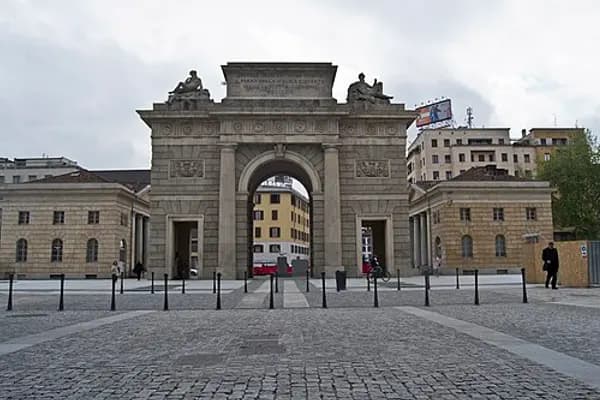
About the neighborhood
Administrative region of Milan in Lombardy, Italy
The Zone 9 of Milan, since 2016 officially Municipality 9 of Milan, (in Italian: Zona 9 di Milano, Municipio 9 di Milano) is one of the 9 administrative divisions of Milan, Italy.
It was officially created as an administrative subdivision during the 1980s. On 14 April 2016, in order to promote a reform on the municipal administrative decentralization, the City Council of Milan established the new Municipality 9, a new administrative body responsible for running most local services, such as schools, social services, waste collection, roads, parks, libraries and local commerce.
On 5 March 1999 the new Zone 9, which corresponds to the northern part of the city, was made up by the union of the previous Zones 2 (Centro Direzionale, Greco, Zara), 7 (Bovisa, Dergano), 8 (Affori, Bruzzano, Comasina) and 9 (Niguarda, Bicocca).
Subdivision
The borough includes the following districts:
Affori, a rural settlement referenced as early as 915 which was annexed to Milan in 1923;
Bicocca, a district incorporated in the city in 1841. In the 19th century, the area of Bicocca was affected by a quick industrialization process, and was gradually absorbed into the urban agglomerate of Milan. In the first half of the 20th century Bicocca became the centre of an important industrial area that also comprised Greco and Sesto San Giovanni, and that greatly contributed to the Italian economy of the time. The first facilities to be established in Bicocca were those of Pirelli, Ansaldobreda, and Wagons-Lits. In the nearby area of Sesto, the Falck steel mill was also a prominent factory. Pirelli maintained a leading role in the area. A historic neighbourhood of Bicocca, "Borgo Pirelli" ("Pirelli Town"), was originally developed as a residential area for the thousands of workers that were employed in the Pirelli factories. Deindustrialization of the Bicocca district began in the 1970s. In 1985, Pirelli started a project to redevelop the area. The resulting "Progetto Bicocca" (Bicocca Project), which affected an area of 960.000 m, was the largest urban transformation project in the history of Italy, and the second in Europe, after that of Berlin. The prominent results of this project were the construction of a large university district (called University of Milan Bicocca) and of the Teatro degli Arcimboldi, a large theatre that has also been used to house La Scala shows while the historic La Scala theatre was undergoing restoration. Other main buildings realized by the project were a seat of the CNR (National Council of Research) and the Istituto Neurologico Besta, a major neurological hospital. Several companies now have their Milanese headquarters in Bicocca, including Pirelli, Prysmian Group, Siemens, Deutsche Bank, ING Group, Reuters, Fastweb, Engie, Philips, Johnson & Johnson, Dell and Hachette-Rusconi;
Bovisa, An industrial area in the outskirt of the city since the second half of the nineteenth century, Bovisa has undergone a thorough transformation since the 1950s, when most factories were dismantled to be moved farther from the expanding city center. After a period of decay, a process of renewal followed, which transformed the Bovisa into a mainly residential suburb. The district is now experiencing an upturn, thanks to the many activities which relocated in the zone. Among them, the Politecnico di Milano, with its Bovisa campus, played a major role. The campus features the schools of Design, Architecture and Industrial Engineering. The area has since gained notoriety as a design and art "melting pot". This trend was confirmed in 2006, when a new headquarters of the Triennale design and art museum, dedicated to modern art, was established in this area;
Bovisasca, a former industrial district, now transformed into a mostly residential area;
Bruzzano;
Centro Direzionale, originally designed to accommodate office buildings for tertiary activities. A relevant part of the design effort focused on the realization of adequate infrastructures supporting heavy daily commute, although only some of the corresponding projects were actually implemented. The main transportation hub in the area is Porta Garibaldi railway station, with connection to the Milan Metro, the suburban network and national rail lines;
Comasina;
Dergano;
Fulvio Testi;
Isola; a district (quartier) of Milan, Italy. It is an area located within Zone 9 of the city.
La Fontana;
Montalbino;
Niguarda;
Porta Garibaldi;
Porta Nuova;
Prato Centenaro;
Segnano.
Historical development
Apart from Affori, Bruzzano, Comasina, Dergano and Segnano, which were autonomous municipalities before being annexed to the main city of Milan in 1923, the urban development of the Zone 9 has always been linked with the development of the Centro Direzionale district.
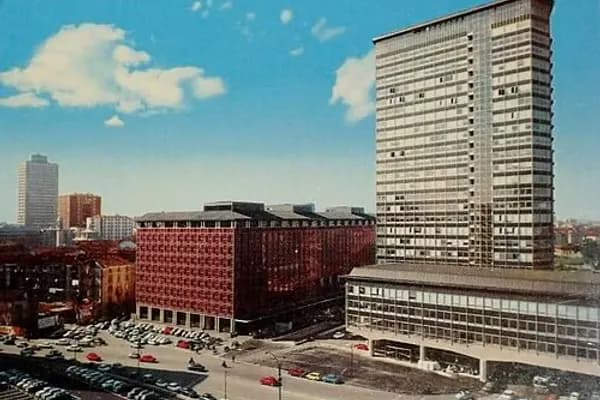
Overall, the realization of the new district took place between 1955 and 1962, but was later suspended as a consequence of the lack of an actual regulation preventing tertiary activities to be established in the city centre. For several years thereafter, the Centro Direzionale remained an heterogeneous and sparse area. Some skyscrapers were built (including the Pirelli Tower, the Galfa Tower, and the Servizi Tecnici Comunali Tower) but other areas remained undeveloped and fell in decay. A major example of the inconsistent use of urban areas in the district was the establishment of the Varesine "Luna Park" (now dismissed) amidst a supposedly office and financial district.
Porta Nuova district development
After a long period of urban decay, the Porta Nuova district is now undergoing a massive renewal, thanks to the "Progetto Porta Nuova" (Porta Nuova Project). The project, which has been under construction since the late 2000s, includes several modern high rise buildings, cultural centres, and a large city park. As a result of these developments, the Porta Nuova district will ideally merge with the bordering Centro Direzionale di Milano, the oldest business district of Milan that is characterized by 1950s-1960s towers, many of which dedicated to government offices and other major public and private companies.
This project effects areas from the neighborhoods of Isola, Varesine and Porta Garibaldi. Construction started in 2009, with completion planned in 2014. The project involves the work of noted architects such as Cesar Pelli, Stefano Boeri and Nicholas Grimshaw. The redevelopment area extends from Porta Garibaldi station to piazza della Repubblica and from Porta Nuova gate to Palazzo Lombardia.
Bosco Verticale
The project was designed as part of the rehabilitation of the historic district of Milan between Via De Castillia and Confalonieri. It consists of two residential towers of which the largest is 26 floors and 110 meters high (called Torre E) and the smaller tower is 18 floors and 76 meters high (called Torre D). It contains 400 condominium units priced from 3,000 Euro per square metre and higher.
It is called Bosco Verticale because each tower houses trees between three and six meters which help mitigate smog and produce oxygen. It is also used to moderate temperatures in the building in the winter and summer. The plants also attenuate noise. The design was tested in a wind tunnel to ensure the trees would not topple from gusts of wind. Botanists and horticulturalists were consulted by the engineering team to ensure that the structure could bear the load imposed by the plants. The steel-reinforced concrete balconies are designed to be 28cm thick, with 1.30metre parapets.
Towers and skyscrapers
Gallery
Municipal government
The area has its own local authority called Consiglio di Municipio (Municipal Council), composed by the President and 30 members directly elected by citizens every five years. The Council is responsible for most local services, such as schools, social services, waste collection, roads, parks, libraries and local commerce in the area, and manages funds (if any) provided by the city government for specific purposes, such as those intended to guarantee the right to education for poorer families.
The current President is Anita Pirovano (PD), elected on 3–4 October 2021.
Here is the current composition of the Municipal Council after 2021 municipal election:
Here is a full lists of the directly elected Presidents of Municipio since 2011:
Education
In this borough are located 17 primary schools, while there are two important universities:
University of Milano-Bicocca, which has its origins from the splitting of the University of Milan, which with about 90,000 students in the 1990s was becoming overcrowded. Bicocca district was chosen as the location for the new university. This area was occupied by the Pirelli industrial complex until the 1980s and the new campus was part of a larger urban renewal project. The university was officially established on 10 June 1998.
Polytechnic University-Bovisa campus, located in the Bovisa district and became active in 1989; campus Bovisa is today composed of campus Durando, opened in 1994, and campus La Masa, inaugurated in 1997. The first is the seat of the School of Design, while the second is dedicated to Industrial, Mechanical, Aerospace, and Energy Engineering faculties. Bovisa also houses the related research facilities, including the wind tunnel.
Parks and gardens
In this borough there are many public parks and gardens:
Library of Trees (90,000 sq), opened in 2018, conceived as a vegetation library which houses more than 100 different species, 500 trees arranged in 22 rings and 135,000 other plants. In the same area, on the occasion of Expo 2015, was temporally created the big Agnes Denes' Wheatfield;
Northern Park of Milan (3,200,000 sq), opened in 1975;
Bruzzano's wood (120,700 sq), opened in 1968;
Nicolò Savarino park (31,590 sq), opened in 1990;
Villa Litta park (76,400 sq), realized in 1687, opened as public park in 1927;
The Cherry Hill (30,000 sq), opened in 2007;
Wanda Osiris garden (22,100 sq), opened in 1991;
Giacomo Della Porta garden (4,400 sq), opened in 1999;
Porro and Jenner garden (1,500 sq), opened in 2000.
Transport
Stations of Milan Metro in the Zone 9:
Gioia, Garibaldi FS;
Affori Centro, Affori FN, Comasina, Dergano, Maciachini, Zara;
Bicocca, Bignami, Ca’ Granda, Garibaldi FS, Isola, Istria, Marche, Ponale, Zara.
Suburban railway stations in the Zone 9:
Milano Porta Garibaldi
Milano Lancetti
Milano Bovisa
Gallery
Maps
References
External links
Wikivoyage has a travel guide for North Milan.
Media related to Municipio 9 (Milan) at Wikimedia Commons
(in Italian) Zone 9 of Milan (municipal website) Archived 2012-05-25 at the Wayback Machine
45°31′01″N 9°11′31″E / 45.516888°N 9.191866°E / 45.516888; 9.191866
Encyclopedic content adapted from the Wikipedia article on Isola, used under CC BY-SA 4.0.
What makes Isola special
Isola stands out among Milan’s neighborhoods for its distinctive character: industrial-chic and local bars. Ranked #4 in Milan, it offers the kind of experience that defines a great city trip — a place where the streets themselves tell a story and every block rewards curiosity.
Best for
Our take on Isola
Isola occupies a distinctive place in Milan's neighborhood landscape. It is the kind of district that rewards travelers who venture beyond the obvious choices — quieter than the tourist-facing areas, richer in local character, and full of the small details that make a city trip memorable.
The energy of Isola builds as the day goes on, peaking in the evening when the streets fill with locals heading to their regular spots. This is a neighborhood where the nightlife feels organic rather than manufactured — bars that have regulars, music venues where the crowd actually listens, late-night spots where the kitchen stays open because the community demands it.
Our editors recommend budgeting at least half a day here — enough time to walk the main streets, sit down for coffee, and discover the side streets where Isola's real character lives.
Living in Isola
Isola is connected to the rest of Milan by public transit, and most visitors find it straightforward to reach from the city center or airport. Once you arrive, the neighborhood is best explored on foot — the scale is human and the streets reward wandering.
The neighborhood transitions through distinct phases during the day. Mornings are quiet — coffee shops and bakeries set the pace. Afternoons bring more energy as the retail and café scene picks up. Evenings are when Isola truly comes alive, with restaurants and bars filling steadily from around 7 PM onward. If you are staying in the neighborhood, embrace the rhythm rather than fighting it.
Accommodation in Isola ranges from boutique hotels to short-term rentals. We generally recommend staying within the neighborhood itself rather than commuting from a hotel elsewhere in Milan — the experience of waking up inside a great neighborhood is fundamentally different from visiting one as a day trip.
What locals say about Isola
Long-term residents of Isola tend to describe their neighborhood with a mix of pride and protectiveness. Like any district with genuine character, Isola inspires loyalty — the kind of place people move to and never quite leave, or leave and spend years trying to get back to.
Residents value the neighborhood's evening energy but will quickly tell you that Isola is more than its bars. The nightlife is an expression of the community, not a tourist attraction — locals know the bartenders by name, have their preferred corners, and treat the neighborhood's bars and restaurants as extensions of their living rooms.
Compared to the more famous districts in Milan, Isola has maintained a lower profile, which many residents consider an advantage. The neighborhood evolves gradually rather than being reshaped by sudden attention, and the result is a community that still feels organic rather than curated.
Visitor tips
- Isola is located in Milan, Italy. The neighborhood is accessible by public transport, taxi, or rideshare from most parts of the city.
- The neighborhood comes alive in the evening. Plan to arrive after sunset to experience the best of the local bar and dining scene.
- Wear comfortable walking shoes — the best way to experience Isola is on foot, wandering the side streets and discovering what lies around each corner.
- Save the neighborhood's location on your phone before you arrive. Offline maps are especially useful for navigating the smaller side streets.