About the neighborhood
Neighborhood within Rochor Planning Area, Central Region, Singapore
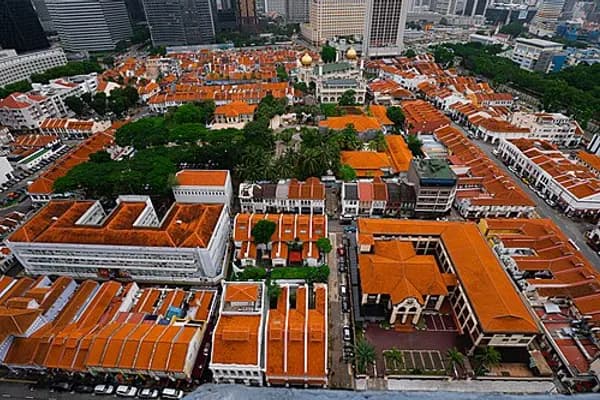
Kampong Glam (IPA: /ˈɡlɑːm/ GLAHM; Malay: Kampung Gelam; Jawi: کامڤوڠ ڬلم; Chinese 甘榜格南; pinyin Gānbǎnggénán; Tamil: கம்போங் கிளாம்) is a neighbourhood and ethnic enclave in Singapore. It is located north of the Singapore River, in the planning area of Rochor, known as the Malay-Muslim quarter.
History
The name of the area is thought to be derived from a Melaleuca species tree, called "gelam" in Malay. "Kampong" (modern spelling "kampung") simply means "village".
Prior to colonisation by the British in 1819, the area was home to the Malay aristocracy of Singapore. It became prominent and more populous after the signing of a treaty between the British East India Company, Sultan Hussein Shah of Johor and Temenggong Abdul Rahman in 1819. The company was given the right to set up a trading post in Singapore under this treaty.
During the colony's early history, under the Raffles Plan of 1822, the settlement was divided according to different ethnic groups which included European Town, Chinese, Chulia (people from the Coromandel Coast of India), Arab and Bugis kampongs. Kampong Glam was designated for the Sultan and his household, as well as the Malay and Arab communities, many of whom were merchants. It was situated east of what was then the European Town.
While the Temenggong and his followers settled in Telok Blangah, Sultan Hussein, his family and followers settled in Kampong Glam. In return, the Sultan was given large areas of land for residential use in Kampong Glam under the treaty. The land was allocated to the Malays and other Muslim immigrants to Singapore, including the Malays from Malacca, the Riau Islands and Sumatra in Indonesia. It also included the Baweanese, Banjarese, Chinese and Indians.
The second half of the nineteenth century saw the rapid growth of immigrant communities in Kampong Glam, initially from Sumatra, and later from other parts of Indonesia and Malaya. This resulted in the setting up of different kampongs, like Kampong Malacca, Kampong Java and Kampong Bugis. There were also a small but successful Arab community of traders in the area.
In the early twentieth century, commercial activities in Kampong Glam expanded as new shop houses and residential buildings were built. A multi-ethnic community soon developed there, comprising not only Malays and Arabs but also the Chinese and Indians.
Later, due to an expansion of commercial activities and an increase in immigrant settlers in Kampong Glam, the Arabs moved to areas like Joo Chiat, Tanglin and Bukit Tunggal (the stretch of Dunearn Road near the junction of Balmoral Road and Chancery Lane, near Anglo-Chinese School (Barker Road) today, was called Tunggal Road).
By the early 1920s, many Malays also moved out to designated resettlement areas in Geylang Serai and Kampong Eunos.
Present
Today, Kampong Glam still retains strong ties to the Native-Malay and Muslim community and has sometimes been termed the "Muslim Quarter" due to its history. The Muslim population still remains a significant presence in Kampong Glam, especially in Bussorah Street. The area remains a centre for Muslim activities and the Sultan Mosque remains a major landmark and congregation point for the Singapore Muslims.
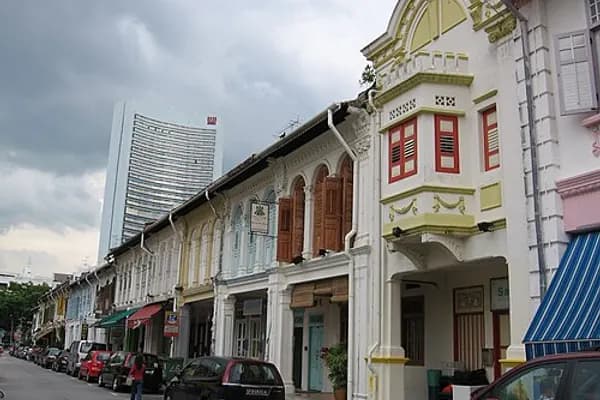
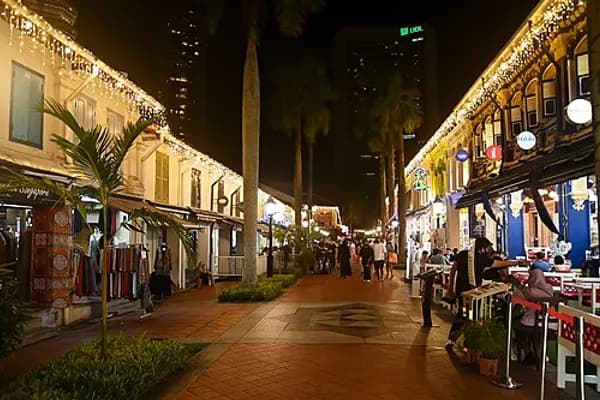
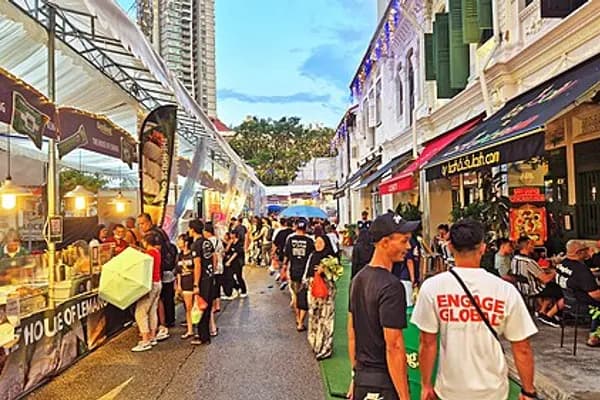
Like Little India and Chinatown, Kampong Glam has been restored, refurbished and new life breathed into it, bringing back the former colour and vibrancy of the area. Rows of conserved shophouses can be found in Haji Lane, Arab Street, Baghdad Street and Bussorah Street. Many of these shophouses have new tenants such as design and IT firms, art galleries, crafts and curiosity shops, food caterers, cafes, bars and restaurants. They blend in with traditional businesses like textile and carpet shops, blacksmiths and shops selling religious items used by Muslims. It is also an area of good restaurants, from Malaysian coffee shops and bakeries to fine modern European dining.
On 16 December 2006, a fire destroyed four shophouses at Sultan Gate at 2145 (SST). Two were vacant, one was a blacksmith shop and the other a shoe shop. Firefighters controlled the fire by surrounding it as it spread through the roof. According to eyewitnesses, the fire started from the second floor of the blacksmith shop. The blacksmith shop is one of the oldest types of shophouses in Singapore which was used for educational tours. It is the last blacksmith shop in the area.
On 20 June 2014, the One Kampong Gelam association was established to enliven and establish Kampong Glam as a vibrant cultural district. The association has since initiated changes such as better car parking systems, road closures, and Ramadan celebrations.
Notable places
Gedung Kuning
Malay Heritage Centre
Vintage Camera Museum
Politics
Beginning from the 1959 general elections, Kampong Glam was a division of its own called Kampong Glam Single Member Constituency (SMC) where the Member of Parliament (MP) seat was held by Former Deputy Prime Minister S. Rajaratnam until 1988 when Loh Meng See took over and served until 2006.
However, after the 1991 general elections, Kampong Glam SMC along with several neighbouring wards were absorbed into the bigger Kampong Glam Group Representation Constituency (GRC) which existed for only one term and the ruling party People's Action Party had won the seats on the nomination day itself.
Prior to the 1997 general elections, Kampong Glam GRC was disbanded and Kampong Glam's electoral division was reverted to Kampong Glam SMC with single-member representation that lasted until the 2001 general election whereby the redrawing of electoral boundaries saw it absorbed into Jalan Besar GRC, which includes parts of the Downtown Core. Denise Phua became elected MP for the area.
In the 2011 general elections, Jalan Besar GRC was dissolved and became part of the newly created Moulmein-Kallang GRC; Phua was also transferred to the new GRC and remained as its MP. In 2015, the short-lived Moulmein-Kallang GRC was abolished with Jalan Besar GRC revived. Phua continued to be the area's MP till present day.
See also
Wikimedia Commons has media related to Kampong Glam.
Haji Lane
Arab Street
References
Further reading
National Heritage Board (2006), Discover Singapore – Heritage Trails, ISBN981-05-6433-3
G. Byrne Bracken (2004), A Walking Tour: Singapore, Times Editions, 2nd ed., ISBN981-232-630-8
External links
Visit Kampong Gelam Official Site
Urban Redevelopment Authority – Shophouse styles at Kampong Glam
Frommer's Guide
Kampong Glam at mosque.org.sg
360 degree virtual tour of Kampong Glam
Encyclopedic content adapted from the Wikipedia article on Kampong Glam, used under CC BY-SA 4.0.
What makes Kampong Glam special
Kampong Glam stands out among Singapore’s neighborhoods for its distinctive character: haji lane, the sultan mosque and street art. Ranked #2 in Singapore, it offers the kind of experience that defines a great city trip — a place where the streets themselves tell a story and every block rewards curiosity.
Best for
Our take on Kampong Glam
Kampong Glam is one of the strongest neighborhoods in Singapore, and it consistently appears in our editors' personal favorites lists. It may not always get the same attention as the city's most famous district, but among travelers who know Singapore well, Kampong Glam is often the first recommendation.
What makes Kampong Glam exceptional is the density of its cultural life. Art galleries, independent bookshops, small theaters, and creative studios are woven into the fabric of the neighborhood rather than clustered in a single zone. You encounter culture here by accident, which is how the best cultural experiences always happen.
Our editors recommend budgeting at least half a day here — enough time to walk the main streets, sit down for coffee, and discover the side streets where Kampong Glam's real character lives.
Living in Kampong Glam
Kampong Glam is connected to the rest of Singapore by public transit, and most visitors find it straightforward to reach from the city center or airport. Once you arrive, the neighborhood is best explored on foot — the scale is human and the streets reward wandering.
Day-to-day life in Kampong Glam has the rhythm of a genuine residential neighborhood. You will find grocery stores, pharmacies, cafés with morning regulars, and the kind of small independent shops that only survive where locals support them. For visitors, this means the infrastructure you need — good coffee, a decent meal, a quiet place to sit — is always within a short walk.
Accommodation in Kampong Glam ranges from boutique hotels to short-term rentals. We generally recommend staying within the neighborhood itself rather than commuting from a hotel elsewhere in Singapore — the experience of waking up inside a great neighborhood is fundamentally different from visiting one as a day trip.
What locals say about Kampong Glam
Long-term residents of Kampong Glam tend to describe their neighborhood with a mix of pride and protectiveness. Like any district with genuine character, Kampong Glam inspires loyalty — the kind of place people move to and never quite leave, or leave and spend years trying to get back to.
The creative community in Kampong Glam is genuine, not aspirational. Residents include working artists, writers, musicians, and designers who chose the neighborhood because it supported their work — affordable studio space, a community that values craft, and enough foot traffic to sustain independent galleries and shops.
Like any neighborhood that has earned attention, Kampong Glam is navigating the tension between popularity and preservation. Rents have risen, new businesses have arrived, and long-time residents occasionally grumble that the neighborhood is not what it was. But the fundamentals — the walkability, the food, the community — remain strong, and most locals we speak to believe the neighborhood is still gaining more than it is losing.
Visitor tips
- Kampong Glam is located in Singapore, Singapore. The neighborhood is accessible by public transport, taxi, or rideshare from most parts of the city.
- Morning is often the best time to explore — the streets are quieter, the light is better for photography, and cafes are at their most welcoming.
- Wear comfortable walking shoes — the best way to experience Kampong Glam is on foot, wandering the side streets and discovering what lies around each corner.