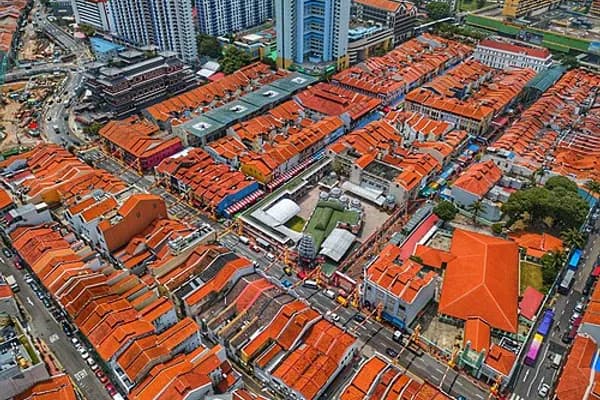
About the neighborhood
Neighborhood in Singapore, subzone of Outram
Malay nameMalayKreta AyerTamil nameTamilசைனா டவுன்
Chinatown is a subzone and ethnic enclave located within the Outram district in the Central Area of Singapore.
This area encompasses five precincts in Singapore: Kreta Ayer, Ann Siang/Club Street, Telok Ayer, Tanjong Pagar/Duxton and Bukit Pasoh. Featuring distinctly Chinese cultural elements, Chinatown has had a historically concentrated ethnic Chinese population.
Chinatown is one of Singapore's most historically and culturally significant districts. Established under the Raffles Town Plan (also known as the Jackson Plan), the area southwest of Singapore River became home to Chinese migrants, a place of commerce, clan associations, and cultural institutions for Chinese migrants in Singapore, eventually growing into the area we now know as Chinatown. As time went on and Singapore developed into the city-state it is now, Chinatown grew from a racial enclave into a vibrant hub, best known for its shophouse-lined streets, traditional markets, and religious landmarks, including Thian Hock Keng Temple and Sri Mariamman Temple.
In recent times, Chinatown has undergone significant changes due to urban redevelopment, heritage branding, and gentrification. While state-led conservation policies have ensured the preservation of much of its historical architecture, the district has seen rising property values, demographic shifts, and a general shift toward tourism-based economic activities. Today, Chinatown functions as both a heritage attraction and a commercial hub, raising debates over how to balance cultural preservation with modernisation.
Etymology
Singapore's Chinatown is known as Niu che shui in Mandarin, Gû-chhia-chúi in Hokkien, and Ngàuh-chē-séui in Cantonese - all of which mean "bullock water-cart" - and Kreta Ayer in Malay, which means "water cart". This is due to the fact that Chinatown's water supply was principally transported by animal-driven carts in the 19th century. Although these names are sometimes used for referring to Chinatown in general, they actually refer to the area of Kreta Ayer Road.
Geography
Chinatown consists of five distinctive sub-areas which were developed at different times.
Telok Ayer – developed in the 1820s
Kreta Ayer – developed in the 1830s
Ann Siang/Club Street – developed in the 1890s
Bukit Pasoh – developed in early 1900s
Tanjong Pagar – developed in the 1920s
Chinatown Complex is located along Smith Street, which was known colloquially as hei yuan kai (theatre street) in Cantonese because of its famous Cantonese opera theatre Lai Chun Yuen, which opened in 1887 to cater to the Cantonese community there, drawing large crowds during the 1910s and 1920s (Nasir, 2005).
History
Early settlement and development (1819–1942)
Origins and colonial planning
The origins of Chinatown can be traced back to 1819, when Sir Stamford Raffles first established a British threshold on Singapore's grounds. Under the Raffles Town Plan of 1822, areas in Singapore became designated for different ethnic groups, with the Chinese allocated to land southwest of the Singapore River. This district was widely referred to as Chinese Campung (Chinese Settlement), and became a centre of Chinese migration, trade and communal activities.
In the aforementioned Raffles Plan of Singapore, Chinatown originally was a division of colonial Singapore where Chinese immigrants tended to reside. Although as Singapore grew, Chinese immigrants settled in other areas of the island-city, Chinatown became overcrowded within decades of Singapore's founding in 1819 and remained such until many residents were relocated at the initiation of Singapore's governmental Housing Development Board in the 1960s.
In 1822, Sir Stamford Raffles wrote to Captain C. E. Davis, President of the Town Committee, and George Bonham and Alex L. Johnson, Esquires, and members, charging them with the task of "suggesting and carrying into effect such arrangements on this head, as may on the whole be most conducive to the comfort and security of the different classes of inhabitants and the general interests and welfare of the place..."
He went on to issue instructions, as a guide to the Committee, which included a general description of Singapore Town, the ground reserved by the government, the European town and principal mercantile establishments and the native divisions and "kampungs". These included areas for Bugis, Arabs, Indians, Malays, and Chinese kampungs. Raffles was very clear in his instructions and his guidelines were to determine the urban structure of all subsequent development. The "five-foot way", for example, the continuous covered passage on either side of the street, was one of the public requirements.
Raffles foresaw the fact that "it may be presumed that they (the Chinese) will always form by far the largest portion of the community". For this reason, he appropriated all of the land southwest of the Singapore River for their accommodation but, at the same time, insisted that the different classes and the different provinces be concentrated in their separate quarters and that these quarters, in the event of fire, be constructed of masonry with tiled roofs.
This thus resulted in the formation of a distinct section titled Chinatown. However, only when parcels of land were leased or granted to the public in and after 1843 for the building of houses and shophouses, did Chinatown's physical development truly begin. In the 19th and early 20th centuries, Chinatown only grew as more Chinese immigrants arrived in Singapore seeking economic opportunities. Majority of these Chinese immigrants worked as labourers, merchants, and craftsmen, contributing to Chinatown's rapid development.
Formation of clan associations and trade networks
As a direct result of the large influx of Chinese migrants into Singapore, clan associations (Huiguan, 会馆) were created to provide social support, employment assistance and financial aid to the Chinese migrants. These clans were often distinguished by dialect groups, surnames or trade and contributed significantly to the Chinese’ community cohesiveness.
Some of the more significant clan associations were:
Hokkien Huay Kuan (福建会馆) – Representing the Hokkien-speaking community.
Cantonese Kongsi (广肇会馆) – Providing aid to Cantonese migrants, particularly in trade and craftsmanship.
Teochew Poit Ip Huay Kuan (潮州八邑会馆) – Supporting Teochew traders and artisans.
Chinatown then became known for its bustling commercial streets, featuring traditional Chinese trades like goldsmithing, calligraphy, and herbal medicine. Markets and hawker stalls also played a crucial role in the local economy, through their sales of goods such as textiles, spices, and food.
Living conditions and social issues
In the late 19th century, Chinatown had developed into a densely populated area with narrow streets and overcrowded dwellings. Moreover, it had suffered from poor sanitation and a lack of proper infrastructure, leading to frequent disease outbreaks as well as poverty and crime.
Not only that, but secret societies were also very much active in Chinatown, controlling the district with their underground activities like gambling, the dealing of opium and protection rackets. The British colonial authorities attempted to curb this through legal regulations and police crackdowns but ultimately failed to do so and secret societies remained influential until the early 20th century.
Japanese occupation and post-war reconstruction (1942–1959)
During World War II, Chinatown was considerably impacted by the Japanese Occupation of Singapore. Following the Japanese invasion of Singapore in 1942, the Japanese military oversaw the Sook Ching massacre – which targeted thousands of Chinese male civilians who were suspected of supporting anti-Japanese resistance movements. These men were detained and executed, many of whom were taken from Chinatown.
The war also caused a severe economic downturn, leading to food shortages and inflation in Singapore. Many businesses struggled, and rebuilding efforts after the war was slow due to the damaged infrastructure and declining trade.
Urban redevelopment and conservation (1960s–2000s)
Post-Independence changes (1960s–1980s)
The shophouses were home to "death houses" until 1961, when death houses were banned, and brothels until 1930, when the Women and Girl's Protection Ordinance was enacted, bringing the prostitution situation under control. To cater to those who visited brothels, or participated in extended affairs of Chinese funerals or came to frequent the opera theatre, street hawkers, food stalls and traders selling household goods occupied the streets. In order to address overcrowding and poor living conditions in the city, all street hawkers were relocated into the newly built Kreta Ayer Complex in 1983, which is today's Chinatown Complex.
Following Singapore's independence in 1965, urban redevelopment policies caused a huge change in Chinatown. The government, through the Housing and Development Board (HDB) and the Urban Redevelopment Authority (URA), introduced measures to modernise the city and improve general living conditions for Singaporeans.
These efforts included:
The development of public housing estates in areas like Toa Payoh, Ang Mo Kio and Bedok, resulting in the relocation of many Chinatown residents.
Older shophouses and residential dwellings in Chinatown were demolished or repurposed for commercial use.
The transition of Chinatown from a previously mainly residential district to a largely commercial based area.
Then came the 1980s, where concerns over the loss of historical landmarks in Singapore led to increased interest in heritage conservation.
Designation as a conservation area (1989)
In 1989, the URA designated Chinatown as a Conservation Area, aiming to preserve its historic architecture and culture. Under these guidelines:
Shophouse restoration projects were introduced to maintain traditional façades and architectural styles.
Regulations were imposed to prevent uncontrolled modifications of heritage buildings.
Chinatown's identity was promoted through heritage trails and cultural tourism initiatives.
In the 1990s, the Singapore Tourism Board (STB) announced a $97.5 million redevelopment plan aiming to revitalise Chinatown. This project aimed to promote Chinatown as an “ethnic quarter” and market it as a “culturally vibrant” location, with preserved cultural and heritage sites like shophouses and buildings.
While conservation efforts were largely successful in preserving Chinatown's physical landscape, the primary aim of these projects were mainly to establish Chinatown as a site of culture, enticing more tourism into Singapore.
Modern developments and commercialisation (2000s–present)
By the 2000s, Chinatown had become a key location known for heritage tourism, attracting both local and international businesses into the area. Several developments contributed to its transformation:
Tourism growth The introduction of guided heritage trails and museums, such as by the Chinatown Heritage Centre, increased tourist interest in the area.
Annual Chinese New Year celebrations and Mid-Autumn Festival events had also become major attractions.
Retail and business expansion Formerly independent businesses were soon replaced by international retail chains, boutique hotels, and upscale dining establishments.
Night markets and food streets became more focused on attracting tourists rather than the display and sale of traditional trades.
Decline of traditional trades Many historic businesses, such as Chinese medicine halls, calligraphy stores, and family-run kopitiams (coffee shops), struggled to compete with the rising rents and changing consumer habits.
Local entrepreneurs have attempted to revitalise traditional industries, but the economic pressures of modernisation continue to challenge small businesses.
Legacy
The legacy of cultural diversity in Chinatown is still present. There used to exist some Hokkien merchants along Havelock Road, Telok Ayer Street, China Street and Chulia Street, and Teochew merchants are mostly in Circular Road, River Valley Road, Boat Quay, and South Bridge Road near Chinatown. The ubiquitous Cantonese are scattered around South Bridge Road, Upper Cross Street, New Bridge Road, and Bukit Pasoh Road as well as others. These days, the former Hokkien and Teochew residents have largely scattered to other parts of the island, leaving the Cantonese as the dominant dialect group in Chinatown.
The Chinese names of Pickering Street are Kian Keng Khau (mouth of the gambling houses) or Ngo Tai Tiahn Hok Kiong Khau (mouth of the five generations of the Tian Hok Temple).
There are also several prominent century-old Chinese temples like Hokkien Thian Hock Keng Temple at Telok Ayer Street, Teochew Wak Hai Cheng Bio Temple at Phillips Street, Siang Cho Keong Temple at Amoy Street, Seng Wong Beo Temple at Peck Seah Street, and Cantonese Cundhi Gong Temple at Keong Siak Roadside.
Guilds, clans, trade unions and associations were all referred to as kongsi are present within Chinatown such as to assist to the needs of each Chinese dialect group, such as Cantonese, Hokkien, etc.
There were the letter writers of Sago Street—in Hokkien this street is called Gu Chia Chwi Hi Hng Cheng (front of Kreta Ayer Theatre), but it was mainly associated with life and death — the sandalwood idols of Club Street and the complicated and simple food of Mosque Street; all rang to the sound of the abacus. Old women could be seen early in the mornings topping and tailing bean sprouts, the skins of frogs being peeled, the newly killed snakes being skinned and the centuries-old panaceas being dispensed by women blessed with the power of healing.
Besides Chinese residents, other races such as the Indians whom migrated during the British Raj live in Chinatown. Within the Chinatown is an important temple for the Tamils, the Sri Mariamman Hindu Tamil Temple, and also mosques, Al-Abrar Mosque at Telok Ayer Street, and Jamae Mosque at Mosque Street. These places of worship catered to the pockets of non-Chinese residents in the area and shows that despite efforts to segregate the early immigrants, they had no qualms living peacefully together, and side by side.
Street name origins
Mosque Street is named after Jamae Mosque, located on the South Bridge Road end of the street. The mosque was completed in 1830 by the Chulia Muslims from the Coromandel coast of South India but also used by the Malay Muslims living in the area. In the early years, Mosque Street was the site of ten stables.
Encyclopedic content adapted from the Wikipedia article on Chinatown, used under CC BY-SA 4.0.