About the neighborhood
Place in Quebec, Canada
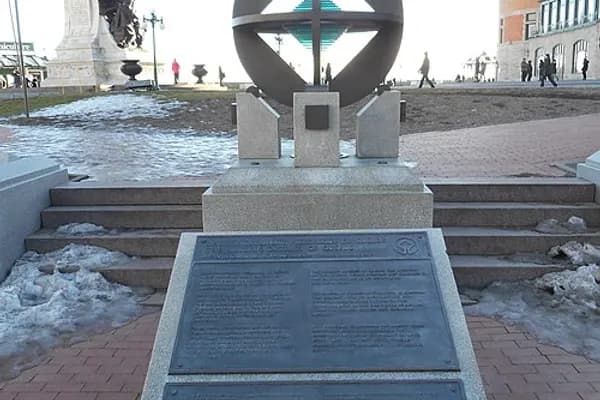
Old Quebec (French: Vieux-Québec, pronounced vjø kebɛk) is a historic neighbourhood of Quebec City, Quebec, Canada. Comprising the Upper Town (French: Haute-Ville) and Lower Town (French: Basse-Ville), the area is a UNESCO World Heritage Site. Administratively, Old Quebec is part of the Vieux-Québec–Cap-Blanc–colline Parlementaire district in the borough of La Cité-Limoilou.
The area is commonly referred to as "the Old City" or "Quebec's Old City" in English. It is sometimes referred to as the Latin Quarter (French: Quartier latin) as well, although this title refers more to area around the Séminaire de Québec, the original site of Laval University.
Upper Town
Samuel de Champlain chose the Upper Town as the site for Fort Saint Louis in 1608. It has remained the city's military and administrative centre because of its strategic position atop the promontory of Cap Diamant. It was occupied mainly by British government officials and Catholic clergy after the British Conquest, while French and English merchants and artisans lived in Lower Town.
Military use did hamper growth in the Upper Town for many years, and a movement arose in the late 19th century to demolish the fortifications as obsolete and as an obstacle to urban development. It was Lord Dufferin who successfully persuaded officials to preserve and rebuild them.
The area declined and fell into disrepair in the 1950s but new building construction began in the 1970s.
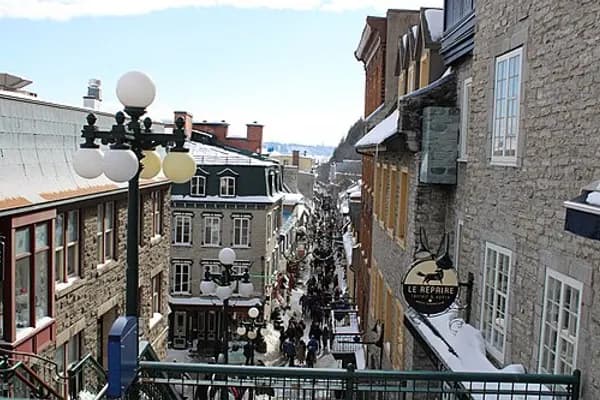
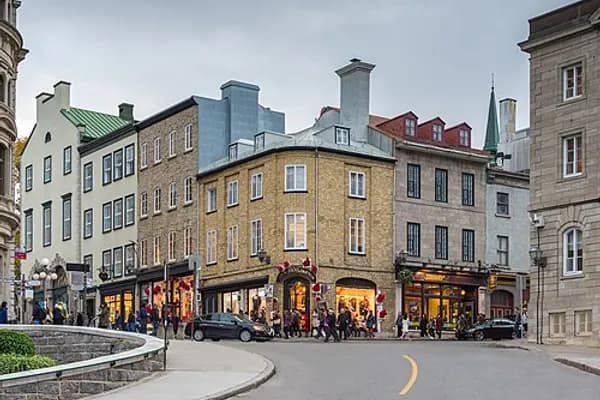
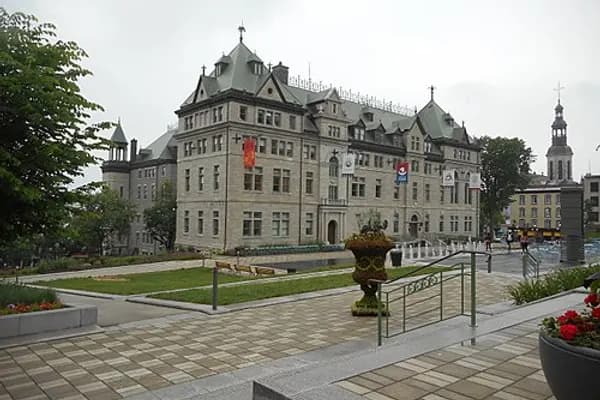
Most of the buildings date to the 19th century, although some date to the 17th and 18th centuries. The area has several commercial streets like Saint Jean, Sainte Anne and De Buade. Some public administration and other institutions in the Upper Town are the Quebec City Hall (Hôtel de Ville), the Séminaire de Québec, the Ursulines Convent, and the Augustinian Monastery and l'Hôtel-Dieu de Québec. There are many hotels, including the Château Frontenac, the Old City being a very popular tourist destination.
Parks in the Upper Town include De l'Esplanade, Artillerie, Des Gouverneurs and Montmorency parks as well as the grounds of l’Hotel-de-Ville.
Lower Town
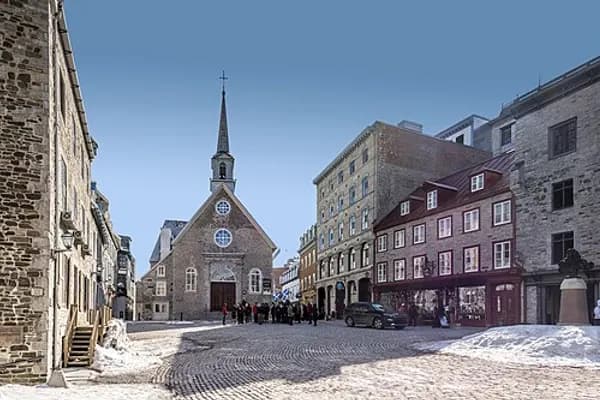
The Lower Town is a historic district located at the bottom of Cap Diamant. During 1608, Samuel de Champlain built a habitation where its remains can be found with Place Royale as its centre. It was restored with the goal of reconstructing the French flair from its origins. Construction of the Church of Notre-Dame-des-Victoires started during 1687 at this location and was completed during 1723. The Musée de la civilisation, the Musée naval de Québec, the caserne Dalhousie and the Théâtre Petit Champlain are among some of the museums, performance halls, theatres and exhibition venues in Lower Town.
Places such as the Louise Basin, Brown Basin, La Pointe-à-Carcy, the Gare du Palais and the Marche du Vieux-Port can be seen from the Port of Quebec.
Other places of interest include:
Place de Paris,
Parc Ulric-Joseph-Tessier,
Saint-Pierre Street,
Saint-Paul Street,
Sault-au-Matelot Street and
Saint-Vallier Est Street, previously called Saint-Charles Street, the first paved road in Quebec.
A funicular (Old Quebec Funicular) allows for easy transportation up Cap Diamant connecting to Upper Town from the narrow Petit-Champlain road at the foot of the Cape to the top with a marvelous view of the city. Côte de la Montagne is another option for hikers.
The Historic District of Old Quebec
The Old Quebec heritage site is located in Quebec City although it is administratively recognized as a part of the borough La Cité-Limoilou. It has gained recognition as a part of Quebec's cultural heritage and is also among UNESCO’s World Heritage Sites.
Background
During 1956, the Historic Sites and Monuments Board of Canada was given the authority to acquire or expropriate any "site, building or other place of national historic interest or significance".
The historic district was established following public debates from 1945 to 1965, concerning the preservation of Old Quebec and the restoration of Place Royale. The historic district of Old Quebec is a UNESCO World Heritage List since 1985.
The district was established by the National Assembly of Quebec on July 10, 1963 after an amendment to the Historic Sites and Monuments Act. The act made the area in the historic area of the city a "Declared Historic District" (French: Arrondissement historique décrété) by the province of Quebec, and was expanded the next year to an area of 135 hectares (330 acres). It includes 1,400 buildings within the neighbourhood of La Cité, including the promontory of Cap Diamant and a strip of land below the cliffs, between the Saint-Charles River and the Saint Lawrence River. The protected perimeter of the area was delimited in two stages. The initial layout included the fortified area as well as its periphery. The second and final layout added other surrounding areas to the plan on May 7, 1964. The whole district covers a total area of 1.4km.
On December 3, 1985, UNESCO declared the Historic District of Old Quebec a World Heritage Site.
Transportation
Rail
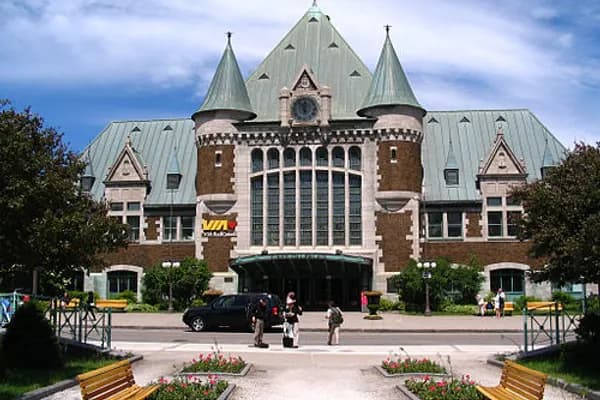
Old Quebec is serviced by Gare du Palais train and bus station. Opened in 1915 by the Canadian Pacific Railway, the châteauesque station is similar in design to the Château Frontenac. Via Rail operates regular services to Montreal via Drummondville. The station is also serviced by the private coach company Orléans Express.
Air
Old Quebec is 16km east of Quebec's Jean Lesage International Airport.
References
External links
Wikimedia Commons has media related to Vieux-Québec.
Encyclopedic content adapted from the Wikipedia article on Vieux-Québec, used under CC BY-SA 4.0.
What makes Vieux-Québec special
Vieux-Québec stands out among Quebec City’s neighborhoods for its distinctive character: unesco old quebec. It tops our ranking of the best neighborhoods in Quebec City, it offers the kind of experience that defines a great city trip — a place where the streets themselves tell a story and every block rewards curiosity.
Best for
Our take on Vieux-Québec
Vieux-Québec is the neighborhood we send friends to first when they visit Quebec City. It earns the top spot in our ranking not because it is the most famous district in the city, but because it delivers the most complete neighborhood experience — the kind of place where every block rewards curiosity and every return visit reveals something new.
What makes Vieux-Québec worth the visit is the texture of daily life here. It is a neighborhood that functions for the people who live in it — not just for the visitors who pass through. The shops serve local needs, the restaurants feed local appetites, and the streets have a rhythm that reflects genuine community rather than tourism infrastructure. That is the quality our editors prize most, and Vieux-Québec has it in abundance.
Our editors recommend budgeting at least half a day here — enough time to walk the main streets, sit down for coffee, and discover the side streets where Vieux-Québec's real character lives.
Living in Vieux-Québec
Vieux-Québec is connected to the rest of Quebec City by public transit, and most visitors find it straightforward to reach from the city center or airport. Once you arrive, the neighborhood is best explored on foot — the scale is human and the streets reward wandering.
Day-to-day life in Vieux-Québec has the rhythm of a genuine residential neighborhood. You will find grocery stores, pharmacies, cafés with morning regulars, and the kind of small independent shops that only survive where locals support them. For visitors, this means the infrastructure you need — good coffee, a decent meal, a quiet place to sit — is always within a short walk.
Accommodation in Vieux-Québec ranges from boutique hotels to short-term rentals. We generally recommend staying within the neighborhood itself rather than commuting from a hotel elsewhere in Quebec City — the experience of waking up inside a great neighborhood is fundamentally different from visiting one as a day trip.
What locals say about Vieux-Québec
Long-term residents of Vieux-Québec tend to describe their neighborhood with a mix of pride and protectiveness. Like any district with genuine character, Vieux-Québec inspires loyalty — the kind of place people move to and never quite leave, or leave and spend years trying to get back to.
What locals appreciate most about Vieux-Québec is its consistency — the feeling that the neighborhood works the same way on a Tuesday morning as it does on a Saturday night. It is not a place that performs for visitors and then goes quiet. The rhythm is genuine, the community is real, and the daily experience of living here is what draws people and keeps them.
Like any neighborhood that has earned attention, Vieux-Québec is navigating the tension between popularity and preservation. Rents have risen, new businesses have arrived, and long-time residents occasionally grumble that the neighborhood is not what it was. But the fundamentals — the walkability, the food, the community — remain strong, and most locals we speak to believe the neighborhood is still gaining more than it is losing.
Visitor tips
- Vieux-Québec is located in Quebec City, Canada. The neighborhood is accessible by public transport, taxi, or rideshare from most parts of the city.
- Morning is often the best time to explore — the streets are quieter, the light is better for photography, and cafes are at their most welcoming.
- Wear comfortable walking shoes — the best way to experience Vieux-Québec is on foot, wandering the side streets and discovering what lies around each corner.