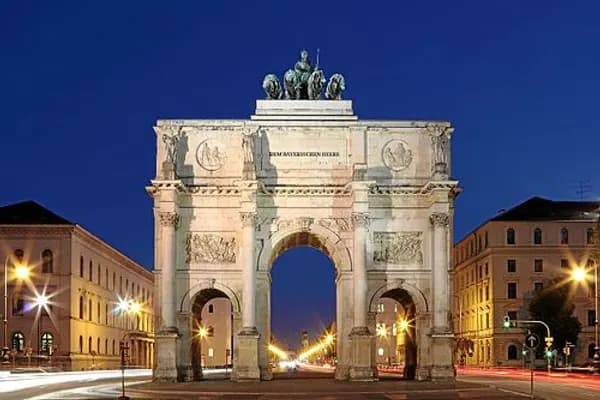
About the neighborhood
Borough in the northern part of Munich, Germany
Schwabing boasts a distinct character that dances between its storied past and the relentless march of modernity. Once the bohemian heart of Munich, this neighborhood echoes with the footsteps of artists and intellectuals who roamed its streets during the late 19th and early 20th centuries. The vibrant Leopoldstraße, Schwabing's main artery, once brimmed with cafés where the likes of Thomas Mann and Rainer Maria Rilke articulated their genius. However, as the city has evolved, so too has Schwabing, trading some of its artistic grit for sleek urban development.
A stroll through Schwabing today reveals a neighborhood that still clings to its creative roots, albeit with a gentrified sheen. The Englischer Garten, a sprawling green oasis, remains a testament to the area's historic allure, inviting locals and visitors alike to unwind among its picturesque landscapes. While the park is surely the main attraction, don’t overlook the quieter nooks like Leopoldpark and Biotop am Ackermannbogen, where the ambiance is less about the hustle and more about hidden moments of tranquility. The influx of students from nearby LMU Munich and the Technical University of Munich injects a youthful energy, even as the cost of living has soared, prompting protests against the encroaching commercialization.
Yet, Schwabing is not a neighborhood that has succumbed entirely to modernity. It still offers a palette of eclectic dining options, from traditional Bavarian fare at the iconic Paulaner Bräuhaus to contemporary bistros that cater to the discerning palate. Art galleries and chic boutiques pepper the streets, providing a nod to the creative spirit that once flourished here. The Schwabinger Tor redevelopment, with its mix of residential, commercial, and leisure spaces, signals a new chapter, but one can only hope it maintains the cultural fabric that has woven itself into the identity of this storied district.
Despite the changes, the essence of Schwabing remains compelling; it’s a place where history and innovation coalesce, beckoning those who appreciate the nuances of urban evolution. Exploring its streets is not just an excursion but a deep dive into the layers of artistic heritage that have shaped Munich.
Encyclopedic content adapted from the Wikipedia article on Schwabing, used under CC BY-SA 4.0.
What makes Schwabing special
Schwabing stands out among Munich’s neighborhoods for its distinctive character: munich's bohemian old neighborhood. It tops our ranking of the best neighborhoods in Munich, it offers the kind of experience that defines a great city trip — a place where the streets themselves tell a story and every block rewards curiosity.
Best for
Our take on Schwabing
Schwabing is the neighborhood we send friends to first when they visit Munich. It earns the top spot in our ranking not because it is the most famous district in the city, but because it delivers the most complete neighborhood experience — the kind of place where every block rewards curiosity and every return visit reveals something new.
What makes Schwabing worth the visit is the texture of daily life here. It is a neighborhood that functions for the people who live in it — not just for the visitors who pass through. The shops serve local needs, the restaurants feed local appetites, and the streets have a rhythm that reflects genuine community rather than tourism infrastructure. That is the quality our editors prize most, and Schwabing has it in abundance.
Our editors recommend budgeting at least half a day here — enough time to walk the main streets, sit down for coffee, and discover the side streets where Schwabing's real character lives.
Living in Schwabing
Schwabing is connected to the rest of Munich by public transit, and most visitors find it straightforward to reach from the city center or airport. Once you arrive, the neighborhood is best explored on foot — the scale is human and the streets reward wandering.
Day-to-day life in Schwabing has the rhythm of a genuine residential neighborhood. You will find grocery stores, pharmacies, cafés with morning regulars, and the kind of small independent shops that only survive where locals support them. For visitors, this means the infrastructure you need — good coffee, a decent meal, a quiet place to sit — is always within a short walk.
Accommodation in Schwabing ranges from boutique hotels to short-term rentals. We generally recommend staying within the neighborhood itself rather than commuting from a hotel elsewhere in Munich — the experience of waking up inside a great neighborhood is fundamentally different from visiting one as a day trip.
What locals say about Schwabing
Long-term residents of Schwabing tend to describe their neighborhood with a mix of pride and protectiveness. Like any district with genuine character, Schwabing inspires loyalty — the kind of place people move to and never quite leave, or leave and spend years trying to get back to.
What locals appreciate most about Schwabing is its consistency — the feeling that the neighborhood works the same way on a Tuesday morning as it does on a Saturday night. It is not a place that performs for visitors and then goes quiet. The rhythm is genuine, the community is real, and the daily experience of living here is what draws people and keeps them.
Like any neighborhood that has earned attention, Schwabing is navigating the tension between popularity and preservation. Rents have risen, new businesses have arrived, and long-time residents occasionally grumble that the neighborhood is not what it was. But the fundamentals — the walkability, the food, the community — remain strong, and most locals we speak to believe the neighborhood is still gaining more than it is losing.
Visitor tips
- Schwabing is located in Munich, Germany. The neighborhood is accessible by public transport, taxi, or rideshare from most parts of the city.
- Morning is often the best time to explore — the streets are quieter, the light is better for photography, and cafes are at their most welcoming.
- Wear comfortable walking shoes — the best way to experience Schwabing is on foot, wandering the side streets and discovering what lies around each corner.
- Save the neighborhood's location on your phone before you arrive. Offline maps are especially useful for navigating the smaller side streets.