About the neighborhood
Borough of Munich, Germany
Au-Haidhausen (German pronunciation: ˈaʊ haɪtˈhaʊzn̩; Central Bavarian: Au-Haidhausn) is the 5th borough of the German city of Munich, Bavaria. It is formed by the Au and Haidhausen districts.
Location
Au lies opposite the Altstadt of the city on the easterly plain tract of the Isar. Haidhausen is above Au on the Isar's uplands. Au-Haidhausen borders Bogenhausen to the north, Berg am Laim to the east, Obergiesing to the south, level with the flow of the Isar at Untergiesing, ending in the west at the river.
History and description
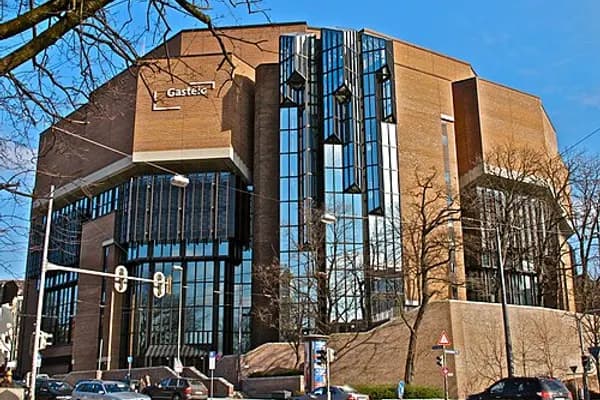
Au and Haidhausen used to be hostel areas for trade workers and day labourers outside of the medieval town walls of Munich. Both formerly independent municipalities were incorporated into the City of Munich on 1 October 1854 and developed into suburbs during the Gründerzeit. Many breweries were located on the high banks of the Isar, thus right on the edge of the terrace. These were good locations for deep natural water sources and beer cellars; for this reason, the name "Keller" (cellar) is still used to refer to the brewery-restaurants nearby. Near Rosenheimer Platz on Rosenheimer street stood the Bürgerbräukeller, the location of the first assassination attempt on Adolf Hitler. Today, one of the largest breweries in Munich can be found there: Paulaner, in Au. Nearby, the Gasteig marks the transition to the inner city, a cultural center which hosts the Munich Philharmonic Orchestra, parts of the University of Music and Performing Arts Munich, the Volkshochschule, Munich's municipal library and important events such as the Filmfest München and the Munich Biennale.
Even though the structural integrity of buildings in Au was heavily compromised during the Second World War and only a fifth of buildings dated before 1919 still stand, the historical townscape of Haidhausen remains largely intact. Of high constructional significance is the Franzosenviertel ("the French quarter"), so called because of given street names to locations of victory in battles of the German-French War. The existence of good condition housing lead to Haidhausen becoming the second largest area of redevelopment in the 1970s, alongside Schwanthalerhöhe. This property redevelopment and revaluation triggered by the upgrade of accommodation lead to not only restructuring of a suburb to the outskirts of the area, but also a change of image, thus putting Haidhausen in competition with Schwabing as a trendy area to live in Munich.
The balanced mixture of accommodation and living in Au and Haidhausen has shifted towards housing; this is due to the outsourcing of otherwise bothersome trades. Most jobs in the district lie in service industries and other public areas.
Haidhausen accommodates the Bayerische Landtag in the Maximilianeum, the Klinikum rechts der Isar and the Wiener Markt. On the northern border the Friedensengel ("peace angel") towers above the city on the Isar plateau. If one follows Prinzregentenstraße from there to the east, around 100 metres along on the right hand side is the Villa Stuck, that the "Malerfürst" ("Painter prince") Franz von Stuck allowed to be constructed according to his own blueprints. As of 2004 the entirely reconditioned buildings of the Villa and the former studio is now an art museum. Further east down Prinzregentenstraße lies the Prinzregententheater, one of the most striking Art Nouveau theatre buildings in Germany; adjacent to which is the Prinzregentenstadion, which serves as a popular ice skating venue in winter. With the Maria-Theresia-Gymnasium in the south the district also accommodates one of the few German Schools of Excellence.
With the Auer Dult taking place three times per year at the Mariahilfplatz, and the tapping of Bock at the Nockherberg in the Salvatorkeller of the Paulaner brewery on the Hochstraße (High street), rebuilt after heavy fire damage, Au has a significant amount of traditional daily culture.
Statistics
(As of 31 December, Inhabitants with principal residence)
(Statistical Pocket Book Munich)
Literature
Helmuth Stahleder: Von Allach bis Zamilapark. Names and historical dates of the history of Munich and its incorporated suburbs. Stadtarchiv München, ed. München: Buchendorfer Verlag 2001. ISBN3-934036-46-5
External links
Wikimedia Commons has media related to Au-Haidhausen.
Wikivoyage has a travel guide for Munich/Haidhausen.
Informationen über den Stadtteil Haidhausen mit Veranstaltungskalender (in German)
Der Wiener Markt (in German)
KulturGeschichtsPfad Au-Haidhausen (in German)
48°07′55″N 11°35′20″E / 48.13194°N 11.58889°E / 48.13194; 11.58889
Encyclopedic content adapted from the Wikipedia article on Haidhausen, used under CC BY-SA 4.0.
What makes Haidhausen special
Haidhausen stands out among Munich’s neighborhoods for its distinctive character: munich's quiet french corner. Ranked #3 in Munich, it offers the kind of experience that defines a great city trip — a place where the streets themselves tell a story and every block rewards curiosity.
Best for
Our take on Haidhausen
Haidhausen is one of the strongest neighborhoods in Munich, and it consistently appears in our editors' personal favorites lists. It may not always get the same attention as the city's most famous district, but among travelers who know Munich well, Haidhausen is often the first recommendation.
What makes Haidhausen worth the visit is the texture of daily life here. It is a neighborhood that functions for the people who live in it — not just for the visitors who pass through. The shops serve local needs, the restaurants feed local appetites, and the streets have a rhythm that reflects genuine community rather than tourism infrastructure. That is the quality our editors prize most, and Haidhausen has it in abundance.
Our editors recommend budgeting at least half a day here — enough time to walk the main streets, sit down for coffee, and discover the side streets where Haidhausen's real character lives.
Living in Haidhausen
Haidhausen is connected to the rest of Munich by public transit, and most visitors find it straightforward to reach from the city center or airport. Once you arrive, the neighborhood is best explored on foot — the scale is human and the streets reward wandering.
This is a neighborhood with strong residential roots, which means the infrastructure of daily life is well-established: grocery stores, pharmacies, parks, playgrounds, and the kind of quiet side streets where children play and neighbors greet each other. For visitors, this translates into a feeling of safety and belonging that more tourist-oriented districts rarely provide.
Accommodation in Haidhausen ranges from boutique hotels to short-term rentals. We generally recommend staying within the neighborhood itself rather than commuting from a hotel elsewhere in Munich — the experience of waking up inside a great neighborhood is fundamentally different from visiting one as a day trip.
What locals say about Haidhausen
Long-term residents of Haidhausen tend to describe their neighborhood with a mix of pride and protectiveness. Like any district with genuine character, Haidhausen inspires loyalty — the kind of place people move to and never quite leave, or leave and spend years trying to get back to.
What locals appreciate most about Haidhausen is its consistency — the feeling that the neighborhood works the same way on a Tuesday morning as it does on a Saturday night. It is not a place that performs for visitors and then goes quiet. The rhythm is genuine, the community is real, and the daily experience of living here is what draws people and keeps them.
Compared to the more famous districts in Munich, Haidhausen has maintained a lower profile, which many residents consider an advantage. The neighborhood evolves gradually rather than being reshaped by sudden attention, and the result is a community that still feels organic rather than curated.
Visitor tips
- Haidhausen is located in Munich, Germany. The neighborhood is accessible by public transport, taxi, or rideshare from most parts of the city.
- Morning is often the best time to explore — the streets are quieter, the light is better for photography, and cafes are at their most welcoming.
- Wear comfortable walking shoes — the best way to experience Haidhausen is on foot, wandering the side streets and discovering what lies around each corner.
- Save the neighborhood's location on your phone before you arrive. Offline maps are especially useful for navigating the smaller side streets.