About the neighborhood
Road in China
Pingjiang Road (Chinese 平江路; pinyin Píngjiāng Lù), historically known as Shiquan Li (Chinese:十泉里), is a street and historic district in Gusu District (formerly the Pingjiang District), northeastern Suzhou, Jiangsu, China. It is a well-preserved area and is part of the so-called Old Town of Suzhou.
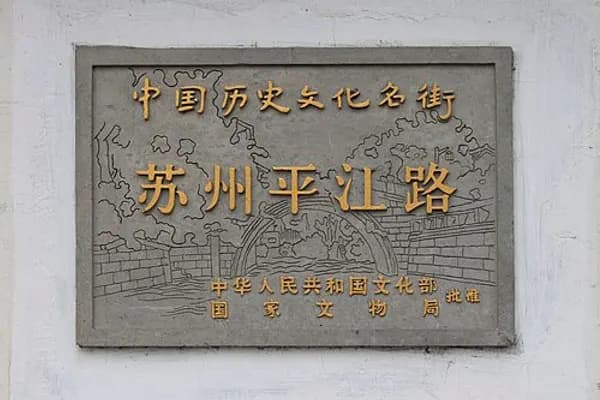
In 2015, the Pingjiang Road Historical Block was added to the list of China's "National Historic and Cultural Streets".
Overview
The main street (Pingjiang Road) is located along Pingjiang He (Chinese:平江河) and is 1,606 metres (5,269ft) in length. It stretches from Ganjiang Donglu (Chinese:干将东路) in the south to Baita Road East (Chinese:白塔东路) in the northwest, near the Humble Administrator's Garden and Suzhou Museum. The entire historic district covers an area of 0.4 square kilometres (0.15sqmi). The city of Suzhou was known as Pingjiang during Southern Song dynasty. As a major thoroughfare of eastern Suzhou back then, the street carries on the former name of the city. It was featured in the map Pingjiang Tu (Chinese:平江图), produced in the year 1229. There are 51 smaller alleys intersecting the street. There are also about 3 kilometres (1.9mi) of canals within the historic district.
In 2009, Pingjiang Road was listed as a Zhongguo Lishi Wenhua Mingjie (Chinese:中国历史文化名街, literally: Famous historical and cultural street of China), one of the first nine streets with such title across China. Along with Shantang Street, the area was also declared a Zhongguo Lishi Wenhua Jiequ (Chinese:中国历史文化街区, literally: Historical and cultural block of China) in 2015.
A BBC Travel article describes Pingjiang Road as less touristy than Shantang Street and states that it is "lined with houses that embody Suzhou’s style – graceful, simple and timeless. Pingjiang Road gives an insight into the leisurely existence of the city’s residents. [It is a] centre of Suzhou's artistic life, lined with bookshops and local opera theatres. There are also several teahouses, where people gather for performances of traditional storytelling and ballad singing".
Couple's Retreat Garden (Ou Yuan), a noted Classical Garden located within the historic district, is part of the UNESCO World Heritage Site Classical Gardens of Suzhou. Guanqian Street is also in walking distance. There are two national-class and 12 provincial-class protection units within the historic district. Pingjiang Road undergone a major renovation prior to the 28th Session of the World Heritage Committee which took place in Suzhou in 2004.
Bridges within the district
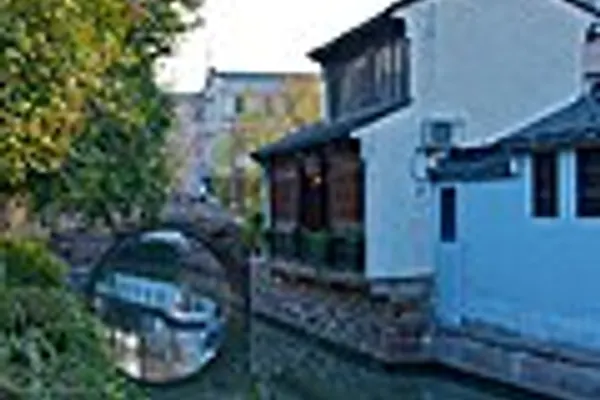
There are 18 stone bridges in the Pingjiang Road historic district. Among them, 12 bridges (or in their previous forms) are shown on the Song dynasty Pingjiang Tu. They are namely Sipo, Shou'an, Xuegao, Jiqing, Sujun, Zhong'an, Tongli, Huxingsi, Beikaiming, Tangjia, Zhumajiao and Xiaoxin. 10 of the bridges are lying in the north–south direction, the other eight in the east–west direction. The historic district thus has the highest density of bridges across Suzhou.
The story of Hong Jun and Sai Jinhua
Hong Jun, a scholar and diplomat temporarily residing on 27 Xuanqiao Lane, Pingjiang Road, met 20-year-old Sai Jinhua in 1886, then as a prostitute while on a flower boat. At the time Hong Jun was in mourning due to his mother's death. Hong Jun made Sai Jinhua his concubine one year after meeting her. Sai Jinhua followed Hong Jun in his diplomatic visits to Russia, Germany, Australia and the Netherlands, Sai Jinhua also gave birth to a daughter named Deguan. The couple returned to Suzhou in 1893 and made 29 Xuanqiao Lane home, neighboring Hong Jun's former residence. However, two months after their return, Hong Jun became sick and died at age 55. Sai Jinhua was forced to leave the house after Hong's death and carried on her profession as a courtesan in Shanghai.
Transportation
Pingjiang Road is within walking distance to the Xiangmen Station of Line 1 of the Suzhou Metro.
Gallery
See also
China portal
Pingjiang Subdistrict
Momi cafe, a cafe in Pingjiang Road
References
External links
Media related to Pingjiang Road at Wikimedia Commons
Encyclopedic content adapted from the Wikipedia article on Pingjiang, used under CC BY-SA 4.0.
What makes Pingjiang special
Pingjiang stands out among Suzhou’s neighborhoods for its distinctive character: unesco old canal suzhou. It tops our ranking of the best neighborhoods in Suzhou, it offers the kind of experience that defines a great city trip — a place where the streets themselves tell a story and every block rewards curiosity.
Best for
Our take on Pingjiang
Pingjiang is the neighborhood we send friends to first when they visit Suzhou. It earns the top spot in our ranking not because it is the most famous district in the city, but because it delivers the most complete neighborhood experience — the kind of place where every block rewards curiosity and every return visit reveals something new.
What makes Pingjiang worth the visit is the texture of daily life here. It is a neighborhood that functions for the people who live in it — not just for the visitors who pass through. The shops serve local needs, the restaurants feed local appetites, and the streets have a rhythm that reflects genuine community rather than tourism infrastructure. That is the quality our editors prize most, and Pingjiang has it in abundance.
Our editors recommend budgeting at least half a day here — enough time to walk the main streets, sit down for coffee, and discover the side streets where Pingjiang's real character lives.
Living in Pingjiang
Pingjiang is connected to the rest of Suzhou by public transit, and most visitors find it straightforward to reach from the city center or airport. Once you arrive, the neighborhood is best explored on foot — the scale is human and the streets reward wandering.
Day-to-day life in Pingjiang has the rhythm of a genuine residential neighborhood. You will find grocery stores, pharmacies, cafés with morning regulars, and the kind of small independent shops that only survive where locals support them. For visitors, this means the infrastructure you need — good coffee, a decent meal, a quiet place to sit — is always within a short walk.
Accommodation in Pingjiang ranges from boutique hotels to short-term rentals. We generally recommend staying within the neighborhood itself rather than commuting from a hotel elsewhere in Suzhou — the experience of waking up inside a great neighborhood is fundamentally different from visiting one as a day trip.
What locals say about Pingjiang
Long-term residents of Pingjiang tend to describe their neighborhood with a mix of pride and protectiveness. Like any district with genuine character, Pingjiang inspires loyalty — the kind of place people move to and never quite leave, or leave and spend years trying to get back to.
What locals appreciate most about Pingjiang is its consistency — the feeling that the neighborhood works the same way on a Tuesday morning as it does on a Saturday night. It is not a place that performs for visitors and then goes quiet. The rhythm is genuine, the community is real, and the daily experience of living here is what draws people and keeps them.
Like any neighborhood that has earned attention, Pingjiang is navigating the tension between popularity and preservation. Rents have risen, new businesses have arrived, and long-time residents occasionally grumble that the neighborhood is not what it was. But the fundamentals — the walkability, the food, the community — remain strong, and most locals we speak to believe the neighborhood is still gaining more than it is losing.
Visitor tips
- Pingjiang is located in Suzhou, China. The neighborhood is accessible by public transport, taxi, or rideshare from most parts of the city.
- Morning is often the best time to explore — the streets are quieter, the light is better for photography, and cafes are at their most welcoming.
- Wear comfortable walking shoes — the best way to experience Pingjiang is on foot, wandering the side streets and discovering what lies around each corner.