About the neighborhood
Quarter in Alsace, France
The Petite France (French pronunciation: pətit fʁɑ̃s), in Alsatian dialect: Französel; "Little France"), also known as the Quartier des Tanneurs (German: Gerberviertel; "Tanner's Quarter") is the south-western part of the Grande Île of Strasbourg, France, the most central and characteristic island of the city that forms the historic centre.
The district is bounded to the north by the Quai de la Bruche (Brischstade), the Rue du Bain-aux-Plantes, the Place Benjamin-Zix and the Rue des Dentelles; to the east by the Rue du Pont-Saint-Martin, the Pont Saint-Thomas (Thomas Bridge) and the Mills footbridge; to the south by the Channel of Zorn-Mühle; and to the west by the Covered Bridges.
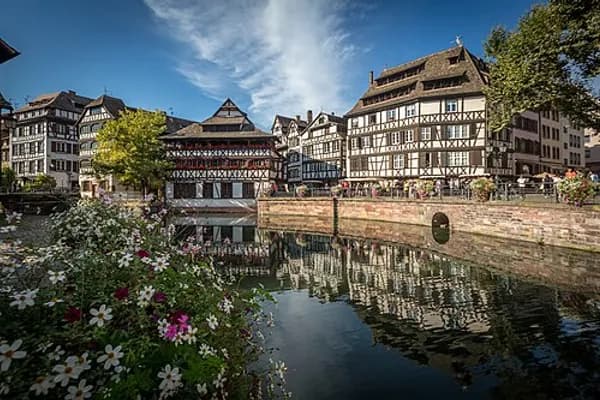
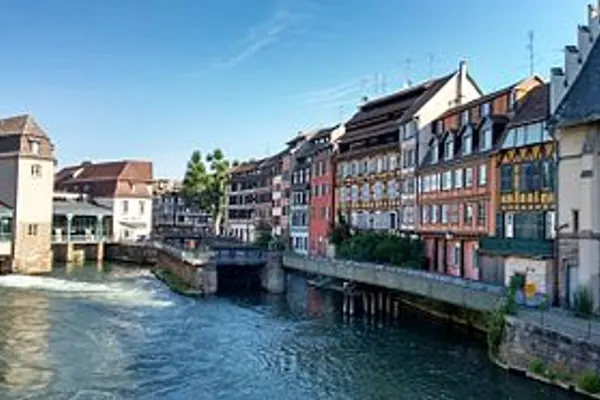
At the Petite France, the river Ill splits up into a number of channels that cascade through an area that was, in the Middle Ages, home to the city's tanners, millers and fishermen, and is now one of Strasbourg's main tourist attractions. The Petite France forms part of the UNESCO World Heritage Site of the Grande Île, designated in 1988.
History
Pflanzbad, Mühlenplan, Gedeckte Brücken
The Petite France district did not emerge as an urban entity until the 20th century. Originally, the term "Little France" was reserved for the dam that separates the Spitzmühlen Canal from the shipping canal. Up until the 19th century, the three units that make up the district today were called in Alsatian dialect "Am Pflanzbad", "Der Mühlenplan" and "Bei den Gedeckten Brücken".
In the 13th century, the Rue du Bain-aux-Plantes, the main street of the quarter, was known as Glanzhof, in the 15th century it became the Pflanzhof, and later the Pflanzbad. This designation referred to a public bathhouse (No. 22) in which women underwent a bath treatment with fragrant and beneficial herbs.
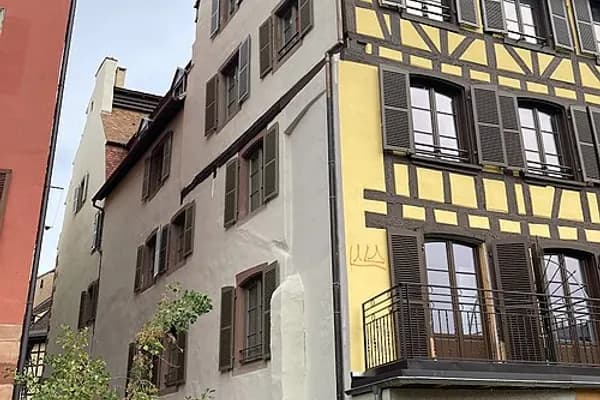
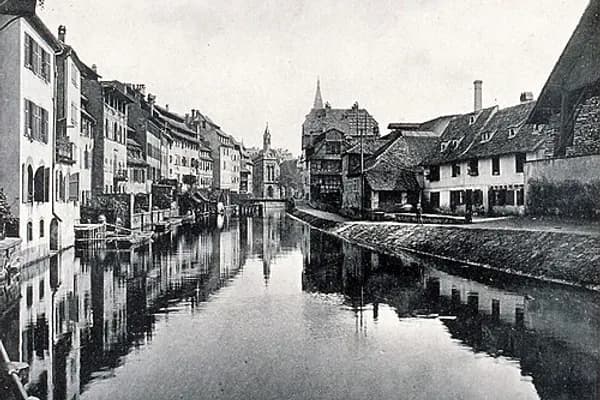
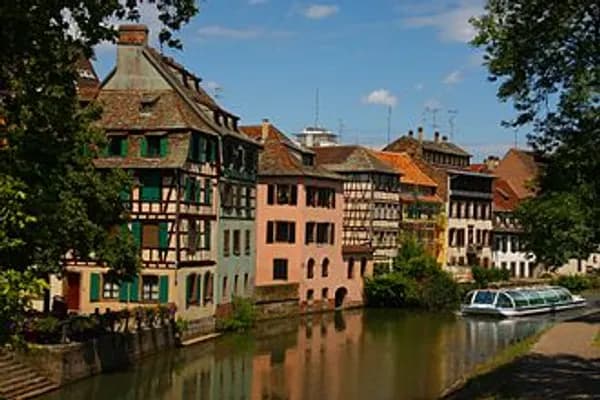
The "Mühlenplan" still corresponds to the Rue des Moulins, which is sometimes also called the mill quarter. The Petite France is therefore not a historical district in the narrower sense, but a picturesque district that emerged with its narrow alleys of half-timbered houses on the banks of the Ill and was not very popular at the time because of the tanneries (white and red tanners) and the associated smells. In addition to the tanners and mill owners, poor fishermen, executioners and prostitutes also lived here. Due to the poverty, many houses were built in half-timbered construction. The origin goes back to the 16th century.
Just upstream of the Petite France, the river Ill flows through the Barrage Vauban, a defensive structure built at the end of the 17th century. Downstream of this, the river splits into the Canal du Faux-Rempart, which flows to the north of the Grande Île, and four channels which flow through the Petite France quarter before reuniting in the main channel of the river, flowing to the south of the Grande Île. These four channels are spanned by the Ponts Couverts, an earlier defensive structure of three bridges and four towers that, despite its name, has not been covered since the 18th century.
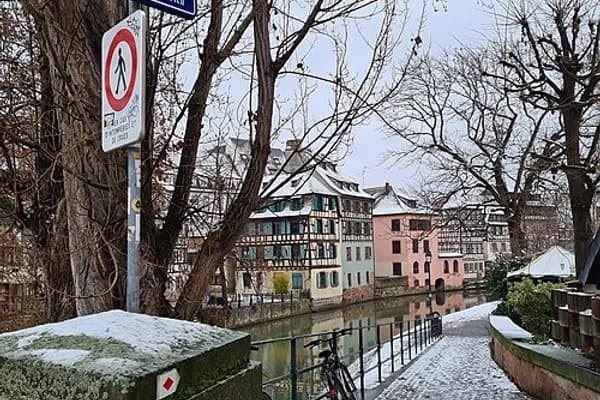
Downstream of the Ponts Couverts, the four channels flow through an area of largely half-timbered buildings which, together with the narrow lanes and footbridges that connect them, mostly date from the 16th and 17th centuries. The sloping roofs of many of the buildings include open lofts where hides were once dried. Three of the four channels flowing through the quarter run over weirs that once drove mills and other industries, whilst the northernmost channel is navigable. This passes through a lock and the Pont du Faisan swing bridge in the centre of the quarter, and is largely used by passenger trip boats.
On the north bank of the Ill at the heart of the quarter is the Maison des Tanneurs, home of the Tanner's Guild, and the Place Benjamin-Zix. From this square lead several streets, including the Rue du Bain-aux-Plantes and the Rue des Dentelles, also lined by half-timbered houses. To the east these lead to the Saint-Thomas church, the city’s main Lutheran church, and to the west back to the Pont Couverts and to the Saint-Pierre-le-Vieux church, actually two churches (one Protestant and one Catholic) in the same building.
Hospice of the Incurable
The origin of the name Petite-France ("Little France") was not given for patriotic or architectural reasons. It can be found in the Alsatian name Blatterhüs of a hospice for the incurable, originally founded in the Finkwiller district and then moved in 1687 to a new building at 6 rue des Moulins, on what is now the Quai de la Petite-France (Blodergängel in Alsatian during the 18th and 19th centuries), where it operated for a period of almost 300 years until 1789 in the then German-speaking and culturally German-influenced Lutheran University City of Strasbourg. Until 1789, all of Alsace was a foreign country under customs law (province à l'instar de l'étranger effectif), i.e. it had a customs border with France, but not with the Holy Roman Empire. The hospice was founded in 1503 by Gaspard Hofmeister, a citizen of the city, for the Landsknechte of Charles VIII of France, who had contracted syphilis during the Italian wars. The return of the Landsknechte from the siege of Naples brought syphilis to the region. The hospice had been expanded in 1506 and 1522 before being moved in 1687. Syphilis is a disease that appeared suddenly in Europe at the end of the 15th century and soon required considerable care for the often marginalised patients. The population called the hospice "Zum Französel" at the time, as syphilis was considered a "French disease". In the 18th century, the place was called the Hospice of the Incurable. In 1795, the building was referred to as "La Petite France", then by extension the entire district.
Sights
Maison des Tanneurs (1572), 42 rue du Bain aux Plantes
Place Benjamin-Zix
Rue du Bain-aux-Plantes
Former tannery (1600) of Huguenot Benjamin Bury, 12 rue des Dentelles
Former tannery (1591) of Henri Haderer
Église Saint-Martin
Anciennes Glacières
Barrage Vauban
Église méthodiste de Sion
Ponts couverts
Blodergängel, Quai de la Petite France
Four defense towers of the old city wall from the 14th century
Gallery
References
Wikimedia Commons has media related to Petite France.
Encyclopedic content adapted from the Wikipedia article on Petite France, used under CC BY-SA 4.0.
What makes Petite France special
Petite France stands out among Strasbourg’s neighborhoods for its distinctive character: strasbourg's half-timbered canals. Ranked #2 in Strasbourg, it offers the kind of experience that defines a great city trip — a place where the streets themselves tell a story and every block rewards curiosity.
Best for
Our take on Petite France
Petite France is one of the strongest neighborhoods in Strasbourg, and it consistently appears in our editors' personal favorites lists. It may not always get the same attention as the city's most famous district, but among travelers who know Strasbourg well, Petite France is often the first recommendation.
What makes Petite France worth the visit is the texture of daily life here. It is a neighborhood that functions for the people who live in it — not just for the visitors who pass through. The shops serve local needs, the restaurants feed local appetites, and the streets have a rhythm that reflects genuine community rather than tourism infrastructure. That is the quality our editors prize most, and Petite France has it in abundance.
Our editors recommend budgeting at least half a day here — enough time to walk the main streets, sit down for coffee, and discover the side streets where Petite France's real character lives.
Living in Petite France
Petite France is connected to the rest of Strasbourg by public transit, and most visitors find it straightforward to reach from the city center or airport. Once you arrive, the neighborhood is best explored on foot — the scale is human and the streets reward wandering.
Day-to-day life in Petite France has the rhythm of a genuine residential neighborhood. You will find grocery stores, pharmacies, cafés with morning regulars, and the kind of small independent shops that only survive where locals support them. For visitors, this means the infrastructure you need — good coffee, a decent meal, a quiet place to sit — is always within a short walk.
Accommodation in Petite France ranges from boutique hotels to short-term rentals. We generally recommend staying within the neighborhood itself rather than commuting from a hotel elsewhere in Strasbourg — the experience of waking up inside a great neighborhood is fundamentally different from visiting one as a day trip.
What locals say about Petite France
Long-term residents of Petite France tend to describe their neighborhood with a mix of pride and protectiveness. Like any district with genuine character, Petite France inspires loyalty — the kind of place people move to and never quite leave, or leave and spend years trying to get back to.
What locals appreciate most about Petite France is its consistency — the feeling that the neighborhood works the same way on a Tuesday morning as it does on a Saturday night. It is not a place that performs for visitors and then goes quiet. The rhythm is genuine, the community is real, and the daily experience of living here is what draws people and keeps them.
Like any neighborhood that has earned attention, Petite France is navigating the tension between popularity and preservation. Rents have risen, new businesses have arrived, and long-time residents occasionally grumble that the neighborhood is not what it was. But the fundamentals — the walkability, the food, the community — remain strong, and most locals we speak to believe the neighborhood is still gaining more than it is losing.
Visitor tips
- Petite France is located in Strasbourg, France. The neighborhood is accessible by public transport, taxi, or rideshare from most parts of the city.
- Morning is often the best time to explore — the streets are quieter, the light is better for photography, and cafes are at their most welcoming.
- Wear comfortable walking shoes — the best way to experience Petite France is on foot, wandering the side streets and discovering what lies around each corner.
- Save the neighborhood's location on your phone before you arrive. Offline maps are especially useful for navigating the smaller side streets.