About the neighborhood
District of Strasbourg, Bas-Rhin in France
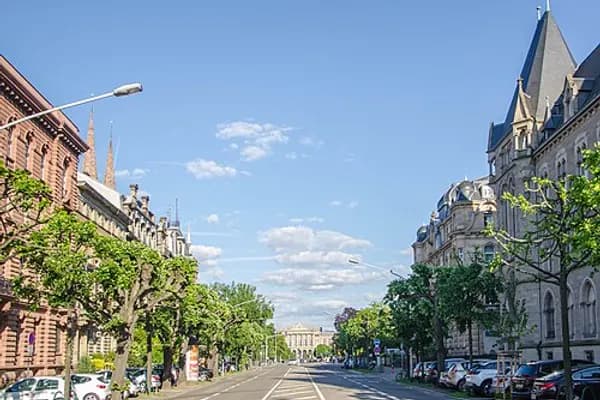
The Neustadt (German for New Town) is a district of Strasbourg, Bas-Rhin, France. In 2017, the heart of the district was listed as a World Heritage Site by UNESCO, as an extension of the site including the older city centre (Grande Île) and Strasbourg Cathedral. The district is a unique example of city planning, merging the Haussmannian model with elements of German architecture and urban planning.
Aside from the Imperial Quarter of Metz, the Neustadt district of Strasbourg contains the most complete and best-preserved examples of urbanism under the German Empire. In Germany itself, the comparable districts of such cities often suffered the bombardment by Allied forces in the Second World War.
History and description
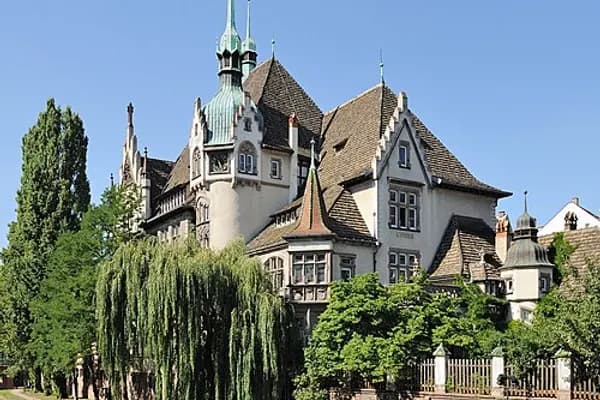
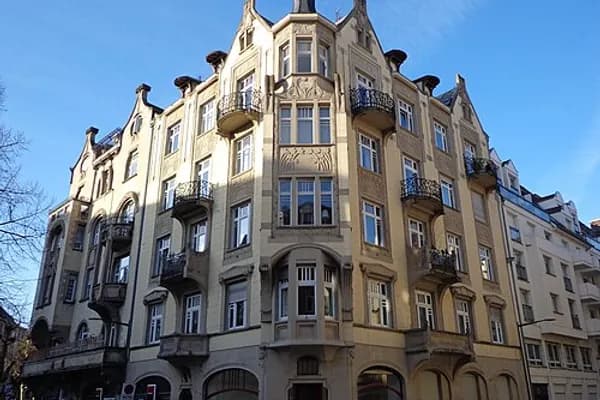
The Neustadt district was created by the Germans during the Reichsland period (1871–1918) to serve as a new city center. As opposed to the old town on the Grande Île, which in 1871 had more narrow and crooked streets and fewer squares than today, the new town was conceived along monumental boulevards and broad, rectilinear streets that were seen as modern, healthy and easy to police. In order to gain the necessary space, several belts of fortifications, mostly dating from the years 1519–1552, and 1630–1681, were torn down; remains of these are found with each archaeological excavation in the area. Many architectural styles were used for the construction of the Neustadt, mostly on a grand scale: Baroque Revival, Renaissance Revival, Gothic Revival, Romanesque Revival, often a mixture of several or all of these styles (Historicism). At the end of the 19th century, at the same time as a new building material, reinforced concrete, a new and better defined style appeared as well: Art Nouveau.
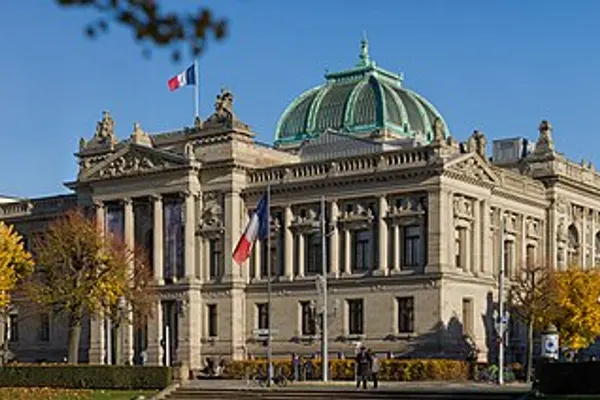
The Neustadt comprises a number of public buildings and monuments that are today classified as Monuments historiques, such as:
Palais du Rhin, former palace of the German Emperors
University Palace (also the observatory, the zoological museum, the botanical garden etc.)
National and University Library
National Theatre of Strasbourg, the former Parliament building of Alsace-Lorraine
Palais de Justice
Palais des Fêtes
St Paul's Church
Strasbourg railway station
Hôtel Brion
Villa Schutzenberger
22, Rue du Général de Castelnau
56, Allée de la Robertsau
and also landmarks that are not classified as Monuments historiques (as of 2019), such as the Saint-Pierre-le-Jeune Catholic Church.
Notable architects
Fritz Beblo
Berninger & Krafft
Jean Geoffroy Conrath
Hermann Eggert
August Hartel
Johann Eduard Jacobsthal
Ludwig Levy
Lütke & Backes
Skjold Neckelmann
August Orth
Otto Warth
References
Literature
Recht, Roland; Foessel, Georges; Klein, Jean-Pierre: Connaître Strasbourg, 1988, ISBN2-7032-0185-0, pages 253–272
Bengel, Sabine; Jordan, Benoît; Nohlen, Klaus; Werlé, Maxime et al.: Strasbourg, de la Grande Île à la Neustadt, un patrimoine urbain exceptionnel, 2013, ISBN9782362190797
Rapetti, Rodolphe; Schnitzler, Bernadette; et al.: Strasbourg 1900, naissance d'une capitale, 2000, ISBN9782850563874
Befort, Paul-André; Daul Léon; Kontzler Chantal; Lery Pierre: Strasbourg 1900, carrefour des arts nouveaux, 2010, ISBN9782355780646
Doucet, Hervé; Haegel, Olivier; Pottecher, Marie; et al.: La Neustadt de Strasbourg: un laboratoire urbain (1871-1930), 2017, ISBN9782362191510
External links
La Neustadt: quartier impérial et université on strasbourg.eu
La Neustadt Archived 2017-08-04 at the Wayback Machine on patrimoine-neustadt-strasbourg.fr
Le quartier impérial allemand (1870–1918) on otstrasbourg.fr
Cathy Blanc-Reibel: The case of Neustadt (Strasbourg), Co-construction of an Urban and Architectural Heritage, Revue des sciences sociales, 15 July 2017.
Wikimedia Commons has media related to Neustadt (Strasbourg).
48°35′14″N 7°45′14″E / 48.5872°N 7.7538°E / 48.5872; 7.7538
Encyclopedic content adapted from the Wikipedia article on Neustadt, used under CC BY-SA 4.0.
What makes Neustadt special
Neustadt stands out among Strasbourg’s neighborhoods for its distinctive character: strasbourg's german imperial new town. Ranked #4 in Strasbourg, it offers the kind of experience that defines a great city trip — a place where the streets themselves tell a story and every block rewards curiosity.
Best for
Our take on Neustadt
Neustadt occupies a distinctive place in Strasbourg's neighborhood landscape. It is the kind of district that rewards travelers who venture beyond the obvious choices — quieter than the tourist-facing areas, richer in local character, and full of the small details that make a city trip memorable.
What makes Neustadt worth the visit is the texture of daily life here. It is a neighborhood that functions for the people who live in it — not just for the visitors who pass through. The shops serve local needs, the restaurants feed local appetites, and the streets have a rhythm that reflects genuine community rather than tourism infrastructure. That is the quality our editors prize most, and Neustadt has it in abundance.
Our editors recommend budgeting at least half a day here — enough time to walk the main streets, sit down for coffee, and discover the side streets where Neustadt's real character lives.
Living in Neustadt
Neustadt is connected to the rest of Strasbourg by public transit, and most visitors find it straightforward to reach from the city center or airport. Once you arrive, the neighborhood is best explored on foot — the scale is human and the streets reward wandering.
Day-to-day life in Neustadt has the rhythm of a genuine residential neighborhood. You will find grocery stores, pharmacies, cafés with morning regulars, and the kind of small independent shops that only survive where locals support them. For visitors, this means the infrastructure you need — good coffee, a decent meal, a quiet place to sit — is always within a short walk.
Accommodation in Neustadt ranges from boutique hotels to short-term rentals. We generally recommend staying within the neighborhood itself rather than commuting from a hotel elsewhere in Strasbourg — the experience of waking up inside a great neighborhood is fundamentally different from visiting one as a day trip.
What locals say about Neustadt
Long-term residents of Neustadt tend to describe their neighborhood with a mix of pride and protectiveness. Like any district with genuine character, Neustadt inspires loyalty — the kind of place people move to and never quite leave, or leave and spend years trying to get back to.
What locals appreciate most about Neustadt is its consistency — the feeling that the neighborhood works the same way on a Tuesday morning as it does on a Saturday night. It is not a place that performs for visitors and then goes quiet. The rhythm is genuine, the community is real, and the daily experience of living here is what draws people and keeps them.
Compared to the more famous districts in Strasbourg, Neustadt has maintained a lower profile, which many residents consider an advantage. The neighborhood evolves gradually rather than being reshaped by sudden attention, and the result is a community that still feels organic rather than curated.
Visitor tips
- Neustadt is located in Strasbourg, France. The neighborhood is accessible by public transport, taxi, or rideshare from most parts of the city.
- Morning is often the best time to explore — the streets are quieter, the light is better for photography, and cafes are at their most welcoming.
- Wear comfortable walking shoes — the best way to experience Neustadt is on foot, wandering the side streets and discovering what lies around each corner.
- Save the neighborhood's location on your phone before you arrive. Offline maps are especially useful for navigating the smaller side streets.