About the neighborhood
Quarter of Dresden in Saxony, Germany
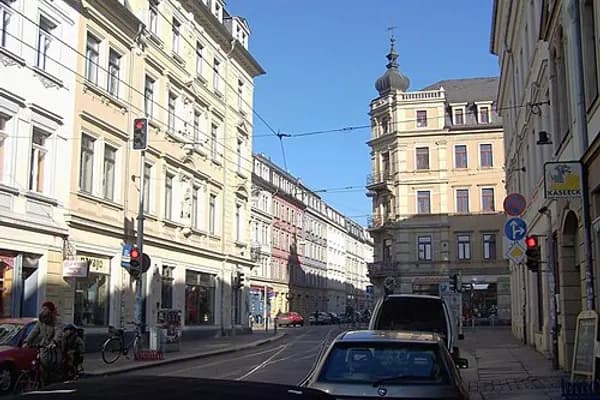
Äußere Neustadt (German pronunciation: ˈɔʏsəʁə ˈnɔʏʃtat, lit.'Outer New Town'), also known as Antonstadt after Anthony (German: Anton), King of Saxony, is a neighborhood in Dresden, Germany. The Äußere Neustadt contains the part of the Neustadt that is located outside of where the old city walls used to be. Today the area is known for its thriving bars and clubs.
Location
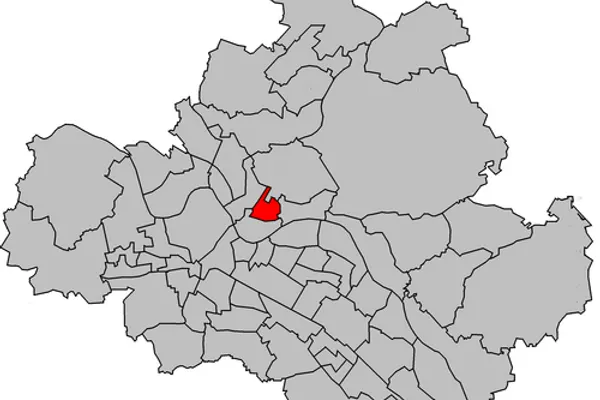
The Äußere Neustadt is bounded by Bautzener Straße and Albertplatz to the south, Königsbrücker Straße to the west, the street Bischofsweg and Alaunpark to the north, and the Prießnitz river to the east. These, however, are the official borders. Many people consider the neighborhood of Hecht to be part of the Äußere Neustadt even though it technically belongs to the Leipziger Vorstadt.
Traffic
Äußere Neustadt is not far away from Bahnhof Dresden-Neustadt which is the second largest train station in Dresden. This station grants access to the ICE network.
A number of tramlines serve the Äußere Neustadt. Albertplatz at the southern border is the most important hub in Dresden north of the Elbe. One of the few single track sections in Dresden is in the quarter due to its cramped streets.
History
The streets have remained mostly the same since they were originally laid out in 1745. Among the first businesses to emerge in the area were a casting house and an alum boilery (Alaunstraße gets its name from the German word for alum). The world's first milk chocolate was produced in 1839 in a factory opened in between modern-day Timaeusstraße and Jordanstraße by Gottfried Heinrich Christoph Jordan and August Friedrich Christian Timaeus.
The area boomed in the late 19th century, when many of its characteristic buildings were erected. Today, it is one of the largest urban areas in Germany with enclosed Wilhelminian-era architecture. This has much to do with the fact that the Äußere Neustadt was not greatly affected by the bombing of Dresden in World War II.
The festival known as Bunte Republik Neustadt ("The Colorful Republic of Neustadt" a play on Bundesrepublik Deutschland, the German name of the federal republic of Germany) has taken place every year since 1990 in the Äußere Neustadt. It has become East Germany's largest city festival with more than 150,000 visitors in 2006.
Attractions
Martin Luther Church
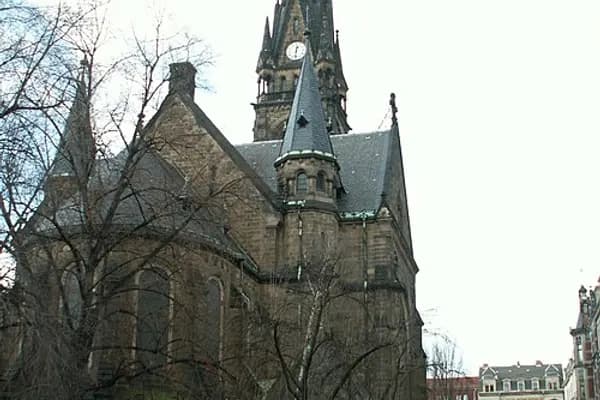
Located on Martin-Luther-Platz, built from 1883 to 1887. With both Romanesque arches and Gothic proportions, the church exterior is an example of historicism. The tower is 81 meters high.
Pfund's dairy
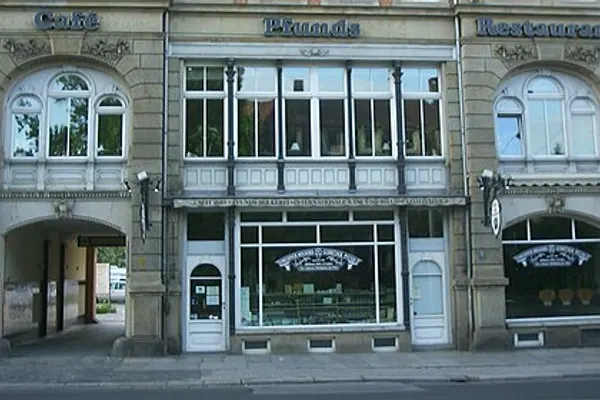
One of Dresden's most popular tourist attractions. Decorated with neo-Renaissance porcelain tiles made by Villeroy & Boch, it is known as the world's most beautiful dairy.
Old Jewish cemetery
Located on Pulsnitzer Straße near Martin-Luther-Platz. Established in 1751, it is the oldest Jewish cemetery in Saxony. A new cemetery was established for the Jewish population of Dresden in the neighborhood of Johannstadt in 1869.
Kunsthofpassage
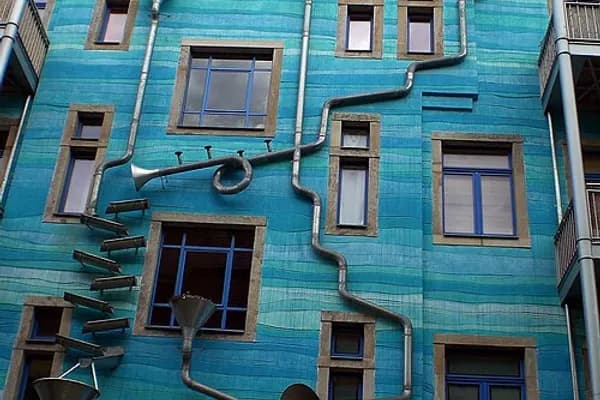
The Kunsthofpassage, located right off Görlitzer Straße, is a complex of buildings whose 5 courtyards contain interesting artwork and decoration, one of which plays musical notes powered by raindrops. The passage contains small boutiques, galleries, bookstores, and cafes.
Nordbad
Dresden's only historical bathhouse. Although it was temporarily closed from 1974 to 1992, it is once again open for business. The bath itself is 8 meters wide and 16 meters long.
Panama Adventure Playground
Neustadt contains a special attraction for children – the Panama Adventure Playground. Children between 6 and 16 are welcome to come and interact with horses, sheep and other animals. Panama was designed as a 'playground within the city', and as such is located in the middle of the block bounded by Görlitzer, Kamenzer, Sebnitzer and Louisen Streets.
Nightlife
The Äußere Neustadt is thought to have one of the liveliest bar scenes in all of Germany, with an extremely high concentration of bars, clubs, and cafes.
Notes
Encyclopedic content adapted from the Wikipedia article on Neustadt, used under CC BY-SA 4.0.
What makes Neustadt special
Neustadt stands out among Dresden’s neighborhoods for its distinctive character: dresden's alternative bar district. Ranked #2 in Dresden, it offers the kind of experience that defines a great city trip — a place where the streets themselves tell a story and every block rewards curiosity.
Best for
Our take on Neustadt
Neustadt is one of the strongest neighborhoods in Dresden, and it consistently appears in our editors' personal favorites lists. It may not always get the same attention as the city's most famous district, but among travelers who know Dresden well, Neustadt is often the first recommendation.
The energy of Neustadt builds as the day goes on, peaking in the evening when the streets fill with locals heading to their regular spots. This is a neighborhood where the nightlife feels organic rather than manufactured — bars that have regulars, music venues where the crowd actually listens, late-night spots where the kitchen stays open because the community demands it.
Our editors recommend budgeting at least half a day here — enough time to walk the main streets, sit down for coffee, and discover the side streets where Neustadt's real character lives.
Living in Neustadt
Neustadt is connected to the rest of Dresden by public transit, and most visitors find it straightforward to reach from the city center or airport. Once you arrive, the neighborhood is best explored on foot — the scale is human and the streets reward wandering.
The neighborhood transitions through distinct phases during the day. Mornings are quiet — coffee shops and bakeries set the pace. Afternoons bring more energy as the retail and café scene picks up. Evenings are when Neustadt truly comes alive, with restaurants and bars filling steadily from around 7 PM onward. If you are staying in the neighborhood, embrace the rhythm rather than fighting it.
Accommodation in Neustadt ranges from boutique hotels to short-term rentals. We generally recommend staying within the neighborhood itself rather than commuting from a hotel elsewhere in Dresden — the experience of waking up inside a great neighborhood is fundamentally different from visiting one as a day trip.
What locals say about Neustadt
Long-term residents of Neustadt tend to describe their neighborhood with a mix of pride and protectiveness. Like any district with genuine character, Neustadt inspires loyalty — the kind of place people move to and never quite leave, or leave and spend years trying to get back to.
Residents value the neighborhood's evening energy but will quickly tell you that Neustadt is more than its bars. The nightlife is an expression of the community, not a tourist attraction — locals know the bartenders by name, have their preferred corners, and treat the neighborhood's bars and restaurants as extensions of their living rooms.
Like any neighborhood that has earned attention, Neustadt is navigating the tension between popularity and preservation. Rents have risen, new businesses have arrived, and long-time residents occasionally grumble that the neighborhood is not what it was. But the fundamentals — the walkability, the food, the community — remain strong, and most locals we speak to believe the neighborhood is still gaining more than it is losing.
Visitor tips
- Neustadt is located in Dresden, Germany. The neighborhood is accessible by public transport, taxi, or rideshare from most parts of the city.
- The neighborhood comes alive in the evening. Plan to arrive after sunset to experience the best of the local bar and dining scene.
- Wear comfortable walking shoes — the best way to experience Neustadt is on foot, wandering the side streets and discovering what lies around each corner.
- Save the neighborhood's location on your phone before you arrive. Offline maps are especially useful for navigating the smaller side streets.