About the neighborhood
Capital city of Saxony, Germany
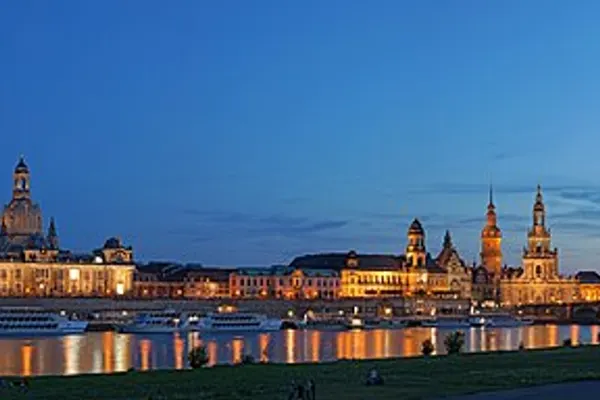
Dresden (/ˈdrɛzdən/; German: ˈdʁeːsdn̩ ; Upper Saxon: Dräsdn; Upper Sorbian: Drježdźany, pronounced ˈdʁʲɛʒdʒanɨ) is the capital city of the German state of Saxony and its second most populous city after Leipzig. It is the 12th most populous city of Germany, the fourth largest by area (after Berlin, Hamburg, and Cologne), and the third-most populous city in the area of former East Germany, after Berlin and Leipzig. Dresden's urban area comprises the towns of Freital, Pirna, Radebeul, Meissen, Coswig, Radeberg, and Heidenau and has around 790,000 inhabitants. The Dresden metropolitan area has over 1.3 million inhabitants.
Dresden is the second largest city on the River Elbe after Hamburg. Most of the city's population lives in the Elbe Valley, but a large, albeit very sparsely populated, area of the city east of the Elbe lies in the West Lusatian Hill Country and Uplands (the westernmost part of the Sudetes) and thus in Lusatia. Many boroughs west of the Elbe lie in the Ore Mountain Foreland, as well as in the valleys of the rivers rising there and flowing through Dresden, the longest of which are the Weißeritz and the Lockwitzbach. The name of the city as well as the names of most of its boroughs and rivers are of Sorbian origin.
Dresden has a long history as the capital and royal residence for the Electors and Kings of Saxony, who for centuries furnished the city with cultural and artistic splendor, and was once by personal union the family seat of Polish monarchs. The city was known as the Jewel Box, because of its Baroque and Rococo city centre. The controversial American and British bombing of Dresden towards the end of World War II killed approximately 25,000 people, most of whom were civilians, and destroyed the entire city centre. After the war, restoration work has helped to reconstruct parts of the historic inner city.
Since German reunification in 1990, Dresden has once again become a cultural, educational and political centre of Germany. The Dresden University of Technology (TU Dresden) is one of the 10 largest universities in Germany and part of the German Universities Excellence Initiative. The economy of Dresden and its agglomeration is one of the most dynamic in Germany and ranks first in Saxony. It is dominated by high-tech branches, often called "Silicon Saxony". According to the Hamburg Institute of International Economics (HWWI) and Berenberg Bank in 2019, Dresden had the seventh best prospects for the future of all cities in Germany.
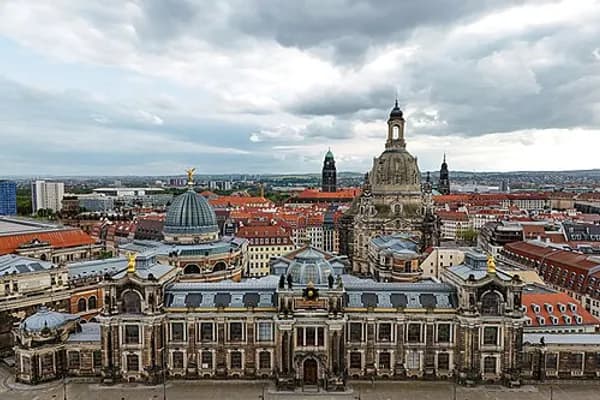
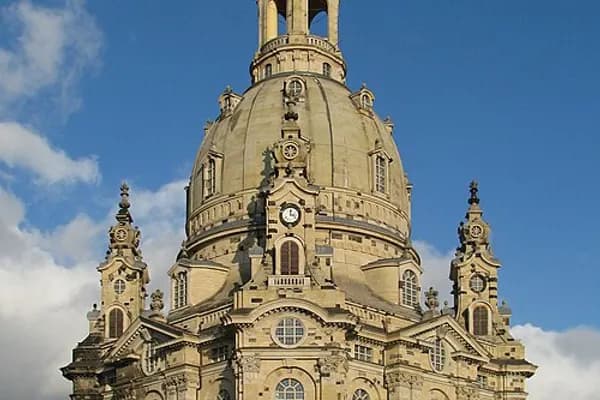
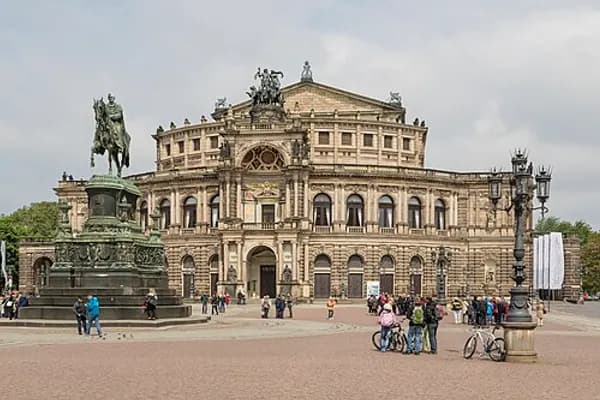
Dresden is one of the most visited cities in Germany with 4.7 million overnight stays per year. Its most prominent building is the Frauenkirche located at the Neumarkt. Built in the 18th century, the church was destroyed during World War II. The remaining ruins were left for 50 years as a war memorial, before being rebuilt between 1994 and 2005. Other famous landmarks include the Zwinger, the Semperoper and Dresden Castle. Furthermore, the city is home to the Dresden State Art Collections, originating from the collections of the Saxon electors in the 16th century. Dresden's Striezelmarkt is one of the largest Christmas markets in Germany and is considered the first genuine Christmas market in the world. Nearby sights include the National Park of Saxon Switzerland, the Ore Mountains and the countryside around Elbe Valley, Moritzburg Castle and Meissen, home of Meissen porcelain.
History
Timeline of Dresden Historical affiliations
Margravate of Meissen, 1206–1316
Margraviate of Brandenburg 1316–1319
Margravate of Meissen, 1319–1423
Electorate of Saxony, 1423–1485
Duchy of Saxony, 1485–1547
Electorate of Saxony, 1547–1806
Kingdom of Saxony, 1806–1848
German Empire, 1848–1849
Kingdom of Saxony, 1849–1918
North German Confederation (Kingdom of Saxony), 1867–1871
German Empire (Kingdom of Saxony), 1867–1918
Weimar Republic (Free State of Saxony), 1918–1933
Nazi Germany, 1933–1945
Soviet occupation zone of Germany, 1945–1949
East Germany, 1949–1990
Germany (Free State of Saxony), 1990–present
The area had been settled in the Neolithic era by Linear Pottery culture tribes c. 7500 BC. Dresden's founding and early growth is associated with the eastward expansion of Germanic peoples, mining in the nearby Ore Mountains, and the establishment of the Margraviate of Meissen. Its name comes from Sorbian Drežďany (meaning either "woods" or "lowland forest-dweller"). Dresden later evolved into the capital of Saxony. Beginning in the 17th century, it became one of Europe’s leading centres of culture and the arts.
Early history
Dresden developed as a German trading settlement on the south bank of the Elbe, established by the Margrave of Meissen Dietrich. The first documentary evidence of Dresden dates to 1206. That year, Dietrich chose Dresden as his interim residence, as documented in a 31 March record calling the place "Dresdene". In 1220, a stone bridge was constructed over the Elbe at the same location as today’s Augustus Bridge. The bridge connected the town with a Sorbian settlement called Drezdany on the northern bank. It was known as Antiqua Dresdin by 1350, and later as Altendresden, both literally "old Dresden".
Dresden was given to Friedrich Clem after the death of Henry the Illustrious in 1288. It was taken by the Margraviate of Brandenburg in 1316 and was restored to the Wettin dynasty after the death of Valdemar the Great in 1319. In 1485, the Saxon Wettin brothers divided their lands under the Treaty of Leipzig, with Ernest retaining the Elector title and the western and northern territories, while Albert received the Meissen area and established Dresden as the capital of the Duchy of Saxonynl; fr; es. Following the Schmalkaldic War, in 1547 Duke Moritz was granted the title of Elector and Dresden became the capital of the Electorate of Saxony.
Early modern age
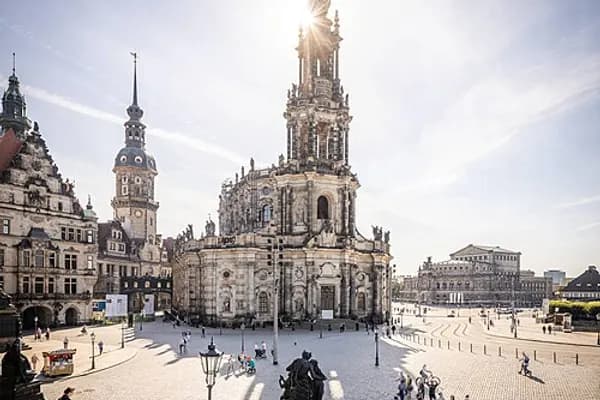
The Elector and ruler of Saxony Frederick Augustus I became King Augustus II the Strong of Poland in 1697. He gathered many of the best musicians, architects and painters from all over Europe to Dresden. His reign marked the beginning of Dresden's emergence as a leading European city for technology and art. During the reign of Elector Frederick Augustus I and his successor Frederick Augustus II most of the city's baroque landmarks were built. These include the Zwinger Royal Palace, the Japanese Palace, the Taschenbergpalais, the Pillnitz Castle and the two landmark churches: the Catholic Hofkirche and the Lutheran Frauenkirche. In addition, significant art collections and museums were founded. Notable examples include the Dresden Porcelain Collection, the Collection of Prints, Drawings and Photographs, the Grünes Gewölbe and the Mathematisch-Physikalischer Salon. Strengthening ties with Poland, postal routes to Poznań, Thorn (Toruń) and Warsaw were established under Augustus II the Strong.
In 1726, there was a riot for two days after a Protestant clergyman was killed by a soldier who had recently converted from Catholicism. In 1745, the Treaty of Dresden between Prussia, Saxony, and Austria ended the Second Silesian War. Only a few years later, Dresden suffered heavy destruction in the Seven Years' War (1756–1763), following its capture by Prussian forces, its subsequent re-capture, and a failed Prussian siege in 1760. Friedrich Schiller completed his Ode to Joy (the literary base of the European anthem) in Dresden in 1785. In 1793, preparations for the Polish Kościuszko Uprising started in the city by Tadeusz Kościuszko in response to the Second Partition of Poland.
19th century
In 1806, Dresden became the capital of the Kingdom of Saxony established by Napoleon. During the Napoleonic Wars the French Emperor made it a base of operations, winning there the Battle of Dresden on 27 August 1813. As a result of the Congress of Vienna, the Kingdom of Saxony became part of the German Confederation in 1815.
In 1828, the Technical School was founded, the predecessor of the present-day TU Dresden (Dresden University of Technology). In 1838, the Dresden Coinage Convention took place in the city which attempted to bring some degree of standardisation to the currencies used in the Zollverein (German Customs Union). Steamboat transport on the Elbe was established in 1837, followed in 1839 by the opening of Dresden’s first railway, providing a direct connection to Leipzig.
Dresden was a centre of the German Revolutions in 1848–1849. The May Uprising saw rebel Saxon troops supported by students, democrats, miners, and workers declaring a provisional government at the Town Hall. During the street fighting the city’s first opera house was destroyed. Prussian forces, aided by loyal Saxon troops, suppressed the revolt, leaving over 150 dead and many imprisoned. The uprising forced Frederick Augustus II of Saxony to flee from Dresden, but he soon after regained control over the city with the help of Prussia.
In 1852, the population of Dresden grew to 100,000 inhabitants, making it one of the biggest cities within the German Confederation. Following the Polish uprisings of 1831, 1848 and 1863, many Poles fled to Dresden, including the artistic and political elite, such as composer Frédéric Chopin, war hero Józef Bem and writer Adam Mickiewicz. Mickiewicz wrote one of his greatest works, Dziady, Part III, there.
As the capital of the Kingdom of Saxony, Dresden became part of the newly founded German Empire in 1871. In the following years, the city became a major centre of economy, including motor car production, food processing, banking and the manufacture of medical equipment.
After the foundation of the German Empire in 1871, Albertstadt, a large military facility, was built. It had a capacity of up to 20,000 military personnel at the beginning of the First World War. The garrison saw only limited use between 1918 and 1934, but was then reactivated in preparation for the Second World War.
20th century
In the early 20th century, Dresden was particularly well known for its camera works and its cigarette factories. During World War I, the city did not suffer any war damage, but lost many of its inhabitants. Between 1918 and 1934, Dresden was the capital of the first Free State of Saxony as well as a cultural and economic centre of the Weimar Republic. The city was also a centre of European modern art until 1933.
After the Nazi seizure of power, two book burnings were organised in the city in 1933, one by the SA on Wettiner Platz, the second one by German Student Union at the Bismarck Column on Räcknitzhöhe.
From 1933 to 1945, the Jewish community of Dresden was reduced from over 6,000 (7,100 people were persecuted as Jews) to 41, mostly as a result of emigration, but later also deportation and murder. The Semper Synagogue was destroyed in November 1938 on Kristallnacht.
Second World War
During the German invasion of Poland at the start of World War II, in September 1939, the Gestapo carried out mass arrests of local Polish activists. Over 1,300 people were executed by the Nazis at the Münchner Platz, a courthouse in Dresden, including labour leaders, undesirables, and resistance fighters. Around two-thirds of the executed individuals originated from the Protectorate of Bohemia and Moravia. The bombing stopped prisoners who were busy digging a large hole into which an additional 4,000 prisoners were to be disposed of.
During the war, Dresden was the location of several forced labour subcamps of the Stalag IV-A prisoner-of-war camp for Allied POWs, and seven subcamps of the Flossenbürg concentration camp, in which some 3,600 men, women and children were imprisoned, mostly Polish, Jewish and Russian. In April 1945, most surviving prisoners were sent on death marches to various destinations in Saxony and German-occupied Czechoslovakia, whereas some women were probably murdered and some managed to escape.
Dresden in the 20th century was a major communications hub and manufacturing centre with 127 factories and major workshops and was designated by the German military as a defensive strongpoint, with which to hinder the Soviet advance. During the final months of the war, Dresden harboured some 600,000 refugees, with a total population of 1.2 million.
Dresden was attacked seven times between 1944 and 1945. The bombing of Dresden by the Royal Air Force (RAF) and the United States Army Air Forces (USAAF) between 13 and 15 February 1945 was controversial. On the night of 13–14 February 1945, 773 RAF Lancaster bombers dropped 1,181.6 tons of incendiary bombs and 1,477.7 tons of high explosive bombs. The inner city of Dresden was largely destroyed. The Dresden Historians' Commission, made up of 13 prominent German historians, in an official 2010 report concluded that casualties numbered between 22,500 and 25,000.
The destruction of Dresden allowed Hildebrand Gurlitt, a major Nazi Museum director and art dealer, to hide a large collection of artwork that had been stolen during the Nazi era, as he claimed it had been destroyed along with his house in Dresden.
The Allies described the operation as the legitimate bombing of a military and industrial target. Several researchers have argued that the February attacks were disproportionate. As a result of the bombings, mostly women and children died. The Albertstadt garrison was not specifically targeted.
Post-war
After the war, Dresden became part of the Soviet occupation zone in Germany. The damage from Allied air raids was so extensive that a narrow-gauge light railway system was constructed to remove the debris. This seven-line railway system employed 5,000 staff and 40 locomotives. The last train remained in service until 1958, though the last debris clearance team was only disbanded in 1977.
Dresden became a major industrial centre of the German Democratic Republic (East Germany), with a great deal of research infrastructure. It was the centre of Bezirk Dresden (Dresden District) between 1952 and 1990.
The East German authorities razed the ruins of many churches and palaces in the 1950s and 1960s (such as the Gothic Sophienkirche and the Wackerbarth-Palais) and rebuilt much of the city in a "socialist modern" style for economic reasons and to break with its past as a royal capital and bourgeois stronghold. Buildings of socialist classicism and spatial design and orientation according to socialist ideals (e.g. the Kulturpalast) were built at the Altmarkt. Large prefabricated housing estates were built on previously undeveloped land in Prohlisde and Gorbitz. Damaged housing in the Johannstadtde and other areas around the city centre were demolished and replaced with apartment blocks. The Äußere Neustadt (Outer New Town) as well as the villa districts in Blasewitz, Striesende, Kleinzschachwitzde, Loschwitz and Weißer Hirschde were largely preserved.
Encyclopedic content adapted from the Wikipedia article on Altstadt, used under CC BY-SA 4.0.