About the neighborhood
Old city of Tunis, Tunisia
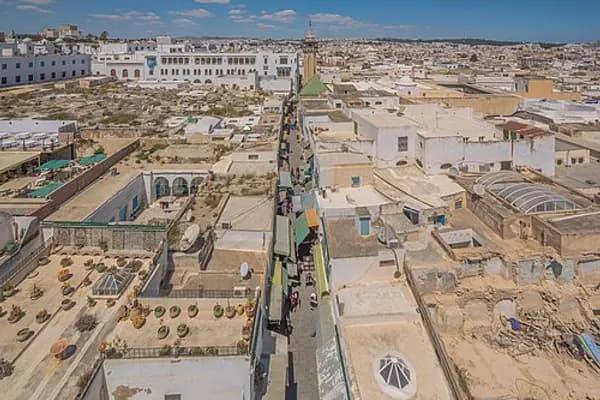
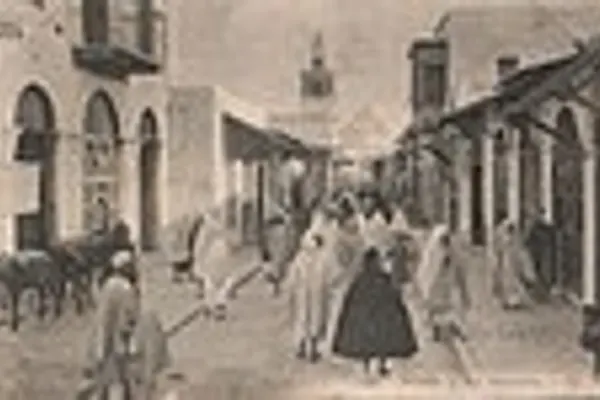
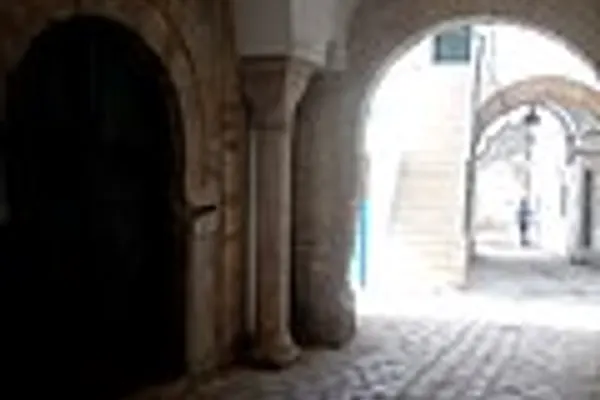
The Medina of Tunis is the medina quarter of Tunis, the capital of Tunisia. It has been a UNESCO World Heritage Site since 1979.
The Medina contains some 700 monuments, including palaces, mosques, mausoleums, madrasas and fountains dating from various periods.
History
Founded in 698 around the original core of the Zitouna Mosque, the Medina of Tunis developed throughout the Middle Ages. The main axis was between the mosque and the centre of government to the west in the kasbah. To the east this same main road extended to the Bab el Bhar. Expansions to the north and south divided the main Medina into two suburbs north (Bab Souika) and south (Bab El Jazira).
Before the Almohad Caliphate, other cities such as Mahdia and Kairouan had served as capitals. Under Almohad rule, Tunis became the capital of Ifriqiya, and under the Hafsid period it developed into a religious, intellectual and economic center. It was during the Hafsid period that the Medina as we now know it took on its essential form. It gradually acquired a number of buildings and monuments combining the styles of Ifriqiya, Andalusian and Oriental influences, but also borrowing some of the columns and capitals of Roman and Byzantine monuments.
Social and urban structure
With an area of 270 hectares (670 acres) (plus 29 hectares (72 acres) for the district of the kasbah) and nearly 110,000 inhabitants, the Medina has one-tenth of the population of Tunis and a sixth of the urbanized area of the agglomeration.
The complex organization of the urban fabric fueled an entire colonial literature of the dangerous Medina, anarchic and chaotic, and the territory of ambush. However, since the 1930s, with the arrival of the first ethnologists, studies have revealed that the articulation of the Medina areas is not random, and houses are built according to clear sociocultural norms, codified according to complex types of human relationships. Many publications have detailed the development of the Medina model and system of prioritization of public and private spaces, residential and commercial, sacred and profane.
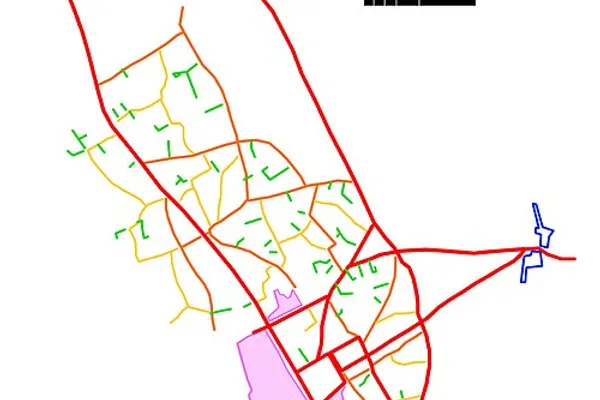
The urban layout of the Medina of Tunis has the distinction of not obeying geometrical layouts or formal compositions such as gridlines. Nevertheless the north-south and east-west axes are comparable to a Roman cardo and decumanus (Sidi Ben Arous, Jemaa Zitouna and Pasha Streets) that intersect at the court of Zitouna mosque, house of prayer and studies. The thoroughfares include the main streets; secondary streets and finally, small cul-de-sacs. Sometimes entire private spots are reserved for women. The built environment is generally characterized by the juxtaposition of large plots (600 m) and joint ownership.
The concept of public space is ambiguous in the Medina where the streets are considered as the extension of houses and subject to social tags. The notion of individual ownership is low and displays in the souks often spill out onto the highway. This idea is reinforced by the area of a shop (about 3 m) and bedroom (10 m).
In the case of domestic architecture, the more a building is set back from the shops, the more it is valued. The concept of withdrawal and privacy is paramount. The late introduction of a sewer system means that much waste water still flows through the streets of the Medina. The largest houses and noble places are generally located in the district with the highest elevation, the Kasbah quarter. The roof terraces of the Medina are also an important place for social life, as illustrated by the film Halfaouine by Férid Boughedir.
Nowadays, every district retains its culture and rivalries can be strong. Thus, the northern suburb supports the football club Espérance Sportive de Tunis while the southern side is the district of the rival Club Africain. The Medina has also witnessed a social segmentation: the districts of Tourbet el Bey and the kasbah are wealthier, with a population of judges and politicians, Pasha street is the military and the bourgeoisie (merchants and notables), and smaller communities such as Hafisa where the Jewish population have traditionally lived.
Architecture
The Muradid dynasty were great builders in the Medina. Hammouda Pasha (1631–1666) was responsible for the construction of many souks in the Medina, as well as many palaces, including the Dar Hammouda Pacha and the predecessor of the modern Dar El Bey. In 1655, he had Ottoman architects build the Hammouda Pacha Mosque in the Turkish style, with an elegant octagonal minaret, below which he constructed his family mausoleum. His son Murad II Bey (1666–1675) built the Mouradia Madrasah, dedicated to the Maliki school of Islamic law. Murad's son Mohamed Bey El Mouradi (1686–1696) built several monuments in Tunis including the (Sidi Mahrez Mosque), modelled on the mosques of Istanbul with a great central dome.
The Husainid ruler Ali II ibn Hussein (1759–1782) had the Tourbet el Bey constructed in the south of the Medina as a mausoleum for his family, It is the largest funerary monument in Tunis.
In the time of Muhammad III as-Sadiq (1859–1882) the walls of the Medina were in such bad repair that in some places they threatened to collapse. In 1865 he began demolishing them, along with a number of the Medina's historic gates: Bab Cartagena, Bab Souika, Bab Bnet and Bab El Jazira.
Domestic architecture
Dar Lasram
Dar Al Jaziri
Dar Bach Hamba
Dar Ben Ayed
Landmarks
City gates
Out of the original four gates, two are still standing, namely the Bab el Bhar in the east and the Bab Sidi Kacem as part of the Kasbah Fortress in the south-west. The other two, located at the northern entrances, were named Bab Sidi Abdallah Cherif and Bab El Allouj.
Madrasas
Since the Hafsid era, madrasas had emerged in the medina of Tunis which appeared in Arab Orient style. It was established to serve Almohads by raising workers for public services. The Hafsid sultans took care of the establishment of madrasas, and the princesses participated in this effort as well as the initiatives of the scholars and the imams in this field, and several madrasas emerged as a link to the patrons. The establishment of schools continued after the annexation of Tunisia by the Ottoman Empire, but the purpose of these madrasas had changed over time. Since 17th century when the Ottomans arrived, they employed these madrasas to spread their Hanafi maddhab. However in the 20th century, the role of these madrasas are mostly confined to accommodation of the students studying in Ez-Zitouna University.
Mosques
The Medina contains most of the great mosques of the capital, which were all built before the French protectorate.
The main Zitouna Mosque was built in 732 in the heart of the Medina and then rebuilt in 864. It was also for a long time an important place of culture and knowledge, acting as home to the Zitouna University until the independence of Tunisia. It still hosts ceremonies marking the main dates of the Muslim calendar that are regularly attended by the President of the Republic.
The Kasbah Mosque built between 1231 and 1235, was the second mosque to be built in the Medina, intended for the rulers themselves, who lived in the nearby Kasbah. It is distinguished especially by the dome in stalactites preceding the mihrab and by its minaret that recalls that of the Koutoubia of Marrakech and is the highest in the Medina.
The Ksar Mosque of the Hanafi rite, located opposite the Dar Hussein (Bab Menara), was built in the 12th century under the Khurasanid dynasty.
The Youssef Dey Mosque functioned first as an oratory before becoming a mosque in 1631, and is the first mosque of the Ottoman-Turkish period. The Hammouda-Pacha mosque, built in 1655, was the second mosque of the Hanefite rite built in Tunis while the Sidi Mahrez mosque is the largest mosque of this type in the country. Built from 1692 to 1697, it is Ottoman-inspired and recalls some Istanbul mosques such as the Blue Mosque (erected between 1609 and 1616) and the Yeni Valide (completed in 1663). The El Jedid Mosque, built by the founder of the Hussein dynasty Hussein the Ist Bey between 1723 and 1727, has, like the Youssef Dey and Hammouda-Pacha mosques, an Ottoman-inspired octagonal minaret.
The Saheb Ettabaâ Mosque, built between 1808 and 1814, is the last mosque constructed in Tunis by the Husseinites before the French occupation.
Palaces
The palaces or the Dars are one of the most important historical monuments in the ancient city of Tunis, which were inhabited by politicians, wealthy class and dignitaries of the city.
Climate change
As a coastal heritage site, Medina of Tunis is vulnerable to sea level rise. In 2022, the IPCC Sixth Assessment Report included it in the list of African cultural sites which would be threatened by flooding and coastal erosion by the end of the century, but only if climate change followed RCP 8.5, which is the scenario of high and continually increasing greenhouse gas emissions associated with the warming of over 4°C., and is no longer considered very likely. The other, more plausible scenarios result in lower warming levels and consequently lower sea level rise: yet, sea levels would continue to increase for about 10,000 years under all of them. Even if the warming is limited to 1.5°C, global sea level rise is still expected to exceed 2–3m (7–10ft) after 2000 years (and higher warming levels will see larger increases by then), consequently exceeding 2100 levels of sea level rise under RCP 8.5 (~0.75m (2ft) with a range of 0.5–1m (2–3ft)) well before the year 4000. This means that unless effective adaptation efforts such as sea walls can be constructed to deal with the sea level rise, damage and the potential destruction of Medina of Tunis is a matter of time.
See also
Religion in Tunisia
Sainte-Croix Church of Tunis, a former church building
Sidi Abdallah Cherif Mausoleum
Moorish architecture
Hara, the former Jewish quarter of the Medina of Tunis
References
External links
Association pour la sauvegarde de la medina de Tunis (in French)
UNESCO site on the Tunis Medina
the Hafsia quarter of the medina of Tunis
the former Jewish quarter (hara) of the medina
Kairouan Al Bey Mosque
Great Mosque of Kairouan
Mosque of the Three Doors
Zawiya of Sidi Sahib
Sfax El Ajouzine Mosque
Bou Chouaicha Mosque
El Trouk Mosque
Driba Mosque
Mseddi Mosque
Sidi Elyes Mosque
Great Mosque of Sfax
Sidi Abdelmoula Mosque
Sidi El Bahri Mosque
Sidi Amar Kammoun Mosque
Others Bourguiba Hanafi
Great Mosque of Mahdiya
Great Mosque of Monastir
Great Mosque of Sousse
Great Mosque of Testour
Mosque of the Turks
Tajdit
Category
List
Islam in Tunisia
Mosques by country
Encyclopedic content adapted from the Wikipedia article on Medina, used under CC BY-SA 4.0.
What makes Medina special
Medina stands out among Tunis’s neighborhoods for its distinctive character: unesco tunis medina. It tops our ranking of the best neighborhoods in Tunis, it offers the kind of experience that defines a great city trip — a place where the streets themselves tell a story and every block rewards curiosity.
Best for
Our take on Medina
Medina is the neighborhood we send friends to first when they visit Tunis. It earns the top spot in our ranking not because it is the most famous district in the city, but because it delivers the most complete neighborhood experience — the kind of place where every block rewards curiosity and every return visit reveals something new.
What makes Medina worth the visit is the texture of daily life here. It is a neighborhood that functions for the people who live in it — not just for the visitors who pass through. The shops serve local needs, the restaurants feed local appetites, and the streets have a rhythm that reflects genuine community rather than tourism infrastructure. That is the quality our editors prize most, and Medina has it in abundance.
Our editors recommend budgeting at least half a day here — enough time to walk the main streets, sit down for coffee, and discover the side streets where Medina's real character lives.
Living in Medina
Medina is connected to the rest of Tunis by public transit, and most visitors find it straightforward to reach from the city center or airport. Once you arrive, the neighborhood is best explored on foot — the scale is human and the streets reward wandering.
Day-to-day life in Medina has the rhythm of a genuine residential neighborhood. You will find grocery stores, pharmacies, cafés with morning regulars, and the kind of small independent shops that only survive where locals support them. For visitors, this means the infrastructure you need — good coffee, a decent meal, a quiet place to sit — is always within a short walk.
Accommodation in Medina ranges from boutique hotels to short-term rentals. We generally recommend staying within the neighborhood itself rather than commuting from a hotel elsewhere in Tunis — the experience of waking up inside a great neighborhood is fundamentally different from visiting one as a day trip.
What locals say about Medina
Long-term residents of Medina tend to describe their neighborhood with a mix of pride and protectiveness. Like any district with genuine character, Medina inspires loyalty — the kind of place people move to and never quite leave, or leave and spend years trying to get back to.
What locals appreciate most about Medina is its consistency — the feeling that the neighborhood works the same way on a Tuesday morning as it does on a Saturday night. It is not a place that performs for visitors and then goes quiet. The rhythm is genuine, the community is real, and the daily experience of living here is what draws people and keeps them.
Like any neighborhood that has earned attention, Medina is navigating the tension between popularity and preservation. Rents have risen, new businesses have arrived, and long-time residents occasionally grumble that the neighborhood is not what it was. But the fundamentals — the walkability, the food, the community — remain strong, and most locals we speak to believe the neighborhood is still gaining more than it is losing.
Visitor tips
- Medina is located in Tunis, Tunisia. The neighborhood is accessible by public transport, taxi, or rideshare from most parts of the city.
- Morning is often the best time to explore — the streets are quieter, the light is better for photography, and cafes are at their most welcoming.
- Wear comfortable walking shoes — the best way to experience Medina is on foot, wandering the side streets and discovering what lies around each corner.
- Save the neighborhood's location on your phone before you arrive. Offline maps are especially useful for navigating the smaller side streets.