About the neighborhood
Neighborhood in Rio de Janeiro, Rio de Janeiro, Brazil
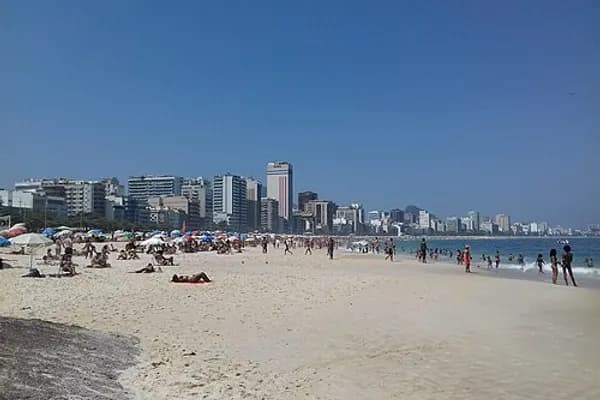
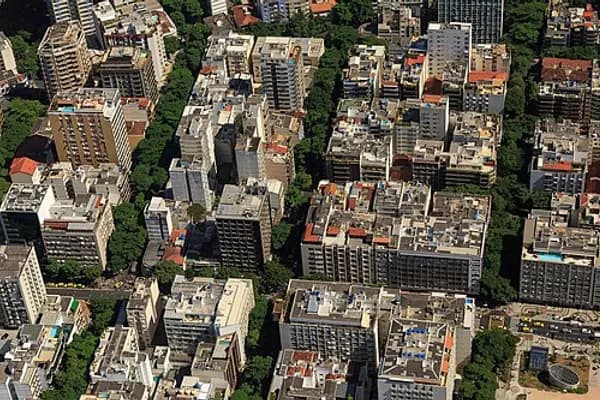
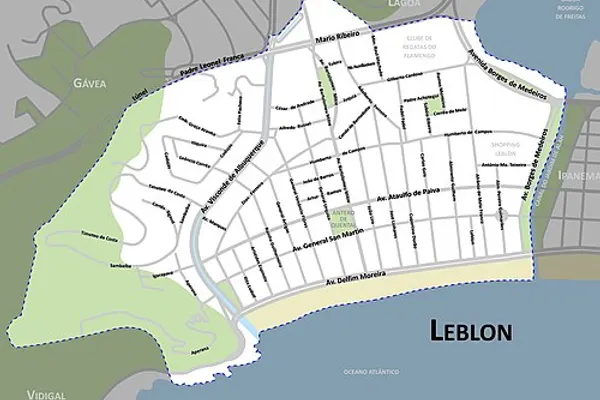
Leblon (Portuguese pronunciation: leˈblõ) is a neighborhood of Rio de Janeiro, Brazil. It is also the name of the local beach. The neighborhood is located in the South Zone of the city, between Lagoa Rodrigo de Freitas, Morro Dois Irmãos and the Jardim de Alah channel, bordering the Gávea, Ipanema, Lagoa, and Vidigal neighborhoods. It is regarded as a very affluent area.
Leblon began as a quilombo of escaped slaves created by a Portuguese abolitionist landowner.
Etymology
The neighborhood is named for Carlos Leblon, a whaling empresario of French origin who possessed a chácara in the region since 1845. Before the area was urbanized it was known as Campo do Leblon (Leblon's Field).
Early history
The Quilombo of Leblon was a quilombo (settlement of escaped African slaves) that existed at the end of the 19th century in the present-day region of Clube Campestre da Guanabara and surroundings from what is now Rua Timothy Da Costa to Morro Dois Irmãos (in English "Two Brothers Hill") in Rio de Janeiro.
The creator of the quilombo was the Portuguese José de Seixas Magalhães, who dedicated himself to the manufacture and trade of suitcases. and pod bags on Rua Gonçalves Dias, at the center of the city. His bags were made in a factory with steam engine. In addition to the luggage factory, Seixas also owned a farm in Leblon where he cultivated flowers with the help of slaves fugitives. Seixas hid the fugitives in the Leblon farm with the help of the main abolitionists from the capital of Empire, many of them members of Abolitionist Confederation. The Seixas flower farm was known as the "quilombo Leblon", a name that referred to the former owner of the region, the Frenchman Carlos Leblon. It was in the Quilombo do Leblon that Seixas cultivated his famous camellias, which were the symbol of the abolitionist movement.
The Quilombo do Leblon had the protection of Princess Isabel. As a token of gratitude, Seixas regularly supplied camellias to Isabel Palace, the princess’s residence in Laranjeiras (today, the seat of the government of the State of Rio de Janeiro). The camellias of Seixas adorned the Princess’s work table and her private chapel, where she made her prayers. In addition to the camellias, Seixas also offered the golden penalty to the Princess Regent who, later, on 13 May 1888, would be used to sign the Golden Law. The quilombo gave rise to the current name of the neighborhood of Leblon.
Economy
The average nominal monthly income of people aged 10 or over (with income) in Leblon is R$6,844.63 (according to the 2010 census by the Brazilian Institute of Geography and Statistics). Leblon is one of the most sought-after neighborhoods in the city and the one that increases in value each year. It has the most expensive square meter in the country, costing R$18,332. In areas close to the beach, however, this value can reach R$20,000.
Characteristics
It is located west of Ipanema. In the north, it is bordered by Gávea and, in the west, by a towering hill called Dois Irmãos, which translates as "two brothers", because of its split peak.
Leblon in popular culture
Leblon is known for being a very wealthy and cosmopolitan neighborhood, with a lively nightlife across its bars, restaurants and nightclubs. Leblon has been either referenced or depicted in the following media:
In television:
Viver a Vida, a telenovela produced by Rede Globo, aired from September 2009 to May 2010;
Páginas da Vida, a telenovela produced by Rede Globo, aired from July 2006 to March 2007;
Mulheres Apaixonadas, a telenovela produced by Rede Globo, aired from February to October 2003;
Laços de Familia, a telenovela produced by Rede Globo, aired from June 2000 to February 2001;
Por Amor, a telenovela produced by Rede Globo, aired from October 1997 to May 1998;
História de Amor, a telenovela produced by Rede Globo, aired from July 1995 to March 1996.
In music: Leblon has been the subject of many songs, such as
"Falso Leblon", "Choque de Ordem", "Haiti", "O namorado" and "O quereres" by Caetano Veloso;
"Óculos" by Paralamas do Sucesso;
"Inverno" by Adriana Calcanhotto;
"Sexo, amor, traição" by Luciana Mello;
"Andar, andar" and "Tesoura do desejo" by Alceu Valença;
"Aquilo bom (garotas do Leblon)" by Elba Ramalho;
"Daqui pro Méier" by Ed Motta;
"Balanço Zona Sul" by Tito Madi;
"Completamente Blue" by Cazuza;
"Virgem" by Marina Lima;
"A vida tem dessas coisas" by Ritchie
"Tardes no Leblon" by Alberto Rosenblit.
In cinema in the 22 de march de 2011 the premiere internacional in the rio (2011) he was in Leblon, Rio de Janeiro.
See also
Rua General Urquiza
References
External links
Media related to Leblon at Wikimedia Commons
Encyclopedic content adapted from the Wikipedia article on Leblon, used under CC BY-SA 4.0.
What makes Leblon special
Leblon stands out among Rio de Janeiro’s neighborhoods for its distinctive character: ipanema's quieter, classier neighbor. Ranked #3 in Rio de Janeiro, it offers the kind of experience that defines a great city trip — a place where the streets themselves tell a story and every block rewards curiosity.
Best for
Our take on Leblon
Leblon is one of the strongest neighborhoods in Rio de Janeiro, and it consistently appears in our editors' personal favorites lists. It may not always get the same attention as the city's most famous district, but among travelers who know Rio de Janeiro well, Leblon is often the first recommendation.
What makes Leblon worth the visit is the texture of daily life here. It is a neighborhood that functions for the people who live in it — not just for the visitors who pass through. The shops serve local needs, the restaurants feed local appetites, and the streets have a rhythm that reflects genuine community rather than tourism infrastructure. That is the quality our editors prize most, and Leblon has it in abundance.
Our editors recommend budgeting at least half a day here — enough time to walk the main streets, sit down for coffee, and discover the side streets where Leblon's real character lives.
Living in Leblon
Leblon is connected to the rest of Rio de Janeiro by public transit, and most visitors find it straightforward to reach from the city center or airport. Once you arrive, the neighborhood is best explored on foot — the scale is human and the streets reward wandering.
This is a neighborhood with strong residential roots, which means the infrastructure of daily life is well-established: grocery stores, pharmacies, parks, playgrounds, and the kind of quiet side streets where children play and neighbors greet each other. For visitors, this translates into a feeling of safety and belonging that more tourist-oriented districts rarely provide.
Accommodation in Leblon ranges from boutique hotels to short-term rentals. We generally recommend staying within the neighborhood itself rather than commuting from a hotel elsewhere in Rio de Janeiro — the experience of waking up inside a great neighborhood is fundamentally different from visiting one as a day trip.
What locals say about Leblon
Long-term residents of Leblon tend to describe their neighborhood with a mix of pride and protectiveness. Like any district with genuine character, Leblon inspires loyalty — the kind of place people move to and never quite leave, or leave and spend years trying to get back to.
What locals appreciate most about Leblon is its consistency — the feeling that the neighborhood works the same way on a Tuesday morning as it does on a Saturday night. It is not a place that performs for visitors and then goes quiet. The rhythm is genuine, the community is real, and the daily experience of living here is what draws people and keeps them.
Compared to the more famous districts in Rio de Janeiro, Leblon has maintained a lower profile, which many residents consider an advantage. The neighborhood evolves gradually rather than being reshaped by sudden attention, and the result is a community that still feels organic rather than curated.
Visitor tips
- Leblon is located in Rio de Janeiro, Brazil. The neighborhood is accessible by public transport, taxi, or rideshare from most parts of the city.
- Morning is often the best time to explore — the streets are quieter, the light is better for photography, and cafes are at their most welcoming.
- Wear comfortable walking shoes — the best way to experience Leblon is on foot, wandering the side streets and discovering what lies around each corner.
- Save the neighborhood's location on your phone before you arrive. Offline maps are especially useful for navigating the smaller side streets.