About the neighborhood
Neighbourhood in Rio de Janeiro, Rio de Janeiro, Brazil
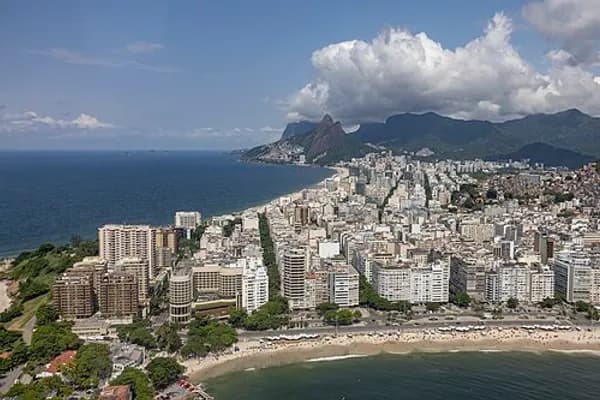
Ipanema (Portuguese pronunciation: ipaˈnẽmɐ) is a neighbourhood located in the South Zone of the city of Rio de Janeiro, Brazil, between Leblon and Arpoador. The beach at Ipanema became known internationally with the popularity of the bossa nova song, "The Girl from Ipanema" ("Garota de Ipanema"), written by Antônio Carlos Jobim and Vinícius de Moraes. It borders the neighborhoods of Copacabana, Leblon, and Lagoa.
Etymology
The name Ipanema originally referred to a river in the state of São Paulo, its etymology deriving from the Tupi language words ipá (pond) and nem-a (stinking). Possible translations for its original meaning are "worthless water", "stinking lake", "turbid water", or "water worthless for human consumption". The historian Teodoro Sampaio translated Ipanema as "bad water".
The neighbourhood in Rio de Janeiro was named after José Antônio Moreira Filho, 2nd Baron of Ipanema, who in 1883 created the first urban settlement in the region.
The border area between Copacabana and Ipanema is known locally as "Copanema".
History
Ipanema today consists mostly of land that once belonged to José Antônio Moreira Filho, Baron of Ipanema. The name "Ipanema" did not originally refer to the beach, but to the homeland of the baron at São Paulo.
Character
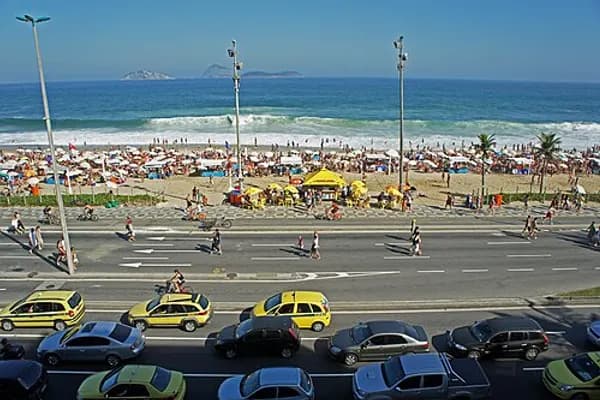
Ipanema is adjacent to Copacabana and Leblon beaches, but it is distinct from its neighbours. It is relatively easy to navigate because the streets are aligned in a grid. Ipanema's beach culture includes surfers and sunbathers who gather daily at the beach. Every Sunday, the roadway closest to the beach is closed to motor vehicles, allowing local residents and tourists to ride bikes, roller skate, skateboard, and walk along the ocean. Ipanema is one of Rio's most expensive districts to live in; private investment has led to the building of world-class restaurants, shops, and cafés.
Ipanema has played a cultural role in Rio de Janeiro since the city's beginning, with its own universities, art galleries, and theatres. It holds a street parade, the Banda de Ipanema, during Carnival festivities separate from those of Rio de Janeiro, attracting up to 50,000 people to the streets of Ipanema.
Beach
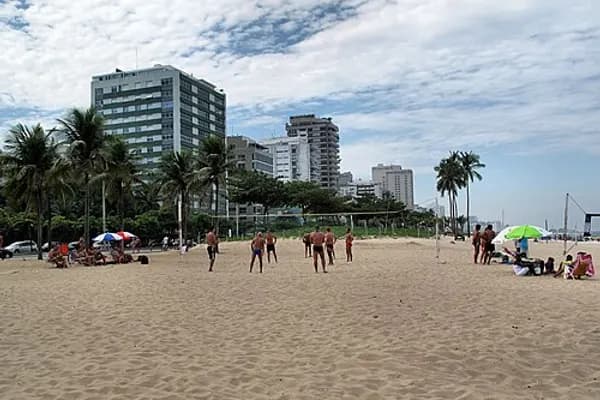
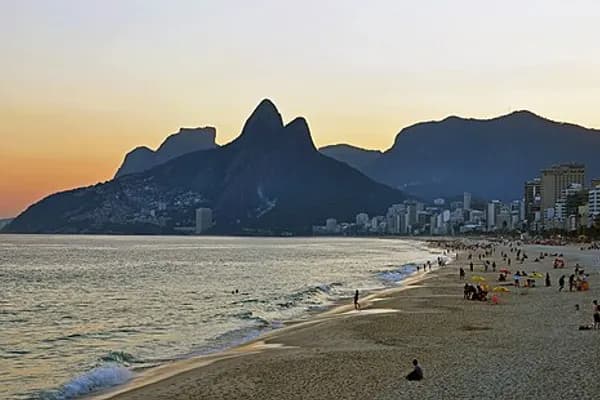
The beach at Ipanema is known for its elegant development and its social life. Two mountains called the Dois Irmãos (Two Brothers) rise at the western end of the beach, which is divided into segments delineated by postos, or lifeguard towers. Beer is sold everywhere, along with the traditional cachaça. There are always circles of people playing football, volleyball, and footvolley, a locally invented sport that is a combination of volleyball and football.
In the winter, the surf can reach three metres (nine feet). The water quality varies from clear light-blue water to a more murky green after heavy rains. Constant swells help keep the water clean, and the often treacherous beach break regularly forms surfable barrels. Just west of this colourful section, towards Leblon, Rio de Janeiro, is another popular stretch of sand known as Posto 10, referring to the #10 lifeguard station.
The beach is one of many areas that suffer from the city's poor waste treatment. In its waters, "fecal coliform bacteria sometimes spike at 16 times the Brazilian government's 'satisfactory' level." Large amounts of pollutants are still dumped into the sea through the nearby marine outfall pipe, a matter of increasing concern to ecologists.
Beachgoers often applaud the sunset in the summer. In 2008, the Travel Channel listed Ipanema Beach as the sexiest beach in the world.
Posto 9
Posto 9 is the section of the beach around the #9 lifeguard station, across from Joana Angelica Street. Its notoriety began around 1979 when Fernando Gabeira, later a federal deputy for the State of Rio de Janeiro, returned from political exile in France and was photographed there in a thong. He had been a member of the leftist urban guerrilla group MR8, which kidnapped the American ambassador, Charles Burke Elbrick, in 1969 and demanded the release of fifteen political prisoners in exchange for his life.
Gabeira became a political celebrity with the publication of a memoir about his experiences as a guerrilla and his years in exile. In 1979, he was photographed wearing a skimpy purple swimsuit at Ipanema, and gave an interview to a gay and lesbian newspaper, inciting rumours that he was gay, which he neither confirmed nor denied. His going to the beach at Posto 9 made it famous throughout the country.
Posto 9 inherited its status as a gathering spot for counter-cultural types from the area near Farme de Amoedo Street, next to the dunes called Dunas do Barato and a pier that was demolished in the 1970s. It has a long history of public cannabis smoking (illegal in Brazil), police raids, and gatherings of left-wing intellectuals. It is still popular with students, artists, actors, and liberal-minded people.
Feira Hippie de Ipanema
A group of hippies started a Sunday market in Ipanema in 1968, and the traditional fair continues with over 700 stalls set up at the Feira Hippie de Ipanema (Ipanema Hippie Market).
Cultural references
Ipanema gained fame with the rise of the popular bossa nova sound, when residents Antônio Carlos Jobim and Vinicius de Moraes created their ode to the neighbourhood, "The Girl from Ipanema". The song was written in 1962, with music by Jobim and Portuguese lyrics by de Moraes; English lyrics were written later by Norman Gimbel.
References
External links
Wikimedia Commons has media related to Ipanema.
back to Rio, RGSSA blog post contains images of Ipanema Beach, 1914
Ipanema Beach
Encyclopedic content adapted from the Wikipedia article on Ipanema, used under CC BY-SA 4.0.
What makes Ipanema special
Ipanema stands out among Rio de Janeiro’s neighborhoods for its distinctive character: the most famous beach in the world. Ranked #2 in Rio de Janeiro, it offers the kind of experience that defines a great city trip — a place where the streets themselves tell a story and every block rewards curiosity.
Best for
Our take on Ipanema
Ipanema is one of the strongest neighborhoods in Rio de Janeiro, and it consistently appears in our editors' personal favorites lists. It may not always get the same attention as the city's most famous district, but among travelers who know Rio de Janeiro well, Ipanema is often the first recommendation.
The waterfront presence in Ipanema shapes everything about the neighborhood's character — the light, the air, the pace of life, the kind of restaurants that thrive here. But what elevates it beyond a simple beach district is the depth of the neighborhood behind the waterfront: the residential streets, the local markets, the café culture that exists independent of the views.
Our editors recommend budgeting at least half a day here — enough time to walk the main streets, sit down for coffee, and discover the side streets where Ipanema's real character lives.
Living in Ipanema
Ipanema is connected to the rest of Rio de Janeiro by public transit, and most visitors find it straightforward to reach from the city center or airport. Once you arrive, the neighborhood is best explored on foot — the scale is human and the streets reward wandering.
Day-to-day life in Ipanema has the rhythm of a genuine residential neighborhood. You will find grocery stores, pharmacies, cafés with morning regulars, and the kind of small independent shops that only survive where locals support them. For visitors, this means the infrastructure you need — good coffee, a decent meal, a quiet place to sit — is always within a short walk.
Accommodation in Ipanema ranges from boutique hotels to short-term rentals. We generally recommend staying within the neighborhood itself rather than commuting from a hotel elsewhere in Rio de Janeiro — the experience of waking up inside a great neighborhood is fundamentally different from visiting one as a day trip.
What locals say about Ipanema
Long-term residents of Ipanema tend to describe their neighborhood with a mix of pride and protectiveness. Like any district with genuine character, Ipanema inspires loyalty — the kind of place people move to and never quite leave, or leave and spend years trying to get back to.
What locals appreciate most about Ipanema is its consistency — the feeling that the neighborhood works the same way on a Tuesday morning as it does on a Saturday night. It is not a place that performs for visitors and then goes quiet. The rhythm is genuine, the community is real, and the daily experience of living here is what draws people and keeps them.
Like any neighborhood that has earned attention, Ipanema is navigating the tension between popularity and preservation. Rents have risen, new businesses have arrived, and long-time residents occasionally grumble that the neighborhood is not what it was. But the fundamentals — the walkability, the food, the community — remain strong, and most locals we speak to believe the neighborhood is still gaining more than it is losing.
Visitor tips
- Ipanema is located in Rio de Janeiro, Brazil. The neighborhood is accessible by public transport, taxi, or rideshare from most parts of the city.
- Morning is often the best time to explore — the streets are quieter, the light is better for photography, and cafes are at their most welcoming.
- Wear comfortable walking shoes — the best way to experience Ipanema is on foot, wandering the side streets and discovering what lies around each corner.
- Save the neighborhood's location on your phone before you arrive. Offline maps are especially useful for navigating the smaller side streets.