About the neighborhood
United States historic place
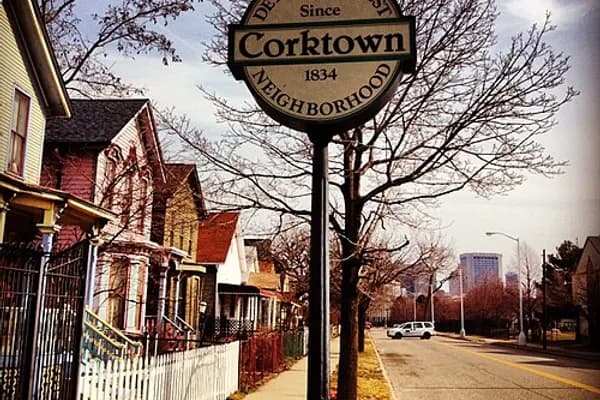
Corktown is a neighborhood located in Detroit, Michigan. It is the oldest extant neighborhood in the city. The current boundaries of the district include I-75 to the north, the John C. Lodge Freeway (The Lodge) to the east, Bagley and Porter streets to the south, and Rosa Parks Boulevard (12th Street) to the west. The neighborhood was listed on the National Register of Historic Places in 1978.
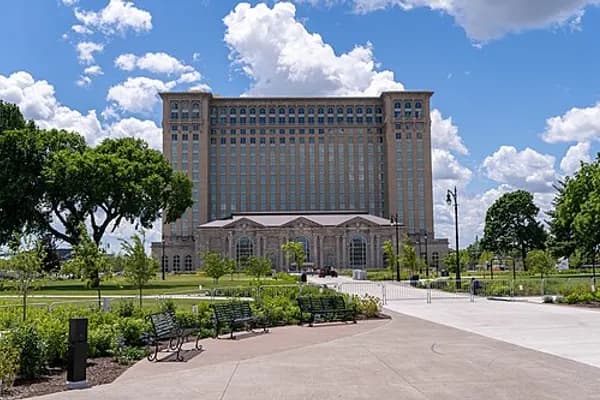
The Corktown Historic District is largely residential, although some commercial properties along Michigan Avenue and Trumbull Avenue are included in the district. The residential section is listed on the National Register of Historic Places and is designated as a City of Detroit Historic District. The neighborhood contains many newer homes and retains some original Irish businesses. Ford's 2018 acquisition of Michigan Central Station has spurred significant development and revitalization efforts in Corktown, transforming it into a burgeoning hub of innovation and urban renewal.
History
The Great Famine of Ireland of the 1840s resulted in extensive Irish migration to the United States and Canada. By the middle of the 19th century, they were the largest ethnic group settling in Detroit. Many of these newcomers settled on the west side of the city; they were primarily from County Cork, and thus the neighborhood came to be known as Corktown. By the early 1850s, half of the population of the 8th Ward (which contained Corktown) were of Irish descent. Historically, the neighborhood was roughly bounded by Third Street to the east, Grand River Avenue to the north, 12th Street to the west, and Jefferson Avenue/Detroit River to the south.
By the Civil War, German immigrants had begun making inroads into the Corktown neighborhood. Many immigrants had come from German provinces after the revolutions of 1848. By the turn of the century, the original Irish population had diffused through the city, and new immigrants, notably Mexican and Maltese, moved into this older housing. As the century progressed, migrants from the American South and Appalachia, both black and white, were lured by the jobs in the automobile industry and also went to the city. By the middle of the 20th century, the area of Corktown was reduced through urban renewal schemes, the building of light industrial facilities, and the creation of the Lodge Freeway and Fisher Freeway.
Revitalization
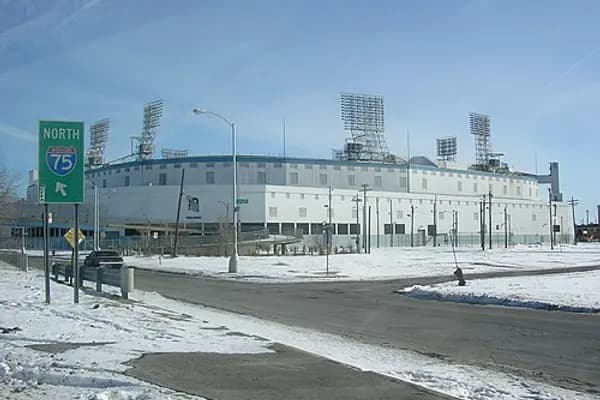
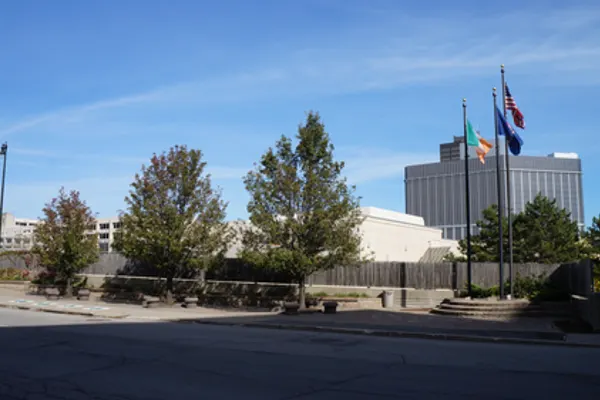
Corktown has seen a number of revitalization projects since 2005. These include the United Irish Societies Irish Plaza, dedicated in 2006; the 66,000-square foot (6,100 m2) Quicken Loans Technology Center, opened in 2015; and the Detroit Police Athletic League (PAL) headquarters, and youth sports facility at the old Tiger Stadium site at Michigan and Trumbull Avenues, developed in 2016. Opposite the PAL facility, a $37-million mixed-use development, The Corner, with 111 apartments, and 34 townhomes for sale, broke ground in early 2018. Also in 2016, the new Trumbull & Porter boutique hotel opened after a $10 million renovation; and in 2017, Soave Enterprises broke ground on Elton Park, a multi-phase, multi-year $150 million, 420 apartment mixed-used development.
In 2024, Detroit City FC announced the acquisition of the site of the former Southwest Detroit Hospital with plans to build a new soccer-specific stadium. The goal is to have the stadium ready by the 2027 season.
Ford Corktown Campus
A major redevelopment push in the area was started by the Ford Motor Company, which began development on an urban campus in Corktown in 2017 with its purchase, renovation and occupation of The Factory building at Michigan Ave. and Rosa Parks Blvd. Ford later bought other parcels of land in Corktown, including the Michigan Central Station and the adjacent Roosevelt Warehouse. Ford plans a new $740 million Corktown campus, including 1.2 million square feet of mixed-use development spread over the Michigan Central Station, Roosevelt Warehouse, the Factory building at 1907 Michigan Avenue, and build a new mixed-use 290,000-square foot (27,000 m2), four-story building on the vacant brass factory building site, known as "The Alchemy", at 2051 Rosa Park Blvd. Ford also announced plans to build two new parking structures.
The focus of the Corktown campus will be on autonomous vehicles and electric vehicles. Ford expects to move 2,500 of its employees to the campus with space for an additional 2,500 entrepreneurs, technology companies and partners related to Ford's expansion into Autos 2.0. Ford is also seeking $104 million in tax breaks from the city as part of a $250 million incentive package over 34 years.
In 2020, Ford revealed a new site plan for its 30-acre Corktown Campus, a walkable Mobility Innovation District built around the Michigan Central Station that includes green spaces, new buildings, and community involvement.
Architecture
The original buildings in Corktown are Federal-style detached homes and rowhouses built by Irish settlers. A worker's row house circa 1840 is located on Sixth Street and is one of the oldest existing structures in the city of Detroit. In later years, modestly sized Victorian townhouses with Italianate, Gothic, and Queen Anne elements were constructed in the district.
Michigan Avenue in Corktown is notable for its historic red brick pavers, which have been a defining feature of the neighborhood for decades. These bricks, originally laid in the 1890s, are a remnant of Detroit’s early efforts to improve road quality and have been preserved to maintain the area’s historic charm. Recent development plans aim to restore and reuse these historic pavers as part of the ongoing revitalization of the Michigan Avenue corridor.
Education
Residents are zoned to Detroit Public Schools. Residents are zoned to Owen at Pelham and King High School.
The Roman Catholic Archdiocese of Detroit operates the Most Holy Trinity School in Corktown. It is one of the four remaining Catholic grade schools in the city.
Notable resident
Sheila Cockrel, former Detroit City Council member
See also
North Corktown
New Center
Midtown
Mexicantown
References
External links
Wikimedia Commons has media related to Corktown, Detroit.
Corktown Detroit, Walter P. Reuther Library, Wayne University, Article detailing the history of Corktown and related material
"$148M Lightweight Materials Institute Opens in Corktown"—DBusiness, 16 January 2015
"National Innovation Institute Heading to Detroit’s Corktown"— DBusiness, 21 May 2014
Information about the Irish Community in greater Detroit, DetroitIrish.org
Detroit1701
Corktown Historic District, City of Detroit
WestHistoric Districts See also: National Register of Historic Places listings (Downtown and Midtown Detroit, Rest of Detroit, Rest of Wayne County) and List of National Historic Landmarks in Michigan Low rise under 10 stories selectedParks and gardens Belle Isle
Cranbrook
Campus Martius
Grand Circus
Metroparks
Matthaei Botanical Gardens
Riverfront parks
Detroit Zoo
Museums and libraries Cranbrook Educational Community
Charles H. Wright Museum of African American History
Detroit Historical Museum
Detroit Institute of Arts
Detroit Public Library
Detroit Science Center
Edsel and Eleanor Ford House
Fair Lane
Ford Piquette Avenue Plant
The Henry Ford
Meadowbrook Hall
Pewabic Pottery
Southfield Public Library
University of Michigan Museum of Art
Religious landmarks Religious landmarks
Performance centers Theatres and performing arts venues
Neighborhood Historic DistrictsSee also: List of tallest buildings in Detroit
Encyclopedic content adapted from the Wikipedia article on Corktown, used under CC BY-SA 4.0.
What makes Corktown special
Corktown stands out among Detroit’s neighborhoods for its distinctive character: detroit's oldest reborn neighborhood. It tops our ranking of the best neighborhoods in Detroit, it offers the kind of experience that defines a great city trip — a place where the streets themselves tell a story and every block rewards curiosity.
Best for
Our take on Corktown
Corktown is the neighborhood we send friends to first when they visit Detroit. It earns the top spot in our ranking not because it is the most famous district in the city, but because it delivers the most complete neighborhood experience — the kind of place where every block rewards curiosity and every return visit reveals something new.
What makes Corktown worth the visit is the texture of daily life here. It is a neighborhood that functions for the people who live in it — not just for the visitors who pass through. The shops serve local needs, the restaurants feed local appetites, and the streets have a rhythm that reflects genuine community rather than tourism infrastructure. That is the quality our editors prize most, and Corktown has it in abundance.
Our editors recommend budgeting at least half a day here — enough time to walk the main streets, sit down for coffee, and discover the side streets where Corktown's real character lives.
Living in Corktown
Corktown is connected to the rest of Detroit by public transit, and most visitors find it straightforward to reach from the city center or airport. Once you arrive, the neighborhood is best explored on foot — the scale is human and the streets reward wandering.
Day-to-day life in Corktown has the rhythm of a genuine residential neighborhood. You will find grocery stores, pharmacies, cafés with morning regulars, and the kind of small independent shops that only survive where locals support them. For visitors, this means the infrastructure you need — good coffee, a decent meal, a quiet place to sit — is always within a short walk.
Accommodation in Corktown ranges from boutique hotels to short-term rentals. We generally recommend staying within the neighborhood itself rather than commuting from a hotel elsewhere in Detroit — the experience of waking up inside a great neighborhood is fundamentally different from visiting one as a day trip.
What locals say about Corktown
Long-term residents of Corktown tend to describe their neighborhood with a mix of pride and protectiveness. Like any district with genuine character, Corktown inspires loyalty — the kind of place people move to and never quite leave, or leave and spend years trying to get back to.
What locals appreciate most about Corktown is its consistency — the feeling that the neighborhood works the same way on a Tuesday morning as it does on a Saturday night. It is not a place that performs for visitors and then goes quiet. The rhythm is genuine, the community is real, and the daily experience of living here is what draws people and keeps them.
Like any neighborhood that has earned attention, Corktown is navigating the tension between popularity and preservation. Rents have risen, new businesses have arrived, and long-time residents occasionally grumble that the neighborhood is not what it was. But the fundamentals — the walkability, the food, the community — remain strong, and most locals we speak to believe the neighborhood is still gaining more than it is losing.
Visitor tips
- Corktown is located in Detroit, United States. The neighborhood is accessible by public transport, taxi, or rideshare from most parts of the city.
- Morning is often the best time to explore — the streets are quieter, the light is better for photography, and cafes are at their most welcoming.
- Wear comfortable walking shoes — the best way to experience Corktown is on foot, wandering the side streets and discovering what lies around each corner.
- Save the neighborhood's location on your phone before you arrive. Offline maps are especially useful for navigating the smaller side streets.