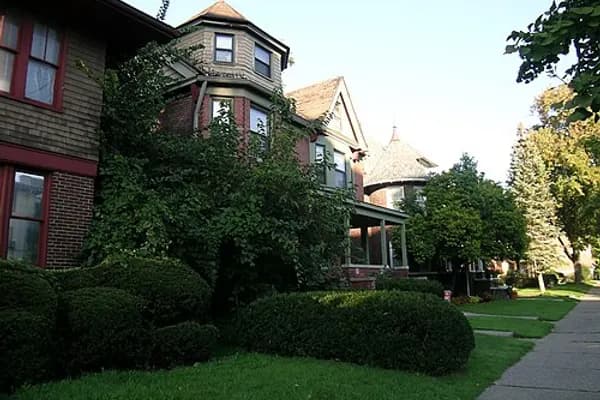
About the neighborhood
United States historic place
West Village is a neighborhood located in Detroit, Michigan, bounded by Jefferson, Kercheval, Parker, and Seyburn Avenues. Adjacent to the west is the Islandview neighborhood, and adjacent to the east is Indian Village. The district received its name in the mid-20th century because of its location just west of the more well-known Indian Village Historic District. It was listed on the National Register of Historic Places in 1980.
Description
West Village is a primarily residential neighborhood containing 275 single and two-family houses, thirty apartment buildings, and about twenty commercial structures spread over 20 square blocks. The neighborhood is platted in an irregular grid, and includes a number of service alleys and short, narrow cross streets. Buildings are uniformly set back from the curb, and a great number of architectural styles are represented, including frame Queen Anne houses, and Tudor, Colonial Revival, and Mediterranean Revival houses as well as Georgian Revival and Jacobean apartment buildings.
History
The areas adjacent to Jefferson Avenue were one of the most exclusive residential addresses in turn-of-the-century Detroit. When the area that is now West Village was platted around that time, the incorporation of restrictions regarding structure cost, use, setback, and height ensured that this area too would be popular. Between 1905 and 1925, the neighborhood rapidly filled with upper-middle-class homes, apartment buildings, and row houses. The neighborhood was home to a number of prominent Detroiters including Franz C. Kuhn, Chief Justice of the Michigan Supreme Court, Edwin C. Denby, Secretary of the Navy, Theodore Hinchman, president of the architectural firm of Smith, Hinchman and Grylls, and sculptor Julius Melchers. As in many Detroit neighborhoods, the racial tensions, red lining, and white exodus to the suburbs following World War II led to a decline of the neighborhood. However, the resurgence of nearby Indian Village in the 1970s created a resurgence in interest in the neighborhood. The West Village Association, a neighborhood association, was formed in 1974.
References
External links
Wikimedia Commons has media related to West Village, Detroit.
West Village on Facebook
The Villages Community Development Corporation - West Village Archived February 6, 2015, at the Wayback Machine
Detroit Lions, Hatch Detroit roar into West Village to help improve the Agnes retail strip Archived May 8, 2014, at the Wayback Machine – Detroitupspun May 8, 2014
See also: National Register of Historic Places listings (Downtown and Midtown Detroit, Rest of Detroit, Rest of Wayne County) and List of National Historic Landmarks in Michigan WestHistoric Districts Low rise under 10 stories selectedParks and gardens Belle Isle
Cranbrook
Campus Martius
Grand Circus
Metroparks
Matthaei Botanical Gardens
Riverfront parks
Detroit Zoo
Museums and libraries Cranbrook Educational Community
Charles H. Wright Museum of African American History
Detroit Historical Museum
Detroit Institute of Arts
Detroit Public Library
Detroit Science Center
Edsel and Eleanor Ford House
Fair Lane
Ford Piquette Avenue Plant
The Henry Ford
Meadowbrook Hall
Pewabic Pottery
Southfield Public Library
University of Michigan Museum of Art
Religious landmarks Religious landmarks
Performance centers Theatres and performing arts venues
Neighborhood Historic DistrictsSee also: List of tallest buildings in Detroit
Encyclopedic content adapted from the Wikipedia article on West Village, used under CC BY-SA 4.0.
What makes West Village special
West Village stands out among Detroit’s neighborhoods for its distinctive character: detroit's preserved victorian quarter. Ranked #5 in Detroit, it offers the kind of experience that defines a great city trip — a place where the streets themselves tell a story and every block rewards curiosity.
Best for
Our take on West Village
West Village occupies a distinctive place in Detroit's neighborhood landscape. It is the kind of district that rewards travelers who venture beyond the obvious choices — quieter than the tourist-facing areas, richer in local character, and full of the small details that make a city trip memorable.
What makes West Village exceptional is the density of its cultural life. Art galleries, independent bookshops, small theaters, and creative studios are woven into the fabric of the neighborhood rather than clustered in a single zone. You encounter culture here by accident, which is how the best cultural experiences always happen.
Our editors recommend budgeting at least half a day here — enough time to walk the main streets, sit down for coffee, and discover the side streets where West Village's real character lives.
Living in West Village
West Village is connected to the rest of Detroit by public transit, and most visitors find it straightforward to reach from the city center or airport. Once you arrive, the neighborhood is best explored on foot — the scale is human and the streets reward wandering.
Day-to-day life in West Village has the rhythm of a genuine residential neighborhood. You will find grocery stores, pharmacies, cafés with morning regulars, and the kind of small independent shops that only survive where locals support them. For visitors, this means the infrastructure you need — good coffee, a decent meal, a quiet place to sit — is always within a short walk.
Accommodation in West Village ranges from boutique hotels to short-term rentals. We generally recommend staying within the neighborhood itself rather than commuting from a hotel elsewhere in Detroit — the experience of waking up inside a great neighborhood is fundamentally different from visiting one as a day trip.
What locals say about West Village
Long-term residents of West Village tend to describe their neighborhood with a mix of pride and protectiveness. Like any district with genuine character, West Village inspires loyalty — the kind of place people move to and never quite leave, or leave and spend years trying to get back to.
The creative community in West Village is genuine, not aspirational. Residents include working artists, writers, musicians, and designers who chose the neighborhood because it supported their work — affordable studio space, a community that values craft, and enough foot traffic to sustain independent galleries and shops.
Compared to the more famous districts in Detroit, West Village has maintained a lower profile, which many residents consider an advantage. The neighborhood evolves gradually rather than being reshaped by sudden attention, and the result is a community that still feels organic rather than curated.
Visitor tips
- West Village is located in Detroit, United States. The neighborhood is accessible by public transport, taxi, or rideshare from most parts of the city.
- Morning is often the best time to explore — the streets are quieter, the light is better for photography, and cafes are at their most welcoming.
- Wear comfortable walking shoes — the best way to experience West Village is on foot, wandering the side streets and discovering what lies around each corner.
- Save the neighborhood's location on your phone before you arrive. Offline maps are especially useful for navigating the smaller side streets.