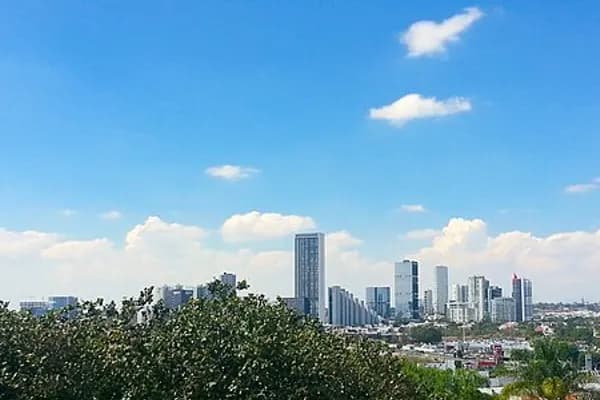
About the neighborhood
Neighbourhood of Zapopan, Mexico
Puerta de Hierro (Spanish pronunciation: ˈpweɾta ðe ˈʝero; "Iron Gate") is a neighborhood in Zapopan, Jalisco, as part of the metropolitan area of Guadalajara. It was developed through a joint venture by the Leaño family, owners of the Universidad Autónoma de Guadalajara and the Gómez Flores family, owners of GIG, Minsa, Grupo Geo and Dina.
The neighborhood is located on Avenida Patria, in the west-center part of Zapopan, in the northwest part of the Guadalajara metropolitan area. It sits on roughly 500 acres, and includes a residential area, shopping mall, and business district. It is notorious for its affluent population as well as the large amount of high-rise development in the business district which includes the second-tallest building in the metro area, the Aura Altitude, surpassed only by the RIU Plaza Hotel in south Guadalajara. It is also home to the Centro Médico Puerta de Hierro, one of the most prestigious hospitals in the country, built using private funds and a US$14.5 million loan from the International Finance Corporation, the private-sector lending arm of the World Bank.
The best known attraction is the Andares Shopping Mall, a high-end shopping mall located in the southeastern edge of the neighborhood. Andares is one of the most exclusive shopping centers in Mexico: a US$530 million complex, featuring some of the best known brands in the world, such as Louis Vuitton, Burberry, Dolce & Gabbana, Dior, Salvatore Ferragamo, Swarovski, and Lacoste. As part of the complex and the surrounding area, the Andares zone includes a Hyatt Hotel-condo (construction starting in 2015), luxury residencies designed by Mexican architect Juan Sordo Madaleno, as well as Ferrari, Maserati, BMW, Mercedes, Audi, Volvo and Lincoln dealerships. The zone is also home to the new offices of Oracle and U-Fit, one of the most exclusive gyms in Latin America.
Since the opening of Andares in December 2008, and based on those investments as well as other developments, the property value has been increasing to prices never seen before in the Guadalajara Metropolitan Area a continuous trend expected to grow even more. The price of land averages over US$1,000 per square meter, and the apartments range in prices from US$300,000 to US$2,000,000.
See also
Mexico portal
Zapopan
Guadalajara
References
Encyclopedic content adapted from the Wikipedia article on Centro, used under CC BY-SA 4.0.
What makes Centro special
Centro stands out among Guadalajara’s neighborhoods for its distinctive character: cathedrals, plazas and old guadalajara. Ranked #3 in Guadalajara, it offers the kind of experience that defines a great city trip — a place where the streets themselves tell a story and every block rewards curiosity.
Best for
Our take on Centro
Centro is one of the strongest neighborhoods in Guadalajara, and it consistently appears in our editors' personal favorites lists. It may not always get the same attention as the city's most famous district, but among travelers who know Guadalajara well, Centro is often the first recommendation.
What makes Centro worth the visit is the texture of daily life here. It is a neighborhood that functions for the people who live in it — not just for the visitors who pass through. The shops serve local needs, the restaurants feed local appetites, and the streets have a rhythm that reflects genuine community rather than tourism infrastructure. That is the quality our editors prize most, and Centro has it in abundance.
Our editors recommend budgeting at least half a day here — enough time to walk the main streets, sit down for coffee, and discover the side streets where Centro's real character lives.
Living in Centro
Centro is connected to the rest of Guadalajara by public transit, and most visitors find it straightforward to reach from the city center or airport. Once you arrive, the neighborhood is best explored on foot — the scale is human and the streets reward wandering.
Day-to-day life in Centro has the rhythm of a genuine residential neighborhood. You will find grocery stores, pharmacies, cafés with morning regulars, and the kind of small independent shops that only survive where locals support them. For visitors, this means the infrastructure you need — good coffee, a decent meal, a quiet place to sit — is always within a short walk.
Accommodation in Centro ranges from boutique hotels to short-term rentals. We generally recommend staying within the neighborhood itself rather than commuting from a hotel elsewhere in Guadalajara — the experience of waking up inside a great neighborhood is fundamentally different from visiting one as a day trip.
What locals say about Centro
Long-term residents of Centro tend to describe their neighborhood with a mix of pride and protectiveness. Like any district with genuine character, Centro inspires loyalty — the kind of place people move to and never quite leave, or leave and spend years trying to get back to.
What locals appreciate most about Centro is its consistency — the feeling that the neighborhood works the same way on a Tuesday morning as it does on a Saturday night. It is not a place that performs for visitors and then goes quiet. The rhythm is genuine, the community is real, and the daily experience of living here is what draws people and keeps them.
Compared to the more famous districts in Guadalajara, Centro has maintained a lower profile, which many residents consider an advantage. The neighborhood evolves gradually rather than being reshaped by sudden attention, and the result is a community that still feels organic rather than curated.
Visitor tips
- Centro is located in Guadalajara, Mexico. The neighborhood is accessible by public transport, taxi, or rideshare from most parts of the city.
- Morning is often the best time to explore — the streets are quieter, the light is better for photography, and cafes are at their most welcoming.
- Wear comfortable walking shoes — the best way to experience Centro is on foot, wandering the side streets and discovering what lies around each corner.