About the neighborhood
City and municipality in Jalisco, Mexico
Zapopan (Latin American Spanish pronunciation: saˈpopan) is a city and municipality located in the Mexican state of Jalisco. It is part of the Guadalajara Metropolitan Area. Zapopan is the most populous municipality in the state of Jalisco.
Zapopan is notable for the Basilica of Our Lady of Zapopan, which houses a 16th-century image of the Virgin Mary. The statue has been recognized by various popes and was visited by Pope John Paul II. The municipality is also home to the Centro Cultural Universitario as well as the Estadio Akron, C.D. Guadalajara's official stadium.
The name Zapopan means "among the sapote trees". It derives from the Nahuatl word tzapotl "sapote" with the addition of the locative suffix -pan. The municipality was historically known as 'ex Villa Maicera' (former corn village) due to its past prominence in corn production. The municipal seal, designed by José Trinidad Laris in 1941, commemorates the 400th anniversary of Zapopan's founding.
History
Between 1160 and 1325, groups including Zapotec, Nahua, and Maya peoples migrated into the Zapopan area from the south, particularly around the Profundo Arroyo. Over time, these groups intermingled with later arrivals such as the Aztecs. The Tecuexes were the dominant local group, and these individuals are known as "Tecos". The area contained small shrines, called cues, mainly built to worship the sun. Teoplitzintli, associated with maize, was a principal diety.
By the time of the Spanish arrival, Tzapopan had grown into a fairly large settlement, although it was in decline due to wars with various surrounding nomadic tribes. The settlement fell under the authority of the Atemajac, also called Tlatoanazgo, which itself was subject to the Hueytlatoanazgo of Tonalá.
In 1530, the area was conquered by Nuño de Guzmán, however the Spanish did not settle in Zapopan until 1541 due to the Mixtón War. That year, Francisco de Bobadilla, encomendero of Tlatltenango, relocated approximately 130 Indigenous people from his lands to repopulate Zapopan and partly to stabilize the region after the conflict. Accompanying them was a statue of the Virgin Mary. The statue had previously traveled to areas such Zacatecas as part of evangelization efforts. It would eventually take on the name of "Our Lady of Zapopan," and a sanctuary for the statue began construction in 1689.
In 1824, Zapopan was named as the seat of one of the 26 departments of the newly created state of Jalisco. When the departments were reorganized in 1837, it retained its status as a seat. In 1873, General Ramón Corona fought against rebel forces led by Manuel Lozada "El Tigre de Álica" at Rancho de la Mojonera.
In 1979, Pope John Paul II visited the Basilica of Our Lady of Zapopan.
Pre-Hispanic Era
Some historians dispute the existence of a pre-Hispanic settlement at the site of present-day Zapopan, as it is not mentioned in any contemporary documents, unlike the nearby settlements of Ixcatán, Tesistán, and Tónala.
According to some historians, between 1160 and 1135, Zapotec, Nahua, and Maya groups migrated into the area that would eventually become Zapopan. These groups later mixed with other groups, including the Aztecs, although the Tecuexes were the dominant group. Early settlements reportedly had religious shrines, primarily dedicated to the sun god and Teopiltzintl. Inhabitants subsisted on maize, beans, fruits, hunting, and fishing.
Despite the fact that Tzapopan may have once been populous, conflicts with neighboring nomadic tribes reduced it to a smaller settlement. It was under the authority of Atemajac, itself under the Hueytlatonazgo of Tonalá, and played a minor role at the time of the Spanish arrival.
Conquest
Around 1530, Nuño de Guzman conquered the Kingdom of Tonalá, which included Tzazopan. After the Mixtón War in 1541, Francisco de Bobadilla, encomendero of Tlaltenango, resettled the area with indigenous peoples from his estate. Friars Antonio de Segovia and Ángel of Valencia placed an image of the Virgin Mary in the settlement on 8 December 1541, which became the patroness of Zapopan. This image reportedly played a central role in stabilizing the settlement. Construction of the present basilica began in 1690 under Juan de Santiago de León Garabito.
Certain historical accounts mention a figure named Nicolás de Bobadilla, reportedly having arrived with Indigenous people from Xalostotitlán around 1541-1543. No reliable evidence, however, confirms his presence or role.
Although it has been suggested that the area was repopulated, chronicles indicate that Indigenous peoples east of the San Juan de Dios River were not displaced during the Mixtón War. Towns were assigned to encomenderos according to Spanish colonial administration practices, rather than being abandoned and resettled.
The foundation of Zapopan is closely linked with the image of the Virgin Mary. During the Spanish conquest, colonial authorities often replaced indigenous religious icons with images of the Virgin. The Virgin of Zapopan became known as a "peacemaker in the wars against the Indigenous people" and the location developed into a prominent shrine in western Mexico.
Friar Antonio de Segovia placed the image at Zapopan, which served as a common religious site for local leaders, following colonial practices of spiritual conquest. The choice of location was not based on population size.
In conclusion, Zapopan was before the conquest a center of worship, and continued to be so after that, as a center of veneration of a Christian image. Subsequently, a population emerged, with Indians owned by Francisco de Bobadilla, encomendero of the region of Tlaltenango, not of Xalostotitlán, around 1570.
The aforementioned Francisco de Bobadilla is a descendant of Pedro de Bobadilla, who belonged to the hosts of Nuño de Guzmán during the conquest; Peter Gerard has conducted the most comprehensive study on the institution of the encomienda in the 17th century in Mexico and identifies a Pedro de Bobadilla as encomendero of the Tlaltenango region based in Tepechitlán around 1608.
19th Century
On 21 June 1823, after the brief and failed imperial takeover by the newly independent viceroyalty of New Spain, the territory of the former province of Guadalajara was proclaimed as the Free State of Jalisco, the first of those who would make up the Federal Republic. The newly established state of Jalisco changed the political division of territory of its jurisdiction—which had been used since the Bourbon reforms—into departments, which in turn were subject to a larger unit known as a Canton. Each Canton was administered by a political chief who depended, in turn, on the Governor of the State. It concentrated political, military and fiscal authority.
On 27 March 1824, under the Political Division Plan of the State of Jalisco, Zapopan was designated a state department, with the town of Zapopan serving as its administrative center and formally recognized as a villa. On November 18 of the same year, once the Political Constitution of the Free and Sovereign State of Jalisco was promulgated, Zapopan was ratified as a department and attached to the first Canton of the State, with the head office in Guadalajara.The Villa de Zapopan was located (and is located) to the northwest of the city of Guadalajara, communicated with it by two paths: the first of them ran to the south-east of Zapopan, crossed the Colomos stream and entered the west part of Guadalajara; the second exited to the east of Zapopan, passing through Zoquipan and Atemajac and then entering through the northern part of Guadalajara through the neighborhood of Mezquitán.
In 1857, with the liberal republicans in power, Jalisco is a state and Zapopan a department attached to the first Canton of Jalisco. At this time, the main populations besides Zapopan were: Tesistan, which is located 10km (6.2mi) north-west of the head; Santa Ana Tepetitlán, located 15km (9.3mi) south of the headwaters; Atemajac 5km (3.1mi) east of the Villa; San Cristobal, 40km (25mi) northwest. Other locations included San Juan de Ocotán, 5km (3.1mi) to the southwest; Jocotán, 5km (3.1mi) south; Nextipac, 12km (7.5mi) to the west; Zoquipan, 2km (1.2mi) to the east; Sale of the Shipyard, 17km (11mi) southwest; and San Esteban and Huaxtla located 10km (6.2mi) northeast above the Oblate Canyon.
A state territorial reform on 6 April 1837 incorporated Zapopan into the Guadalajara District. In 1846, a subsequent reorganization reinstated Zapopan as a department within the First Canton of Jalisco, with Guadalajara as its head. This administrative structure remained largely unchanged until 1914, when municipalities became the primary territorial units of Mexico. The 1917 Political Constitution of Jalisco established Zapopan as a free municipality.
The status of Zapopan as a municipal seat remained until 7 December 1994, when state decree 14358 elevated it from a villa to a ciudad (city).
City
Basilica of Zapopan and Virgin of Zapopan
The Virgin of Zapopan is an image of Our Lady of the Conception which was made in Michoacán by native artisans in the early 16th century. The statue is 34cm (13in) tall and made with corn stalks (caña de maíz), except for her hands which are made of wood. It was donated for evangelization efforts by Antonio de Segovia, and carried to Zapopan by Miguel de Bolonia, who had the image tied to his body. Tradition holds that the image played a role in ending the Mixtón War in the 16th century and was associated with relief from 17th-century epidemics in Guadalajara. It was named the "General" (La Generala) of the Army of the Three Guarantees in 1821, with the military title ratified in 1852 and 1894 by elements of the federal and state governments. It is still called by this alternate name. In 1919, it was crowned Queen of Jalisco by the Pope Benedict XV.
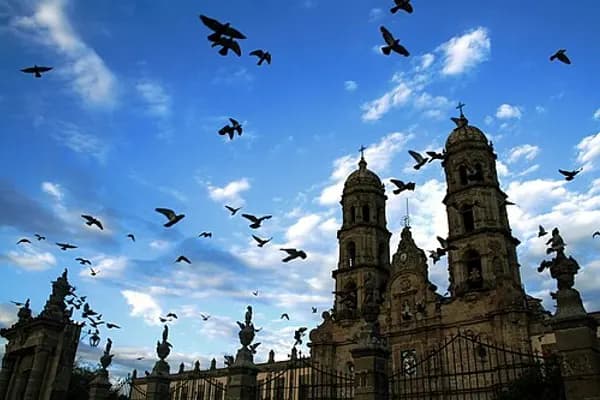
Construction of the Basilica of Zapopan began in 1689. and finished in 1892. It has been modified and expanded since then. In front of the structure is a large atrium. The atrium contains bronze statues of Antonio de Segovia, who donated the image of the Virgin in the 16th century and one of Pope John Paul II, with a child dressed as a charro, who represents Jalisco. The facade is Plateresque and the entrances have Ionic columns and coats of arms. The main altar is made of marble from Carrara and Cyprus with the image of the Virgin of Zapopan in a glass case at the top. Another important sculpture is that of the Holy Family, which has been in the church since 1832. It was sculpted by Victoriano Acuña.
In 1940 Pope Pius XII designated the church a basilica. Part of the basilica building is dedicated to the Huichol Museum, which is dedicated to the art and culture of the Huichol people as well as some displays from the Tepehuán and Cora peoples. Another section of the basilica houses the Museum of the Virgin of Zapopan, where offerings left for the image can be seen, as well as items that have been used for its worship over the centuries.
Annually, a large procession in this image's honor takes place on the 12th of October, coinciding with Columbus Day (called "Día de la Raza" (Day of the Race) in Spanish). This tradition started in 1734, when this image was named the patron of Guadalajara and the protector against epidemics, storms and other calamities. Starting at 6 am, the image is carried on the streets from the Guadalajara Cathedral to the Basilica of Zapopan. The streets, including the wide avenue of Manuel Avila Camacho in Zapopan proper, are packed with dancers, vendors selling traditional food and crafts and spectators. The image stops periodically to receive homage from the many traditional dance groups and mariachi bands along the way. Traditional dances include "Los Tastoanes," "La Danza del Águila Real," "la de La Conquista" and "Los Huehuenches." Once returned to its home at the Basilica, celebrations continue and end with fireworks at night.
Other landmarks
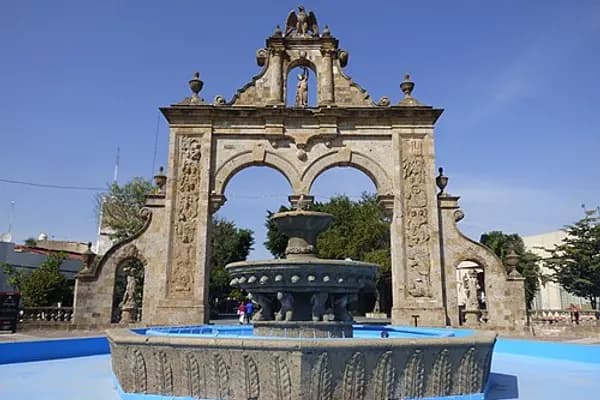
On Paseo Teopiltzintli, which was the main thoroughfare into the city, is the Arco de Ingreso a Zapopan (Entrance Arch), built by the Spanish founders of the city. It is made of quarried stone and is twenty metres (66ft) high. The arch area is decorated with sculptures and the arch itself is topped with large jars and an eagle. The Paseo Teopiltzintli leads to the Plaza de las Americas, after passing the Plaza Cívica.
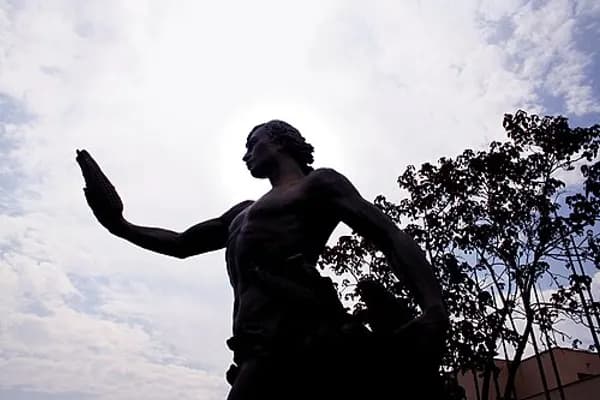
The Plaza de las Américas—Juan Pablo II Square is located on the eastern side of the Basilica of Zapopan. It is paved with pink quarried stone, and contains a stone kiosk and four large fountains. There are two large sculptures in bronze depicting the god and goddess of corn, done by Juan Méndez. A statue of John Paul II is located here also.
The main walking corridor of the city is Andador 20 de Noviembre, which is lined with galleries, bars, and restaurants. On Saturdays, artists and antique dealers display their wares for sale on the walkway.
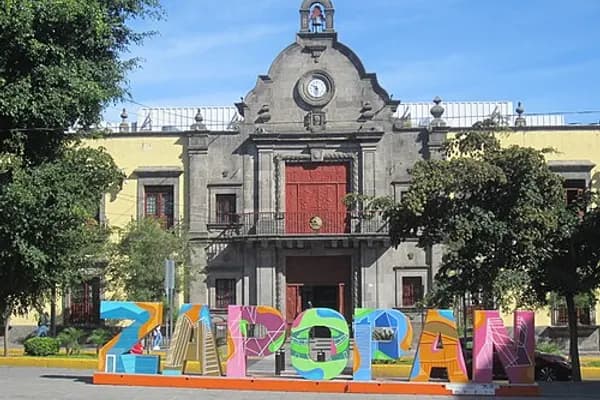
The Municipal Palace was constructed in 1942 as a school. It became the seat of the municipal government in 1968, and has been remodeled several times since. The facade is decorated with reliefs. The building's staircase contains a mural called "La Revolución Universal" (The Universal Revolution) done by Guadalajara artist Guillermo Chavez Vega in 1970. This mural depicts scenes from the French, Industrial, English, Mexican and Socialist Revolutions. It also contains images of indigenous art. The Plaza Cívica or Civic Plaza is in front of the municipal palace, with a 7 metres (23ft) flagpole and a bronze sculpture of the Mexican themed eagle devouring a serpent.
The Municipal Cultural Center, built in 1979, holds exhibitions of fine art as well as theatrical and dance events. Next to it is the Plaza del Arte (Art Plaza) which is decorated with arches and columns of quarried stone and three permanent sculptures. The main mural of the building is entitled "La Historia de la Villa y la Revolución Mexicana" (The story of the village and the Mexican Revolution) painted in 1980 by Ricardo Peña. It also contains twenty-three other murals done by art students over the years.
The Estadio Akron football stadium of the Guadalajara's club C.D. Guadalajara is next to the Bosque de la Primavera, in the northwestern Guadalajara Metropolitan area, just off the Anillo Periferico ring road and Avenida Vallarta in Zapopan. The stadium covers 147,000 square metres (1,580,000ft) and has seating for over 45,000 people.
The Neoclassical style Temple of San Pedro Apóstol was finished at the end of the 19th century. The atrium has a balustrade, and contains two large crosses with reliefs carved on them. The facade of the church is made of quarried stone with buttresses that flank the portal and side walls. Inside is a sculpture of Saint Peter, done by J. Cruz de la Mora in 1931, who was a native of Zapopan. The church also contains a painting from the 17th century done by Juan Correa called "The Baptism of Jesus."
Encyclopedic content adapted from the Wikipedia article on Zapopan, used under CC BY-SA 4.0.