About the neighborhood
Borough of Stuttgart in Baden-Württemberg, Germany
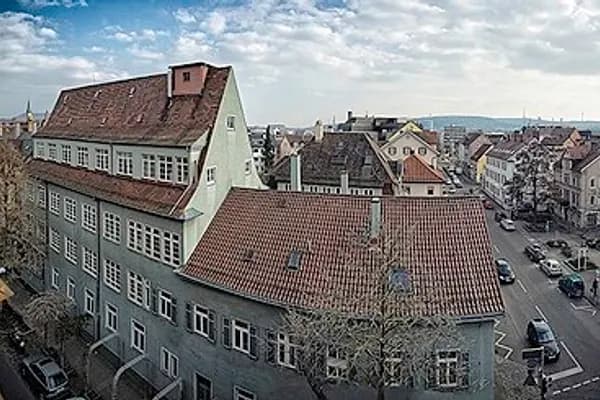
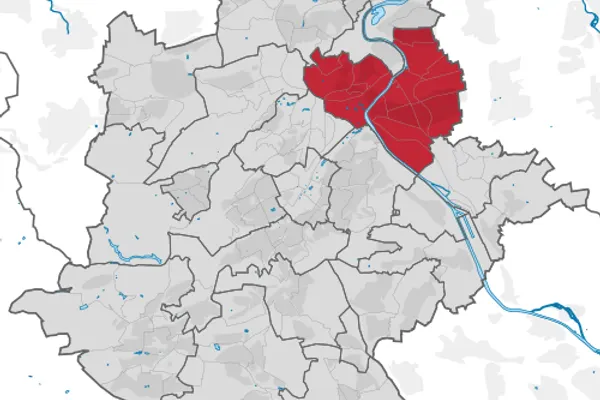
Bad Cannstatt (German pronunciation: baːt ˈkanʃtat), also called Cannstatt (until July 23, 1933) or Kannstadt (until 1900), is one of the outer Stadtbezirke, or city boroughs, of Stuttgart in Baden-Württemberg, Germany. Bad Cannstatt is the oldest and most populous of Stuttgart's boroughs, and one of the most historically significant towns in the area of Stuttgart. The town is home to the Cannstatter Wasen and Cannstatter Volksfest beer festivals, the MHPArena (VfB Stuttgart), the Hanns-Martin-Schleyer-Halle, and the Porsche-Arena.
Name
Bad Cannstatt's name originates from a Castra stativa, Cannstatt Castrum, the massive Roman castra that was erected on the hilly ridge in AD 90 to protect the valuable river crossing and local trade. In the past, Bad Cannstatt has been known as simply Cannstatt or Kannstatt, Cannstadt, Canstatt, Kanstatt, and Condistat. Its name was changed to include "Bad" (German: Bath) to mention the town's spas on 23 July 1933.
History
Bad Cannstatt lies on the Neckar at the convergence of various regional trails. The area was inhabited by the Seelberg mammoth hunters during the last glacial period. The town was founded during the Roman period, records survive of Roman knowledge of the area's springs. The nearby Sielberg is notable for its caverns and fossils.
In 746 Carloman, Mayor of the Palace of Austrasia, called a council at Cannstatt, arrested and executed virtually all nobles of the Alemanni. This marks the transfer of power from the Alemanni to the emerging Carolingians. The present name first appeared as the seat of a court held by Charlemagne in the 8th century while trying the rebellious dukes of Alemannia and Bavaria.
Cannstatt was the capital of the county of Württemberg into the 14th or 15th century; the Rotenberg was the location of the ruling house's ancestral castle. Cannstatt subsequently formed part of the duchy, electorate, and kingdom of Württemberg. It lay about 2.5 miles (4km) from Stuttgart proper, although it has since grown to include Bad Cannstatt. In the 13th or 14th century, Louis the Bavarian expanded its rights and privileges to equality with Esslingen. Its 15th-century cathedral was dedicated to StUffo. In 1755, the Great Lisbon earthquake caused the town hall to subside about 3 feet (1m). During the wars which followed the French Revolution, the town was the site on 21 July 1796 of a French victory over the Austrian Empire.
In the 19th century, it boasted an attractive town hall, a royal theater, a market house, the Wilhelma and Rosenstein palaces, and extensive industry including wool-spinning, dyeing, steelmaking, and construction of machinery. There were then about 40 mineral springs, which were considered beneficial for "dyspepsia and weakness of the nervous system", as well as "diseases of the throat". Cannstatt was the site of Gottlieb Daimler's invention of the first petroleum-fueled automobile in 1886 and housed an automotive factory before the First World War. Around that time, it also had notable railway and chemical works and a brewery. Cannstatt was incorporated into Stuttgart in 1904.
Of the 19 surviving mineral springs, 11 are recognized as state wells. In the world, it is now second to only Újbuda in Budapest, Hungary, in scale. The Mombach spring is the only one that releases its water without pressure in large quantities; its outflow is used in the adjacent baths and the Wilhelma spa.
Famous residents
Famous people associated with Bad Cannstatt include:
Gottlieb Daimler, inventor of the first automobile, developed in Cannstatt, and part-founder of Daimler-Benz. (Karl Benz independently invented a successful automobile in the same year, 96km away in Ladenburg.)
Emy Gordon (née von Beulwitz), writer, translator and Catholic activist
Georg Pfäfflin (1908–1972), German Lutheran pastor
Notes
Citations
Footnotes
References
Baynes, T. S., ed. (1878), "Canstatt", Encyclopædia Britannica, vol.5 (9thed.), New York: Charles Scribner's Sons, pp.26–27.
Chisholm, Hugh, ed. (1911), "Cannstatt", Encyclopædia Britannica, vol.5 (11thed.), Cambridge University Press, p.189.
Encyclopedic content adapted from the Wikipedia article on Bad Cannstatt, used under CC BY-SA 4.0.
What makes Bad Cannstatt special
Bad Cannstatt stands out among Stuttgart’s neighborhoods for its distinctive character: stuttgart's oldest district. Ranked #5 in Stuttgart, it offers the kind of experience that defines a great city trip — a place where the streets themselves tell a story and every block rewards curiosity.
Best for
Our take on Bad Cannstatt
Bad Cannstatt occupies a distinctive place in Stuttgart's neighborhood landscape. It is the kind of district that rewards travelers who venture beyond the obvious choices — quieter than the tourist-facing areas, richer in local character, and full of the small details that make a city trip memorable.
What makes Bad Cannstatt exceptional is the density of its cultural life. Art galleries, independent bookshops, small theaters, and creative studios are woven into the fabric of the neighborhood rather than clustered in a single zone. You encounter culture here by accident, which is how the best cultural experiences always happen.
Our editors recommend budgeting at least half a day here — enough time to walk the main streets, sit down for coffee, and discover the side streets where Bad Cannstatt's real character lives.
Living in Bad Cannstatt
Bad Cannstatt is connected to the rest of Stuttgart by public transit, and most visitors find it straightforward to reach from the city center or airport. Once you arrive, the neighborhood is best explored on foot — the scale is human and the streets reward wandering.
Day-to-day life in Bad Cannstatt has the rhythm of a genuine residential neighborhood. You will find grocery stores, pharmacies, cafés with morning regulars, and the kind of small independent shops that only survive where locals support them. For visitors, this means the infrastructure you need — good coffee, a decent meal, a quiet place to sit — is always within a short walk.
Accommodation in Bad Cannstatt ranges from boutique hotels to short-term rentals. We generally recommend staying within the neighborhood itself rather than commuting from a hotel elsewhere in Stuttgart — the experience of waking up inside a great neighborhood is fundamentally different from visiting one as a day trip.
What locals say about Bad Cannstatt
Long-term residents of Bad Cannstatt tend to describe their neighborhood with a mix of pride and protectiveness. Like any district with genuine character, Bad Cannstatt inspires loyalty — the kind of place people move to and never quite leave, or leave and spend years trying to get back to.
The creative community in Bad Cannstatt is genuine, not aspirational. Residents include working artists, writers, musicians, and designers who chose the neighborhood because it supported their work — affordable studio space, a community that values craft, and enough foot traffic to sustain independent galleries and shops.
Compared to the more famous districts in Stuttgart, Bad Cannstatt has maintained a lower profile, which many residents consider an advantage. The neighborhood evolves gradually rather than being reshaped by sudden attention, and the result is a community that still feels organic rather than curated.
Visitor tips
- Bad Cannstatt is located in Stuttgart, Germany. The neighborhood is accessible by public transport, taxi, or rideshare from most parts of the city.
- Morning is often the best time to explore — the streets are quieter, the light is better for photography, and cafes are at their most welcoming.
- Wear comfortable walking shoes — the best way to experience Bad Cannstatt is on foot, wandering the side streets and discovering what lies around each corner.
- Save the neighborhood's location on your phone before you arrive. Offline maps are especially useful for navigating the smaller side streets.