About the neighborhood
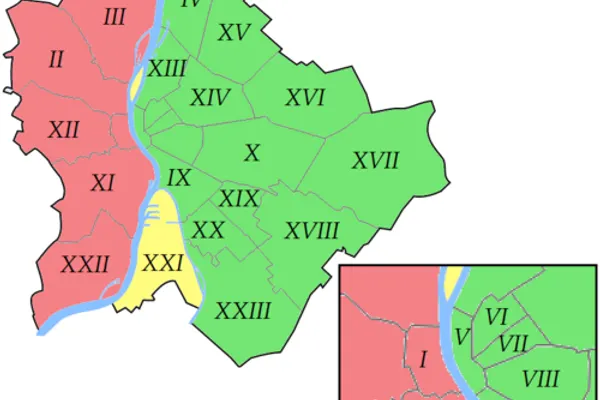
Budapest, the capital of Hungary has 23 districts (Hungarian: kerület, pronounced ˈkɛrylɛt), each with its own municipal government.
The number of districts in Budapest
Budapest was organized into 10 districts (numbered from I to X) in 1873 after the unification of the cities of Pest, Buda and Óbuda. The districts at that time:
Buda: I, II
Óbuda: III
Pest: IV, V, VI, VII, VIII, IX, X
In the 1930s, 4 new districts were organized, numbered from XI to XIV. On 1 January 1950, 7 neighboring towns and 16 villages were annexed to Budapest by creating 9 new districts, so the number of its districts increased to 22. District IV was annexed to District V and the number IV was given to the northernmost newly merged town, Újpest. Former district borders were also partly modified but the old numbering system is still clear on the map. In 1994, Soroksár left District XX, became the newest district and received the number XXIII.
Districts
Listed below are the ordinal numbers of the 23 districts of Budapest, their official names (if there is one), and the names of the neighbourhoods within the districts. Each district can be associated with one or more neighbourhoods named after former towns within Budapest.
Buda is the hilly part on the west bank of the Danube (red cells in the table below), Districts I, II, III, XI, XII, XXII
Pest is the flat part on the east bank of the Danube (green cells in the table below). Districts IV, V, VI, VII, VIII, IX, X, XIII, XIV, XV, XVI, XVII, XVIII, XIX, XX, XXIII
Csepel is a big island in the south which barely belongs to Budapest. This part of the island is the District XXI and is also referred as Csepel.
Margaret Island is an island that is directly administered by the Municipality of Budapest (used to be part of District XIII) and is used as a recreational area
There is a third island called Óbuda Island (Óbudai-sziget) which forms parts of District III and hosts the Sziget Festival since 1993.
List of districts by population, territory and population density
Arrangement of districts
District I is a small area in central Buda (the western side), including the historic Castle. District II is in Buda again, in the northwest, and District III stretches along in the northernmost part of Buda.
To reach District IV, one must cross the Danube to find it in Pest (the eastern side), also at north. With District V, another circle begins: it is located in the absolute centre of Pest. Districts VI, VII, VIII and IX are the neighbouring areas to the east, going southwards, one after the other.
District X is another, more external circle also in Pest, while one must jump to the Buda side again to find Districts XI and XII, going northwards. No more districts remaining in Buda in this circle, we must turn our steps to Pest again to find Districts XIII, XIV, XV, XVI, XVII, XVIII, XIX and XX (mostly external city parts), almost regularly in a semicircle, going southwards again.
District XXI is the extension of the above route over a branch of the Danube, the northern tip of a long island (Csepel-sziget) south from Budapest. District XXII is still on the same route in southwest Buda, and finally District XXIII is again in southernmost Pest, irregular only because it was part of District XX until the mid-90s.
Twin towns – sister cities (districts)
Budapest I – Budavár
Capestrano, Italy
Carouge, Switzerland
Innere Stadt (Vienna), Austria
Lendava, Slovenia
Marlow, England, United Kingdom
Mukachevo, Ukraine
Odorheiu Secuiesc, Romania
Old Town (Bratislava), Slovakia
Prague 1 (Prague), Czech Republic
Regensburg, Germany
Savonlinna, Finland
Senta, Serbia
Śródmieście (Warsaw), Poland
Budapest II
Beşiktaş, Turkey
Finike, Turkey
Mosbach, Germany
Żoliborz (Warsaw), Poland
Budapest III – Óbuda-Békásmegyer
Bemowo (Warsaw), Poland
Billigheim, Germany
Büyükçekmece, Turkey
Miercurea Ciuc, Romania
Old Town (Košice), Slovakia
Stirling, Scotland, United Kingdom
Budapest V – Belváros-Lipótváros
Bačka Topola, Serbia
Charlottenburg-Wilmersdorf (Berlin), Germany
Gheorgheni, Romania
Inlăceni (Atid), Romania
Mondragone, Italy
Old Town (Kraków), Poland
Rakhiv, Ukraine
Rimetea, Romania
Rožňava, Slovakia
Budapest VI – Terézváros
Târgu Secuiesc, Romania
Temerin, Serbia
Zadar, Croatia
Budapest VII – Erzsébetváros
Karlovac, Croatia
Nevers, France
Požega, Croatia
Safed, Israel
Stari Grad (Belgrade), Serbia
Stavroupoli, Greece
Sveti Vlas (Nesebar), Bulgaria
Budapest VIII – Józsefváros
Pescina, Italy
Budapest IX – Ferencváros
Berehove, Ukraine
Kanjiža, Serbia
Kráľovský Chlmec, Slovakia
Sfântu Gheorghe, Romania
Budapest X – Kőbánya
Bălan, Romania
Jarosław, Poland
Letovice, Czech Republic
Litochoro, Greece
Štúrovo, Slovakia
Vinkovci, Croatia
Wolverhampton, England, United Kingdom
Budapest XI – Újbuda
Ada, Serbia
Bad Cannstatt (Stuttgart), Germany
Bahçelievler, Turkey
Bene, Ukraine
Berehove Raion, Ukraine
District 1 (Ho Chi Minh City), Vietnam
Prague 5 (Prague), Czech Republic
Ruse, Bulgaria
Sânzieni, Romania
Târgu Mureș, Romania
Trogir, Croatia
Trstice, Slovakia
Ustroń, Poland
Yiwu, China
Żoliborz (Warsaw), Poland
Budapest XII – Hegyvidék
Arad, Romania
Budapest XIII
Floridsdorf (Vienna), Austria
Košice-Juh (Košice), Slovakia
Ochota (Warsaw), Poland
Osijek, Croatia
Sovata, Romania
Budapest XIV – Zugló
Ciceu, Romania
Opava, Czech Republic
Racibórz, Poland
Racoş, Romania
Steglitz-Zehlendorf (Berlin), Germany
Budapest XV
Dabas, Hungary
Donji Kraljevec, Croatia
Liesing (Vienna), Austria
Linyi, China
Marzahn-Hellersdorf (Berlin), Germany
Nad jazerom (Košice), Slovakia
Obervellach, Austria
Sanming, China
Topliţa, Romania
Budapest XVI
Tây Hồ District (Hanoi), Vietnam
Budapest XVII – Rákosmente
Gheorgheni, Romania
Krosno County, Poland
Lovran, Croatia
Budapest XVIII – Pestszentlőrinc-Pestszentimre
Artashat, Armenia
Băile Tușnad, Romania
Dąbrowa County, Poland
Izvoru Crișului, Romania
Moldava nad Bodvou, Slovakia
Nesebar, Bulgaria
Nin, Croatia
Odorheiu Secuiesc, Romania
Roding, Germany
San Nicola la Strada, Italy
Tiachiv, Ukraine
Budapest XIX – Kispest
Krzeszowice, Poland
Pendik, Turkey
Smolyan, Bulgaria
Sombor, Serbia
Tășnad, Romania
Vrbovec, Croatia
Budapest XX – Pesterzsébet
Alushta, Ukraine
Belin, Romania
Cristuru Secuiesc, Romania
Nowa Słupia, Poland
Olgiate Comasco, Italy
Nord-Ost (Frankfurt), Germany
Budapest XXI – Csepel
Băile Tușnad, Romania
Gănești, Romania
Kielce, Poland
Rijeka, Croatia
Salonta, Romania
Wołomin, Poland
Budapest XXII – Budafok-Tétény
Baraolt, Romania
Białołęka (Warsaw), Poland
Bonn (Bonn), Germany
Koson, Ukraine
Kristianstad, Sweden
Primorski District (Varna), Bulgaria
Budapest XXIII – Soroksár
Nürtingen, Germany
Odorheiu Secuiesc, Romania
Sędziszów Małopolski, Poland
Tongzhou (Beijing), China
Törökbálint, Hungary
Tvarditsa, Bulgaria
References
External links
District I-X street maps clearly showing boundaries
Districts I. Várkerület
II. 2nd district
III. Óbuda-Békásmegyer
IV. Újpest
V. Belváros-Lipótváros
VI. Terézváros
VII. Erzsébetváros
VIII. Józsefváros
IX. Ferencváros
X. Kőbánya
XI. Újbuda
XII. Hegyvidék
XIII. 13th district
XIV. Zugló
XV. 15th district
XVI. 16th district
XVII. Rákosmente
XVIII. Pestszentlőrinc-Pestszentimre
XIX. Kispest
XX. Pesterzsébet
XXI. Csepel
XXII. Budafok-Tétény
XXIII. Soroksár
Events and traditions Budapest Fashion Week
Budapest Fringe Festival
Budapest Spring Festival
Budapest Opera Ball
Café Budapest Contemporary Arts Festival
Hungarian Cuisine
Hungarian National Ballet
LOW Festival
Sziget Festival
Universities Budapest Business School
Budapest University of Technology
Corvinus University
Eötvös Loránd University
Hungarian University of Fine Arts
Liszt Ferenc Academy of Music
Moholy-Nagy University of Art and Design
National University of Public Service
Óbuda University
Semmelweis University
University of Physical Education
Academy of Drama and Film
Andrássy University
Aquincum Institute of Technology
Budapest Metropolitan University
Budapest University of Jewish Studies
Central European University
International Business School
Károli Gáspár University of Reformed Church
Pázmány Péter Catholic University
Economy Budapest Stock Exchange
Economy of Budapest
List of companies based in Budapest
Budapest Metropolitan Area
Transport Budapest Ferenc Liszt International Airport
Budapest Metro
Budapest Tram Network
Budapest Commuter Railway
BuBi Bicycle
M0 Ring Road
Eastern railway station
Western railway station
Southern railway station
History of Budapest
Category
Encyclopedic content adapted from the Wikipedia article on Stuttgart-Ost, used under CC BY-SA 4.0.
What makes Stuttgart-Ost special
Stuttgart-Ost stands out among Stuttgart’s neighborhoods for its distinctive character: quiet, hilltop stuttgart. Ranked #4 in Stuttgart, it offers the kind of experience that defines a great city trip — a place where the streets themselves tell a story and every block rewards curiosity.
Best for
Our take on Stuttgart-Ost
Stuttgart-Ost occupies a distinctive place in Stuttgart's neighborhood landscape. It is the kind of district that rewards travelers who venture beyond the obvious choices — quieter than the tourist-facing areas, richer in local character, and full of the small details that make a city trip memorable.
What makes Stuttgart-Ost exceptional is the density of its cultural life. Art galleries, independent bookshops, small theaters, and creative studios are woven into the fabric of the neighborhood rather than clustered in a single zone. You encounter culture here by accident, which is how the best cultural experiences always happen.
Our editors recommend budgeting at least half a day here — enough time to walk the main streets, sit down for coffee, and discover the side streets where Stuttgart-Ost's real character lives.
Living in Stuttgart-Ost
Stuttgart-Ost is connected to the rest of Stuttgart by public transit, and most visitors find it straightforward to reach from the city center or airport. Once you arrive, the neighborhood is best explored on foot — the scale is human and the streets reward wandering.
This is a neighborhood with strong residential roots, which means the infrastructure of daily life is well-established: grocery stores, pharmacies, parks, playgrounds, and the kind of quiet side streets where children play and neighbors greet each other. For visitors, this translates into a feeling of safety and belonging that more tourist-oriented districts rarely provide.
Accommodation in Stuttgart-Ost ranges from boutique hotels to short-term rentals. We generally recommend staying within the neighborhood itself rather than commuting from a hotel elsewhere in Stuttgart — the experience of waking up inside a great neighborhood is fundamentally different from visiting one as a day trip.
What locals say about Stuttgart-Ost
Long-term residents of Stuttgart-Ost tend to describe their neighborhood with a mix of pride and protectiveness. Like any district with genuine character, Stuttgart-Ost inspires loyalty — the kind of place people move to and never quite leave, or leave and spend years trying to get back to.
The creative community in Stuttgart-Ost is genuine, not aspirational. Residents include working artists, writers, musicians, and designers who chose the neighborhood because it supported their work — affordable studio space, a community that values craft, and enough foot traffic to sustain independent galleries and shops.
Compared to the more famous districts in Stuttgart, Stuttgart-Ost has maintained a lower profile, which many residents consider an advantage. The neighborhood evolves gradually rather than being reshaped by sudden attention, and the result is a community that still feels organic rather than curated.
Visitor tips
- Stuttgart-Ost is located in Stuttgart, Germany. The neighborhood is accessible by public transport, taxi, or rideshare from most parts of the city.
- Morning is often the best time to explore — the streets are quieter, the light is better for photography, and cafes are at their most welcoming.
- Wear comfortable walking shoes — the best way to experience Stuttgart-Ost is on foot, wandering the side streets and discovering what lies around each corner.