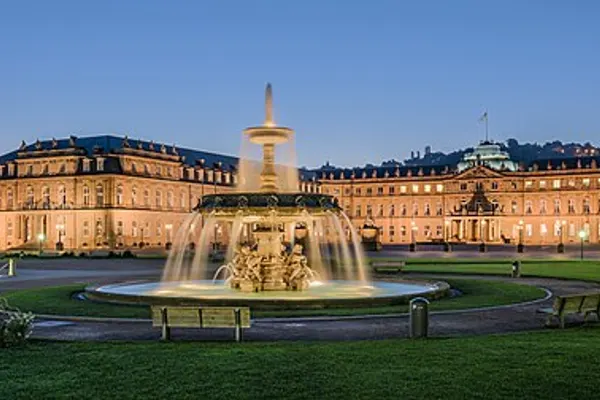
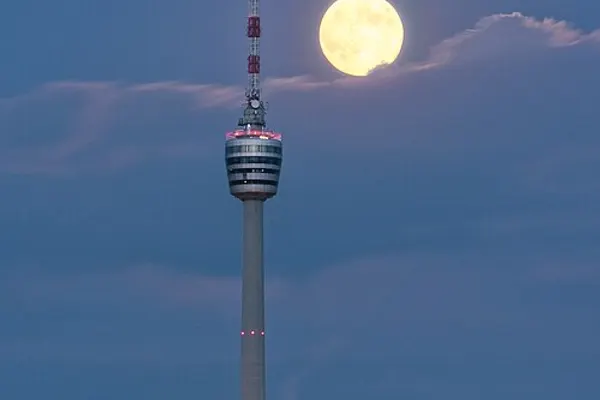
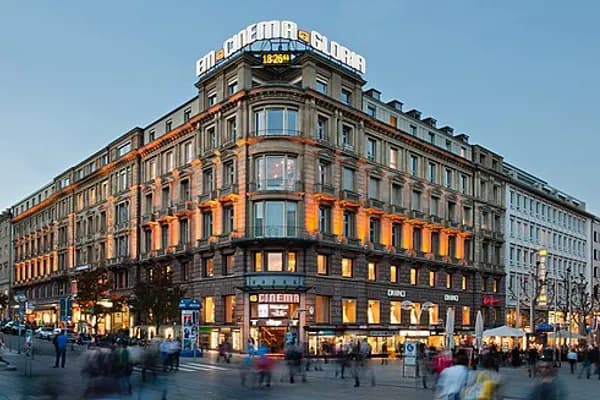
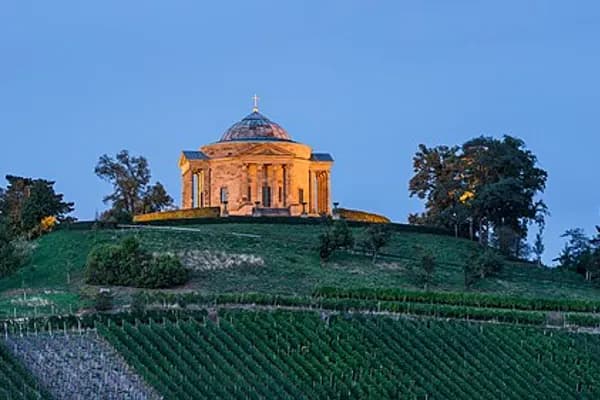
About the neighborhood
Capital of Baden-Württemberg, Germany
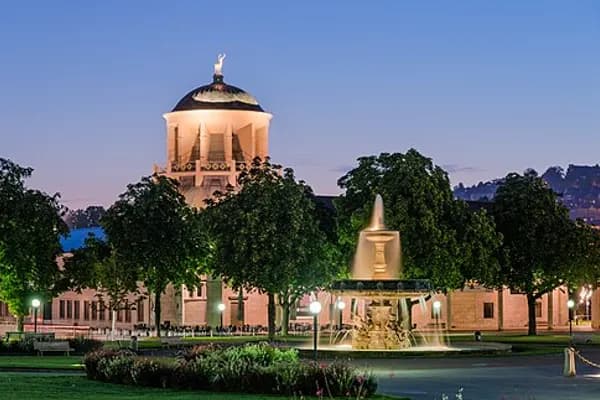
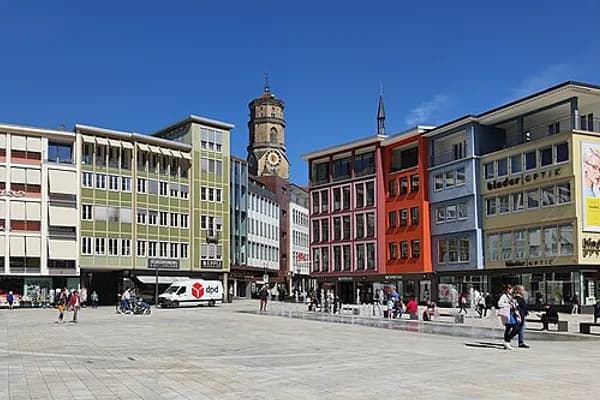
Stuttgart (/ˈstʌtɡɑːrt, ˈstʊt-/; German: ˈʃtʊtɡaʁt ; Swabian: Schduagert ˈʃd̥ua̯ɡ̊ɛʕd̥; Alemannic: Stuttgart; names in other languages) is the capital and largest city of the German state of Baden-Württemberg. It is located on the Neckar river in a fertile valley known as the Stuttgarter Kessel (Stuttgart Cauldron) and lies an hour from the Swabian Jura and the Black Forest. Stuttgart has a population of 613,111 as of 2023, making it the sixth largest city in Germany, while over 2.8 million people live in the city's administrative region and nearly 5.5 million people in its metropolitan area, making it the fourth largest metropolitan area in Germany. The city's metropolitan area is consistently ranked among the top 5 European metropolitan areas by GDP. Mercer listed Stuttgart as 21st on its 2015 list of cities by quality of living; innovation agency 2thinknow ranked the city 24th globally out of 442 cities in its Innovation Cities Index; and the Globalization and World Cities Research Network ranked the city as Beta-status global city in their 2020 survey. Stuttgart was one of the host cities for the official tournaments of the 1974 and 2006 FIFA World Cups.
Stuttgart is unusual in the scheme of German cities. It is spread across a variety of hills (some of them covered in vineyards), valleys (especially around the Neckar river and the Stuttgart basin) and parks. The city is known as the "cradle of the automobile". As such, it is home to famous automobile museums like the Mercedes-Benz Museum and Porsche Museum, as well as numerous auto-enthusiast magazines, which contributes to Stuttgart's status as Germany's "Autohauptstadt" ("car capital city"/"capital of cars"). The city's tourism slogan is "Stuttgart offers more". Under current plans to improve transport links to the international infrastructure (as part of the Stuttgart 21 project), Stuttgart unveiled a new city logo and slogan in March 2008, describing itself as "Das neue Herz Europas" ("The new Heart of Europe"). For business, it describes itself as "Where business meets the future". In July 2010, the city unveiled a new logo, designed to entice more business people to stay in the city and enjoy breaks in the area.
Since the seventh millennium BC, the Stuttgart area has been an important agricultural area and has been host to a number of cultures seeking to utilize the rich soil of the Neckar valley. The Roman Empire conquered the area in AD 83 and built a massive castrum near Bad Cannstatt, making it the most important regional centre for several centuries. Stuttgart's roots were truly laid in the tenth century with its founding by Liudolf, Duke of Swabia, as a stud farm for his warhorses. Initially overshadowed by nearby Bad Cannstatt, the town grew steadily and was granted a charter in 1320. The fortunes of Stuttgart turned with those of the House of Württemberg, and they made it the capital of their county, duchy, and kingdom from the 15th century to 1918. Stuttgart prospered despite setbacks in the Thirty Years' War and devastating air raids by the Allies on the city and its automobile production during World War II. However, by 1952, the city had bounced back and became the major cultural, economic, industrial, financial, tourism and publishing centre it is today.
Stuttgart is known for its strong high-tech industry, especially in the automotive sector. It has the highest general standard of prosperity of any German city. In addition to many medium-sized companies, several major corporations are headquartered in Stuttgart, including Porsche, Bosch, Exyte, and Mercedes-Benz Group. Stuttgart is an important financial center; the Stuttgart Stock Exchange is the second largest in Germany (after Frankfurt), and the Landesbank Baden-Württemberg (LBBW) is Germany's largest Landesbank. Stuttgart is also a major transport junction; it is among the most congested conurbations of Europe, and its airport is the sixth-busiest in Germany (2019). Stuttgart is a city with a high number of immigrants; according to Dorling Kindersley's Eyewitness Travel Guide to Germany, "In the city of Stuttgart, every third inhabitant is a foreigner." 40% of Stuttgart's residents, and 64% of the population below the age of five, are of immigrant background. In the rest of Germany, 28.7% of people are of immigrant background, with a relatively higher percentage living in cities and former western Germany (such as Stuttgart).
Etymology
Stuttgart, often nicknamed the "Schwabenmetropole" (English: Swabian metropolis) in reference to its location in the centre of Swabia and the local dialect spoken by the native Swabians, has its etymological roots in the Old High German word Stuotgarten, or "stud farm", because the city was founded in 950AD by Duke Liudolf of Swabia to breed warhorses.
In the local dialects of Alemannic German it can be "Schtuegert", and in Swabian German "Stuagart"; with similar variant spellings, usually dropping the central T sound.
History
Historical affiliations
Roman Empire 83–475
Kingdom of Alamannia c.475–911
Duchy of Swabia 915–1313
Duchy of Württemberg 1495–1803
Electorate of Württemberg 1803–1805
Kingdom of Württemberg 1805–1918
German Empire 1871–1918
Weimar Republic 1918–1933
Nazi Germany 1933–1945
Allied-occupied Germany 1945–1949
West Germany 1949–1990
Germany 1990–present
Antiquity
Originally, the most important location in the Neckar river valley was the hilly rim of the Stuttgart basin at what is today Bad Cannstatt. Thus, the first settlement of Stuttgart was a massive Roman Castra stativa (Cannstatt Castrum) built c.90 AD to protect the vineyards blanketing the landscape and the road from Mogontiacum (now Mainz) to Augusta Vindelicorum (Augsburg). Cannstatt was a part of the Roman imperial province Germania Superior.
As with many military installations, settlement sprang up nearby and remained there even after the limes moved further east. When they did, the town was left in the capable hands of a local brickwork that produced sophisticated architectural ceramics and pottery. When the Romans were driven back past the Rhine and Danube rivers in the third century by the Alamanni, the settlement temporarily vanished from history until the seventh century.
Middle Ages
In 700, Duke Gotfrid mentions as document regarding prop. Archaeological evidence shows that later Merovingian era Frankish farmers continued to till the same land the Romans did.
Cannstatt is mentioned in the Abbey of St. Gall's archives as "Canstat ad Neccarum" (German: Cannstatt-on-Neckar) in 708. The etymology of the name "Cannstatt" is not clear, but as the site is mentioned as condistat in the Annals of Metz (9th century), it is mostly derived from the Latin word condita ("foundation"), suggesting that the name of the Roman settlement might have had the prefix "Condi-". Alternatively, Sommer (1992) suggested that the Roman site corresponds to the Civitas Aurelia G attested to in an inscription found near Öhringen. There have also been attempts at a derivation from a Gaulish *kondâti- "confluence".
In AD 950, Duke Liudolf of Swabia, son of the current Holy Roman Emperor Otto I, decided to establish study for his cavalry during the Hungarian invasions of Europe on the Nesenbach river valley 5km (3.1mi) south of the old Roman castrum. The land and title of Duke of Swabia remained in Liudolf's hands until his rebellion was quashed by his father four years later. In 1089, Bruno of Calw built the precursor building to the Old Castle.
Stuttgart's viticulture, first documented in the Holy Roman Empire in the year AD 1108, kept people in the area of that study for some time, but the area was still largely overshadowed by nearby Cannstatt because of its role as a local crossroad for many major European trade routes. Nevertheless, the existence of a settlement here (despite the terrain being more suited for that original study) during the High Middle Ages is provided by a gift registry from Hirsau Abbey dated to around 1160 that mentions a "Hugo de Stuokarten". A settlement at this locale was again mentioned in 1229, but this time by Pope Gregory IX. In AD 1219, Stuttgart (then Stuotgarten) became a possession of Herman V, Margrave of Baden. In addition to Backnang, Pforzheim, and Besigheim, Hermann would also found the Stuttgart we know today in c.1220. In 1251, the city passed to the Ulrich I von Württemberg as part of Mechthild von Baden's dowry. His son, Eberhard I "the Illustrious", would be the first to begin the many major expansions of Stuttgart under the House of Württemberg.
Eberhard desired to expand the realm his father had built through military action with the aid of the anti-king Henry Raspe IV, Landgrave of Thuringia, but was thwarted by the action of Emperor Rudolph I. Further resistance by Eberhard I against the Emperor's created Vogts and Bailiwicks as well as the newly appointed Duke of Swabia Rudolf II, Duke of Austria, eventually led to armed conflict and initial successes upon Emperor Rudolph I's death in 1291 against the Emperor's men. After initially defeating his regional rivals, Henry VII, newly elected as Emperor, decided to take action against Eberhard I in 1311 during his war with the Free imperial city of Esslingen by ordering his Vogt, Konrad IV von Weinberg, to declare war on Eberhard I. Eberhard I, defeated on the battlefield, lost Stuttgart and his castle (razed in 1311) to Esslingen and the city was thus managed by the city state from 1312 to 1315. Total destruction of the county was prevented by Henry VII's death on 24 August 1313 and the elections of Louis IV as King of the Germans and Frederick III as anti-king. Eberhard seized the opportunity granted to him by the political chaos, and recaptured his hometown and birthplace in 1316, and made much territorial gain. With peace restored at last, Eberhard began repairs and expansion to Stuttgart beginning with the reconstruction of Wirtemberg Castle, ancestral home to the House of Württemberg, in 1351 and then began expansion of the city's defenses. 1371 were important years for Stuttgart: Eberhard I moved the seat of the county to the city to a new and expanded castle, the collegiate church in Beutelsbach, where previous members of the Württemberg dynasty had been buried prior to its destruction in 1311, moved to its current location in Stuttgart in 1320, and the town's Stiftkirche was expanded into an abbey, and the control of the Martinskirche by the Bishopric of Constance was broken by Papal order in 1321. A year after the city became the principal seat of the Counts of Württemberg in 1320, the city was granted status as a city and given civic rights. At the end of the 14th century, new suburbs sprang up around Leonhard Church and near the city's fortifications as well. Towards the end of the 15th century, Count Ulrich V began construction of a new suburb on the northeastern edge of the city around the Dominican monastery Hospitalkirche. In the 1457, the first Landtag of the Estates of Württemberg was established in Stuttgart and a similar institution was established in Leonberg. After the temporary partitions of the County of Württemberg by the Treaties of Nürtingen, Münsingen, and Esslingen, Stuttgart was once again declared the capital of the county in 1483.
Early Modern era
In 1488, Stuttgart officially became the de facto residence of the Count himself as opposed to the location of his home, the Old Castle. Eberhard I, then Count Eberhard V, became the first Duke of Württemberg in 1495, and made Stuttgart the seat of the Duchy of Württemberg in addition to the County thereof. All this would be lost to the Württembergs during the reign of his son, Ulrich. Though Ulrich initially made territorial gains as a result of his decision to fight alongside the Emperor Maximilian I, he was no friend of the powerful Swabian League nor of his own subjects, who launched the Poor Conrad rebellion of 1514. Despite this and his rivalry with the Swabian League, his undoing would actually come in the form of his unhappy marriage to Sabina of Bavaria. In 1515, Ulrich killed an imperial knight and lover of Sabina's by the name of Hans von Hutten, obliging her to flee to the court of her brother, William IV, Duke of Bavaria, who successfully had Ulrich placed under Imperial ban twice. When the Emperor died in 1519, Ulrich struck, seizing the Free Imperial City of Reutlingen, prompting the League to intervene. That same year, Ulrich was soundly defeated and he was driven into exile in France and Switzerland following the League's conquest of Württemberg. Württemberg was then sold by the League to Emperor Charles V, who then granted it to his brother, Ferdinand I, thus beginning the 12 year ownership of the county by the Habsburgs. When the peasants Ulrich had crushed before rose once again in the German Peasants' War, Stuttgart was occupied by the peasant armies for a few days in the Spring of 1525. Ulrich, with the help of Philip I, Landgrave of Hesse, seized the chance to restore himself to power (albeit as an Austrian vassal) in the turmoil of the Reformation and War with the Turks and invited Erhard Schnepf to bring the Reformation to Stuttgart. He accepted, was named Court Preacher in Stuttgart, and worked in concert with Ambrosius Blarer until his dismissal following his resistance to the Augsburg Interim by the Duke in 1548. Duke Ulrich himself died two years later, and was succeeded by his son, Christoph. He had grown up in a Württemberg in turmoil and wished to rebuild its image. To this end, he once again began a construction boom all over the Duchy under the direction of Court Architect Aberlin Tretsch; knowing full well that the time of the Reisekönigtum was over, Christoph and Tretsch rebuilt and remodeled the Old Castle into a Renaissance palace, and from 1542 to 1544, what is today the Schillerplatz was built as a town square. Duke Christoph also responded to the increasing need for drinking water by embarking upon a massive hydraulic engineering project in the form of a 2,810ft (860m) tunnel to Pffaf Lake, the Glems, and the Nesenbach from 1566 to 1575. In 1575, Georg Beer was also appointed Court Architect, and he built the Lusthaus. But it was architect Heinrich Schickhardt who would carry Tretsch's torch further; Schickhardt constructed the Stammheim Castle in the suburb of Stammheim, rebuilt the Fruchtkasten in the today's Schillerplatz, and expanded the Prinzebau.
Encyclopedic content adapted from the Wikipedia article on Stuttgart-West, used under CC BY-SA 4.0.