About the neighborhood
Affluent district of Shanghai, China
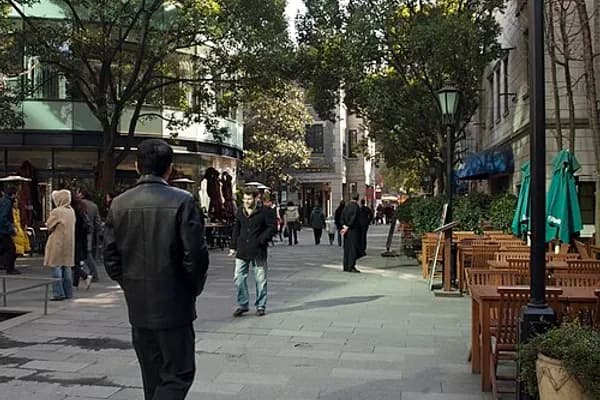
Xintiandi (Chinese 新天地; pinyin Xīntiāndì, Shanghainese: Shinthidi lit. "New Sky and Earth", fig. "New World") is an affluent car-free shopping, eating and entertainment district of Shanghai. Xintiandi now refers to the wider area centered around Madang Road which includes both pedestrian-only and motor traffic roads.
Overview
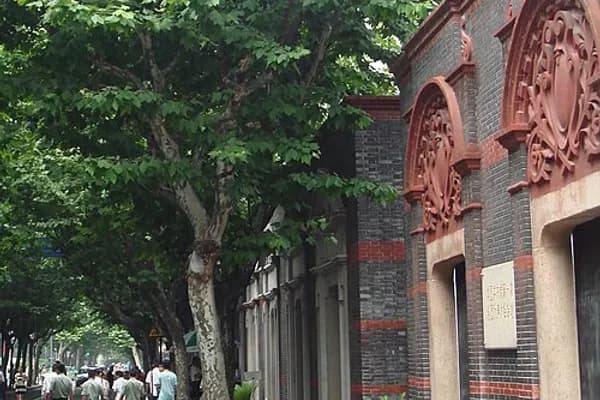
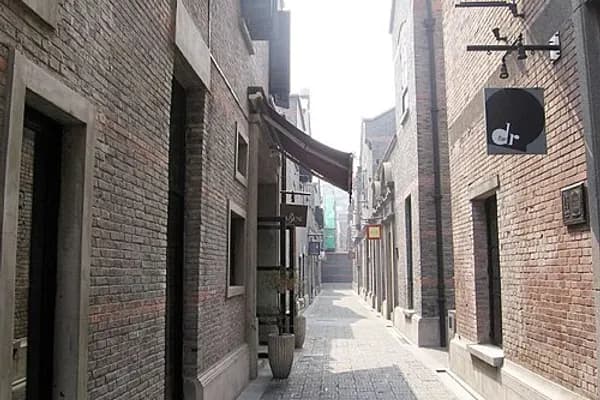
The district is composed of an area of reconstituted traditional mid-19th century shikumen ("stone gate") houses on narrow alleys, some adjoining houses which now serve as book stores, cafes and restaurants, and shopping malls. Most of the cafes and restaurants feature both indoor and outdoor seating. Xintiandi has an active nightlife on weekdays as well as weekends, though romantic settings are more common than loud music and dance places. It is considered one of the first lifestyle centers in China. It is also the most expensive place to live in China, with some apartments costing more than Tokyo, Singapore, New York and London. It is generally home to the Chinese elites and top executive expats or immigrants. The slogan of the area is "Let tomorrow meet yesterday at today in Shanghai".
Xintiandi is the location of the site of the first congress of the Chinese Communist Party, which is now preserved at the Museum of the First National Congress of the Chinese Communist Party. Also nearby are the Shikumen Open House Museum and the site of the Provisional Government of the Republic of Korea.
Redevelopment
In 1996, Shui On Group acquired 23 square blocks in the former French Concession area of Shanghai. This was part of a larger redevelopment project at southern Taipingqiao Road. At the time of its redevelopment, the government could not itself fund the work and the 1997 Asian Financial Crisis had weakened the real estate market overfall.
Shui On's redevelopment of the area required it to meet strict historical preservation requirements. Height requirements were a particular challenge for redevelopment, as required by the historic terraced buildings, including the site of the 1st National Congress of the Chinese Communist Party. The historical preservation requirements meant that redevelopment came at a high cost; Shui On offset these costs through its development of modern buildings adjacent to the historic core of Xintiandi.
Among other redevelopment approaches seeking to preserve the historical character of the area, the internal spaces of various houses were merged to create a larger space for restaurants, bars, nightclubs, and shops. Many tour groups both domestic and from abroad also visit Xintiandi as one of the main attractions in Shanghai.
The Xintiandi redevelopment was also collaborated with global architecture firm Skidmore, Owings & Merrill, including with Benjamin T. Wood and Nikken Sekkei International. The urban renewal is considered one of the first examples of the placemaking approach in China. It was a success both from a real estate business perspective and as a cultural phenomenon. According to academics Fulong Wu and Fangzhu Zhang, this was also an instance of private development being utilised to meet the political and governmental needs to the state.
Redevelopment was completed in 2001. The previously neglected area became a hub of activity and influenced the development of other attempts to revitalise other older neighborhoods around the country.
Transportation
The closest Shanghai Metro stations in the vicinity are South Huangpi Road Station (on Line 1), Xintiandi Station (on Line 10 and Line 13) and Madang Road Station (on Line 9 and Line 13).
See also
Tianzifang
50 Moganshan Road
Lee Tung Street
References
External links
Wikimedia Commons has media related to Xintiandi.
www.shanghaixintiandi.com Archived 2015-11-19 at the Wayback Machine (in English)
Xintiandi redevelopment Archived 2021-08-02 at the Wayback Machine
Xintiandi Architect
This list is incomplete. Culture and demographicsTourist attractionsPlaces of worshipSkyscrapersSports venuesSports teamsTransportUniversitiesGovernance Shanghai Municipal Public Security Bureau
Category
31°13′21″N 121°28′12″E / 31.22260°N 121.47010°E / 31.22260; 121.47010
Encyclopedic content adapted from the Wikipedia article on Xintiandi, used under CC BY-SA 4.0.
What makes Xintiandi special
Xintiandi stands out among Shanghai’s neighborhoods for its distinctive character: shanghai's stylish reborn lanes. Ranked #2 in Shanghai, it offers the kind of experience that defines a great city trip — a place where the streets themselves tell a story and every block rewards curiosity.
Best for
Our take on Xintiandi
Xintiandi is one of the strongest neighborhoods in Shanghai, and it consistently appears in our editors' personal favorites lists. It may not always get the same attention as the city's most famous district, but among travelers who know Shanghai well, Xintiandi is often the first recommendation.
What makes Xintiandi worth the visit is the texture of daily life here. It is a neighborhood that functions for the people who live in it — not just for the visitors who pass through. The shops serve local needs, the restaurants feed local appetites, and the streets have a rhythm that reflects genuine community rather than tourism infrastructure. That is the quality our editors prize most, and Xintiandi has it in abundance.
Our editors recommend budgeting at least half a day here — enough time to walk the main streets, sit down for coffee, and discover the side streets where Xintiandi's real character lives.
Living in Xintiandi
Xintiandi is connected to the rest of Shanghai by public transit, and most visitors find it straightforward to reach from the city center or airport. Once you arrive, the neighborhood is best explored on foot — the scale is human and the streets reward wandering.
Day-to-day life in Xintiandi has the rhythm of a genuine residential neighborhood. You will find grocery stores, pharmacies, cafés with morning regulars, and the kind of small independent shops that only survive where locals support them. For visitors, this means the infrastructure you need — good coffee, a decent meal, a quiet place to sit — is always within a short walk.
Accommodation in Xintiandi ranges from boutique hotels to short-term rentals. We generally recommend staying within the neighborhood itself rather than commuting from a hotel elsewhere in Shanghai — the experience of waking up inside a great neighborhood is fundamentally different from visiting one as a day trip.
What locals say about Xintiandi
Long-term residents of Xintiandi tend to describe their neighborhood with a mix of pride and protectiveness. Like any district with genuine character, Xintiandi inspires loyalty — the kind of place people move to and never quite leave, or leave and spend years trying to get back to.
What locals appreciate most about Xintiandi is its consistency — the feeling that the neighborhood works the same way on a Tuesday morning as it does on a Saturday night. It is not a place that performs for visitors and then goes quiet. The rhythm is genuine, the community is real, and the daily experience of living here is what draws people and keeps them.
Like any neighborhood that has earned attention, Xintiandi is navigating the tension between popularity and preservation. Rents have risen, new businesses have arrived, and long-time residents occasionally grumble that the neighborhood is not what it was. But the fundamentals — the walkability, the food, the community — remain strong, and most locals we speak to believe the neighborhood is still gaining more than it is losing.
Visitor tips
- Xintiandi is located in Shanghai, China. The neighborhood is accessible by public transport, taxi, or rideshare from most parts of the city.
- Morning is often the best time to explore — the streets are quieter, the light is better for photography, and cafes are at their most welcoming.
- Wear comfortable walking shoes — the best way to experience Xintiandi is on foot, wandering the side streets and discovering what lies around each corner.
- Save the neighborhood's location on your phone before you arrive. Offline maps are especially useful for navigating the smaller side streets.