About the neighborhood
Neighbourhood of Leipzig, Germany
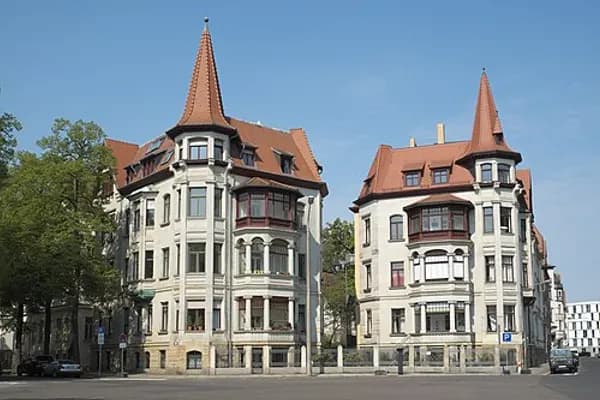
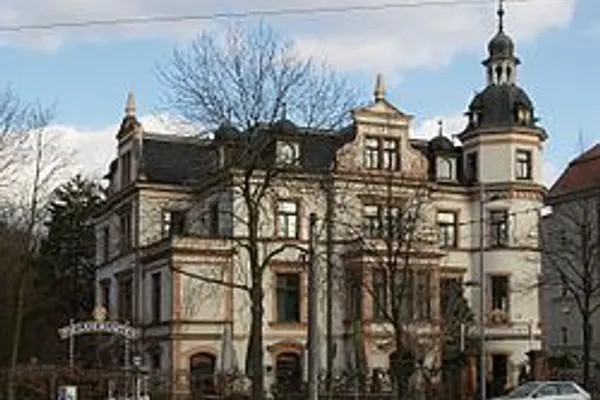
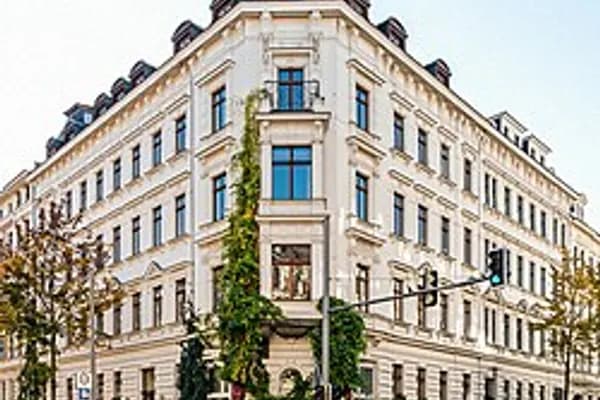
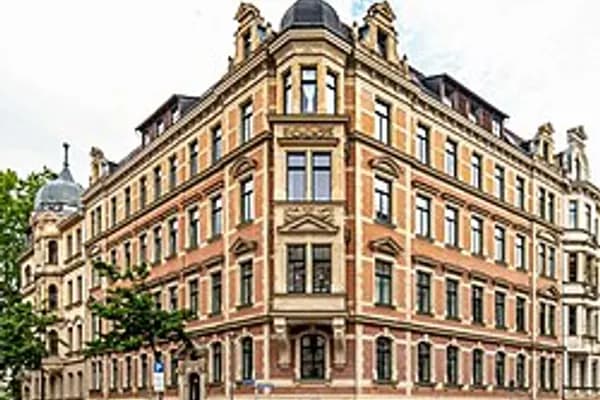
Waldstraßenviertel (German pronunciation: ˈvaltʃtʁaːsn̩ˌfɪʁtl̩, "Forest Street Quarter/Neighbourhood") is a neighbourhood in the north west of Leipzig's borough Mitte in Saxony, Germany. It is considered one of the largest complete areas of Gründerzeit buildings in Europe and is therefore considered of important cultural and heritage status. Many of its buildings are therefore protected or listed.
Statistics
The neighbourhood Waldstrassenviertel is part of the Zentrum-Nordwest locality. It covers an area of 396ha (978.5 acres).
History
Originally this area was forest and grassland. Slavic settlements probably arose very early in the Elster and Pleisse areas. The Via Regia, along today's Ranstädter Steinweg and Jahnallee, was an old trade route that was protected by royal privileges. Hiberno-Scottish missionaries used the Via Regia as early as the 7th century and founded the St. Jacob's Chapel, the first chapel in what later became the city of Leipzig.
In the period from the 10th to the 12th century, numerous river regulation measures took place, for example the Elstermühlgraben (Elster mill ditch) was built and the Parthe was moved to the north. This made further settlement of the area possible.
As early as the Middle Ages, the Via Regia was lined with two rows of houses on the Ranstädter Steinweg, the Mühlgrabensiedlung (mill ditch settlement) was built to the north and the Jacobsviertel or St. Jacob parish to the south next to the St. Jacob's Chapel. Another small settlement of fishermen named The Naundörfchen was located south of the Jacobsviertel and was first mentioned in a document in 1295.
From these settlements, the Ranstädter Vorstadt or Rannische Vorstadt emerged in the 12th century, which was closed off at the level of the current Leibnizstrasse by the Outer Ranstädt Gate. Because of the two mill ditches, butchers, tanners, dyers and fishermen lived in the Rannische Vorstadt.
The Jacobsmühle (Jacob's Mill, later Angermühle) stood near the St. Jacob's Chapel. To the north of it, the Hospital St. Georg (1212-1631) was built between Elstermühlgraben and Pleisse on the edge of the Rosental in 1212 at the behest of Theodoric I, Margrave of Meissen.
Outside the Outer Rannish Gate, north of the Via Regia, was the Leipzig Council Brickworks. In the area of today's Funkenburgstrasse, a large folwark, the Große Funkenburg, was built around the year 1600 with a large garden, two lakes and several outbuildings. It served, among other things, as a restaurant and was a popular Leipzig excursion destination.
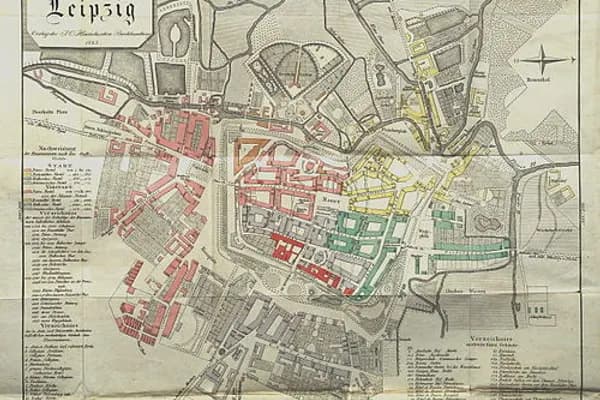
Around 1830, the city's population grew rapidly again, so that further development in the Waldstrasse district became necessary. However, the annual spring floods made this almost impossible and construction could only begin after further regulatory measures.
From around 1830, the Lortzingstrasse/Rosentalgasse area emerged from the buildings that still exist today. This was followed from around 1860 by the Leibnizstrasse area, the Waldplatz and the southern part of the Waldstrasse with its side streets up to Fregestrasse.
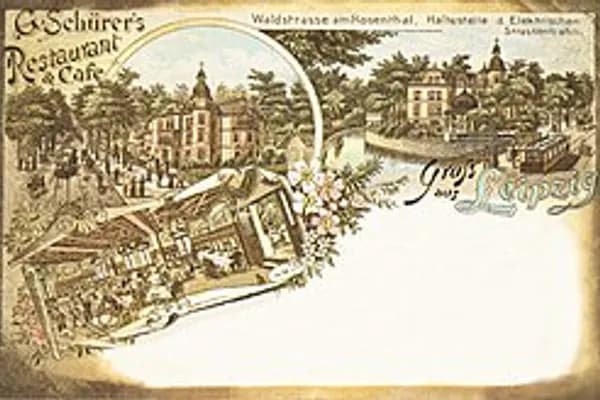
After the Große Funkenburg was demolished in 1897, the remaining area in the area of Funkenburgstrasse and Tchaikovskystrasse was also included in the rectangular street pattern and the district was expanded northwards to Christianstrasse. The northern part, from Fregestrasse onwards, was built in open block perimeter buildings, often in the now modern architectural style of Art Nouveau. Architects from the turn of the century such as Paul Möbius, Emil Franz Hänsel and Raymund Brachmann created striking residential buildings. At the northern end of the district, the Waldstrasse bridge was built over the Elstermühlgraben and a garden restaurant and café was built in 1892/93, which is called Mückenschlösschen (Mosquito castle) because of the area that was once full of mosquitoes.
After the Jewish emancipation in Saxony, the proportion of the Jewish population in the neighbourhood increased. This was particularly evident in the trading city of Leipzig, where the majority of the traders were Jews from Eastern Europe. Many of them settled in what is now the Waldstrasse district, where almost 20% of the population was of Jewish origin. Various Jewish social institutions emerged, such as the Eitingon Hospital or the Ariowitsch Foundation as a retirement home. The Jews of the Waldstrasse district were mainly employed in the fur trading center around Brühl Street. By 1933, around 2,500 Jewish people lived in the Waldstrasse district.
The area between Christianstrasse and Goyastrasse was the last construction phase to be built from around 1925 until the 1960s. In addition to residential buildings, there is also the former Jewish (Eitingon) hospital on the street of the same name.
During the period of industrial housing construction from the 1970s onwards, the building structure, some of which was severely damaged, was neglected, so that the houses continued to deteriorate. After reunification, the Gründerzeit style houses were gradually renovated.
In the area between Goyastrasse and Elstermühlgraben, after 1990, in addition to individual residential buildings, a car dealership, the Goyastrasse municipal nursing home (Städtisches Altenpflegeheim Goyastrasse) and a new building for the Leipzig secondary school for sports (Sportoberschule Leipzig) were built.
The city received a gold medal in the 1994 federal competition from the German Federal Ministry for Housing, Urban Development and Building for its strategy to preserve the Waldstrasse district. On the other hand, several well-preserved and listed buildings were demolished after 2000, for example the late classicist small Funkenburg and the residential and commercial building at Friedrich-Ebert-Strasse 81 a/b, primarily for traffic planning reasons, which led to massive public protests.
Public facilities
In this district there is the Lessing-Grundschule (Lessing elementary school) and the Sportoberschule as well as the Leipzig Natural History Museum in the building of a former secondary school. The building of the former Höhere Israelitische Schule (Higher Israelite School) on Gustav-Adolf-Strasse houses the German Central Library for the Blind.
Famous People
Numerous famous people have lived in the Waldstraßenviertel, many of whom were musicians. Examples are: Albin Ackermann-Teubner, Samuel Agnon, August Bebel, Max Beckmann, Georg Bötticher, Hans Driesch, Bernard Katz, Heinrich August Marschner, Georg Trexler, Auguste Schmidt.
In 1827/1828 the composer Heinrich Marschner lived in the house named Goldene Laute (Ranstädter Steinweg 8) and completed his opera Der Vampyr here .
Albert Lortzing composed his opera Zar und Zimmermann (Tsar and Carpenter) in a garden house in the Funkenburg.
Gustav Mahler lived from 1887 to 1888 in number 12 Gustav-Adolf-Strasse and wrote his Symphony No. 1 there among others.
Since 2014, a memorial plaque at Hinrichsenstrasse 32 commemorates Friedrich Nietzsche, who lived there during several stays.
Accessibility
The main streets of the Waldstrassenviertel are the Jahnallee which continuates the Ranstädter Steinweg coming from the city center and the Waldstrasse after that the neighbourhood is named. At the crossroads is a place named Waldplatz. In the main streets are tracks of the Leipzig tram with several tram stops:
Leibnizstrasse (Line 3, 4, 7, 15)
Waldplatz (Line 3, 4, 7, 8, 15)
Feuerbachstrasse (Line 4)
Am Mückenschlösschen (Line 4)
See also
List of streets and squares in Leipzig
References
Bibliography
Ringel, Sebastian (2023). Vom Wandel der Leipziger Vorstädte. 300 verlorene Bauten aus 160 Jahren (in German). Leipzig: überland Verlagsgesellschft mbH. ISBN978-3-948049-07-2.
Hocquél, Wolfgang (2023). Architekturführer Leipzig. Von der Romanik bis zur Gegenwart (in German). Leipzig: Passage Verlag. ISBN978-3-95415-128-8.
Riedel, Horst (2005). Stadtlexikon Leipzig von A bis Z (in German). Pro Leipzig. ISBN3-936508-03-8.
Lange, Bernd-Lutz (2006). Davidstern und Weihnachtsbaum. Erinnerungen von Überlebenden (in German). Berlin: Aufbau-Taschenbuch-Verlag. ISBN978-3-7466-8143-6.
Lehmstedt, Mark; Haß, Katja (2023). Leipziger Spaziergänge: Waldstraßenviertel (in German). Leipzig: Lehmstedt Verlag. ISBN978-3957971449.
External links
Wikimedia Commons has media related to Waldstraßenviertel.
Wikimedia Commons has media related to Album zum Waldstraßenviertel.
Das Leipziger Waldstraßen- und Bachstraßenviertel. Eine Dokumentation der städtebaulichen Erneuerung im Förderprogramm Städtebaulicher Denkmalschutz, Broschüre der Stadt Leipzig, Dezernat Stadtentwicklung und Bau, Leipzig 2017 (in German)
Waldstraßenviertel in Leipzig-Lexikon (in German)
Residents club of Waldstraßenviertel (in German)
Seidel, Mirko (18 January 2019). "Das Waldstraßenviertel in Leipzig – Historismus in seiner schönsten Form". architektur-blicklicht.de (in German). Retrieved 2 March 2024.
51°20′57″N 12°21′19″E / 51.349189°N 12.355175°E / 51.349189; 12.355175
Germany portal
Saxony portal
Encyclopedic content adapted from the Wikipedia article on Waldstraßenviertel, used under CC BY-SA 4.0.
What makes Waldstraßenviertel special
Waldstraßenviertel stands out among Leipzig’s neighborhoods for its distinctive character: leipzig's gründerzeit quarter. Ranked #5 in Leipzig, it offers the kind of experience that defines a great city trip — a place where the streets themselves tell a story and every block rewards curiosity.
Best for
Our take on Waldstraßenviertel
Waldstraßenviertel occupies a distinctive place in Leipzig's neighborhood landscape. It is the kind of district that rewards travelers who venture beyond the obvious choices — quieter than the tourist-facing areas, richer in local character, and full of the small details that make a city trip memorable.
What makes Waldstraßenviertel exceptional is the density of its cultural life. Art galleries, independent bookshops, small theaters, and creative studios are woven into the fabric of the neighborhood rather than clustered in a single zone. You encounter culture here by accident, which is how the best cultural experiences always happen.
Our editors recommend budgeting at least half a day here — enough time to walk the main streets, sit down for coffee, and discover the side streets where Waldstraßenviertel's real character lives.
Living in Waldstraßenviertel
Waldstraßenviertel is connected to the rest of Leipzig by public transit, and most visitors find it straightforward to reach from the city center or airport. Once you arrive, the neighborhood is best explored on foot — the scale is human and the streets reward wandering.
Day-to-day life in Waldstraßenviertel has the rhythm of a genuine residential neighborhood. You will find grocery stores, pharmacies, cafés with morning regulars, and the kind of small independent shops that only survive where locals support them. For visitors, this means the infrastructure you need — good coffee, a decent meal, a quiet place to sit — is always within a short walk.
Accommodation in Waldstraßenviertel ranges from boutique hotels to short-term rentals. We generally recommend staying within the neighborhood itself rather than commuting from a hotel elsewhere in Leipzig — the experience of waking up inside a great neighborhood is fundamentally different from visiting one as a day trip.
What locals say about Waldstraßenviertel
Long-term residents of Waldstraßenviertel tend to describe their neighborhood with a mix of pride and protectiveness. Like any district with genuine character, Waldstraßenviertel inspires loyalty — the kind of place people move to and never quite leave, or leave and spend years trying to get back to.
The creative community in Waldstraßenviertel is genuine, not aspirational. Residents include working artists, writers, musicians, and designers who chose the neighborhood because it supported their work — affordable studio space, a community that values craft, and enough foot traffic to sustain independent galleries and shops.
Compared to the more famous districts in Leipzig, Waldstraßenviertel has maintained a lower profile, which many residents consider an advantage. The neighborhood evolves gradually rather than being reshaped by sudden attention, and the result is a community that still feels organic rather than curated.
Visitor tips
- Waldstraßenviertel is located in Leipzig, Germany. The neighborhood is accessible by public transport, taxi, or rideshare from most parts of the city.
- Morning is often the best time to explore — the streets are quieter, the light is better for photography, and cafes are at their most welcoming.
- Wear comfortable walking shoes — the best way to experience Waldstraßenviertel is on foot, wandering the side streets and discovering what lies around each corner.
- Save the neighborhood's location on your phone before you arrive. Offline maps are especially useful for navigating the smaller side streets.