About the neighborhood
District of Leipzig in Saxony, Germany
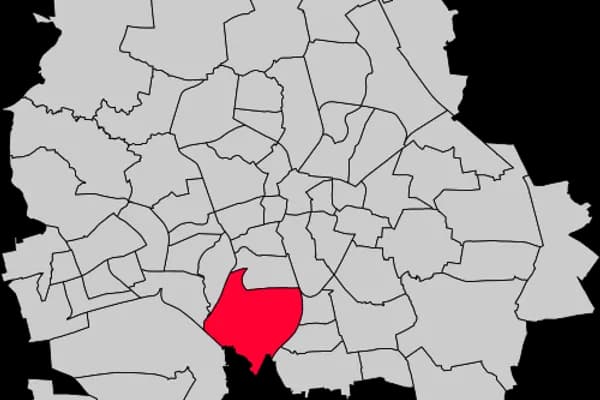
Connewitz (German pronunciation: ˈkɔnəvɪts) is a locality in Leipzig in Saxony, Germany. It is a subdivision (Ortsteil) in the borough of Leipzig-Süd (Stadtbezirk).
Geography
Location
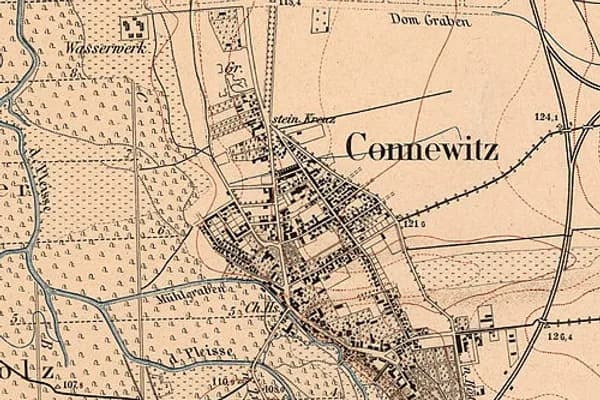
Connewitz is located about 3km (1.9mi) south of downtown Leipzig. The area includes floodplain forests and former fields to the east and up to ten meters higher. Only this area is developed.
Schleußiger Weg, Wundt Street, and Richard-Lehmann-Street form the northern boundaries of the district. The eastern and southeastern borders are formed by the Leipzig–Hof railway line. In the south, the built-up area of Markkleeberg forms the border. Here, however, a few short streets in the area called the Wolfswinkel still belong to Connewitz in an isolated location. The Plagwitz-Markkleeberg railway line the western embankment of the Elster floodplain and the western bank of the Elster floodplain follow to the west.
The neighboring localities are, clockwise from the north, Südvorstadt, Marienbrunn, Lößnig, Dölitz-Dösen, Markkleeberg (independent town), Großzschocher, Kleinzschocher and Schleußig.
Forest and water
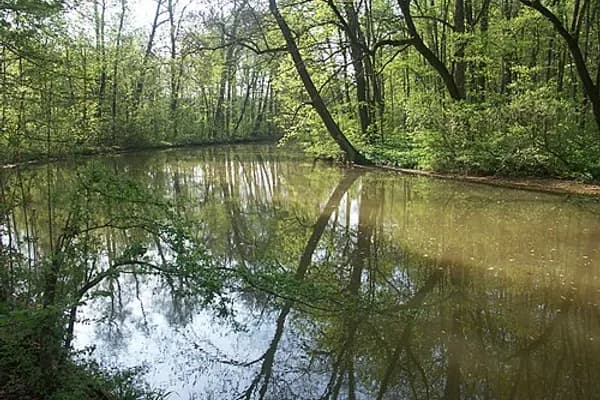
With 384ha (948.9 acres) of forest (53% of its area), Connewitz has the largest proportion of forest in Leipzig's districts. This forest, the Connewitzer Holz, forms the main part of the southern Leipzig Riverside Forest as a contiguous area. It is used for both forestry and recreational purposes. In addition to a dense network of footpaths, cycle paths and bridleways, there is also the Leipzig Wildlife Park, which is home to indigenous animal species. Sports and catering facilities are also available.
Historically, Connewitzer Holz and Dölitzer Holz on the other side of the southeastern district boundary on the right bank of the Pleiße formed the Leipziger Ratsholz. Before the village merged with Ötzsch and Dölitz at the beginning of the 20th century, this forest area was interrupted only by a few meadows.
The forest district Connewitzer Holz is divided into Beipert and Probstei on the left side of the river Pleiße and Batschke-Floß ditches, Pfarrholz, Haken, Wolfswinkel, Langes Feld, Dachsbau, Horst, Gautzscher Spitze und Siebenacker between Floß ditches and Pleiße and Streitholz, Stempel, Mühlholz and Apitzsch on the right side of the river Pleiße.
The Pleiße runs the full length of the Connewitzer Holz from south to north. As early as the first half of the 13th century, the three villages of Dölitz, Lößnig, and Connewitz jointly built a ditch off the Pleiße for the operation of their mills, the Mühlpleiße, which still runs today, with minor changes, in the border area between the forest and the settlement area and flows into the Pleiße at the Hakenbrücke bridge. Shortly before this, the flood bed of the Pleiße flows into the Pleiße on the left in the area of the former Jungfernlachen estuary.
About 150m (492.1ft) to the left is the Panichs Lache and about 350m (1,148.3ft) to the left is the Batschke, usually called Floß ditches in Leipzig. The Batschke used to be a branch of the White Elster near Zwenkau and was once used to raft firewood across the Weiße Elster to Leipzig. The connection to the Elster River was interrupted by lignite mining. Today the Floß ditches receive its water from Cospudener See. It is the connection between Leipzig's waterways and Cospudener See and, since the completion of a bridge in Markkleeberg, can be used for continuous boat traffic.
Further west, in addition to numerous oxbow lakes and puddles, there is another waterway, the Paußnitz. A former tributary of the Batschke, it is fed with Elster water via the Grenz ditches and flows into the Elster floodplain. The latter forms the western border of Connewitz. It was built for flood protection and, like the Pleiße, is used for water sports. Still, in Connewitz, the Pleißemühl ditches branch off at the Pleiße weir and flows through the southern suburbs to the city center.
In historical times there were two watercourses east of the Pleiße in Connewitz. The Trenken ditches (also known as Tränken ditches) came from Probstheida via the Connewitz field (today Marienbrunn) and the area of Hildebrandt street to the Mühlpleiße. Today it is piped and integrated into Leipzig's sewage system. The second was the Dom ditches, from the Marienquelle (near the Monument to the Battle of Nations) roughly along the course of today's Richard-Lehmann Street westward to Heilemann Street and then southward into the former Streitteich pond. Today, only depressions in the ground on the south side of Richard-Lehmann Street and between Heilemann Street and Focke Street remain as reminders of the Dom ditches.
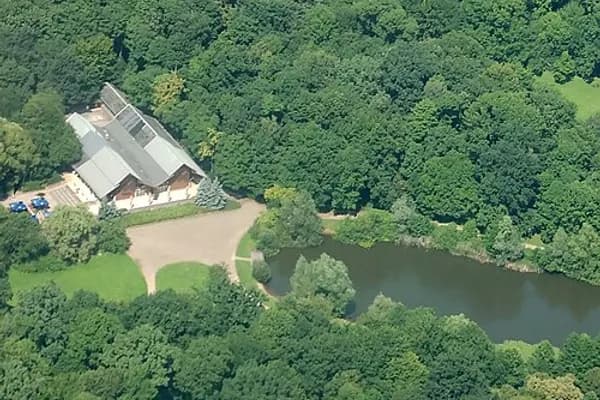
The Streitteich pond in the area of today's Teich Street was the largest of the nine former Connewitz ponds, most of which were located along the Trenken ditches. The former poplar pond near Bornaische Street is still indicated today by the low location of the allotment gardens on Burgstädter Street. The Connewitz village pond was located at the intersection of Probstheidaer Street and Prinz-Eugen Street. Today, the only remaining ponds in Connewitz are the hook pond at the Wildpark guesthouse, which was built in the early 1970s, the smaller frog pond in the Wildpark, and a pond between the buildings on Prinz-Eugen-Street and Mühlpleiße with a connection to the latter.
History
The Connewitz village
There is evidence of a settlement on the site of the present village as far back as the Iron Age.
After the migration of peoples, Sorbian settlers founded the village of Connewitz (Old Sorbian: *Końovica or *Końovici = "horse place", "place where horses graze") probably after the seventh century. The center of the village was a rundling in the triangle of today's Prinz-Eugen-, Probstheidaer- and Biedermann Street. The village developed in a northwestern direction towards the edge of the Pleiße floodplain until it merged with the Sorbian settlement of Döbschütz (later the upper and lower villages) to form a long, cul-de-sac village. The Sorbian population was assimilated by the German settlers in the course of the German East settlement and the rural land take-over in a long process from about the eleventh century. In the upper part of the village, a manor house was established (ca. 1100 Knight of Kunawitz).
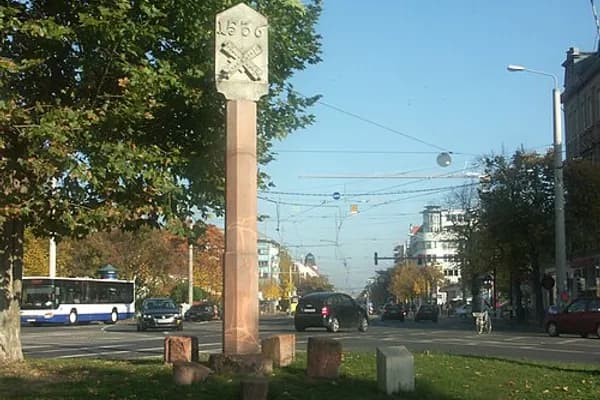
Between 1200 and 1250, the villages of Dölitz, Lößnig, and Connewitz jointly built the 4km (2.5mi) long Mühl ditches for the operation of their mills. In 1275/76 the Augustinian monastery in Leipzig acquired the manor and the rights to the Döbschütz mill. In the 15th century, it expanded its activities. A copper hammer and a grinder were added to the flour, oil, and spice mill. In 1496, the city of Leipzig erected a wooden cross at the fork north of Connewitz, which was replaced in 1536 by a stone column depicting a cross (Connewitz Cross). The surviving stone column from 1536 can be found in the Leipzig City History Museum.
After the Reformation, the Leipzig City Council acquired the Connewitz estate in 1543 and established four threshing estates in 1545. The village of Connewitz, which until the Reformation had belonged to the Chapel of the Holy Cross in Ölschwitz, was assigned to the parish of Probstheida. The Connewitz forester's office was established in 1563. Between 1619 and 1629, 17 farm workers' houses were built next to the mill, the new village of Connewitz, which separated from Connewitz in 1705, but "returned" in 1839. During the Thirty Years' War, there were several cases of looting and plundering when troops passed through. In 1755/56 the (old) cemetery of Connewitz was built near the cross and in 1770/71 a small late baroque church was built in the upper village on the Schulberg, which remained a filial church of Probstheida until 1875.
During the Battle of the Nations near Leipzig, troops from Napoleon's army barricaded themselves in Connewitz, which was severely damaged in the fierce fighting. At the beginning of the 19th century, wealthy Leipzig citizens discovered the beautiful location of Connewitz and built country houses here. In 1830, Schumann's "Lexicon of Saxony", continued by Albert Schiffner, stated that Connewitz was "one of the most beautiful villages in Saxony".
In 1839 Connewitz became an independent municipality with its council according to the Saxon Rural municipality regulations. Until 1856, the town was part of the Electoral Saxon or Royal Saxon District Office of Leipzig. From 1856 Connewitz belonged to the Court Office of Leipzig II and from 1875 to the District Administration of Leipzig. From 1859 to 1871 in the area between Bornaischer Street and today's Wolfgang-Heinze-Street and from 1865 to 1890 between Wolfgang-Heinze-Street and Neudörfchen. In 1877, the address book lists 310 residential buildings.
In 1866, the waterworks for the city of Leipzig were put into operation at the western end of today's Richard-Lehmann Street. From 1887 it was gradually shut down due to the transition to overland supply. In 1868/69, the flood bed of the Pleiße was created for flood protection and the network of paths in the Connewitz Forest was laid out with hiking and riding trails. Street lighting with gas lamps began in 1872. In 1877, the Süd Street (today's Karl-Liebknecht-Strasse) was completed as a straight connection from the cross to the city of Leipzig. In 1880, the new Connewitz Cemetery was opened on Meusdorfer Street, which still exists today.
Finally, in 1891, Connewitz, now with a population of 1,0596, was consolidated into Leipzig along with five other town-like villages. The poverty-stricken village had been seeking incorporation since 1888 to share in Leipzig's economic growth. Before consolidation, the village was also known as Connewitz bei Leipzig.
Connewitz as a Leipzig district
The lively building activity continued after the consolidation, initially by extending the cross streets beyond Bornaische Street to the east and connecting them via Zwenkauer Street. The new church of Connewitz, today's Paul-Gerhardt-church, was consecrated on the site of the old cemetery in 1900. The old church was demolished two years later. From 1911 to 1914, about 60 houses with about 350 apartments were built each year in Connewitz.
The development of the Connewitz section of Süd street also began in 1913 with the Königlich-Sächsische Bauschule (now LUAS) and the Teutonia insurance building opposite it (later the Oberfinanzdirektion, then the Leipzig district headquarters of the SED, now an office complex). In 1926, the building of the Oberpostdirektion (now the Lipsius building of the LUAS) followed next door, i.e. all buildings that were important beyond Connewitz.
In 1913, the International Building Exhibition was held in Leipzig. For this purpose, 48 single-family houses, 14 semi-detached houses, and 10 apartment buildings were erected on the eastern Connewitz site, far from the Connewitz development, as the exhibition object of a garden city, the core of the later independent Leipzig district of Marienbrunn.
After a period of stagnation during and after World War I, residential construction in the northeastern part of Connewitz began in earnest in 1926. Residential buildings, some in the Art Deco style, were erected in and around today's Bernhard-Göring-, Richard-Lehmann-, Arthur-Hoffmann-, and Gustav-Freytag-Street. Between 1930 and 1940, the Eisenbahner-Baugenossenschaft Leipzig built 426 apartments, some in the New Objectivity style, on the newly laid out streets of Burgstädter, Kohrener, and Narsdorfer Street.
In 1926, the Waldbad Connewitz, which was closed again in 1989, was opened, and in 1927/28 Connewitz was given another access from the east with the construction of the Markthallenbrücke bridge and the embankment of today's Richard-Lehmann-Street.
In 1930, St.-Bonifatius Church was built on Biedermann Street in memory of the Catholic merchants who died in the First World War. In 1931, the adjacent St. Elisabeth Hospital was opened. Another hospital was added in 1936, when the Villa Schomburgk on Prinz-Eugen-Street, built by Theodor Kösser in 1899, was used as the Bethanien Hospital, the first in-patient hospital in Saxony. Since 2014, the building has been an outpatient rehabilitation center of the Elisabeth Hospital.
The air raids on Leipzig during World War II caused considerable destruction in Connewitz. Nearly half of the residential buildings north of the cross, parts of Herder Street (including the school), Brand Street (Friedrichshallen entertainment center), and today's Wolfgang-Heinze-Street were affected, as well as the Connewitz Mill, the Wald-Café, the Zum Wassergott inn, and large parts of the gas works. On April 18, 1945, U.S. Army troops occupied the city, and after the Red Army took over on July 2, 1945, Leipzig became part of the Soviet occupation zone.
Connewitz 1945–1989
In the 1950s and early 1960s, after the wartime rubble had been cleared, attempts were made to fill in the gaps in the urban fabric. Predominantly four-story, mostly plain residential buildings were erected, for example on Brand Street and Windscheid Street, on Bernhard-Göring-Street and Richard-Lehmann-Street, and Hildebrandplatz. In 1953, the first phase of construction of the German Postal Engineering School began, and in 1958, the expansion of the Technical University (now LUAS).
In 1969, the department store at the cross and the indoor swimming pool in Arno-Nitzsche-Street was built, which was closed in 2004. In 1970, the student gym was opened next to the indoor pool.
From 1957 to 1962, the gasworks was significantly expanded to ensure Leipzig's gas supply. In 1977, the gas coking plant was shut down and the city's gas was supplied by the black pump gas combine until it was converted to natural gas. Between 1984 and 1987, a lignite-based combined heat and power plant was built on the site, but it ceased operation in 2004 for environmental reasons and was demolished, except for the furnace.
Due to the interruption of the F2 and F95 trunk roads by the lignite mines south of Leipzig, the new four-lane F2 was built in the early 1980s, which reached Leipzig via Markkleeberg through Connewitzer Holz at Wundt Street. This gave Connewitz direct access to the highway network with two slip roads.
The decay of the old building fabric, which could be found everywhere during the GDR era, was particularly noticeable in the old part of Connewitz around Biedermann Street. Large-scale demolition and replacement with large prefabricated buildings was therefore planned and had already begun when the events of 1989/90 (the first People's Building Conference) put an end to it for the time being.
Connewitz after 1989
Encyclopedic content adapted from the Wikipedia article on Connewitz, used under CC BY-SA 4.0.