About the neighborhood
Urban neighborhood in the city of Havana, Cuba
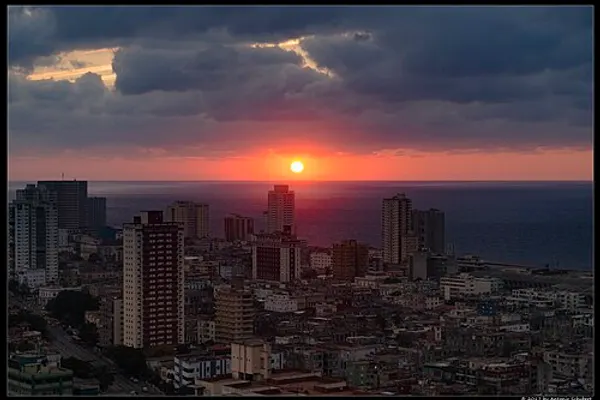
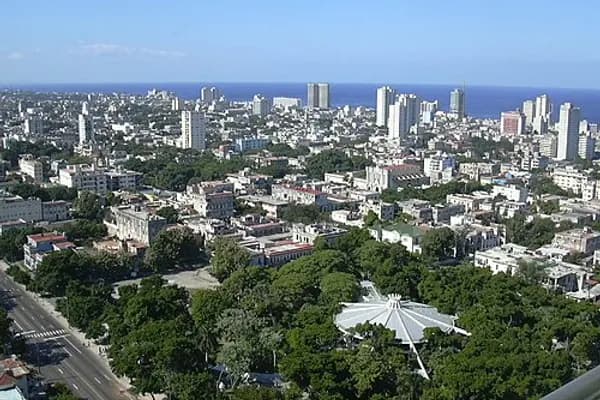
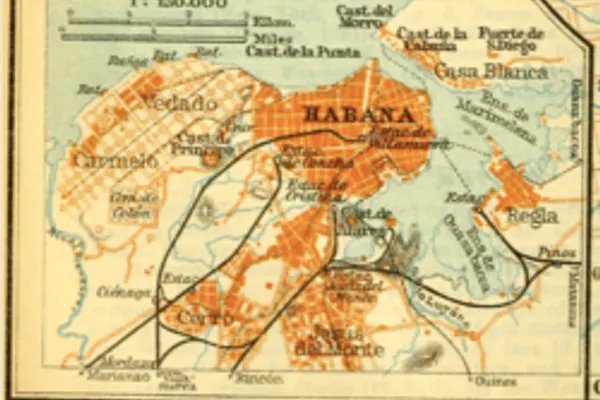
Vedado (Spanish: El Vedado, Spanish pronunciation: el βeˈðaðo) is a central business district and urban neighborhood in the city of Havana, Cuba. Bordered on the east by Calzada de Infanta and Central Havana, and on the west by the Alemendares River and Miramar / Playa district, Vedado is a more modern part of the city than the areas to the east, developed in the first half of the 20th century, during the Republic period. In 2016 it was described by one commentator as the city's "most affluent" section. The main street running east to west is Calle 23, also known as "La Rampa". The northern edge of the district is the waterfront seawall known as the Malecón, a famous and popular place for social gatherings in the city. The area popularly referred to as 'Vedado' consists of the wards (consejos populares) of Vedado, Rampa, Vedado-Malecón and Carmelo, all in the municipality of Plaza de la Revolución.
History
El Vedado was since the 16th century a part of the country where building was prohibited for military reasons. This changed in 1859 with the division of a piece of land in what would later be called el Carmelo. The land was divided with a tartan grid of 100 meter for the blocks and 16 meter for the streets. The main streets were 25 meters wide to make them suitable for a tram.
Soon followed other urban areas: el Vedado in 1860 and Medina in 1883. And at the start of the First Republic the once forbidden land was parcelled in full. Línea street was intended to build the tram track. The Avenidas Paseo, Presidentes (calle G) and 23 where among the other important streets.
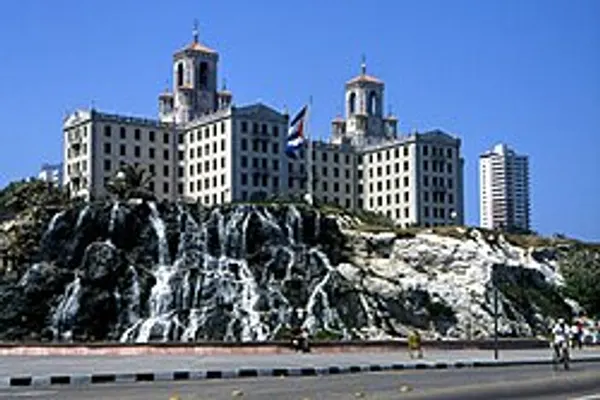
The first buildings in this area were mainly bourgeois villas. In the thirties there was a first period of prosperity in which, among others, the López Serrano building and the hotel Nacional were built.
During the construction boom of the 1950s, dozens of tall apartment buildings were constructed. A famous building from that period is the Havana Hilton hotel, at that time the tallest hotel in Latin America.
Notable sites
Among the notable sites in Vedado are the hotels: Hotel Nacional de Cuba (National Hotel), the Havana Libre (former Hilton), Melia Cohiba Hotel and Hotel Riviera.
In addition:
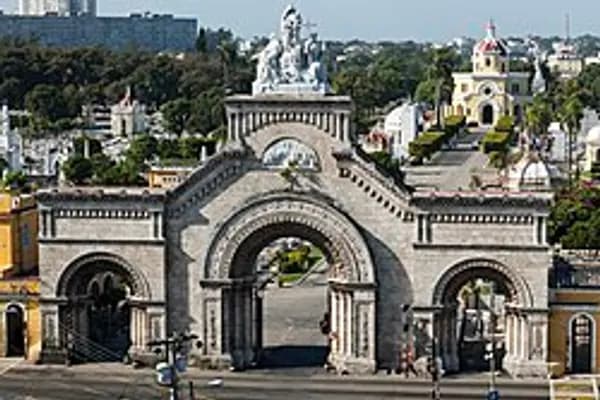
Colon Cemetery
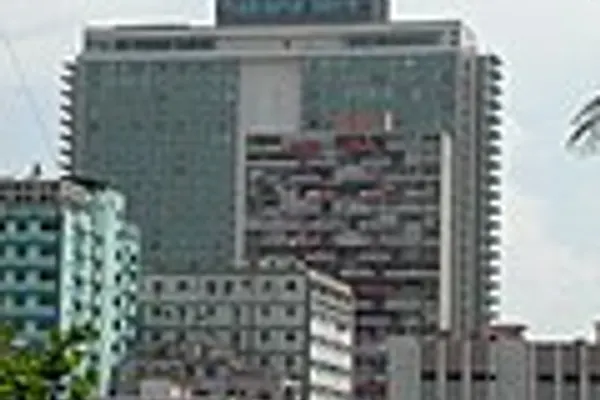
FOCSA Building, tallest building in Cuba at 121 m
Edificio del Seguro Médico, Havana
López Serrano Building, first skyscraper in Cuba
Radiocentro CMQ Building
Coppelia (ice cream parlor)
Embassy of the United States, Havana
José Martí Anti-Imperialist Plaza
Jewish religious centers include the Gran Sinagoga Bet Shalom and the Centro Hebreo Sefaradi
John Lennon Park, named for the statue of Lennon located there
Monument to the Victims of the USS Maine
University of Havana
National broadcast center for Cuban television.
Cementerio Chino (The Chinese Cemetery)
Nearby neighborhoods include:
To the east: Central Havana
To the west: Miramar
Economy
Aero Caribbean has its headquarters in Vedado.
The Venezuelan airline Conviasa has an office in the IACC Building in Vedado.
Government and infrastructure
Instituto de Aeronáutica Civil de Cuba, Cuba's civil aviation authority, has its headquarters in Vedado.
Culture
Gay scene
23rd Street in Vedado is also the centerpoint of the city's gay scene in a country which now grants many rights to LGBT citizens. At night, 23rd St. is reminiscent of a gay district between the Cinema Yara and Coppelia ice cream parlor, and the foot of 23rd at the Malecón, with numerous gay entertainment options nearby such as the Bim Bom outdoor bar and the Las Vegas nightclub. Many of the casas particulares target LGBT clients as customers.
See also
Cubaportal
References
Bibliography
Carles Crosas Armengol (2008). "Reticulas verdes, nuevas ciudades decimonönicas. El paradigma del Vedado, 'En sanche Jardin' de La Habana" Green grids, new nineteenth-century cities; the paradigm of Vedado, garden of Havana (PDF). Revista Iberoamericana de Urbanismo (in Spanish). Polytechnic University of Catalonia. ISSN2013-6242.
Günter Mertins [in German]; Orestes Sardiñas Gómez (2014). "El Vedado / Havana (Cuba): Consequences of the Transformation Process Within a Former Upper-Class Residential Quarter". Erdkunde. 68 (3): 209–217. doi:10.3112/erdkunde.2014.03.05. ISSN0014-0015. JSTOR24365233.
External links
Media related to Vedado at Wikimedia Commons
23°07′52″N 82°23′39″W / 23.1311111111°N 82.3941666667°W / 23.1311111111; -82.3941666667
Encyclopedic content adapted from the Wikipedia article on Vedado, used under CC BY-SA 4.0.
What makes Vedado special
Vedado stands out among Havana’s neighborhoods for its distinctive character: havana's 20th-century grandeur. Ranked #2 in Havana, it offers the kind of experience that defines a great city trip — a place where the streets themselves tell a story and every block rewards curiosity.
Best for
Our take on Vedado
Vedado is one of the strongest neighborhoods in Havana, and it consistently appears in our editors' personal favorites lists. It may not always get the same attention as the city's most famous district, but among travelers who know Havana well, Vedado is often the first recommendation.
What makes Vedado worth the visit is the texture of daily life here. It is a neighborhood that functions for the people who live in it — not just for the visitors who pass through. The shops serve local needs, the restaurants feed local appetites, and the streets have a rhythm that reflects genuine community rather than tourism infrastructure. That is the quality our editors prize most, and Vedado has it in abundance.
Our editors recommend budgeting at least half a day here — enough time to walk the main streets, sit down for coffee, and discover the side streets where Vedado's real character lives.
Living in Vedado
Vedado is connected to the rest of Havana by public transit, and most visitors find it straightforward to reach from the city center or airport. Once you arrive, the neighborhood is best explored on foot — the scale is human and the streets reward wandering.
Day-to-day life in Vedado has the rhythm of a genuine residential neighborhood. You will find grocery stores, pharmacies, cafés with morning regulars, and the kind of small independent shops that only survive where locals support them. For visitors, this means the infrastructure you need — good coffee, a decent meal, a quiet place to sit — is always within a short walk.
Accommodation in Vedado ranges from boutique hotels to short-term rentals. We generally recommend staying within the neighborhood itself rather than commuting from a hotel elsewhere in Havana — the experience of waking up inside a great neighborhood is fundamentally different from visiting one as a day trip.
What locals say about Vedado
Long-term residents of Vedado tend to describe their neighborhood with a mix of pride and protectiveness. Like any district with genuine character, Vedado inspires loyalty — the kind of place people move to and never quite leave, or leave and spend years trying to get back to.
What locals appreciate most about Vedado is its consistency — the feeling that the neighborhood works the same way on a Tuesday morning as it does on a Saturday night. It is not a place that performs for visitors and then goes quiet. The rhythm is genuine, the community is real, and the daily experience of living here is what draws people and keeps them.
Like any neighborhood that has earned attention, Vedado is navigating the tension between popularity and preservation. Rents have risen, new businesses have arrived, and long-time residents occasionally grumble that the neighborhood is not what it was. But the fundamentals — the walkability, the food, the community — remain strong, and most locals we speak to believe the neighborhood is still gaining more than it is losing.
Visitor tips
- Vedado is located in Havana, Cuba. The neighborhood is accessible by public transport, taxi, or rideshare from most parts of the city.
- Morning is often the best time to explore — the streets are quieter, the light is better for photography, and cafes are at their most welcoming.
- Wear comfortable walking shoes — the best way to experience Vedado is on foot, wandering the side streets and discovering what lies around each corner.
- Save the neighborhood's location on your phone before you arrive. Offline maps are especially useful for navigating the smaller side streets.