About the neighborhood
Fort
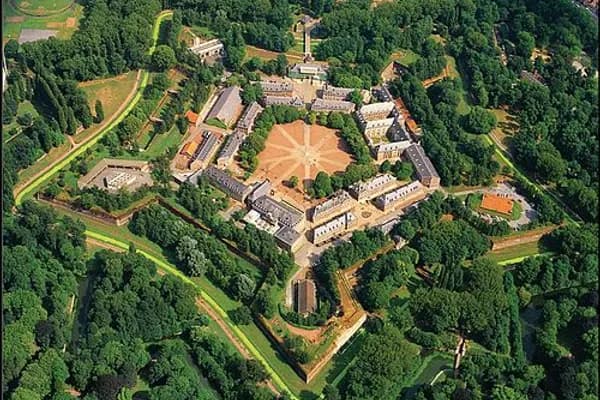
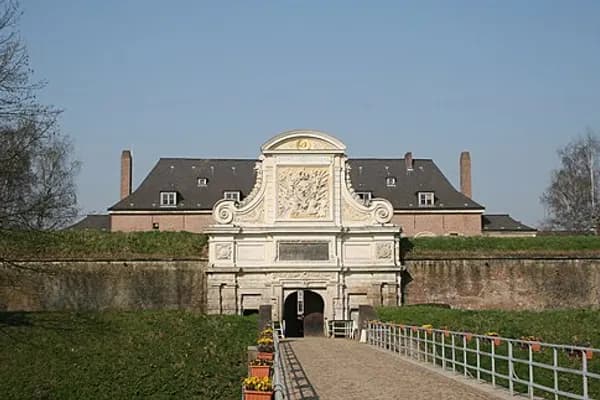
The Citadel of Lille (French: Citadelle de Lille; Dutch: Citadel van Rijsel) is a pentagonal citadel of the city wall of Lille, in France. It was built between 1667 and 1670. It hosts the Corps de réaction rapide France.
Dubbed "Queen of the citadels" (Reine des citadelles) by Vauban, it is one of the most notable citadels designed by Vauban. It is remarkable for its size, the quality of the architecture, and the state of preservation today. Its various components have been classified as historic monuments in 1914, 1921 and 1934 respectively.
A first-class military installation
This "Queen of Citadels" is the matrix of most citadels designed by Vauban. Established on the border of Flanders, it was part of a double-line of fortified towns between Gravelines, Dunkirk and Maubeuge-Rocroi. It delineated the famous "Pré Carré" ("square field") conceived by Vauban comprising 28 fortified cities. From Lille, Vauban supervised the construction of the many citadels and canals of the North, which controlled the border between France and Belgium.
Lille was taken from Spain by French troops in August 1667, and Louis XIV immediately ordered the construction of a fortress. Louis Nicolas de Clerville and Vauban proposed plans. Vauban's were those chosen by the King. Work was started in 1668 under the direction of Lille's master mason, Simon Vollant. In 1671, the citadel became operational while Vauban continued to shape the city by constructing, a few steps away, a new neighborhood around the Rue Royale. The design of the citadel follows a simple but very effective idea: not one of its walls can be approached by the enemy without them being under fire from a nearby wall.
Location
The citadel was constructed to the west of the city on marshland at the junction of the rivers Deûle and Bucquet. This allowed the use of swamp water and mud as a natural defense to make conditions more difficult for any possible enemy besieging the citadel. Through a system of locks and water gates, 1,700 hectares around the citadel could be flooded to a depth of 55 cm. A wide esplanade interrupted the works, connecting the fort to the city. In 1750, a canal along the esplanade was dug according to the plans drawn up by Vauban.
References
External links
Media related to Citadelle de Lille at Wikimedia Commons
50°38′28″N 3°02′40″E / 50.64111°N 3.04444°E / 50.64111; 3.04444
Encyclopedic content adapted from the Wikipedia article on Vauban, used under CC BY-SA 4.0.
What makes Vauban special
Vauban stands out among Lille’s neighborhoods for its distinctive character: lille's student district. Ranked #3 in Lille, it offers the kind of experience that defines a great city trip — a place where the streets themselves tell a story and every block rewards curiosity.
Best for
Our take on Vauban
Vauban is one of the strongest neighborhoods in Lille, and it consistently appears in our editors' personal favorites lists. It may not always get the same attention as the city's most famous district, but among travelers who know Lille well, Vauban is often the first recommendation.
What makes Vauban worth the visit is the texture of daily life here. It is a neighborhood that functions for the people who live in it — not just for the visitors who pass through. The shops serve local needs, the restaurants feed local appetites, and the streets have a rhythm that reflects genuine community rather than tourism infrastructure. That is the quality our editors prize most, and Vauban has it in abundance.
Our editors recommend budgeting at least half a day here — enough time to walk the main streets, sit down for coffee, and discover the side streets where Vauban's real character lives.
Living in Vauban
Vauban is connected to the rest of Lille by public transit, and most visitors find it straightforward to reach from the city center or airport. Once you arrive, the neighborhood is best explored on foot — the scale is human and the streets reward wandering.
Day-to-day life in Vauban has the rhythm of a genuine residential neighborhood. You will find grocery stores, pharmacies, cafés with morning regulars, and the kind of small independent shops that only survive where locals support them. For visitors, this means the infrastructure you need — good coffee, a decent meal, a quiet place to sit — is always within a short walk.
Accommodation in Vauban ranges from boutique hotels to short-term rentals. We generally recommend staying within the neighborhood itself rather than commuting from a hotel elsewhere in Lille — the experience of waking up inside a great neighborhood is fundamentally different from visiting one as a day trip.
What locals say about Vauban
Long-term residents of Vauban tend to describe their neighborhood with a mix of pride and protectiveness. Like any district with genuine character, Vauban inspires loyalty — the kind of place people move to and never quite leave, or leave and spend years trying to get back to.
What locals appreciate most about Vauban is its consistency — the feeling that the neighborhood works the same way on a Tuesday morning as it does on a Saturday night. It is not a place that performs for visitors and then goes quiet. The rhythm is genuine, the community is real, and the daily experience of living here is what draws people and keeps them.
Compared to the more famous districts in Lille, Vauban has maintained a lower profile, which many residents consider an advantage. The neighborhood evolves gradually rather than being reshaped by sudden attention, and the result is a community that still feels organic rather than curated.
Visitor tips
- Vauban is located in Lille, France. The neighborhood is accessible by public transport, taxi, or rideshare from most parts of the city.
- Morning is often the best time to explore — the streets are quieter, the light is better for photography, and cafes are at their most welcoming.
- Wear comfortable walking shoes — the best way to experience Vauban is on foot, wandering the side streets and discovering what lies around each corner.
- Save the neighborhood's location on your phone before you arrive. Offline maps are especially useful for navigating the smaller side streets.