About the neighborhood
Prefecture and commune in Hauts-de-France, France
Lille (/ˈliːl/, LEEL; French: lil ; Dutch: Rijsel ˈrɛisəl ; Picard: Lile; West Flemish: Rysel) is a city in the northern part of France, within French Flanders. Positioned along the Deûle river, near France's border with Belgium, it is the capital of the Hauts-de-France region, the prefecture of the Nord department, and the main city of the European Metropolis of Lille.
The city of Lille proper had a population of 238,246 in 2023 within its small municipal territory of 35km (14sqmi), but together with its French suburbs and exurbs the Lille metropolitan area (French part only), which extends over 1,666km (643sqmi), had a population of 1,528,848 (2022), the fourth most populated in France after Paris, Lyon, and Marseille. The city of Lille and 94 suburban French municipalities have formed since 2015 the European Metropolis of Lille, an indirectly elected metropolitan authority now in charge of wider metropolitan issues, with a population of 1,194,040 (2022).
More broadly, Lille belongs to a vast conurbation formed with the Belgian cities of Mouscron, Kortrijk, Tournai and Menin, which gave birth in January 2008 to the Eurometropolis Lille–Kortrijk–Tournai, the first European Grouping of Territorial Cooperation (EGTC), which has more than 2.1 million inhabitants.
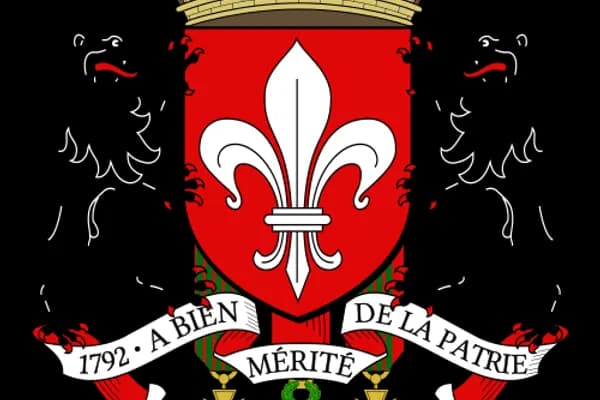
Nicknamed in France the "Capital of Flanders", Lille and its surroundings belong to the historical region of Romance Flanders, a former territory of the county of Flanders that is not part of the linguistic area of West Flanders. A garrison town (as evidenced by its Citadel), Lille has had an eventful history from the Middle Ages to the French Revolution. Very often besieged during its history, it belonged successively to the Kingdom of France, the Burgundian State, the Holy Roman Empire of Germany and the Spanish Netherlands before being definitively attached to the France of Louis XIV following the War of Spanish Succession along with the entire territory making up the historic province of French Flanders. Lille was again under siege in 1792 during the Franco-Austrian War, and in 1914 and 1940. It was severely tested by the two world wars of the 20th century during which it was occupied and suffered destruction.
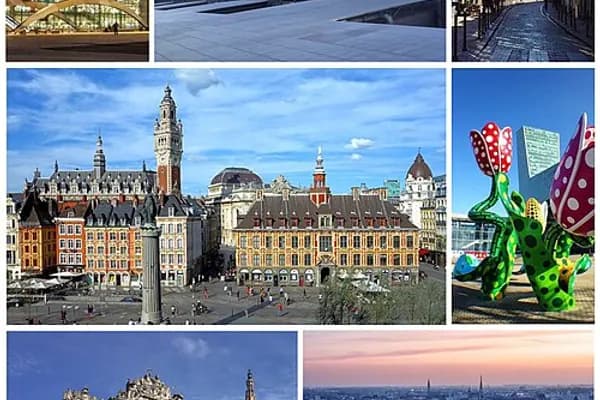
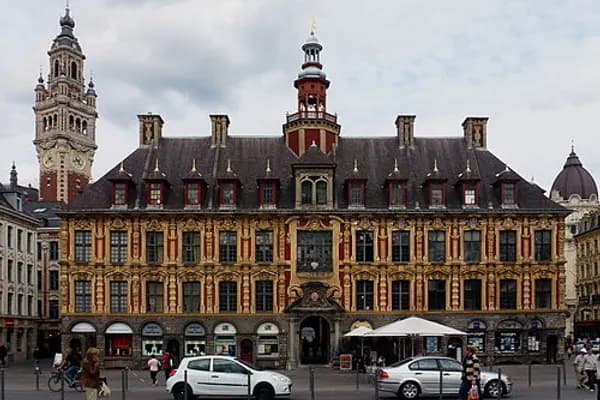
A merchant city since its origins and a manufacturing city since the 16th century, the Industrial Revolution made it a great industrial capital, mainly around the textile and mechanical industries. Their decline, from the 1960s onwards, led to a long period of crisis and it was not until the 1990s that the conversion to the tertiary sector and the rehabilitation of the disaster-stricken districts gave the city a different face. Today, the historic center, Old Lille, is characterized by its 17th-century red brick town houses, its paved pedestrian streets and its central Grand'Place. The belfry of the Hôtel de Ville (City Hall) is one of the 23 belfries in the Nord-Pas-de-Calais and Somme regions that were classified as UNESCO World Heritage Sites in July 2005, in recognition of their architecture and importance to the rise of municipal power in Europe.
The construction of the brand-new Euralille business district in 1988 (now the third largest in France) and the arrival of the TGV and then the Eurostar in 1994 made the city easily accessible from major European cities. The development of its international airport, annual events such as the Braderie de Lille in early September (attracting three million visitors), the development of a student and university center (with more than 110,000 students in colleges and schools of the University of Lille and the Catholic University of Lille, the third largest in France behind Paris and Lyon), its ranking as a European Capital of Culture in 2004 and the events of Lille 2004 (European Capital of Culture) and Lille 3000 are the main symbols of this revival. The European metropolis of Lille was awarded the "World Design Capital 2020".
History
Origins
Archeological digs seem to show the area as inhabited by as early as 2000 BC, most notably in the modern quartiers of Fives, Wazemmes and Vieux Lille. The original inhabitants of the region were the Gauls, such as the Menapians, the Morins, the Atrebates and the Nervians, who were followed by Germanic peoples: the Saxons, the Frisians and the Franks.
The legend of "Lydéric and Phinaert" puts the foundation of the city of Lille at 640. In the 8th century, the language of Old Low Franconian was spoken, as attested by toponymic research. Lille's Dutch name is Rijsel, which comes from ter ijsel (at the island) from Middle Dutch ijssel ("small island, islet"), calque of Old French l'Isle ("the Island"), itself from Latin Īnsula, from īnsula ("island").
From 830 to around 910, the Vikings invaded Flanders. After the destruction caused by Normans' and the Magyars' invasion, the eastern part of the region was ruled by various local princes.
The first mention of the town dates from 1066: apud Insulam (Latin for "at the island"). It was then controlled by the County of Flanders, as were the regional cities (the Roman cities Boulogne, Arras, Cambrai as well as the Carolingian cities Valenciennes, Saint-Omer, Ghent and Bruges). The County of Flanders thus extended to the left bank of the Scheldt, one of the richest and most prosperous regions of Europe.
Middle Ages
The Carolingian duke Évrard lived in the city in the 9th century and participated in many of the day's political and military affairs. There was an important Battle of Lille in 1054. Raimbert of Lille (fl. c. 1100) was an early nominalist who taught at Lille.
From the 12th century, the fame of the Lille cloth fair began to grow. In 1144 Saint-Sauveur parish was formed, which would give its name to the modern-day quartier Saint-Sauveur.
The counts of Flanders, Boulogne, and Hainaut came together with England and East Frankia and tried to regain territory taken by Philip II of France following Henry II of England's death, a war that ended with the French victory at Bouvines in 1214. Infante Ferdinand, Count of Flanders was imprisoned and the county fell into dispute: it would be his wife, Jeanne, Countess of Flanders and Constantinople, who ruled the city. She was said to be well loved by the residents of Lille, who by that time numbered 10,000.
In 1225, the street performer and juggler Bertrand Cordel, doubtlessly encouraged by local lords, tried to pass himself off as Baldwin I of Constantinople (the father of Jeanne of Flanders), who had disappeared at the battle of Adrianople. He pushed the counties of Flanders and Hainaut towards sedition against Jeanne in order to recover his land. She called her cousin, Louis VIII ("The Lion"). He unmasked the imposter, whom Countess Jeanne quickly had hanged. In 1226 the king agreed to free Infante Ferdinand, Count of Flanders. Count Ferrand died in 1233, and his daughter Marie soon after. In 1235, Jeanne granted a city charter by which city governors would be chosen each All Saint's Day by four commissioners chosen by the ruler. On 6 February 1236, she founded the Countess's Hospital (Hospice Comtesse). It was in her honour that the hospital of the Regional Medical University of Lille was named "Jeanne of Flanders Hospital" in the 20th century.
The Countess died in 1244 in the Abbey of Marquette, leaving no heirs. The rule of Flanders and Hainaut thus fell to her sister, Margaret II, Countess of Flanders, then to Margaret's son, Guy of Dampierre. Lille fell under the rule of France from 1304 to 1369, after the Franco-Flemish War (1297–1305).
The county of Flanders fell to the Burgundian State next, after the 1369 marriage of Margaret III, Countess of Flanders, and Philip the Bold, Duke of Burgundy. Lille thus became one of the three capitals of said Duchy, along with Brussels and Dijon. By 1445, Lille counted some 25,000 residents. Philip the Good, Duke of Burgundy, was even more powerful than the King of France, and made Lille an administrative and financial capital.
On 17 February 1454, one year after the taking of Constantinople by the Turks, Philip the Good organised a Pantagruelian banquet at his Lille palace, the still-celebrated "Feast of the Pheasant". There the Duke and his court undertook an oath to Christianity.
In 1477, at the death of the last duke of Burgundy, Charles the Bold, Mary of Burgundy married Maximilian of Austria, who thus became Count of Flanders.
Early modern era
The 16th and 17th centuries were marked by a boom in the regional textile industry, the Protestant revolts and outbreaks of the Black Death.
Lille came under the rule of the Charles V, Holy Roman Emperor in 1519. The Low Countries fell to his eldest son, Philip II of Spain, in 1555. The city remained under Spanish Habsburg rule until 1668. Reformed Christianity first appeared in the area in 1542, and by 1555, the authorities were taking steps to suppress that form of Protestantism. In 1566, the countryside around Lille was affected by the Beeldenstorm. In 1578, the Hurlus, a group of Protestant rebels, stormed the castle of the Counts of Mouscron. They were removed four months later by a Catholic Wallon regiment, and they tried several times between 1581 and 1582 to take the city of Lille, all in vain. The Hurlus were notably held back by the legendary Jeanne Maillotte.
Also in 1581, at the call of Elizabeth I of the Kingdom of England, the north of the Seventeen Provinces, having gained a Protestant majority, successfully revolted and formed the Dutch Republic. The war brought or exacerbated periods of famine and plague (the last in 1667–1679).
The first printer to set up shop in Lille was Antoine Tack in 1594. The 17th century saw the building of new institutions: an Irish College in 1610, a Jesuit college in 1611, an Augustinian college in 1622, almshouses or hospitals such as the Maison des Vieux hommes in 1624 and the Bonne et Forte Maison des Pauvres in 1661, and of a Mont-de-piété in 1626.
Unsuccessful French attacks on the city were launched in 1641 and 1645. In 1667, Louis XIV successfully laid siege to Lille, resulting in it becoming French in 1668 under the Treaty of Aix-la-Chapelle, provoking discontent among the citizens of the prosperous city. A number of important public works undertaken between 1667 and 1670, such as when Sébastien Le Prestre, Marquis of Vauban build the Citadel of Lille, or the creation of the quartiers of Saint-André and la Madeleine, enabled the French king to gradually gain the confidence of his new subjects in Lille, some of whom continued to feel Flemish, but they had always spoken the Romance Picard language.
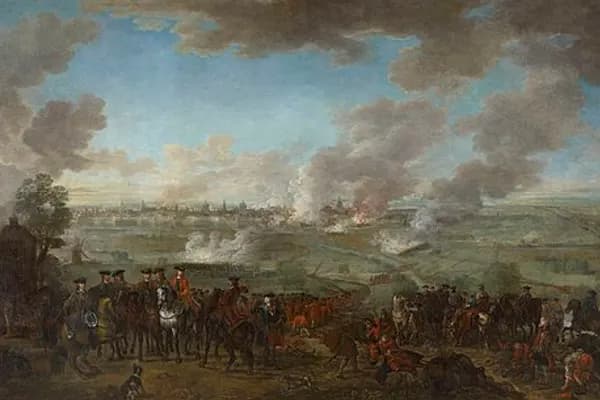
In 1708, during the War of the Spanish Succession, the Grand Alliance managed to capture Lille. For five years, from 1708 to 1713, the Dutch continued to occupy the city. Throughout the 18th century, Lille remained a profoundly Catholic city. It took little part in the French Revolution, but there were riots and the destruction of churches. In 1790, the city held its first municipal elections.
Post-French Revolution
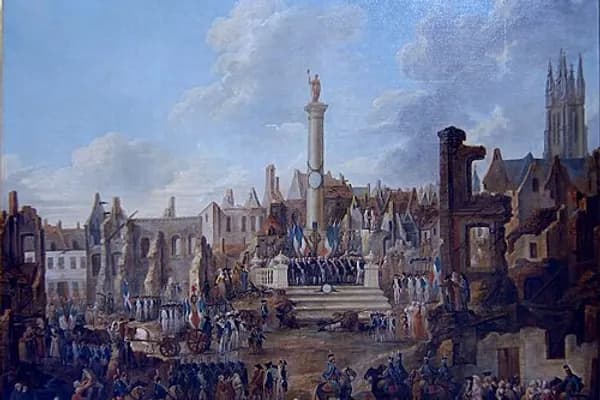
In 1792, in the aftermath of the French Revolution, the Austrians, then in the United Provinces, laid siege to Lille. The "Column of the Goddess", erected in 1842 in the "Grand-Place" (officially named Place du Général-de-Gaulle), is a tribute to the city's resistance, led by Mayor François André-Bontefr. Although Austrian artillery destroyed many houses and the main church of the city, the city did not surrender, and the Austrian Army left after eight days.
The city continued to grow and, by 1800, had some 53,000 residents, leading to Lille becoming the seat of the Nord département in 1804. In 1846, a railway connecting Paris and Lille was built. In the early 19th century, Napoleon I's continental blockade against the United Kingdom led to Lille's textile industry developing even more fully. The city was known for its cotton while the nearby towns of Roubaix and Tourcoing worked wool. Leisure activities were thoroughly organised in 1858 for the 80,000 inhabitants. Cabarets or taverns for the working class numbered 1,300, or one for every three houses. At that time the city counted 63 drinking and singing clubs, 37 clubs for card players, 23 for bowling, 13 for skittles, and 18 for archery. The churches likewise have their social organizations. Each club had a long roster of officers, and a busy schedule of banquets festivals and competitions. In 1853, Alexandre Desrousseaux composed his lullaby "P'tit quinquin".
In 1858, Lille annexed the adjacent towns of Esquermes, Fives, Moulins-Lille and Wazemmes. Lille's population was 158,000 in 1872, growing to over 200,000 by 1891. In 1896 Lille became the first city in France to be led by a socialist, Gustave Delory.
By 1912, Lille's population stood at 217,000. The city profited from the Industrial Revolution, particularly via coal and the steam engine. The entire region grew wealthy thanks to its mines and textile industry.
First World War
Lille's occupation by the Germans began on 13 October 1914 after a ten-day siege and heavy shelling, which destroyed 882 apartment and office blocks and 1,500 houses, mostly around the railway station and in the centre. By the end of October, the city was being run by German authorities. Because Lille was only 20 kilometres (12mi) from the battlefield, German troops passed through the city regularly on their way to and from the front. As a result, occupied Lille became a place for the hospitalisation and the treatment of wounded soldiers as well as a place for soldiers' relaxation and entertainment. Many buildings, homes and businesses were requisitioned to those ends.
Lille was liberated by the Allies on 17 October 1918, when General William Birdwood and his troops were welcomed by joyous crowds. The general was made an honorary citizen of the city of Lille on 28 October.
The only audio recording known to have been made during World War I was recorded near Lille in October 1918. The two-minute recording captured the Royal Garrison Artillery conducting a gas shell bombardment.
Lille was also the hunting ground of the German World War I flying ace Max Immelmann, who was nicknamed "the Eagle of Lille".
Années Folles, Great Depression and Popular Front
In July 1921, at the Pasteur Institute in Lille, Albert Calmette and Camille Guérin discovered the first anti-tuberculosis vaccine, known as BCG ("Bacille de Calmette et Guérin"). The Opéra de Lille, designed by Lille architect Louis M. Cordonnier, was dedicated in 1923.
From 1931, Lille felt the repercussions of the Great Depression, and by 1935, a third of the city's population lived in poverty. In 1936, the city's mayor, Roger Salengro, became Minister of the Interior of the Popular Front but eventually killed himself after right-wing groups led a slanderous campaign against him.
Second World War
Encyclopedic content adapted from the Wikipedia article on Centre, used under CC BY-SA 4.0.