About the neighborhood
Neighbourhood in Toronto, Ontario, Canada
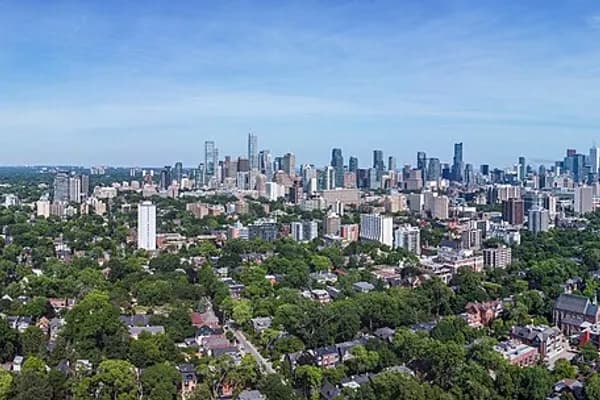
The Annex is a neighbourhood in Midtown Toronto, Ontario, Canada. The traditional boundaries of the neighbourhood extend north to Dupont Street, south to Bloor Street, west to Bathurst Street and east to Avenue Road. The City of Toronto recognizes a broader neighbourhood definition that includes the adjacent Seaton Village and Yorkville areas.
Bordering the St. George campus of the University of Toronto, the Annex has long been a student quarter, and it is also home to many fraternity houses and members of the university's faculty. According to the 2011 Canadian census, the neighbourhood has an average income of $66,742.67, significantly above the average income in the Toronto census metropolitan area.
The Annex is not known for its large population of immigrants – in 2011, Statistics Canada declared that there were about 4,665 immigrants (predominantly from the United Kingdom and the United States) living in the area. As of the 2021 census, the three census tracts that compose the Annex have a total population of 14,149 and an average population density of 9,685 people/km.
Character
The Annex is mainly residential, and streets are lined with tall trees dwarfing the large Victorian and Edwardian houses, most of them built between 1880 and the early 1900s. The 1950s and 1960s saw the replacement of some houses with mid-rise (and a handful of high-rise) apartment buildings in the International style. These were surrounded with landscaped green spaces in an attempt to better fit into the neighbourhood. Due to a government freeze on development in 1975 for buildings higher than 45 feet, most of the original houses still exist.
There are now over 500 buildings in the Annex that are protected by the Toronto Historical Board, so developers have less chance of maximizing their ventures by tearing down old mansions and developing low rises and townhouse complexes. Some of architect Uno Prii's most expressive, sculptural apartment buildings are located in the Annex. Because of its proximity to the university, the Annex has a high rate of seasonal tenant turnover, and its residents range from university students to older long-time residents.
The stretch of Bloor Street between Avenue Road and Bathurst Street is a vibrant social and mixed-use area offering a wide range of services from moderate-priced dining to independent discount retailers, in buildings which often include residential space in upper floors.
Just west of the Annex proper, along Bloor Street (between Bathurst Street and Christie Street), there are street signs that post Koreatown due to the high percentage of Korean-owned businesses (although that neighbourhood is officially called Seaton Village), but many locals refer to the area as "West Annex" (even though the official West Annex area is bounded by Bloor, Bathurst, the CP Railway, and Spadina). During the 1950s and 1960s, an influx of Hungarian immigrants moved into the neighbourhood after the 1956 Hungarian Revolution was suppressed, and some of the businesses and properties along Bloor may still be owned by Hungarian-Canadian families.
Annex style house
The Annex is home to many examples of a uniquely Torontonian style of house that was popular among the city's elite in the late nineteenth century. Examples of this style survive in the former upper class areas along Jarvis and Sherbourne Street, and also around the University of Toronto St. George. Most of these buildings are found in the Annex, and the style is thus known by some as the 'Annex style house.'
The original conception is attributed to E. J. Lennox, the most prominent architect in late nineteenth century Toronto. His design for the residence of contractor Lewis Lukes at 37 Madison Avenue (completed in 1887) introduced a design that would be imitated and modified over the next two decades.
The Annex style house borrows elements from both the American Richardsonian Romanesque and the British Queen Anne Revival. Annex style houses typically feature large rounded Romanesque arches, along with Queen Anne style decorative items such as turrets. Attics are emphasized in the exterior architecture. The houses are most often made of brick, though some also incorporate Credit Valley sandstone.
Originally built for some of the city's wealthiest citizens, the houses are generally large. As the wealthy moved away from the neighbourhood, many of the houses were subdivided into apartments.
Seaton Village
Seaton Village, or the "West Annex" as it is sometimes incorrectly known, is west of Bathurst Street and includes the Koreatown shopping district at its southern border. While Seaton Village shares several characteristics with the Annex (notably its architecture and its popularity with University of Toronto students), it is generally quieter, more family-oriented, and has smaller, less expensive homes.
Vermont Square Park is near the centre of Seaton Village. The park has a playground, including a wading pool. St. Albans Boys and Girls club and the Bill Bolton hockey arena are also located in the park.
Clinton Street features a house almost totally covered with circular "woodcakes" cut from billiards cues.
History
European settlement of this area began in the 1790s when surveyors laid out York Township. The area east of Brunswick Avenue became part of the village of Yorkville, while the region west of Brunswick was part of Seaton Village. In 1883, Yorkville agreed to annexation with the City of Toronto. In 1886, Simeon Janes, a developer, created a subdivision which he called the Toronto Annex. The Annex area became part of Toronto in 1887 and Seaton Village joined Toronto in 1888.
First residents of the area included Timothy Eaton, patriarch of the Eatons Department Store, and George Gooderham Sr. (1830–1905), president of Gooderham & Worts Distillery. The Annex's first Golden Era lasted until the early 1900s, when the upper classes began to migrate northward above the Davenport escarpment to newer more fashionable suburbs in Forest Hill and Lawrence Park. The neighbourhood remained largely Anglo-Saxon until after WW II when Hungarian, Italians, Ukrainian immigrants started to move in.
In the 1960s, the proposed Spadina Expressway would have divided the Annex in half. Annex area residents, along with other resident grassroots groups, successfully opposed its construction.
Notable people
The northern Annex (north of Bloor Street) was home to many members of Toronto's Eaton family and members of the Baldwin, Ross, and Simpson families until the mid-twentieth century. Timothy Eaton had his residence at the corner of Lowther Avenue and Walmer Road, and the Baldwin family built three houses on the northern side of Lowther near Bedford Road. Beatrice Worsley, who received the first PhD in what would now be called computer science and was the first female computer scientist in Canada, lived on Lowther on land which is now part of Bedford Park. Frederick Banting, the co-discoverer of insulin and recipient of the Nobel Prize for Medicine, lived on the south east corner of Lowther and Bedford Road.
Admiral Road in the Annex is home to the writer Margaret Atwood, as well as John Ralston Saul and his wife, the former Governor General of Canada Adrienne Clarkson. Her ex-husband Stephen Clarkson lived on nearby Lowther Avenue, across from former MP Belinda Stronach. Former Prime Minister and Nobel Laureate Lester B. Pearson lived at 12 Admiral Road from 1925 to 1928. bpnichol lived at 59 Admiral with Lea Hindley-Smith, founder of Therafields, and her family, from 1966.
David Suzuki lived for years on Bernard Avenue, and Catherine O'Hara lived in the Annex for several years. Explorer Norman Elder owned the Norman Elder Museum at 140 Bedford Road. The noted urban theorist and activist Jane Jacobs lived at 69 Albany Avenue from 1971 until her death in 2006. CBC writer, producer and actor Ken Finkleman and members of the rock band Sloan also reside in the neighbourhood.
Brunswick Avenue in particular has served as a home for many writers, including Matt Cohen, Austin Clarke, Morley Callaghan, Howard Engel, Marian Engel, and bpNichol. Katherine Govier, who wrote a collection of short stories entitled Fables of Brunswick Avenue (published in 1985), also lived on this street.
Seaton Village is the former home of Canadian poet and children's author Dennis Lee, Oscar-winning (for Chicago) sound engineer David Lee (no relation, now deceased), sociologist Barry Wellman, and Meghan Markle. It is the current home of novelist and playwright Ann-Marie MacDonald.
Major League Baseball All Star outfielder Goody Rosen also lived in the Annex.
Transportation
The Annex is well served by public transit, including four Toronto Transit Commission (TTC) subway stations: Bathurst, Dupont, St. George, and Spadina. Spadina and St. George stations act as interchange stations, allowing passengers both north-west subway travel as well as east–west. Streetcar services run south from Bathurst and Spadina stations. Bus service operates on Avenue Road, Spadina Road, Dupont Street, Davenport Road, and northward on Bathurst Street.
References
External links
Wikimedia Commons has media related to The Annex.
The Annex on torontoneighbourhoods.net Archived January 30, 2011, at the Wayback Machine
The Annex Neighbourhood profile
The Annex history on Toronto.com
The Annex travel guide from Wikivoyage
100 years of historic Annex photos
Encyclopedic content adapted from the Wikipedia article on The Annex, used under CC BY-SA 4.0.
What makes The Annex special
The Annex stands out among Toronto’s neighborhoods for its distinctive character: toronto's literary, academic heart. Ranked #4 in Toronto, it offers the kind of experience that defines a great city trip — a place where the streets themselves tell a story and every block rewards curiosity.
Best for
Our take on The Annex
The Annex occupies a distinctive place in Toronto's neighborhood landscape. It is the kind of district that rewards travelers who venture beyond the obvious choices — quieter than the tourist-facing areas, richer in local character, and full of the small details that make a city trip memorable.
What makes The Annex exceptional is the density of its cultural life. Art galleries, independent bookshops, small theaters, and creative studios are woven into the fabric of the neighborhood rather than clustered in a single zone. You encounter culture here by accident, which is how the best cultural experiences always happen.
Our editors recommend budgeting at least half a day here — enough time to walk the main streets, sit down for coffee, and discover the side streets where The Annex's real character lives.
Living in The Annex
The Annex is connected to the rest of Toronto by public transit, and most visitors find it straightforward to reach from the city center or airport. Once you arrive, the neighborhood is best explored on foot — the scale is human and the streets reward wandering.
Day-to-day life in The Annex has the rhythm of a genuine residential neighborhood. You will find grocery stores, pharmacies, cafés with morning regulars, and the kind of small independent shops that only survive where locals support them. For visitors, this means the infrastructure you need — good coffee, a decent meal, a quiet place to sit — is always within a short walk.
Accommodation in The Annex ranges from boutique hotels to short-term rentals. We generally recommend staying within the neighborhood itself rather than commuting from a hotel elsewhere in Toronto — the experience of waking up inside a great neighborhood is fundamentally different from visiting one as a day trip.
What locals say about The Annex
Long-term residents of The Annex tend to describe their neighborhood with a mix of pride and protectiveness. Like any district with genuine character, The Annex inspires loyalty — the kind of place people move to and never quite leave, or leave and spend years trying to get back to.
The creative community in The Annex is genuine, not aspirational. Residents include working artists, writers, musicians, and designers who chose the neighborhood because it supported their work — affordable studio space, a community that values craft, and enough foot traffic to sustain independent galleries and shops.
Compared to the more famous districts in Toronto, The Annex has maintained a lower profile, which many residents consider an advantage. The neighborhood evolves gradually rather than being reshaped by sudden attention, and the result is a community that still feels organic rather than curated.
Visitor tips
- The Annex is located in Toronto, Canada. The neighborhood is accessible by public transport, taxi, or rideshare from most parts of the city.
- Morning is often the best time to explore — the streets are quieter, the light is better for photography, and cafes are at their most welcoming.
- Wear comfortable walking shoes — the best way to experience The Annex is on foot, wandering the side streets and discovering what lies around each corner.
- Save the neighborhood's location on your phone before you arrive. Offline maps are especially useful for navigating the smaller side streets.