
Home /Canada /Toronto
#1 Best Neighborhood in Toronto

Kensington Market

Toronto's most multicultural block

About the neighborhood

Neighbourhood in Toronto, Canada

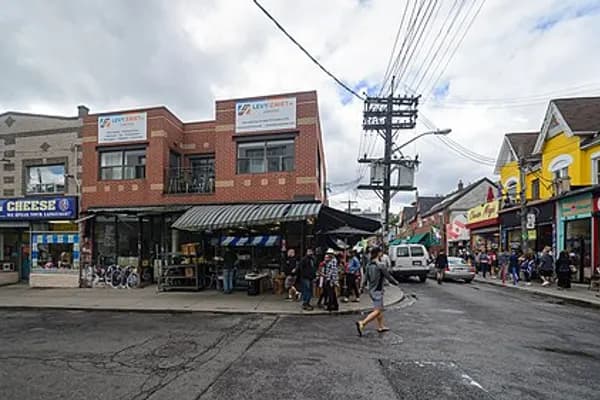
Kensington Market is a distinctive multicultural neighbourhood in Downtown Toronto, Ontario, Canada. The Market is an older neighbourhood and one of the city's best-known. In November 2006, it was designated a National Historic Site of Canada. Robert Fulford wrote in 1999 that "Kensington today is as much a legend as a district. The (partly) outdoor market has probably been photographed more often than any other site in Toronto."

Its approximate borders are College St. on the north, Spadina Ave. on the east, Dundas St. W. to the south, and Bathurst St. to the west. Most of the neighbourhood's eclectic shops, cafes, and other attractions are located along Augusta Ave. and neighbouring Nassau St., Baldwin St., and Kensington Ave. In addition to the Market, the neighbourhood features many Victorian homes, the Kensington Community School, Bellevue Square and Toronto Western Hospital.

History

Early history

George Taylor Denison, after serving in the Canadian Militia during the War of 1812, purchased an area of land in 1815 from Queen Street West to Bloor Street, roughly between where Augusta and Lippincott Streets now run. Denison used the area now known as Bellevue Square Park as a parade ground for his volunteer cavalry troop, which he commanded during the Upper Canada Rebellion. This troop later became the Governor General's Horse Guards.

In 1837 a brewery opened in the area of St Andrew Street and Kensington Avenue (marked in 1858 map of the area) and after several ownership changes ceased operations in 1894.

The Denison estate was subdivided in the 1850s. During the 1880s, houses were built on small plots for Irish and Scottish immigrant labourers coming to Toronto; much of the housing is in the style of Victorian architecture row houses, which are moderate in size and exemplify true Victorian architecture. Many of these houses still stand along Wales Avenue and elsewhere, and these homes have been inhabited by many waves of immigrants in the decades that followed. Housing found closer to the market area tends to feature retail at the front of the house.

During the early twentieth century, Kensington became populated by eastern European Jewish immigrants and some Italians, who moved there from "The Ward", an overcrowded immigrant-reception area between Yonge Street and University Avenue. The Ward was a cluster of densely packed houses and was one of the poorer areas of the city. The Ward's residents moved west of Spadina Ave to enjoy less population density, better housing conditions, and opportunities to create storefront businesses.

In the 1920s, the area became known as "the Jewish Market". Jewish merchants operated small shops as tailors, furriers and bakers. Around 60,000 Jews lived in and around Kensington Market during the 1920s and 1930s, worshipping at over 30 local synagogues. From the beginning, the market sold items imported from the homelands of many immigrant communities.

Post-war developments

After the Second World War, most of the Jewish population moved north to neighbourhoods uptown or in the suburbs. During the 1950s, a large number of immigrants from the Azores, fleeing political conflict with the regime of António de Oliveira Salazar, moved into the area and further west along Dundas Street. The arrival of new waves of immigrants from the Caribbean and East Asia changed the community, making it even more diverse as the century wore on. The Vietnam War brought a number of American political refugees to the neighbourhood, and particularly to nearby Baldwin Village, adding a unique utopian flavour to local politics. As Chinatown is located just east of Kensington, the Chinese are now the largest ethnic group. During the 1980s and 1990s, identifiable groups of immigrants came from Central America, Somalia, Ethiopia, Sudan, Iran, Vietnam, Chile and other global trouble spots.

In the 1960s there were plans to tear down the densely packed small houses and replace them with large, apartment-style housing projects, as was done to neighbouring Alexandra Park. These plans came to an end with the election of David Crombie as Mayor of Toronto. Crombie was strongly opposed to the massive urban restructuring plans that had been in vogue in previous decades.

Recent development

The market resisted the recession of the 1980s partially thanks to a floating population of students attending George Brown College, which was where the Kensington Lofts are today. George Brown College sold the property in the mid-1990s and without the extra student traffic, many stores were victims of the recession of the mid to late 90s. In addition, many Portuguese store owners were by that time too old to continue working their small shops, which led to abundant vacancy and invited a new wave of immigrant entrepreneurs. Businesses like La Perola, El Emporio Latino and El Buen Precio took advantage of the growing wave of Latin American immigrants and opened the door to offering ethnic street foods. Jumbo Empanadas was one of the first to spice up the flavours of the market from a cart; later moved into a basement close to Nassau, and then to its current location. All other Latin shops started selling their Pupusas, and by 2000, a young couple of entrepreneurs opened the first taqueria in Canada, calling it "El Trompo".

All this movement lead to a rebirth of Augusta Avenue. However, there were seedy spots whose patrons scared away the fiercest yuppies. A Nike store tried to open up in the market and the community rejected it very strongly by dumping dozens of running shoes splattered with red paint in protest for the treatment Nike's workers receive around the world. Eventually, such businesses (both too seedy and too mainstream) transformed or moved out. The Nike store was a tremendous corporate failure.

Today the neighbourhood is a noted tourist attraction, and a centre of Toronto's cultural life as artists and writers moved into the area. Land prices in the area have increased sharply, but despite its increased appeal to professionals, Kensington remains a predominantly working-class, immigrant community. In 2021, after a year of neighbourhood organizing to resist the eviction and displacement of residents of a 3-storey building, a local Community Land Trust was able to purchase the building and preserve the affordable rents provided. The Kensington Market Community Land Trust continues to own and operate the building as of 2024.

Kensington is protected by a variety of policies, mainly to enhance the atmosphere that is unique to the neighbourhood. In November 2006, Kensington Market was proclaimed a National Historic Site of Canada. Toronto's "Official Plan", which is the vision for the city until 2026, does not designate much change for the neighbourhood as seen in its land use map for the neighbourhood. With no major change, one can assume that Kensington is very much a stable neighbourhood.

In addition to the Official Plan, Kensington is subject to "Site and Area Specific Policy." The policies which relate to proposed developments state, "Any public or private developments and work should be consistent with the special characteristics of the area." The new developments must adhere to these guidelines which include:

low-scale buildings with retail at grade (street level);

minimal setbacks;

open-air display of goods on the boulevard.

Through city policy, the Kensington uniqueness will be upheld for all to enjoy.

Characteristics

Cars and pedestrians

Narrow streets make the market challenging for those driving and especially parking in the neighbourhood. On Saturdays and some late afternoons, pedestrians walk freely down the middle of the street or between slow-moving cars. In the 2006 Canadian Census, 34.59% of Kensington residents walked to work, compared to 7.10% of City of Toronto residents. When considering the car, 15.70% of Kensington residents used a vehicle to get to work, whereas 49.39% City of Toronto residents drove a vehicle to commute to work.

Since 2004, residents and businesses have organized a series of Pedestrian Sunday events. Parts of Augusta St., Baldwin St. and Kensington Ave. are closed to motorized traffic and the streets become a pedestrian mall. Live music, dancing, street theatre and games are among the special events on the closed streets. Typically taking place on the last Sunday of every month, this type of event has been organized on half a dozen weekends a year since 2005.

Commercial gentrification

A small supermarket, Zimmerman's Freshmart, opened in the Market in February 2005, leading to some controversy. Danny Zimmerman, the cousin of Freshmart's owner and the owner of a rival store across the street, expressed concern it would compete with smaller businesses, or would otherwise lead to a more "corporate" market. Zimmerman's Freshmart closed in 2016. The arrival of COBS Bread in 2006 continues this potential trend, though COBS shuttered in 2014 and was replaced by the independent Black Bird Bakery.

Landmarks

Some notable landmarks include the Number 8 Fire Station, Tom's Place, Bellevue Square Park with a statue of actor Al Waxman, and St. Stephen's Community House. Percy Faith, the 1950s composer and band leader, lived as a child at 171 Baldwin Street. His uncle, Louis Roterbergh, a master violinist, taught him the violin, and was reputed to play at the house at Baldwin as crowds gathered below to listen. Bellevue Square contains a plaque given to Kensington Market in 2006 officially recognizing it as a national historic site.

A non-permanent landmark of Kensington Market is the Garden Car, which has been a staple of the neighbourhood since 2007. Originally built in 2006 by local advocacy group Streets are for People, the car is a public art piece that doubles as a community garden. There have been 3 cars since the inception of the first Garden Car.

Shops

The area is filled with a mix of food stores selling an immense variety of meats, fish and produce. There are also several bakeries, spice and dry goods stores, and cheese shops. Stores sell a wide variety of new and used clothing, and there are discount and surplus stores. It is also home to many restaurants covering a wide variety of styles and ethnicities. A unique architectural feature of the neighbourhood are the extensions built onto the front of many buildings (which would be against by-laws in other places). In recent years, the neighbourhood has seen a small explosion of upscale cafés, restaurants and clubs, replacing many of the older ethnic businesses. There has been much speculation that Kensington's long history as an immigrant working-class neighbourhood is near its end.

Counterculture

Businesses such as Manifestudio, a photo gallery and eco-politics community space run by GlobalAware Independent Media, help create an environment friendly to radical politics. Trotskyists are sometimes seen handing out pamphlets at the corner of Baldwin and Kensington. Over the past two decades, several alternative bookstores have flourished in Kensington Market, including Who's Emma, the Anarchist Free Space, and Uprising Books.

One of Canada's most famous independent bookstores, This Ain't the Rosedale Library, also moved to Kensington from Church and Wellesley in 2008. It later closed in June 2010, failing to pay rent.

Performance spaces like Bread & Circus (2009–2011), Double Double Land (2009–2018) and Videofag (2012–2016) have helped cultivate Kensington Market's vibrant independent arts scene.

Culture

Festivals

The annual "Kensington Market Festival of Lights", which is now known as the Kensington Market Winter Solstice Festival, is celebrated as a parade on the streets of Kensington Market during the Winter Solstice in December. This carnival parade of giant puppets, firebreathers, stiltwalkers and samba musicians was created and founded by Ida Carnevali in 1987 as a way of beckoning the return of the sun on the longest night of the year. Artists and groups such as the Samba Squad, Shadowland Theatre, Clay & Paper Theatre, Richard Underhill, the Befana Choir and the Kensington Horns participate in this event. For many years, the parade ended in a post-sunset concert and spectacle in Bellevue Square; since 2009, the parade has ended at Alexandra Park to handle the larger crowd.

The Pedestrian Sundays festival is a car-free festival where the streets close to cars in several Sundays in the summer. The festival ran for five years, attracting many people to party on the streets of Kensington Market, including bands, street foods, etc.

Bellevue Square Park hosts many concerts and festivals throughout late spring and summer. In addition, the Chiaroscuro Reading Series is held the second Tuesday of each month at Augusta House. Prominent science fiction, fantasy, and horror authors offer readings of their works.

Kensington in popular culture

Former Toronto mayor Mel Lastman and actor Al Waxman (who starred in the CBC Television series King of Kensington) were both born and raised in the Kensington Market neighbourhood. After Waxman's death in 2001, he was honoured with a statue in the north-west corner of Bellevue Square Park. In addition to King of Kensington, Kensington Market has been the setting for the television series Twitch City, which was filmed above the record store Paradise Bound, and Katts and Dog as well as the street riot scenes of the 1984 comedy Police Academy. Kensington Market was the primary setting for Cory Doctorow's novel Someone Comes to Town, Someone Leaves Town.

Canadian singer-songwriter Murray McLauchlan mentions Kensington Market in his 1975 song "Down By The Henry Moore."

Kids' CBC, the daily children's programming block on CBC Television, includes some interstitial segments featuring Mamma Yamma, who owns a vegetable stand in Kensington Market. Played by puppeteer Ali Eisner, Mamma Yamma teaches children about food-related subjects such as nutrition, table manners and basic mathematics, and also often incorporates celebrity and musical guests.

Demographics

Encyclopedic content adapted from the Wikipedia article on Kensington Market, used under CC BY-SA 4.0.

Explore on the ground

Map & local discovery

© OpenStreetMap contributorsOpen in Google Maps →
🍽️
Discover
Restaurants
Discover
Cafés
🍸
Discover
Bars & Clubs
🛍️
Discover
Shops
🖼️
Discover
Museums & Art
🛏️
Discover
Hotels
From Wikimedia Commons

Kensington Market in pictures

Kensington Market photo 1

Photos from the Wikipedia article on Kensington Market, available under the same CC BY-SA / public-domain terms as the source article.

More in Toronto

Other great neighborhoods in Toronto
