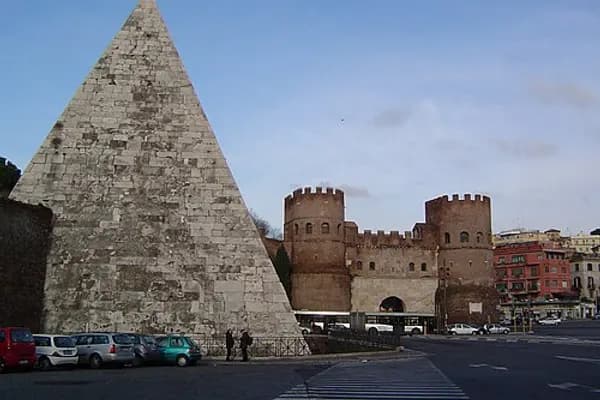
About the neighborhood
20th rione of Rome
Testaccio (Italian: teˈstattʃo) is the 20th rione of Rome, Italy, identified by the initials R. XX, deriving its name from Monte Testaccio. It is located within the Municipio I. Its coat of arms depicts an amphora, referencing to the broken vessels that Monte Testaccio is made of.
History
In antiquity, much of the Tiber trade took place here, and the remains of broken clay vessels (amphorae) were stacked creating the artificial Testaccio hill, which today is a source of much archaeological evidence as to the history of ancient everyday Roman life.
Until the urban recovery that took place after 1870, which destined a huge area to industrial and manufacturing purposes, the borough was chiefly inhabited by poor farmers and shepherds, it was vulnerable to the Tiber floods and infested by malaria. The zone between Monte Testaccio and the city walls (Prati di Testaccio) was public and commonly used by the citizens as a recreation ground, traditional destination of holiday trips and of the typical ottobrate, hence the name prati del popolo romano (lit.'Rome people's meadows').
The portion of the rione, inside the Aurelian Walls, is born as a residential extension of the productive area, housing the laborers of the several industries that arose at the end of 19th century by the side of Via Ostiense. The first town plan, in 1873, designated the area for the industrial expansion of Rome because of the level terrain and of the several communication routes with the city, such as Via Ostiense, the river and the new railway.
Albeit until 1921 the rione was administratively a portion of Ripa, Testaccio has always had a strong identity, even if it had often a bad reputation, especially due to the countless traffics that took place in the harbor. In 1884 an inquiry launched by the municipality bestowed on Testaccio the national record in alcohol usage, while between the 1980s and the 90s it was the stronghold of the so-called Testaccini, a branch of the Banda della Magliana.
Testaccio is considered the cradle of A.S. Roma, as the Campo Testaccio has been the home stadium of the football club between 1929 and 1940.
In modern times, the area became a center of activity for butchers. Testaccio was one of Rome's traditional working-class neighbourhoods, but the recent process of gentrification has made it increasingly attractive to tourists. The neighbourhood is home to several of Rome's culinary highlights. Testaccio's reputation among tourists is expanding.
Geography
Initially a part of Ripa, the rione was established in 1921.
Testaccio has two principal squares:
Piazza Testaccio, the core of the rione, location of the local market until 2012, when it was moved to Via Luigi Galvani;
Piazza Santa Maria Liberatrice, the social kernel of the borough, where the church and the theatre are: the square has an ample park in the middle, which is named after the Di Consiglio family, fallen in the Ardeatine massacre.
Boundaries
Eastward, the rione is separated from San Saba (R. XXI) by the portion of Via Marmorata between Piazzale Ostiense and Largo Manlio Gelsomini, while the boundary with Ripa (R. XII) is marked by the remaining stretch of Via Marmorata, up to Piazza dell'Emporio.
To the west and to the north, Testaccio borders with quartiere Portuense (Q. XI), from which it is separated by the stretch of the River Tiber between Ponte Sublicio and Ponte San Paolo.
Southward, the rione borders with quartiere Ostiense (Q. X): the border is defined by the Aurelian Walls beside Viale del Campo Boario, between Ponte San Paolo and Piazzale Ostiense.
Odonymy
Roads and squares of Testaccio are mostly named after explorers, scientists and engineers. Odonyms of the rione can be categorised as follows:
Local names, such as Lungotevere Testaccio, Via Marmorata (named after the countless marbles and stones arriving at the harbour in the past centuries), Via Caio Cestio (named after the Roman magistrate for whom the namesake pyramid was built) and Piazza dell'Emporio (after the Emporium);
Explorers and seamen, e.g. Ludovico di Vartemà, Orazio Antinori, Gustavo Bianchi, Antonio Cecchi, Romolo Gessi, Pietro Querini, Amerigo Vespucci;
Entrepreneurs and ship owners, e.g. Florio, Ginori and Raffaele Rubattino;
Scientists and engineers, like Giovanni Branca, Galileo Ferraris, Beniamino Franklin, Luigi Galvani, Alessandro Volta, Nicola Zabaglia;
Typographers, such as Giovanni Battista Bodoni and Aldo Manuzio;
Artists, e.g. Luca della Robbia, Paolo Caselli, Lorenzo Ghiberti, Mastro Giorgio and Ottavio Leoni;
Roman dialect poets, e.g. Orazio Giustiniani.
Places of interest
Palaces and other buildings
Ex Mattatoio
Porta San Paolo
Archaeological sites
Pyramid of Cestius
Porticus Aemilia
Churches and religious features
Santa Maria Liberatrice
Santa Maria della Divina Provvidenza
Protestant Cemetery
Other
Fontana delle Anfore
Education
Testaccio has a public library, named after Enzo Tortora, and a biblioteca federata, Biblioteca della Scuola popolare di musica Testaccio.
Famous residents
Elsa Morante, writer
Luigi Di Biagio, Serie A footballer
Claudio Ranieri, Series A coach
Enrico Letta, Italian politician
Giuliano Ferrara, journalist and opinion maker
Rachel Roddy, writer
References
External links
Aventino and Testaccio travel guide from Wikivoyage
Story and Pictures of Testaccio
Pictures of Testaccio
History and Guide of Testaccio Neighborhood
41°52′34″N 12°28′30″E / 41.87611°N 12.47500°E / 41.87611; 12.47500
Encyclopedic content adapted from the Wikipedia article on Testaccio, used under CC BY-SA 4.0.
What makes Testaccio special
Testaccio stands out among Rome’s neighborhoods for its distinctive character: the real home of roman cooking. Ranked #3 in Rome, it offers the kind of experience that defines a great city trip — a place where the streets themselves tell a story and every block rewards curiosity.
Best for
Our take on Testaccio
Testaccio is one of the strongest neighborhoods in Rome, and it consistently appears in our editors' personal favorites lists. It may not always get the same attention as the city's most famous district, but among travelers who know Rome well, Testaccio is often the first recommendation.
What makes Testaccio worth the visit is the texture of daily life here. It is a neighborhood that functions for the people who live in it — not just for the visitors who pass through. The shops serve local needs, the restaurants feed local appetites, and the streets have a rhythm that reflects genuine community rather than tourism infrastructure. That is the quality our editors prize most, and Testaccio has it in abundance.
Our editors recommend budgeting at least half a day here — enough time to walk the main streets, sit down for coffee, and discover the side streets where Testaccio's real character lives.
Living in Testaccio
Testaccio is connected to the rest of Rome by public transit, and most visitors find it straightforward to reach from the city center or airport. Once you arrive, the neighborhood is best explored on foot — the scale is human and the streets reward wandering.
Day-to-day life in Testaccio has the rhythm of a genuine residential neighborhood. You will find grocery stores, pharmacies, cafés with morning regulars, and the kind of small independent shops that only survive where locals support them. For visitors, this means the infrastructure you need — good coffee, a decent meal, a quiet place to sit — is always within a short walk.
Accommodation in Testaccio ranges from boutique hotels to short-term rentals. We generally recommend staying within the neighborhood itself rather than commuting from a hotel elsewhere in Rome — the experience of waking up inside a great neighborhood is fundamentally different from visiting one as a day trip.
What locals say about Testaccio
Long-term residents of Testaccio tend to describe their neighborhood with a mix of pride and protectiveness. Like any district with genuine character, Testaccio inspires loyalty — the kind of place people move to and never quite leave, or leave and spend years trying to get back to.
What locals appreciate most about Testaccio is its consistency — the feeling that the neighborhood works the same way on a Tuesday morning as it does on a Saturday night. It is not a place that performs for visitors and then goes quiet. The rhythm is genuine, the community is real, and the daily experience of living here is what draws people and keeps them.
Compared to the more famous districts in Rome, Testaccio has maintained a lower profile, which many residents consider an advantage. The neighborhood evolves gradually rather than being reshaped by sudden attention, and the result is a community that still feels organic rather than curated.
Visitor tips
- Testaccio is located in Rome, Italy. The neighborhood is accessible by public transport, taxi, or rideshare from most parts of the city.
- Morning is often the best time to explore — the streets are quieter, the light is better for photography, and cafes are at their most welcoming.
- Wear comfortable walking shoes — the best way to experience Testaccio is on foot, wandering the side streets and discovering what lies around each corner.
- Save the neighborhood's location on your phone before you arrive. Offline maps are especially useful for navigating the smaller side streets.