About the neighborhood
Quarter of the city of Zurich, Switzerland
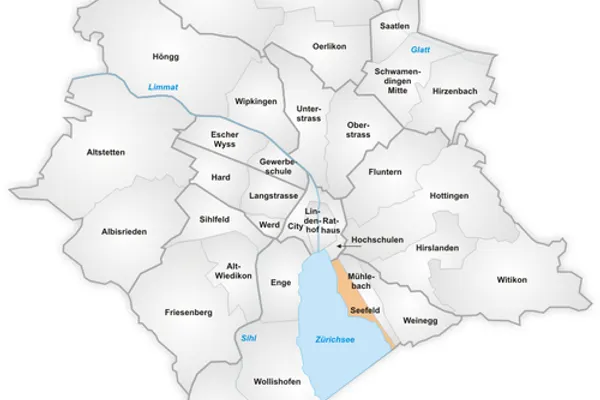
Seefeld (Swiss Standard German pronunciation: ˈzeːfɛld ) is a quarter in the district 8 of Zürich.
It was a part of Riesbach municipality that was incorporated into Zürich in 1893. The quarter has a population of 5,807 distributed over an area of 2.42km (0.93sqmi); 71.6% (1.76km (0.68sqmi)) of the district's area belongs to Lake Zürich.
Quaianlagen
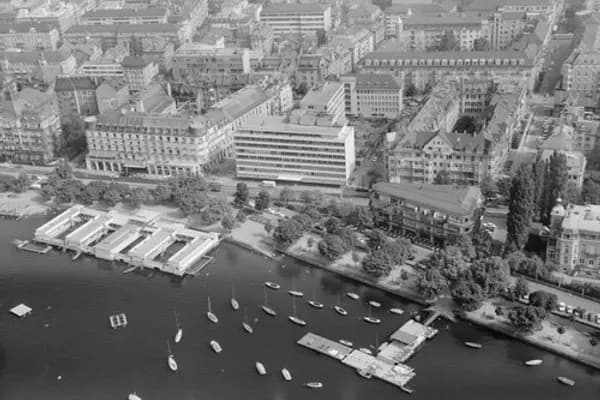
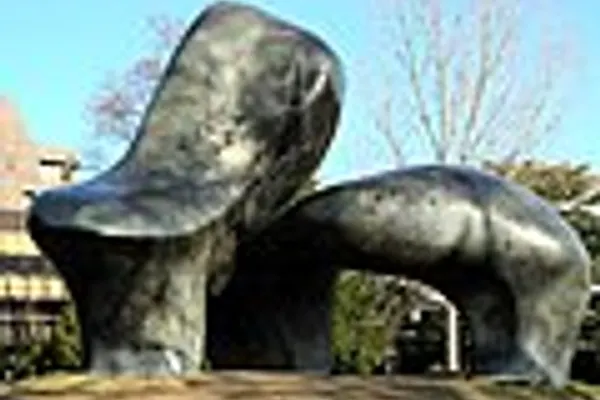
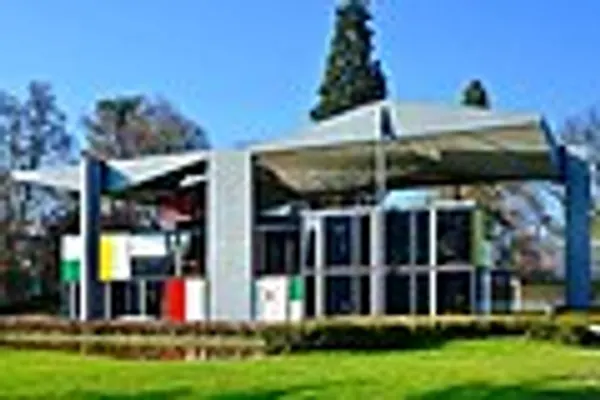
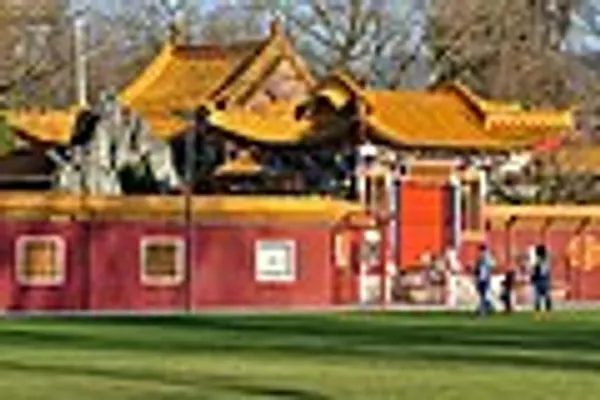
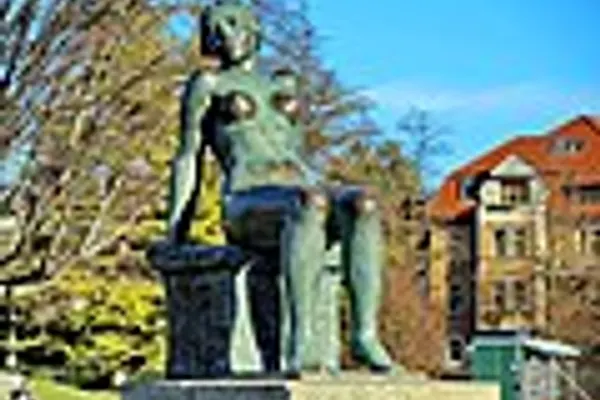
Hafen Riesbach, meaning Riesbach harbour area is situated between Seefeldquai and Blatterwiese. The harbour itself is as the Enge harbour used as a private-owned marina. 2004, the old kiosk at the popular open lido at Riesbachstrasse was replaced by a polygonal pavilion was designed by the architects Andreas Furrimann and Gabrielle Hächler, and now houses a small restaurant. As well as the Seefeldquai, it is part of the historical Quaianlagen, and combines park designs from different design periods. The stone pillar Klausstud originally stood in the lake and served as a border designation of the medieval right of ban of the city republic of Zürich. At that place also ended the fishing rights of the urban fishermen, and from here the Einsiedeln Abbey pilgrims proved their honour to the Protestantic city by lowering the volume of their prayers and songs. Since the landfills in the construction of the quais, the pillar stands in the middle of the park. The sculpture by Henry Moore is named Sheep Piece, 1971–72, and was donated in 1976. The Pavillon Le Corbusier, the former Centre Le Corbusier – Heidi Weber Museum, an art museum dedicated to the work of the Swiss-French architect Le Corbusier, is situated between Seefeldquai and Blatterwiese. Between Blatterwiese and Bellerivestrasse, in 1993 the Chinese Garden Zürich was inaugurated.
Other points of interest
Other points of interest include the Suchard Museum and Bellerive Museum, the two lake shore baths Seebad Utoquai and Strandbad Tiefenbrunnen, the Botanical Garden (Weinegg quarter) of the University of Zürich, some old mansions and the Mühle Tiefenbrunnen, a brewery and mill converted to a cultural centre. In Seefeld quarter, you can find an above-average number of delicatess and hairdress shops, and law firms. As a residential district, Seefeld quarter is very popular, but cheap apartments usually are unavailable.
Transportation
Public transport include Tiefenbrunnen railway station of the Zürich S-Bahn on lines S6 and S16 stopping there, and Stadelhofen railway station, one of the S-Bahn's nodal stations is nearby. For local use, Zürich tram routes 2 and 4, trolley bus line 33, bus lines 912 and 916 to the surrounding municipalities. ZSG station Zürichhorn is another public transport service.
Gallery
References
Wikimedia Commons has media related to Seefeld (Zürich).
47°21′45.89″N 8°32′54.61″E / 47.3627472°N 8.5485028°E / 47.3627472; 8.5485028
Islands Au Peninsula
Bauschänzli
Grosser Hafner
Hurden Peninsula
Lützelau
Rapperswil Peninsula
Saffa
Schönenwerd
Ufenau
Rivers Jona
Limmat
Linth
Schmerikoner Aa
Sihl
Steinenbach
Wägitaler Aa
Valleys Küsnachter Tobel
Limmattal
Sihltal
Mountains Adlisberg
Albis
Buechberg
Etzel
Pfannenstiel
Uetliberg
Zimmerberg
Zürichberg
Landmarks Felsenegg
Frauenwinkel
Ganymed statue
Goldküste
Hurden canal
Lindenhof (Rapperswil)
Obersee
Quaibrücke
Rapperswil–Hurden bridge
Seedamm
Zürichhorn
Transportation Forchbahn
Horgen–Meilen ferry
LAF cable car
St. Gallen S-Bahn
SZU
VBZ
Voralpen Express
VZO
Zimmerbergbus
Lake Zurich Navigation Company
Zürich S-Bahn
ZVV
People Gerold Späth
House of Rapperswil Elisabeth
Johann I
Johann II
Lydia Escher
Rudolf Brun
Ulrich von Hutten
Encyclopedic content adapted from the Wikipedia article on Seefeld, used under CC BY-SA 4.0.
What makes Seefeld special
Seefeld stands out among Zurich’s neighborhoods for its distinctive character: lakeside luxury zurich. Ranked #5 in Zurich, it offers the kind of experience that defines a great city trip — a place where the streets themselves tell a story and every block rewards curiosity.
Best for
Our take on Seefeld
Seefeld occupies a distinctive place in Zurich's neighborhood landscape. It is the kind of district that rewards travelers who venture beyond the obvious choices — quieter than the tourist-facing areas, richer in local character, and full of the small details that make a city trip memorable.
What makes Seefeld worth the visit is the texture of daily life here. It is a neighborhood that functions for the people who live in it — not just for the visitors who pass through. The shops serve local needs, the restaurants feed local appetites, and the streets have a rhythm that reflects genuine community rather than tourism infrastructure. That is the quality our editors prize most, and Seefeld has it in abundance.
Our editors recommend budgeting at least half a day here — enough time to walk the main streets, sit down for coffee, and discover the side streets where Seefeld's real character lives.
Living in Seefeld
Seefeld is connected to the rest of Zurich by public transit, and most visitors find it straightforward to reach from the city center or airport. Once you arrive, the neighborhood is best explored on foot — the scale is human and the streets reward wandering.
Day-to-day life in Seefeld has the rhythm of a genuine residential neighborhood. You will find grocery stores, pharmacies, cafés with morning regulars, and the kind of small independent shops that only survive where locals support them. For visitors, this means the infrastructure you need — good coffee, a decent meal, a quiet place to sit — is always within a short walk.
Accommodation in Seefeld ranges from boutique hotels to short-term rentals. We generally recommend staying within the neighborhood itself rather than commuting from a hotel elsewhere in Zurich — the experience of waking up inside a great neighborhood is fundamentally different from visiting one as a day trip.
What locals say about Seefeld
Long-term residents of Seefeld tend to describe their neighborhood with a mix of pride and protectiveness. Like any district with genuine character, Seefeld inspires loyalty — the kind of place people move to and never quite leave, or leave and spend years trying to get back to.
What locals appreciate most about Seefeld is its consistency — the feeling that the neighborhood works the same way on a Tuesday morning as it does on a Saturday night. It is not a place that performs for visitors and then goes quiet. The rhythm is genuine, the community is real, and the daily experience of living here is what draws people and keeps them.
Compared to the more famous districts in Zurich, Seefeld has maintained a lower profile, which many residents consider an advantage. The neighborhood evolves gradually rather than being reshaped by sudden attention, and the result is a community that still feels organic rather than curated.
Visitor tips
- Seefeld is located in Zurich, Switzerland. The neighborhood is accessible by public transport, taxi, or rideshare from most parts of the city.
- Morning is often the best time to explore — the streets are quieter, the light is better for photography, and cafes are at their most welcoming.
- Wear comfortable walking shoes — the best way to experience Seefeld is on foot, wandering the side streets and discovering what lies around each corner.
- Save the neighborhood's location on your phone before you arrive. Offline maps are especially useful for navigating the smaller side streets.