About the neighborhood
Church, convent, and museum in Italy
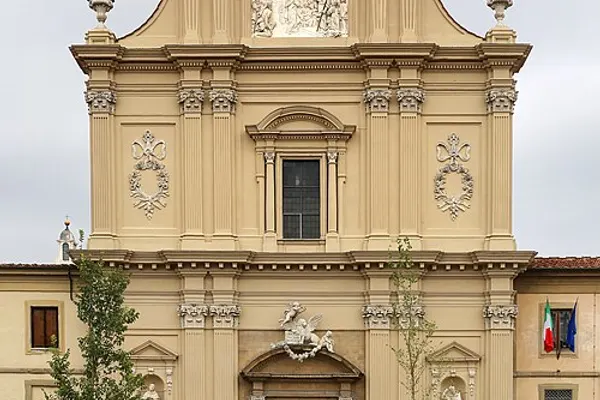
San Marco is a Catholic religious complex in Florence, Italy. It comprises a church and a convent. The convent, which is now the Museo Nazionale di San Marco, has three claims to fame. During the 15th century it was home to two famous Dominicans, the painter Fra Angelico and the preacher Girolamo Savonarola. The church houses the relics of St Antoninus of Florence and the tomb of Pico Della Mirandola, a Renaissance philosopher known as the "Father of Humanism."
History
Sylvestrines
The present convent occupies the site where a Vallombrosian monastery existed in the 13th century, which later passed to the Sylvestrine monks. The church was used both for monastic liturgical functions and as a parish church.
From this initial period there have recently been rediscovered some traces of frescoes below floor level. In 1418 the Sylvestrines, accused of laxity in their observance of the Rule, were pressured to leave, but it took a direct intervention of Pope Eugene IV and the Council of Basel before finally in 1437 the San Marco buildings were vacated, the displaced Sylvestrines moved to the smaller monastery of San Giorgio alla Costa.
Dominicans
A decisive element in securing the move was the intervention of Cosimo de' Medici the Elder, who since 1420 had already shown his support for the reformed Franciscan convent of Bosco ai Frati. From his return from exile in 1434, he had made clear his desire to see an observant community of Dominicans established in Florence. This was achieved when a group arrived from the Convent of San Domenico, Fiesole, not far from the city. On their arrival, the new residents found the San Marco buildings in poor condition, so much so that for two years or so they were obliged to live in damp cells or wooden huts. For funds to renovate the entire complex, they appealed to Cosimo. According to Giorgio Vasari's Lives of the Most Excellent Painters, Sculptors, and Architects, Cosimo in fact invested in the new convent a notable amount of finance, amounting to some 40,000 florins.
Medici reconstruction
In 1437 Cosimo commissioned Michelozzo, the Medici family's favourite architect, to rebuild the San Marco convent on Renaissance lines. He worked on San Marco from 1439 to 1444. By 1438 the work was well underway and the final dedication took place on Epiphany night 1443 in the presence of Pope Eugene IV and the Archbishop of Capua, cardinal Niccolò d'Acciapaccio. San Marco became one of the main elements in the new configuration of the area to the North of the centre of Florence (the so-called “Medici quarter”), along with the Medici family palazzo and the basilica of San Lorenzo. These years marked the height of the Medici family's artistic patronage, above all in connection with the transfer to Florence of the Ecumenical Council from Ferrara to Florence in 1439. Michelozzo succeeded in developing an architectural model for the renaissance library. It included a long narrow hall, divided into three parts by two rows of plain columns.
Church
The church has a single nave with side chapels designed in the late 16th century by Giambologna, and housing paintings from the 16th–17th centuries. In the late 17th century the tribune and the carved ceiling were also realized. A further renovation was carried on in 1678 by Pier Francesco Silvani. The façade, in Neo-Classical style, was built in 1777–1778.
It houses the relics of Antoninus of Florence, a founder of the San Marco, and later Archbishop of Florence; Cosimo de’ Medici used to say that the safety of Florence depended entirely on his prayers. Pico Della Mirandola and other notables of Florentine society are also buried in the church.
Among the artworks, the most ancient is a 14th-century crucifix in the counter-façade. The crucifix on the high altar (1425–1428) is by Fra Angelico. Over the first altar to the right is St. Thomas Praying by Santi di Tito from 1593, while over the second altar is a Madonna with Saints by Fra Bartolomeo.
Giambologna completed the Cappella di Sant'Antonino (also known as Salviati Chapel) in May 1589. The Salviati family had been linked by marriage to the Medici (Pope Leo XI was the son of Francesca Salviati, the daughter of Giacomo Salviati and Lucrezia de' Medici). The interior was decorated in fresco with a Translation and Funeral of St. Antonino Perozzi by Domenico Passignano. The dome of the chapel is by Bernardino Poccetti, also author of frescoes in the Sacrament Chapel. The latter also has canvases by Santi di Tito, Crespi, Francesco Morandini, Jacopo da Empoli, and Francesco Curradi.
Convent
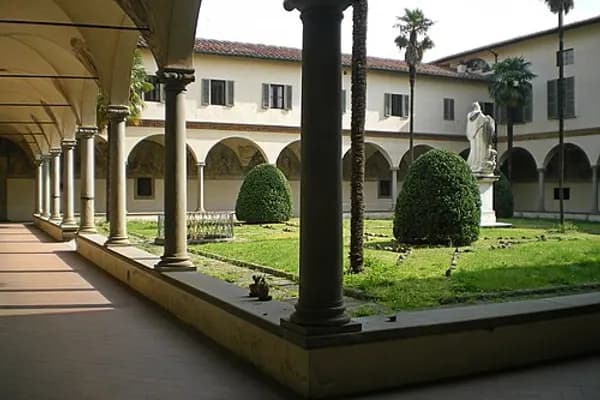
The work was planned according to arrangements that took account of simplicity and practicality, but were of great elegance: a sober, though comfortable, Renaissance edifice. The internal walls were covered in whitewashed plaster, layout centred on two cloisters (named after Saint Antoninus and Saint Dominic), with the usual conventual features of a chapter house, two refectories and guest quarters on the ground level. On the upper floor were the friars' cells, small walled enclosures overarched by a single trussed roof. The cloisters, chapter house and dorters (or dormitories), in the form described, must have been finished by 1440–1441. The South dormitory, which overlooks Piazza San Marco, was completed in 1442. Work on the rest of the convent went on until 1452.
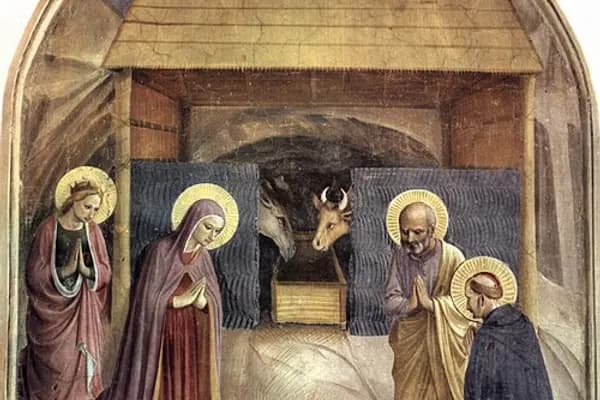
Cosimo de' Medici had a cell in the convent, in the corridor with cells dedicated to guests (adjacent to those of the friars), for his personal retreat. These cells of the friars' dorter or dormitory, including that of Cosimo, and many other walls were decorated by Fra Angelico in collaboration with others, including Benozzo Gozzoli.
An outstanding feature of the convent is the library on the first floor.
Savonarola era
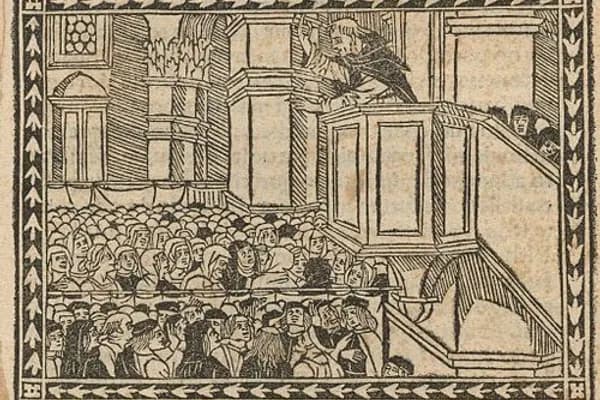
In addition to Fra Angelico, Antonino Pierozzi and Fra Bartolomeo, San Marco was the home from 1489 onwards of the friar Girolamo Savonarola, who represents a major event in the history of the house, and a drama on a European scale.
Having become prior of the convent, Savonarolo unleashed a fierce campaign against the Florentines’ morals and their ostentation of luxury. He was to fall foul of the court of Pope Alexander VI Borgia and was burnt at the stake in front of the Palazzo della Signoria in 1498.
Recent times
The convent was confiscated from the Dominicans in 1808, during the Napoleonic Wars, and again in 1866, when it was seized by the new Kingdom of Italy, whose temporary capital was Florence.
Until recently San Marco still housed a community of Dominican friars, who occupied the Western part of the complex adjacent to the larger cloister. In 2014 the few friars remaining were transferred to join the community at Santa Maria Novella in the city.
The convent is now constituted as the Museo Nazionale di San Marco. The entrance to the museum is from the Cloister of St. Antoninus, decorated with frescoes by Bernardino Poccetti in the 16th–17th century.
References
External links
Wikimedia Commons has media related to San Marco (Florence).
43°46′43″N 11°15′32″E / 43.77847325072136°N 11.259024442660994°E / 43.77847325072136; 11.259024442660994
Towers (Torri) degli Amidei
degli Alberti
dei Belfredelli
dei Della Bella
dei Gianfigliazzi
dei Mannelli
dei Pulci
Giotto's Campanile
Library Biblioteca Riccardiana (Palazzo Medici Riccardi)
British Institute of Florence
Gabinetto Vieusseux (Palazzo Strozzi)
Kunsthistorisches Institut
Laurentian Library
National Central Library
Landmarks Fountain of Neptune
Giotto's Campanile
Monument to Dante
Ponte Vecchio
Railway stations
Theatres Teatro del Maggio Musicale Fiorentino
Teatro Comunale
Teatro della Pergola
Teatro Verdi
Squares Piazza del Duomo
Piazza della Repubblica
Piazza della Signoria
Piazza Santa Croce
Piazza San Lorenzo
Piazzale Michelangelo
Streets Via Cavour
Via de' Tornabuoni
Forts Belvedere
Fortezza da Basso
Gardens and parks Bardini Gardens
Boboli Gardens
Giardino dell'Iris
Giardino delle Rose
Orto Botanico di Firenze
Parco delle Cascine
Villas Medici villas di Castello
La Petraia
di Careggi
Medicea L'Ambrogiana
del Poggio Imperiale
Gamberaia
I Tatti
Il Gioiello
La Pietra
Rusciano
Events and traditions Buchette del vino
Calcio storico fiorentino
Maggio Musicale Fiorentino
Scoppio del carro
Districts of Florence
Trams in Florence
Encyclopedic content adapted from the Wikipedia article on San Marco, used under CC BY-SA 4.0.
What makes San Marco special
San Marco stands out among Florence’s neighborhoods for its distinctive character: the accademia and museum-rich north. Ranked #5 in Florence, it offers the kind of experience that defines a great city trip — a place where the streets themselves tell a story and every block rewards curiosity.
Best for
Our take on San Marco
San Marco occupies a distinctive place in Florence's neighborhood landscape. It is the kind of district that rewards travelers who venture beyond the obvious choices — quieter than the tourist-facing areas, richer in local character, and full of the small details that make a city trip memorable.
What makes San Marco exceptional is the density of its cultural life. Art galleries, independent bookshops, small theaters, and creative studios are woven into the fabric of the neighborhood rather than clustered in a single zone. You encounter culture here by accident, which is how the best cultural experiences always happen.
Our editors recommend budgeting at least half a day here — enough time to walk the main streets, sit down for coffee, and discover the side streets where San Marco's real character lives.
Living in San Marco
San Marco is connected to the rest of Florence by public transit, and most visitors find it straightforward to reach from the city center or airport. Once you arrive, the neighborhood is best explored on foot — the scale is human and the streets reward wandering.
Day-to-day life in San Marco has the rhythm of a genuine residential neighborhood. You will find grocery stores, pharmacies, cafés with morning regulars, and the kind of small independent shops that only survive where locals support them. For visitors, this means the infrastructure you need — good coffee, a decent meal, a quiet place to sit — is always within a short walk.
Accommodation in San Marco ranges from boutique hotels to short-term rentals. We generally recommend staying within the neighborhood itself rather than commuting from a hotel elsewhere in Florence — the experience of waking up inside a great neighborhood is fundamentally different from visiting one as a day trip.
What locals say about San Marco
Long-term residents of San Marco tend to describe their neighborhood with a mix of pride and protectiveness. Like any district with genuine character, San Marco inspires loyalty — the kind of place people move to and never quite leave, or leave and spend years trying to get back to.
What locals appreciate most about San Marco is its consistency — the feeling that the neighborhood works the same way on a Tuesday morning as it does on a Saturday night. It is not a place that performs for visitors and then goes quiet. The rhythm is genuine, the community is real, and the daily experience of living here is what draws people and keeps them.
Compared to the more famous districts in Florence, San Marco has maintained a lower profile, which many residents consider an advantage. The neighborhood evolves gradually rather than being reshaped by sudden attention, and the result is a community that still feels organic rather than curated.
Visitor tips
- San Marco is located in Florence, Italy. The neighborhood is accessible by public transport, taxi, or rideshare from most parts of the city.
- Morning is often the best time to explore — the streets are quieter, the light is better for photography, and cafes are at their most welcoming.
- Wear comfortable walking shoes — the best way to experience San Marco is on foot, wandering the side streets and discovering what lies around each corner.
- Save the neighborhood's location on your phone before you arrive. Offline maps are especially useful for navigating the smaller side streets.