About the neighborhood
Franciscan church in Florence, Italy
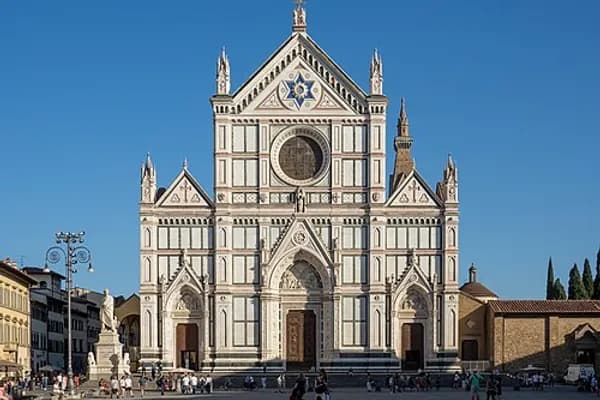
The Basilica di Santa Croce (Italian for 'Basilica of the Holy Cross') is a minor basilica and the principal Franciscan church of Florence, Italy. It is situated on the Piazza di Santa Croce, about 800 metres (2,600ft) southeast of the Duomo, on what was once marshland beyond the city walls. Being the burial place of notable Italians, including those from the Italian Renaissance such as Michelangelo, Galileo, and Machiavelli, as well as the poet Foscolo, political philosopher Gentile and the composer Rossini, it is also known as the Temple of the Italian Glories (Tempio dell'Itale Glorie).
Building
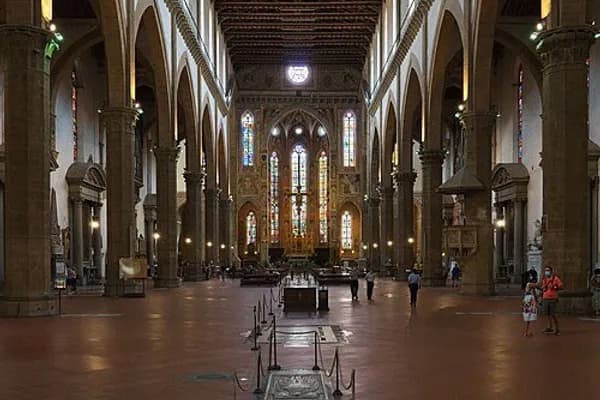
The basilica is the largest Franciscan church in the world. Its most notable features are its sixteen chapels, many of them decorated with frescoes by Giotto and his pupils, and its tombs and cenotaphs. Legend says that Santa Croce was founded by St Francis himself. The construction of the current church, which replaced an older building, was begun on 12 May 1294, possibly by Arnolfo di Cambio, and paid for by some of the city's wealthiest families. It was consecrated in 1442 by Pope Eugene IV. The building's design reflects the austere approach of the Franciscans. The floorplan is an Egyptian or Tau cross (a symbol of St Francis), 115 metres in length with a nave and two aisles separated by lines of octagonal columns. To the south of the church was a convent, some buildings of which remain.
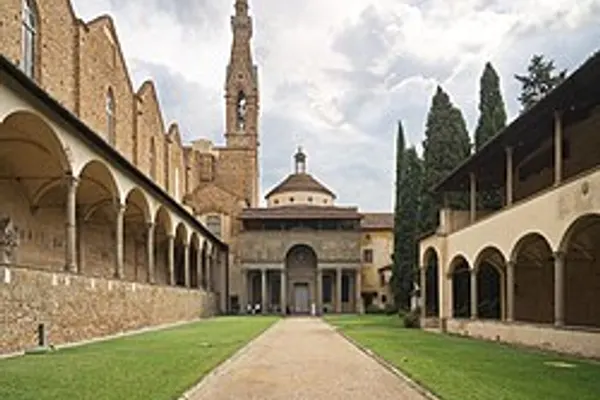
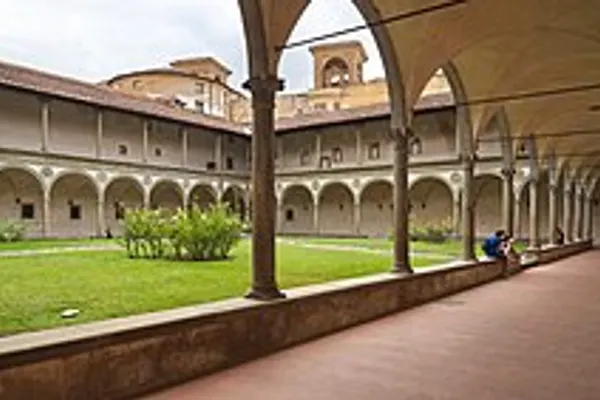
The Primo Chiostro, the main cloister, houses the Cappella dei Pazzi, built as the chapter house, completed in the 1470s. Filippo Brunelleschi (who had designed and executed the dome of the Duomo) was involved in its design which has remained rigorously simple and unadorned.
In 1560, the choir screen was removed as part of changes arising from the Counter-Reformation and the interior of this area was rebuilt by Giorgio Vasari. As a result, there was damage to the church's decoration and most of the altars previously located on the screen were lost. The Bardi Chapel which contained a cycle of frescoes of the life of St Francis was plastered over, at the behest of Cosimo I, and Vasari placed some new altars against the walls, causing considerable damage to the frescoes.
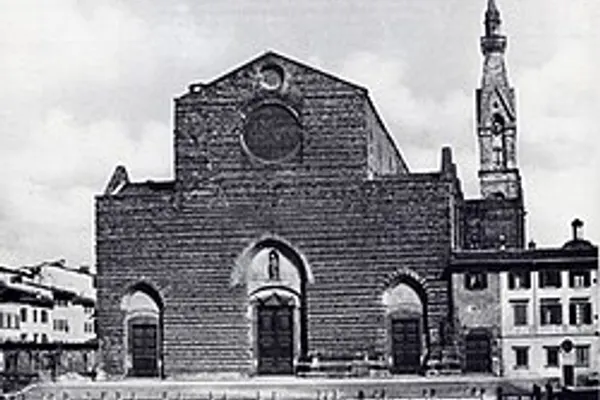
The bell tower was built in 1842, replacing an earlier one damaged by lightning. The neo-Gothic marble façade dates from 1857 to 1863. The Jewish architect Niccolò Matas from Ancona designed the church's façade, working a prominent Star of David into the composition. Matas had wanted to be buried with his peers but because he was Jewish, he was buried under the threshold and honoured with an inscription.
In 1866, the complex became public property, as a part of government suppression of most religious houses, following the wars that gained Italian independence and unity.
During the 19th-century restorations, the 16th-century altars and plaster were removed from the Bardi Chapel, revealing Giotto's frescoes of the Life of St Francis, which include the Death of St. Francis. This painting, missing sections where an altar had been attached to the wall, was heavily restored in the 19th century. These restorations were later removed to reveal those areas which are definitively Giotto's, leaving portions of the painting missing.
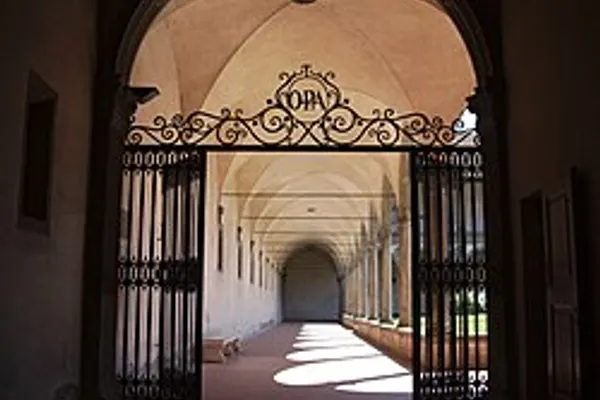
The Museo dell'Opera di Santa Croce is housed mainly in the refectory, also off the cloister. A monument to Florence Nightingale stands in the cloister, in the city in which she was born and after which she was named. Brunelleschi also built the inner cloister, completed in 1453.
In 1940, during the safe hiding of various works during World War II, Ugo Procacci noticed the Badia Polyptych being carried out of the church. He reasoned that this had been removed from the Badia Fiorentina during the Napoleonic occupation and accidentally re-installed in Santa Croce. Between 1958 and 1961, Leonetto Tintori removed layers of whitewash and overpaint from Giotto's Peruzzi Chapel scenes to reveal his original work.
In 1966, the Arno River flooded much of Florence, including Santa Croce. The water entered the church bringing mud, pollution and heating oil. The damage to buildings and art treasures was severe, taking several decades to repair.
Today the former dormitory of the Franciscan friars houses the Scuola del Cuoio (Leather School). Visitors can watch as artisans craft purses, wallets, and other leather goods which are sold in the adjacent shop.
Restoration
The basilica has been undergoing a multi-year restoration program with assistance from Italy's civil protection agency. On 20 October 2017, the property was closed to visitors due to falling masonry which caused the death of a tourist from Spain. The basilica was closed temporarily during a survey of the stability of the church. The Italian Ministry of Culture said that "there will be an investigation by magistrates to understand how this dramatic fact happened and whether there are responsibilities over maintenance."
Art
Artists whose work is present in the church include (for funerary monuments and stained-glass windows see below):
Benedetto da Maiano: pulpit; with his brother Giuliano: doors to Cappella dei Pazzi
Cimabue: Crucifix, badly damaged by the 1966 flood and now in the refectory
Andrea della Robbia: altarpiece in Cappella Medici
Luca della Robbia: glazed terracotta decoration of Cappella dei Pazzi
Desiderio da Settignano: frieze in Cappella dei Pazzi
Donatello: Cavalcanti Annunciation on the south wall; crucifix in the lefthand Cappella Bardi di Vernio; St Louis of Toulouse in the refectory (originally made for Orsanmichele)
Agnolo Gaddi: fresco cycle of The Legend of the True Cross in the apse with stained glass windows designed by him (1385–1387); fresco decoration of the Cappella Castellani with scenes of the lives of SS Anthony the Great, John the Baptist, John the Evangelist and Nicholas (1385)
Taddeo Gaddi: frescoes in the Baroncelli Chapel; Crucifixion in the sacristy; Arbor vitae with the Last Supper in the refectory (c. 1330–1340 or 1360), considered his best work
Giotto: frescoes in Cappella Peruzzi and righthand Cappella Bardi; possibly Coronation of the Virgin, altarpiece in the Baroncelli Chapel, also attributed to Taddeo Gaddi
Giovanni da Milano: frescoes in Cappella Rinuccini) with Scenes of the Life of the Virgin and the Magdalen
Maso di Banco: frescoes in Cappella Bardi di Vernio) depicting Scenes from the life of St. Sylvester (1335–1338)
Henry Moore: statue of a warrior in the Primo Chiostro
Andrea Orcagna: frescoes largely disappeared during Vasari's remodelling, but some fragments remain in the refectory
Antonio Rossellino: relief of the Madonna del Latte (1478) in the south aisle
Santi di Tito: Supper at Emmaus and Resurrection, altarpieces in the north aisle
Giorgio Vasari: Way to Calvary
Domenico Veneziano: SS John and Francis in the refectory
Once present in the church's Medici Chapel, but now split between the Florentine Galleries and the Bagatti Valsecchi Museum in Milan, is a polyptych by Lorenzo di Niccolò, whilst the Novitiate Altarpiece by Filippo Lippi and a predella by Pesellino was painted for the church's Novitiate Chapel.
Stained-glass windows
Santa Croce also contains some of the earliest stained-glass windows in Florence. In medieval Italy, stained-glass windows were usually designed by a painter and then created by a glazier, an artist with specialized training in the fabrication of stained-glass windows. Many of the private chapels located in the church's transept, as well as the high altar chapel of the church, contain well preserved late 13th- and 14th-century stained-glass windows. There are also several examples of 19th- and 20th-century stained glass in Santa Croce. The windows in and around the high altar chapel include:
Funerary monuments
The basilica became popular with Florentines as a place of worship and patronage and it became customary for greatly honoured Florentines to be buried or commemorated there. Some were in chapels "owned" by wealthy families such as the Bardi and Peruzzi. As time progressed, space was also granted to notable Italians from elsewhere. For 500 years monuments were erected in the church including those to:
Leon Battista Alberti (15th-century architect and artistic theorist)
Giovan Vincenzo Alberti (Florentine senator and minister to first two Lorraine Grand-Dukes)
Vittorio Alfieri (18th-century poet and dramatist) by Antonio Canova
Eugenio Barsanti (co-inventor of the internal combustion engine)
Lorenzo Bartolini (19th-century sculptor)
Julie Clary, wife of Joseph Bonaparte, and their daughter Charlotte Napoléone Bonaparte
Leonardo da Vinci (1919 commemorative plaque, buried in Château d'Amboise in France)
Leonardo Bruni (15th-century chancellor of the Republic, scholar and historian) by Bernardo Rossellino
Dante (buried in Ravenna)
Ugo Foscolo (19th-century poet)
Galileo Galilei
Giovanni Gentile (20th-century philosopher)
Lorenzo Ghiberti (artist and bronze-smith)
Giovanni Lami
Niccolò Machiavelli by Innocenzo Spinazzi
Carlo Marsuppini (15th-century chancellor of the Republic of Florence) by Desiderio da Settignano
Michelangelo Buonarroti by Giorgio Vasari with sculptures by Valerio Cioli, Iovanni Bandini, and Battista Lorenzi.
Raffaello Morghen (19th-century engraver)
Giovanni Battista Niccolini (poet)
Gioachino Rossini by Giuseppe Cassioli
Louise of Stolberg-Gedern (wife of Charles Edward Stuart, 'Bonnie Prince Charlie')
Guglielmo Marconi (buried in his birthplace at Sasso Marconi, near Bologna)
Enrico Fermi (nuclear physicist, memorial only - Fermi is buried in Chicago, Illinois)
Cloister monuments
Giuseppe La Farina
Florence Nightingale
In literature
Romola (1863), George Eliot
A Room with a View (1908), E.M. Forster, Chapter 2
Hannibal (1999), Thomas Harris, Chapter 35
See also
History of late medieval Arabic and Western European domes
History of Italian Renaissance domes
References
Footnotes
Citations
External links
Works related to Catholic Encyclopedia (1913)/Suppression of Monasteries in Continental Europe at Wikisource
Wikimedia Commons has media related to Santa Croce (Florence).
Official website
Church and Museum of Santa Croce on the private website for tourism, Museumsinflorence.com
BBC video about Giotto frescoes in the Basilica of Santa Croce, Florence
Towers (Torri) degli Amidei
degli Alberti
dei Belfredelli
dei Della Bella
dei Gianfigliazzi
dei Mannelli
dei Pulci
Giotto's Campanile
Library Biblioteca Riccardiana (Palazzo Medici Riccardi)
British Institute of Florence
Gabinetto Vieusseux (Palazzo Strozzi)
Kunsthistorisches Institut
Laurentian Library
National Central Library
Landmarks Fountain of Neptune
Giotto's Campanile
Monument to Dante
Ponte Vecchio
Railway stations
Theatres Teatro del Maggio Musicale Fiorentino
Teatro Comunale
Teatro della Pergola
Teatro Verdi
Squares Piazza del Duomo
Piazza della Repubblica
Piazza della Signoria
Piazza Santa Croce
Piazza San Lorenzo
Piazzale Michelangelo
Streets Via Cavour
Via de' Tornabuoni
Forts Belvedere
Fortezza da Basso
Gardens and parks Bardini Gardens
Boboli Gardens
Giardino dell'Iris
Giardino delle Rose
Orto Botanico di Firenze
Parco delle Cascine
Villas Medici villas di Castello
La Petraia
di Careggi
Medicea L'Ambrogiana
del Poggio Imperiale
Gamberaia
I Tatti
Il Gioiello
La Pietra
Rusciano
Events and traditions Buchette del vino
Calcio storico fiorentino
Maggio Musicale Fiorentino
Scoppio del carro
Districts of Florence
Trams in Florence
Encyclopedic content adapted from the Wikipedia article on Santa Croce, used under CC BY-SA 4.0.