About the neighborhood
Historical affiliations
Silesians until 985
Duchy of Poland 985–1025
Kingdom of Poland 1025–1038
Duchy of Bohemia 1038–1054
Kingdom of Poland 1054–1320
Duchy of Silesia 1320–1348
Lands of the Bohemian Crown 1348–1526
Habsburg Empire 1526–1742
Kingdom of Prussia 1742–1871
German Empire 1871–1918
Weimar Germany 1918–1933
Nazi Germany 1933–1945
Polish People's Republic 1945–1989
Republic of Poland 1989–present
Wrocław (German: Breslau) has long been the largest and culturally dominant city in Silesia, and is today the capital of Poland's Lower Silesian Voivodeship, and the country's third most populous city proper.
The history of Wrocław starts at a crossroads in Lower Silesia. It was one of the centres of the Duchy and then Kingdom of Poland, and briefly, in the first half of the 13th century, the centre of half of the divided Kingdom of Poland. German settlers arrived in increasing numbers after the first Mongol invasion of Poland in 1241. Later on, the city became part of the Bohemian Crown Lands and the Holy Roman Empire following the Treaty of Trentschin of 1335. In 1526, it came under Habsburg rule as part of the Bohemian Crown. After the War of Austrian Succession, Austria ceded the city and region to the Kingdom of Prussia in the Treaty of Breslau of 1742. Following the unification of Germany, Breslau became part of the German Reich in 1871. The city was the economic, cultural and scientific centre of Eastern Germany with the University of Breslau producing nine Nobel Prize laureates. During World War II, the Nazis operated multiple labour camps and prisons throughout the city. In the final phase of the war, the city was besieged by the Red Army in the Battle of Breslau and suffered extensive destruction as a result of the combat. After the war, the city became part of Poland and the German-speaking majority of its population was expelled to the remainder of Germany in accordance with the Potsdam Agreement.
Origin
The city of Wrocław originated as a stronghold situated at the intersection of two long-existing trading routes, the Via Regia and the Amber Road. The city was founded in the 10th century, possibly by a local duke Wrocisław, who may also be the city's namesake. At the time the city was limited to the district of Ostrów Tumski (the Cathedral Island) and was first mentioned by Thietmar of Merseburg in 1000 as "Wrotizlava".
Poland
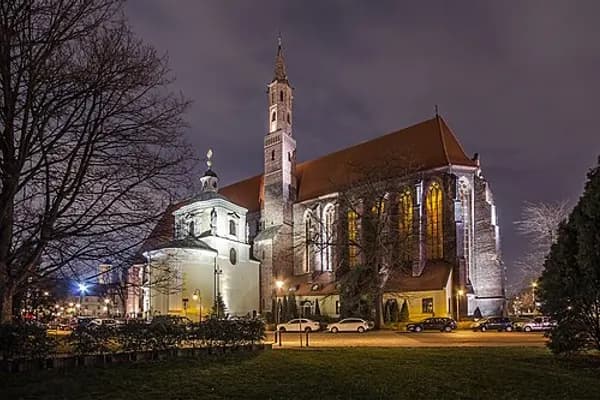
In 985 Duke Mieszko I of Poland of the Piast dynasty conquered Silesia and Wrocław. In 1000 Mieszko's son, Duke and future King Bolesław I of Poland, in the then capital of Poland, Gniezno, established the Bishopric of Wrocław (as one of the oldest bishoprics of Poland and the first bishopric of Silesia) along with the bishoprics of Kraków and Kołobrzeg and the Archbishopric of Gniezno. It was a suffragan of the Archbishopric of Gniezno, the See independent of the German Archbishopric of Magdeburg, which had tried to lay claim to jurisdiction over the Polish church. The city quickly became a commercial centre and expanded rapidly to the neighbouring Wyspa Piaskowa (Sand Island) and then to the left bank of the Odra river. Hugo Weczerka writes that around 1000 the town had approximately 1000 inhabitants. An uprising in took place in 1037-1038 against the church and probably also against the bishop and the representatives of the Polish king, who were expelled. In 1038 the city fell to Bohemia and in 1054 it was regained by Poland. The Gesta principum Polonorum chronicle from the 1110s named Wrocław one of the three political centers of the Polish Kingdom alongside Kraków and Sandomierz. In 1138 it became the capital of the Piast-ruled Duchy of Silesia, which slowly detached from Poland. By 1139 two more settlements were built. One belonged to Governor Piotr Włostowic (a.k.a. Piotr Włast Dunin; ca. 1080–1153) and was situated near his residence on the Olbina by the St. Vincent's Benedictine Abbey. The other settlement was founded on the left bank of the Oder River, near the present seat of the university. It was located on the Via Regia that lead from Leipzig and Legnica and followed through Opole, and Kraków to Kievan Rus'. Polish, Bohemian, Jewish, Walloon and German communities existed in the city.
In the first half of the 13th-century duke Henry I the Bearded of the Silesian line of the Piast dynasty, managed to reunite much of the divided Polish kingdom. He became the duke of Kraków (Polonia Minor) in 1232, which gave him the title of the senior duke of Poland (see Testament of Bolesław III Krzywousty). Henry started striving for the Polish crown. His activity in this field was continued by his son and successor Henry II the Pious whose work towards this goal was halted by his sudden death in 1241 (Battle of Legnica). Polish territories acquired by the Silesian dukes in this period are called "The monarchy of the Silesian Henries". Wrocław was the centre of the divided Kingdom of Poland.
The city was devastated in 1241 during the first Mongol invasion of Poland. The inhabitants burned down their own city to force the Mongols to a quick withdrawal. The invasion, according to Norman Davies, led German historiography to portray the Mongol attack as an event which eradicated the Polish community. However, in light of historical research this is doubtful, as many Polish settlements remained, even in the 14th century, especially on the right bank of the Oder and Polish names such as Baran or Cebula appear including among Wrocław's ruling elite.
Georg Thum, Maciej Lagiewski, Halina Okolska and Piotr Oszczanowski write that the decimated population was replenished by many Germans. A different thesis is presented by Norman Davies who writes that it is wrong to portray people of that time as "Germans" as their identities were those of Saxons and Bavarians, while historian Norbert Conrads argues that a Polish identity didn't exist either, a view shared by Czech author František R. Kraus. While Germanisation started, Norman Davies writes that "Vretslav was a multi-ethnic city in the Middle Ages. Its ethnic composition moved in an endless state of flux, changing with each political and cultural ebb and flow to which it was exposed". German author Georg Thum states that Breslau, the German name of the city, appeared for the first time in written records, and the city council from the beginning used only the Latin and German.
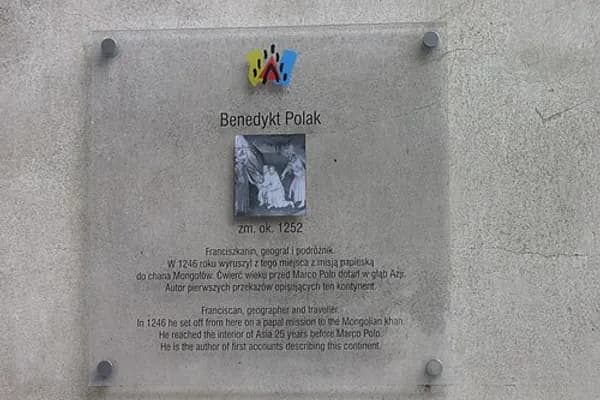
In 1245, in Wrocław, Franciscan friar Benedict of Poland, considered one of the first Polish explorers, joined Italian diplomat Giovanni da Pian del Carpine, on his journey to the seat of the Mongol Khan near Karakorum, the capital of the Mongol Empire. It was the first such journey by Europeans, and they returned with the letter from Güyük Khan to Pope Innocent IV.
The rebuilt town adopted Magdeburg rights in 1262 and, at the end of the 13th century joined the Hanseatic League. The expanded town was around 60 hectares in size and the new Main Market Square (Rynek), which was covered with timber-framed houses, became the new centre of the town. The original foundation, Ostrów Tumski, was now the religious centre. In 1273, Piwnica Świdnicka, one of the oldest still operating restaurants in Europe, was opened. With the ongoing Ostsiedlung the Polish Piast dynasty dukes remained in control of the region, however, their influence declined continuously as the self-administration rights of the city council increased. German historian Norbert Conrads writes that they adopted the German language and culture and became Germanized in the 13th century. Wrocław – despite the beginnings of Germanization – remained in close union with the Polish church, and local Piasts remained active in Polish politics, while Polish was still used in the court as late as the 14th century. Rather, the Silesian Piasts had a carefully planned Germanization policy, whose aim was not necessarily to join the Holy Roman Empire.
During much of the Middle Ages, Wrocław was ruled by Dukes of the Piast dynasty. In 1335 the last Piast Duke of Wrocław, Henry VI the Good, died. With the Treaty of Trentschin the city passed to John of Luxembourg, who fought a war with Casimir the Great over Silesia. John died while fighting in France and the war ended inconclusively. The issue was resolved only in 1372 by an agreement between Charles IV of Luxembourg and Louis I of Hungary; and while the city lost political ties to the Polish state, it remained connected to Poland by religious links and the existence of Polish population within it. Jan Długosz described the foreign rule over Wrocław as unlawful and expressed his hope that it would eventually return to Poland.
The bishops of Wrocław was known as the prince-bishops ever since Bishop Przecław of Pogorzela (1341–1376) bought the Duchy of Grodków from Duke Bolesław III the Generous and added it to the episcopal Duchy of Nysa, after which the Bishops of Wrocław had the titles of Prince of Nysa and Dukes of Grodków, taking precedence over the other Silesian rulers.
Bohemia and Hungary
In 1348, the city was incorporated with almost the entirety of Silesia into the Lands of the Bohemian Crown, and a Landeshauptmann (Provincial governor) was appointed to administrate the region. Between 1342 and 1344 two fires destroyed large parts of the city. In 1352 Bohemian King Charles IV, who was also elected King of Germany, visited the town. His successors Wenceslaus and Sigismund became involved in a long-lasting feud with the city and its magistrate, culminating in the revolt of the guilds in 1418 when local craftsmen killed seven councillors. In a tribunal two years later, when Sigismund was in town, 27 ringleaders were executed. He also called up for a Reichstag in the same year, which discussed the earlier happenings in the city.
In June 1466, in Wrocław, Polish diplomat Jan Długosz held a meeting with a papal legate, starting a peace process between Poland and the Teutonic Order, which a few months later culminated in the signing of the Second Peace of Thorn that ended the Thirteen Years' War, the longest of Polish–Teutonic wars.
When George of Poděbrady was elected king of Bohemia, the city opposed him since he was a Hussite and instead sided with his Catholic rival Matthias Corvinus. After the city fought alongside Corvinus against George in 1466, the local classes rendered homage to the king on 31 May 1469 in the city, where the king also met the daughter of mayor Krebs, Barbara, whom he took as his mistress. In 1474 the city was besieged by combined Polish-Bohemian forces, however in November 1474 Kings Casimir IV of Poland, his son Vladislaus II of Bohemia and Matthias Corvinus of Hungary met in the nearby village of Muchobór Wielki (present-day district of Wrocław) and in December 1474 a ceasefire was signed, according to which the city remained under Hungarian rule. Matthias Corvinus incorporated the city with Silesia in his dominion, which he controlled until his death in 1490. 1475 marks the beginning of movable type printing in the city and in Silesia, when Kasper Elyanpl opened his printing shop (Drukarnia Świętokrzyska). That same year he published the Statuta synodalia episcoporum Wratislaviensiumpl, which contains the first-ever text printed in Polish. It was also the first ever printing in Silesia. The first illustration of the city was published in the Nuremberg Chronicle in 1493. Documents of that time referred to the town by many variants of the name including Wratislaw, Bresslau and Presslau.
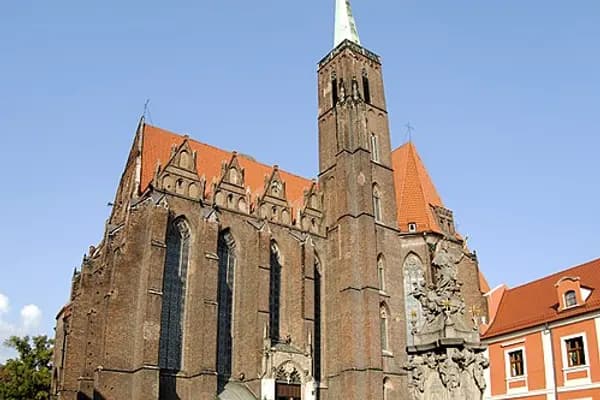
From 1502 to 1538 renowned astronomer Nicolaus Copernicus was a scholaster of the Collegiate Church of the Holy Cross.
Habsburg Monarchy
The ideas of the Protestant Reformation reached Breslau already in 1518, and in 1519 the writings of Luther, Eck and the opening of the Leipzig Disputation by Mosellanus were published by local printer Adam Dyon. In 1523 the town council unanimously, appointed Johann Heß as the new pastor of St. Maria Magdalena and thus introduced the Reformation in Breslau. In 1524 the town council issued a decree that obliged all clerics to the Protestant sermon and in 1525 another decree banned a number of Catholic customs. Breslau had become dominated by Protestants although a Catholic minority remained. Norman Davies states that as a city it was located on the borderline between Polish and German parts of Silesia, writing that "Vretslav lay astride the dividing line"; it also hosted a Czech community.
After the death of Louis II in the Battle of Mohács in 1526, the Habsburg monarchy of Austria inherited the Bohemian Crown with the city. In 1530 Ferdinand I awarded Breslau its current coat of arms. On 11 October 1609 German emperor Rudolf II granted the Letter of Majesty, which ensured the free exercise of church services for all Silesian Protestants. During Thirty Years' War the city suffered badly, was occupied by Saxon and Swedish troops and lost 18,000 of its 40,000 residents to plague.
The Counter-Reformation had started with Rudolf II and Martin Gerstmann, bishop of Breslau. One of his successors, bishop Charles of Austria, did not accept the letter of the majesty on his territory. At the same time, the emperor encouraged several Catholic orders to settle in Breslau. The Minorites came back in 1610, the Jesuits arrived in 1638, the Capuchins in 1669, the Franciscans in 1684 and the Ursulines in 1687. These orders undertook an unequalled amount of construction which shaped the appearance of the city until 1945. The Jesuits were the main representatives of the Counter-Reformation in Breslau and Silesia. Much more feared were the Liechtensteiner dragoons, which converted people by force and expelled those who refused. At the end of the Thirty Years' War, Breslau was only one of a few Silesian cities which stayed Protestant, and after the Treaty of Altranstädt of 1707 four churches were given back to the local Protestants.
During the Counter-Reformation, the intellectual life of the city, which was shaped by Protestantism and Humanism, flourished, as the Protestant bourgeoisie of the city lost its role as the patron of the arts to the Catholic orders. Breslau and Silesia, which possessed six of the 12 leading grammar schools in the Holy Roman Empire, became the centre of German Baroque literature. Poets such as Martin Opitz, Andreas Gryphius, Christian Hoffmann von Hoffmannswaldau, Daniel Casper von Lohenstein and Angelus Silesius formed the so-called First and Second Silesian school of poets which shaped the German literature of that time.
Encyclopedic content adapted from the Wikipedia article on Rynek, used under CC BY-SA 4.0.