About the neighborhood
Capital city of Panama
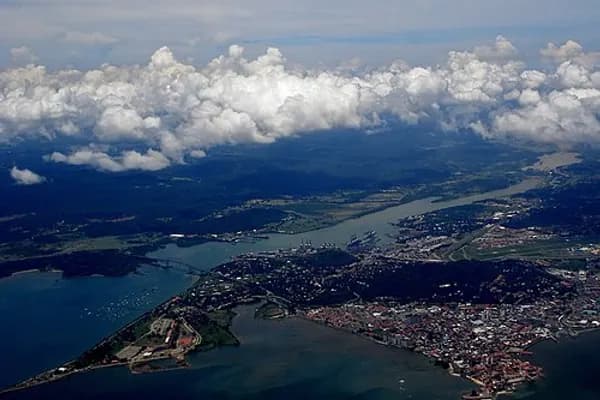
Panama City, also known as Panama, is the capital and largest city of the Republic of Panama. It has a total population of 410,354 in the city proper and 1,086,990 in the Panama District, which includes the outer corregimientos of the city. The metropolitan area has over 2,100,000 people. The city is at the Pacific entrance of the Panama Canal, in the province of Panama. The city is the political and administrative center of the country, as well as a hub for banking and commerce.
The city of Panama was founded on 15 August 1519, by Spanish conquistador Pedro Arias Dávila. The city was the starting point for expeditions that conquered the Inca Empire of Peru. It was a stopover point on one of the most important trade routes in the American continent, leading to the fairs of Nombre de Dios and Portobelo, through which passed most of the gold and silver that Spain mined from the Americas.
On 28 January 1671, the original city was destroyed by a fire when the privateer Henry Morgan sacked and set fire to it. The city was formally reestablished two years later on 21 January 1673, on a peninsula 8km (5 miles) from the original settlement. The site of the previously devastated city is still in ruins, and is now a World Heritage Site and popular tourist attraction.
History
The city was founded on 15 August 1519, by Pedro Arias de Ávila, also known as Pedrarias Dávila. Within a few years of its founding, the city became a launching point for the exploration and conquest of Peru and a transit point for gold and silver headed back to Spain through the Isthmus. The Genoese-Italians and the Spanish encountered coconuts which had arrived from the Philippines before Spanish colonization. In 1520, Genoese merchants controlled the port and the commerce of the region, mainly for the slave trade, thanks to a concession given by the Spaniards, who had the Republic of Genoa as its main banking base.
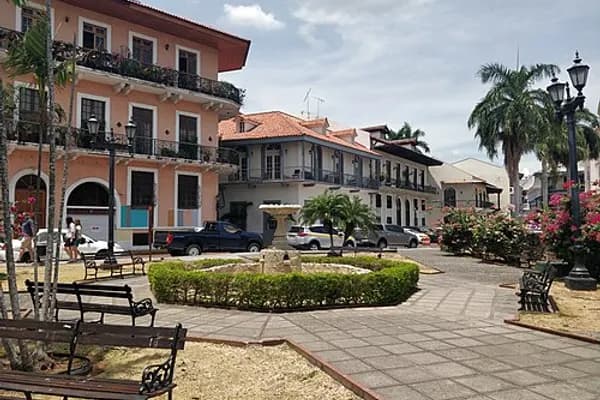
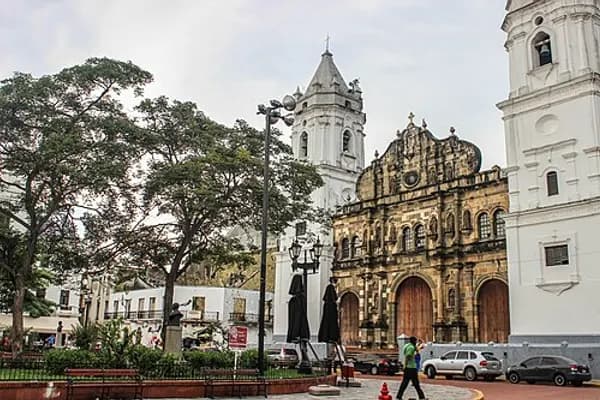
In 1671 Henry Morgan with a band of 1,400 men attacked and looted the city, which was subsequently destroyed by fire. The ruins of the old city still remain and are a popular tourist attraction known as Panamá Viejo (Old Panama). The city was rebuilt in 1673 in a new location approximately 5 miles (8km) southwest of the original city. This is now known as the Casco Viejo (Old Quarter) of the city. Panama City is the fourth earliest-founded of the modern-day capital cities in the Americas.
One year before the start of the California Gold Rush, the Panama Railroad Company was formed, but the railroad did not begin full operation until 1855. Between 1848 and 1869, the year the first transcontinental railroad was completed in the United States, about 375,000 people crossed the isthmus from the Atlantic to the Pacific, and 225,000 in the opposite direction. This traffic greatly increased the prosperity of the city during that period.
After declaring independence from Colombia on 3 November 1903, Philippe Bunau-Varilla (a French engineer) was named Envoy Extraordinary and Minister Plenipotentiary. Bunau-Varilla negotiated the Hay-Bunau-Varilla Treaty of 1903, which provided the United States with a 10-mile-wide strip of land for the canal, a one-time $10 million payment to Panama, and an annual annuity of $250,000. The United States also agreed to guarantee the independence of Panama. Completed in 1914, the Panama Canal symbolized U.S. technological prowess and economic power. Although U.S. control of the canal eventually became an irritant to U.S.-Panamanian relations, at the time it was heralded as a major foreign policy achievement.
The construction of the Panama Canal was of great benefit to the infrastructure and economy. Of particular note are the improvements in health and sanitation brought about by the American presence in the Canal Zone. William Gorgas, the chief sanitary officer for the canal construction, had a particularly large impact. He hypothesized that diseases were spread by the abundance of mosquitos native to the area, and ordered the fumigation of homes and the cleansing of water. This led to yellow fever being eradicated by November 1905, as well malaria rates falling dramatically. However, most of the laborers for the construction of the canal were brought in from the Caribbean, which created unprecedented racial and social tensions in the city.
During World War II, construction of military bases and the presence of larger numbers of U.S. military and civilian personnel brought about unprecedented levels of prosperity to the city. Panamanians had limited access, or no access at all, to many areas in the Canal Zone neighboring the Panama city metropolitan area. Some of these areas were military bases accessible only to United States personnel. Some tensions arose between the people of Panama and the U.S. citizens living in the Panama Canal Zone. This erupted in the 9 January 1964, events, known as Martyrs' Day.
In the late 1970s through the 1980s the city of Panama became an international banking center, bringing a lot of undesirable attention as an international money-laundering locale. In 1989 after nearly a year of tension between the United States and Panama, President George H. W. Bush ordered the invasion of Panama to depose General Manuel Noriega, the country's de facto dictator. As a result, a portion of the El Chorrillo neighborhood, which consisted mostly of old wood-framed buildings dating back to the 1900s (though still a large slum area), was destroyed by fire. In 1999, the United States officially transferred full control of the Panama Canal to the Republic of Panama, which remains in control today.
The city of Panama is still a banking center, although with very visible controls in the flow of cash. Shipping is handled through port facilities in the area of Balboa operated by the Hutchison Whampoa Company of Hong Kong and through several ports on the Caribbean side of the isthmus. Balboa, which is within the greater Panama metropolitan area, was formerly part of the Panama Canal Zone, and the administration of the former Panama Canal Zone was headquartered there.
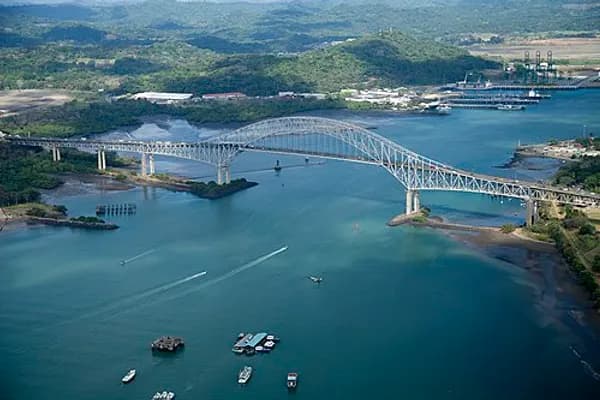
The Panama Canal is one of the main attractions to the Panama City area. The Centennial Bridge spans the area near Gold Hill on the left and Contractor Hill on the right. This is the site of the highest elevation of the Panama Canal construction. Geography
Panamá is between the Pacific Ocean and tropical rain forest in the northern part of Panama. The Parque Natural Metropolitano (Metropolitan Nature Park), stretching from Panama City along the Panama Canal, has unique bird species and other animals, such as tapir, puma, and caimans. At the Pacific entrance of the canal is the Centro de Exhibiciones Marinas (Marine Exhibitions Center), a research center for those interested in tropical marine life and ecology, managed by the Smithsonian Tropical Research Institute.
Tropical forests around Panama are vital for the functioning of the Panama Canal, providing it with the water required for its operation. Due to the canal's importance to the Panamanian economy, tropical forests around the canal have been kept in an almost pristine state; the canal is thus a rare example of a vast engineering project in the middle of a forest that helped to preserve that forest. Along the western side of the canal is the Parque Nacional Soberanía (Sovereignty National Park), which includes the Summit botanical gardens and a zoo. The best known trail in this national park is Pipeline Road, popular among birdwatchers.
Nearly 500 rivers lace Panama's rugged landscape. Most are unnavigable; many originate as swift highland streams, meander in valleys, and form coastal deltas. However, the Río Chepo and the Río Chagres, both within the boundaries of the city, work as sources of hydroelectric power.
The Río Chagres is one of the longest and most vital of the approximately 150 rivers that flow into the Caribbean. Part of this river was dammed to create Gatun Lake, which forms a major part of the transit route between the locks near each end of the canal. Both Gatun Lake and Madden Lake (also filled with water from the Río Chagres) provide hydroelectricity to the former Canal Zone area. The Río Chepo, another major source of hydroelectric power, is one of the more than 300 rivers emptying into the Pacific.
Climate
Under the Köppen climate classification, Panama City has a tropical savanna climate (Köppen Aw), a little drier than a tropical monsoon climate. It sees 1,900mm (74.8in) of precipitation annually. The wet season spans from May through December, and the dry season spans from January through April. Temperatures remain constant throughout the year, averaging around 27°C (81°F). Sunshine is subdued in Panama because it lies in the Intertropical Convergence Zone, where there is a nearly continual cloud formation, even during the dry season.
Cityscape
Architecture
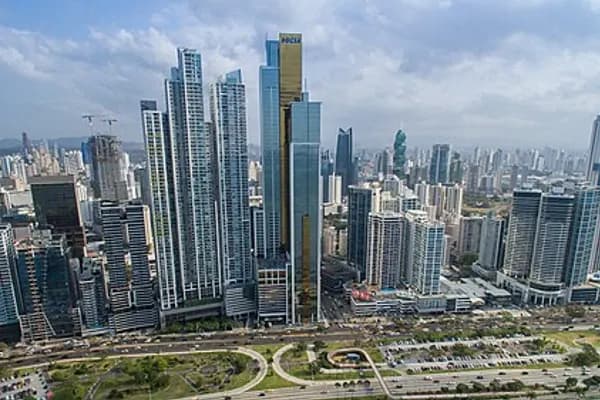
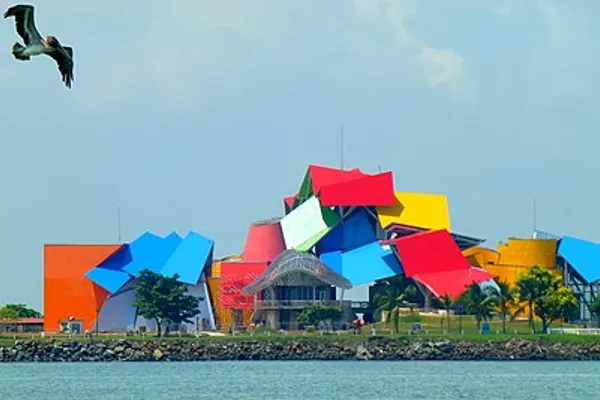
Panama's old quarter (or Casco Viejo, Panama) features many architectural styles, from Spanish colonial buildings to French and Antillean townhouses built during the construction of the Panama Canal. The more modern areas of the city have many high-rise buildings, which together form a very dense skyline. There are more than 110 high-rise projects under construction, with 127 already built. The city holds the 45th place in the world by high-rise buildings count.
The Centennial Bridge that crosses the Panama Canal earned the American Segmental Bridge Institute prize of excellence, along with seven other bridges in the Americas.
Neighborhoods
The city is in Panama District, although its metropolitan area also includes some populated areas on the opposite side of the Panama Canal. As in the rest of the country, the city is divided into corregimientos, in which there are many smaller boroughs. The old quarter, known as the Casco Viejo, is in the corregimiento of San Felipe. San Felipe and twelve other corregimientos form the urban center of the city, including Santa Ana, El Chorrillo, Calidonia, Curundú, Ancón, Bella Vista, Bethania, San Francisco, Juan Diaz, Pueblo Nuevo, Parque Lefevre, and Río Abajo.
The skyline of Panama City from Ancon Hill. 2008 Economy
As the economic and financial center of the country, Panama City's economy is service-based, heavily weighted toward banking, commerce, and tourism. The economy depends significantly on trade and shipping activities associated with the Panama Canal and port facilities in Balboa. Panama's status as a convergence zone for capital from around the world due to the canal helped the city establish itself as a prime location for offshore banking and tax planning. Consequently, the economy has relied on accountants and lawyers who help global corporations navigate the regulatory landscape. The city has benefited from significant economic growth in recent years, mainly due to the ongoing expansion of the Panama Canal, an increase in real estate investment, and a relatively stable banking sector. There are around eighty banks in the city, at least fifteen of which are local.
Panama City is responsible for the production of approximately 55% of the country's GDP. This is because most Panamanian businesses and premises are in the city and its metro area. It is a stopover for other destinations in the country, as well as a transit point and tourist destination in itself.
Tourism is one of the most important economic activities in terms of revenue generation. This sector of the economy has seen a great deal of growth since the transfer of the Panama Canal Zone at the end of the twentieth century. The number of hotel rooms increased by more than ten-fold, from 1,400 in 1997 to more than 15,000 in 2013, while the number of annual visitors increased from 457,000 in 1999 to 1.4million in 2011. The city's hotel occupancy rate has always been relatively high, reaching the second highest for any city outside the United States in 2008, after Perth, Australia, and followed by Dubai. However, hotel occupancy rates have dropped since 2009, probably due to the opening of many new luxury hotels. Several international hotel chains, such as Le Méridien, Radisson, and RIU, have opened or plan to open new hotels in the city, along with those previously operating under Marriott, Sheraton, InterContinental, and other foreign and local brands. The Trump Organization built the Trump Ocean Club, its first investment in Latin America, in 2006 and it is the tallest building in the city. In 2018 it was renamed The Bahia Grand Panama following falling occupancy rates associated with the declining brand value of the Trump name. Meanwhile, it is a JW Marriott property. Hilton Worldwide opened a Hilton Garden Inn in El Cangrejo, and in 2013, The Panamera, the second Waldorf Astoria Hotel in Latin America.
Land reclamation projects have created additional new land for highways, housing, and parkland developments, Cinta Costera.
Demographics
The city proper has 410,354 inhabitants in 13 corregimientos. There are 13 others that form the larger Panama District. The inhabitants of Panama City are commonly referred to as capitalinos and include large numbers of mestizos (70%), people with mixed Caribbean and European/Amerindian ancestry (14%), white people (10%), Amerindians (6%), as well as Afro-Panamanians. There is a great deal of cultural diversity within the city, which manifests itself in the wide variety of languages commonly spoken, such as German, Portuguese, French, Arabic, Chinese, Hebrew and English, in addition to Spanish.
Population by corregimiento
Culture
World Heritage Sites
Panamá Viejo
Panamá Viejo ("Old Panama") is the name used for the architectural vestiges of the Monumental Historic Complex of the first Spanish city founded on the Pacific coast of the Americas by Pedro Arias de Ávila on 15 August 1519. This city was the starting point for the expeditions that conquered the Inca Empire in Peru in 1532. It was a stopover point on one of the most important trade routes in the history of the American continent, leading to the famous fairs of Nombre de Dios and Portobelo, where most of the gold and silver that Spain took from the Americas passed through.
Casco Viejo or Casco Antiguo
Built and settled in 1671 after the destruction of Panama Viejo by the privateer Henry Morgan, the historic district of Panama City (known as Casco Viejo, Casco Antiguo or San Felipe) was conceived as a walled city to protect its settlers against future pirate attacks. It was designated a World Heritage Site by UNESCO in 2003.
Encyclopedic content adapted from the Wikipedia article on Punta Pacifica, used under CC BY-SA 4.0.