About the neighborhood
Suburb in Auckland, New Zealand
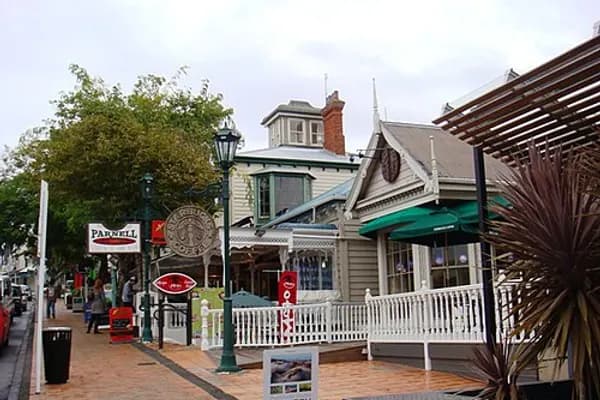
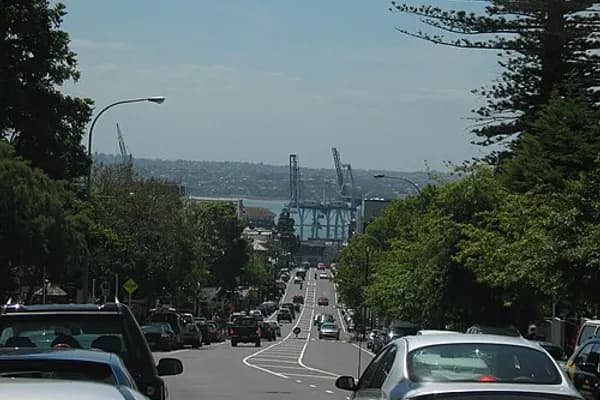
Parnell (Māori: Panēra) is a suburb of Auckland, New Zealand. It is one of New Zealand's most affluent suburbs, consistently ranked within the top three wealthiest, and is often billed as Auckland's "oldest suburb" since it dates from the earliest days of the European settlement of Auckland in 1841. It is characterised by its mix of tree-lined streets with large estates; redeveloped industrial zones with Edwardian town houses and 1920s bay villas; and its hilly topography that allows for views of the port, the Waitematā Harbour, Rangitoto Island and the Auckland Domain. To its west lies the Auckland Domain, to the south Newmarket, and to the north the Ports of Auckland.
Parnell Rise and Parnell Road make up the main road through Parnell. Parnell Rise leads to the central business district to the west; Parnell Road runs from Parnell Rise uphill to the top of the suburb, and then bends almost 90 degrees and continues towards Newmarket in the south-east. Parnell Road ends at the intersection of George and Sarawia Streets, where it becomes Broadway. Early European settlers knew Parnell Road as "Manukau Road" until well after the formation of Khyber Pass Road in 1845.
History
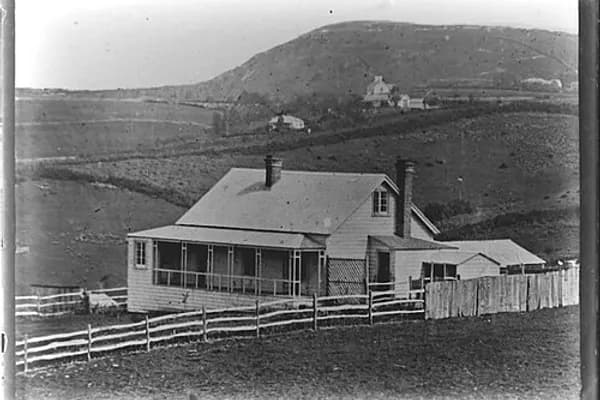
The Parnell area has a long history of settlement by Tāmaki Māori. Point Resolution was the location of Taurarua pā, occupied by the Waiōhua confederation. The name Taurarua ("annoying chant") refers to a battle between Waiōhua and Ngāti Whātua where Waiohua warriors goaded Ngāti Whātua to attack using mocking chants. This was one of the final strongholds of this iwi before it was taken by Ngāti Whātua in the 1740s, when twin brother chiefs Humataitai and Hupipi were defeated by Ngāti Whātua. Prior to European settlement, Parnell was occupied by Ngāti Whātua-o-Ōrākei. The Domain was known as Pukekawa, which translates to 'hill of bitter memories.' This is in reference to the battles that occurred between Ngāpuhi and Ngāti Whatua during the Musket Wars. The Government acquired the area from Ngāti Whātua as part of a 3,000-acre (12km) land deal in 1840.
Robert Tod purchased 3 acres (1.2ha) from the Government on 1 September 1841. He quickly subdivided it into 36 sections, which he advertised for sale on 4 September 1841 as the "Village of Parnell". In the early 1830s Tod had supplied copies of the Bible to a Plymouth Brethren mission in Baghdad, one of whose members was John Vesey Parnell. Streets in the village of Parnell were named Groves, Cronin and Calman after other missionaries to Baghdad, Anthony Norris Groves, Edward Cronin and Erasmus Scott Calman. These were later renamed Eglon, Fox and Marston Streets.
Governance
Local government
The Parnell Road District was formed 13 February 1863 but did not operate until 1868. In 1877 the road district was dissolved and the Borough of Parnell was constituted. In 1913 the borough was amalgamated into the City of Auckland.
The following served as mayors of the Borough of Parnell until its incorporation into Auckland City:
Parnell forms part of the Ōrākei Ward within Auckland Council.
Electorate
Parnell forms part of the Epsom Electorate for parliamentary representation. Parnell represents approximately 20% of the population in the electorate. The Member of Parliament for Epsom, David Seymour, represents ACT New Zealand.
Demographics
Parnell covers 2.88km (1.11sqmi) and had an estimated population of 8,390 as of June 2025, with a population density of 2,913 people per km.
Parnell had a population of 7,788 in the 2023 New Zealand census, an increase of 225 people (3.0%) since the 2018 census, and an increase of 693 people (9.8%) since the 2013 census. There were 3,678 males, 4,059 females and 48 people of other genders in 3,087 dwellings. 7.1% of people identified as LGBTIQ+. The median age was 36.2 years (compared with 38.1 years nationally). There were 756 people (9.7%) aged under 15 years, 2,376 (30.5%) aged 15 to 29, 3,378 (43.4%) aged 30 to 64, and 1,275 (16.4%) aged 65 or older.
People could identify as more than one ethnicity. The results were 71.6% European (Pākehā); 6.9% Māori; 2.6% Pasifika; 24.3% Asian; 4.7% Middle Eastern, Latin American and African New Zealanders (MELAA); and 1.4% other, which includes people giving their ethnicity as "New Zealander". English was spoken by 96.8%, Māori language by 1.3%, Samoan by 0.3%, and other languages by 29.2%. No language could be spoken by 1.3% (e.g. too young to talk). New Zealand Sign Language was known by 0.3%. The percentage of people born overseas was 41.4, compared with 28.8% nationally.
Religious affiliations were 30.9% Christian, 1.6% Hindu, 1.4% Islam, 0.3% Māori religious beliefs, 1.8% Buddhist, 0.4% New Age, 0.5% Jewish, and 1.7% other religions. People who answered that they had no religion were 55.5%, and 6.1% of people did not answer the census question.
Of those at least 15 years old, 3,507 (49.9%) people had a bachelor's or higher degree, 2,631 (37.4%) had a post-high school certificate or diploma, and 891 (12.7%) people exclusively held high school qualifications. The median income was $54,500, compared with $41,500 nationally. 1,908 people (27.1%) earned over $100,000 compared to 12.1% nationally. The employment status of those at least 15 was that 3,483 (49.5%) people were employed full-time, 1,191 (16.9%) were part-time, and 237 (3.4%) were unemployed.
Notable buildings and landmarks
Lower Parnell Road
The Swan Hotel, 31–35 Parnell Rise – constructed prior to 1856 and is one of the earliest timber public houses surviving in Auckland. Additions to the building date from the 1880s and were designed by Edward Bartley. This building originally stood directly on the foreshore. Historically this cove (now completely reclaimed) had been used by Maori to beach their waka; this usage continued after European settlement and part of the foreshore was demarcated as a Maori hostel (currently used by police Commercial Vehicle Safety Team as a heavy vehicle weighbridge and compliance checkpoint).
Parnell Rail Bridge – 19th century metal rail bridge on massive volcanic basalt rock piers. This structure allows the rail line to cross over Parnell Road without disrupting traffic.
Mayfair Apartments – 1930s brick Neo-Georgian highrise apartment block.
Windsor Castle Hotel, 144 Parnell Road – a hotel which dates from the 1850s. The hotel was remodelled in the 1880s after the architect R. MacKay Fripp was commissioned to convert the existing hotel into a larger pub; the existing facade was built during this conversion.
Former Heard Factory – three storeyed art-deco style industrial building built for a confectionery manufacturer.
Heard Park – this land was donated to the city in 1953 by the Heard family, the owners of Heards Candy, the adjacent large Art-Deco Heards building.
Church of St John the Baptist (Catholic), 204 Parnell Road – this church was designed by Edward Mahoney and formally instituted by Bishop Pompallier in 1861; it is the only Catholic church in Parnell and the oldest Catholic church in the city. The Sisters of Mercy had a convent here and a Catholic primary school ran for a century, until it closed due to falling rolls in the 1950s.
Parnell Road
Whitby Lodge, 330 Parnell Road – erected by the early 1870s, Whitby Lodge is one of few surviving colonial dwellings in Auckland constructed of the local volcanic stone basalt. Possibly erected as early as 1848 or 1852. It is possible that Fraser erected a building on the site at the time of his purchase in 1864, or improved an existing structure. The roof beams are not supported by the masonry walls, suggesting this is an earlier wooden structure which was subsequently clad in stone. The building was occupied by the Consulate General of the Cook Islands as an Embassy from 1978 until 1 December 1994.
Hulme Court, 350 Parnell Road – a stone-built, Regency-style house surrounded by trellised verandahs, was built in 1843 for Sir Fredrick Whitaker; it is the second oldest surviving house in Auckland, and the oldest documented dwelling still standing on its original site. In its early years, the house was occupied by a succession of notable people including George Selwyn, Governor Gore Browne, who used it as a temporary Government House in the 1850s, and Sir Francis Dillon Bell, who was the Minister of Native Affairs and an advisor to Governor Grey, and Colonel Hulme, who acted as commander of British Army troops in New Zealand, and after whom the house is named.
Former Parnell Public Library – corner of Parnell Road and St Georges Bay Road. 1920s Neo-Classical building.
Saint Stephen's Corner
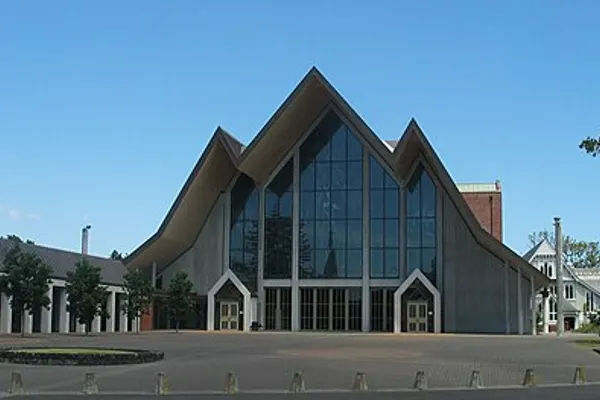
The Anglican Cathedral, which stands at the top of the hill, is the most distinctive feature of Parnell. The cathedral serves as a replacement to the original St Mary's Cathedral, which was demolished in 1888 after standing for just 28 years. The current building has two parts: the brick choir and body of the church date from about 1960 and represent a "modern" simplified version of Gothic. This closely resembles Guildford Cathedral, by Edward Maufe, completed in 1961. The massing of the forms, the detailing of the masonry and the smooth expanses of plain brick occur in both buildings. Over the transept entrance stands a bronze sculpture of the Archangel Michael defeating the Devil, very similar to the Epstein sculpture of the same subject on Coventry Cathedral (finished 1962). The front part of the church, built in the 1990s to the design of Professor Richard Toy and John Sinclair, recalls the new Coventry Cathedral built after World War II. It features large stained-glass windows, illuminated by the sunlight at certain times of the day. Māori motifs and symbols appear in the newer part of the building, which awaits a large spire to finish the composition.
St Mary's Cathedral Church – Next to this building stands the smaller St Mary's, a wooden neo-Gothic structure which dates from 1885 and served as the pro-cathedral after the demolition of the earlier St Mary's and until the building of the current cathedral. Designed by B.W Mountfort, it stood on the other side of Parnell Road until the 1980s.
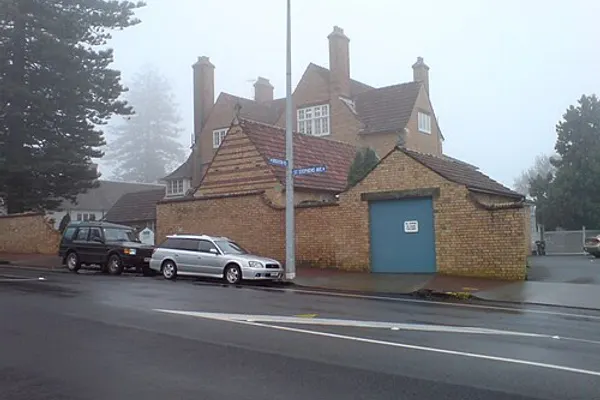
Bishopscourt – St Stephens Avenue. Also known as Selwyn Court, this is the residence of the Anglican Bishop of Auckland. This wooden gothic house, designed by Frederick Thatcher, has a chapel and an octagonal turret. Bishop Selwyn and his wife moved here in May 1865.
Neligan House – St Stephens Avenue. Fine Arts & Crafts brick residence built for Bishop Neligan in 1908 by Noel Bamford & Hector Pierce.
St Stephens House – St Stephens Avenue. Wooden Edwardian mansion, now used for Anglican social services.
The Old Deanery – St Stephens Avenue – A Frederick Thatcher-designed neo-Tudor house built from volcanic scoria rock, probably by Benjamin Strange. This is probably the birthplace of the novelist Hugh Walpole whose father was Dean of the Cathedral at the time.
Northern area of Parnell
Tower House, 33 St Stephen's Avenue – landmark brick mansion from 1904 with distinctive turret. The residence of A.E.T. Devore, Mayor of Auckland 1886–1889.
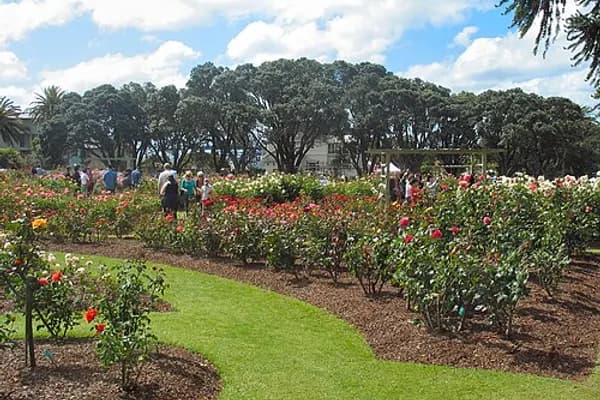
Parnell Rose Gardens Dove Myer Robinson Park, 85 to 87 Gladstone Road, Parnell – this park was created in 1913 as Parnell Park – (Parnell amalgamated with Auckland that year) largely as a result of the activities of Auckland Mayor Christopher Parr (later Sir James Parr). It was renamed in the 1970s to honour the popular and longest-serving mayor of Auckland, Sir Dove Myer Robinson. The park was created out of the gardens of several large estates which occupied the point in the late 19th century; primarily that of Sir John Logan Campbell and Justice Gillies; it enjoys expansive views of the Waitematā Harbour. This area consists of a number of different areas; the cottage style Nancy Steen Garden popular for wedding ceremonies; sweeping on down to Judges Bay and the salt water Parnell Baths. The Parnell Rose Garden is a major city attraction, containing beautifully maintained rose beds, and leads on to extended open spaces and areas with specimen trees. The park is also home to some remarkable native trees – the oldest manuka and largest pohutukawa in Auckland. There are car parking facilities and artworks at the Fred Ambler Lookout, an open space that overlooks the container terminal.
Judges Bay – so-called because in 1841 Judge William Martin and Attorney General William Swainson arrived in Auckland with houses in prefabricated sections. Swainson built on the west side and the Martins on the east of this bay. Known as Taurarua 'the two ropes' it is thought that this name referred to the two administrators of British justice. From here Martin and his neighbour Swainson would commute to work in Auckland by rowboat; they employed Māori boatmen who were supplied with uniforms. Lady Martin taught English to the local Māori and late in her life wrote of her experiences in early colonial New Zealand.
Parnell Baths, the largest saltwater pools in New Zealand. Originally opened in 1914, and renovated in 1950 to a modernist design by the office of the City Architect Tibor Donner. It owes much to the AA-trained architect, Ralph Wilkinson, who was then working in Donner's office. Ewen Wainscott was site architect. noted for murals by James Turkington The complex won an NZIA Gold Medal in 1957.
St Stephens Church and graveyard – important early Anglican Chapel and cemetery.
Southern area of Parnell
Kinder House – scoria residence built for the Rev John Kinder (1819–1903)in 1857, of volcanic scoria rock by Benjamin Strange. Now a museum, Kinder House is open to the public weekdays from 11am to 3pm. There is a modest entry charge. Various booklets and postcards are on sale.
Ewelme Cottage – the kauri-constructed Ewelme Cottage has a link with the Anglican community in Auckland, the dwelling designed and built by the Reverend Vicesimus Lush (1817–1882) and his wife Blanche in 1863–64. Ewelme Cottage, was extended 18 years after it was originally built; it remained in family hands until 1968 when it became part of the New Zealand Historic Places Trust.
Encyclopedic content adapted from the Wikipedia article on Parnell, used under CC BY-SA 4.0.
What makes Parnell special
Parnell stands out among Auckland’s neighborhoods for its distinctive character: auckland's oldest suburb. Ranked #5 in Auckland, it offers the kind of experience that defines a great city trip — a place where the streets themselves tell a story and every block rewards curiosity.
Best for
Our take on Parnell
Parnell occupies a distinctive place in Auckland's neighborhood landscape. It is the kind of district that rewards travelers who venture beyond the obvious choices — quieter than the tourist-facing areas, richer in local character, and full of the small details that make a city trip memorable.
What makes Parnell worth the visit is the texture of daily life here. It is a neighborhood that functions for the people who live in it — not just for the visitors who pass through. The shops serve local needs, the restaurants feed local appetites, and the streets have a rhythm that reflects genuine community rather than tourism infrastructure. That is the quality our editors prize most, and Parnell has it in abundance.
Our editors recommend budgeting at least half a day here — enough time to walk the main streets, sit down for coffee, and discover the side streets where Parnell's real character lives.
Living in Parnell
Parnell is connected to the rest of Auckland by public transit, and most visitors find it straightforward to reach from the city center or airport. Once you arrive, the neighborhood is best explored on foot — the scale is human and the streets reward wandering.
Day-to-day life in Parnell has the rhythm of a genuine residential neighborhood. You will find grocery stores, pharmacies, cafés with morning regulars, and the kind of small independent shops that only survive where locals support them. For visitors, this means the infrastructure you need — good coffee, a decent meal, a quiet place to sit — is always within a short walk.
Accommodation in Parnell ranges from boutique hotels to short-term rentals. We generally recommend staying within the neighborhood itself rather than commuting from a hotel elsewhere in Auckland — the experience of waking up inside a great neighborhood is fundamentally different from visiting one as a day trip.
What locals say about Parnell
Long-term residents of Parnell tend to describe their neighborhood with a mix of pride and protectiveness. Like any district with genuine character, Parnell inspires loyalty — the kind of place people move to and never quite leave, or leave and spend years trying to get back to.
What locals appreciate most about Parnell is its consistency — the feeling that the neighborhood works the same way on a Tuesday morning as it does on a Saturday night. It is not a place that performs for visitors and then goes quiet. The rhythm is genuine, the community is real, and the daily experience of living here is what draws people and keeps them.
Compared to the more famous districts in Auckland, Parnell has maintained a lower profile, which many residents consider an advantage. The neighborhood evolves gradually rather than being reshaped by sudden attention, and the result is a community that still feels organic rather than curated.
Visitor tips
- Parnell is located in Auckland, New Zealand. The neighborhood is accessible by public transport, taxi, or rideshare from most parts of the city.
- Morning is often the best time to explore — the streets are quieter, the light is better for photography, and cafes are at their most welcoming.
- Wear comfortable walking shoes — the best way to experience Parnell is on foot, wandering the side streets and discovering what lies around each corner.
- Save the neighborhood's location on your phone before you arrive. Offline maps are especially useful for navigating the smaller side streets.