About the neighborhood
Capital municipality of Vietnam
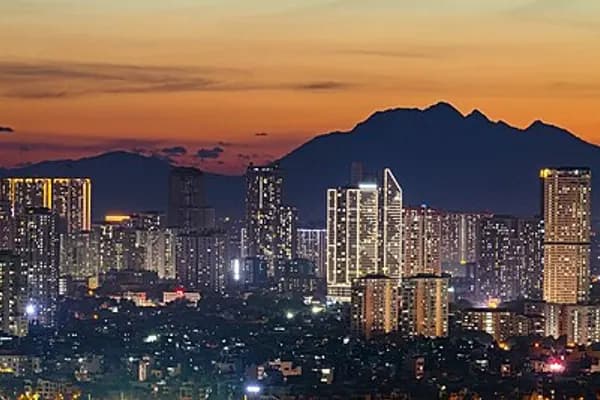
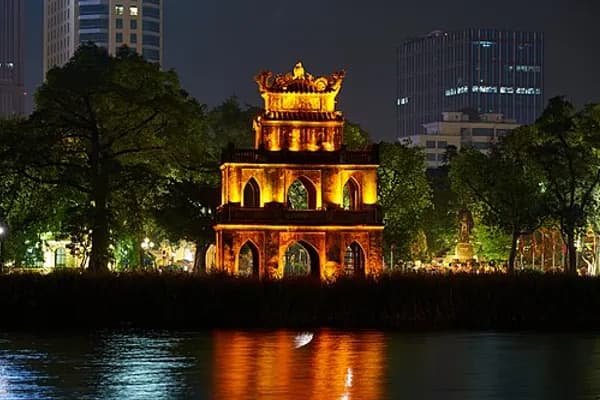
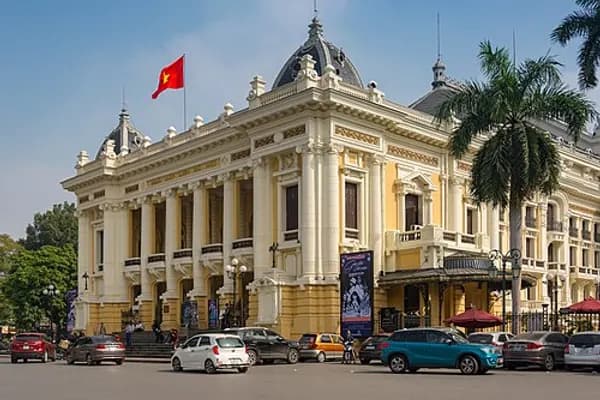
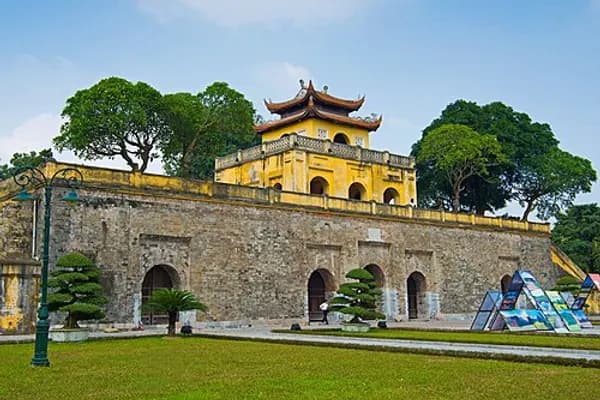
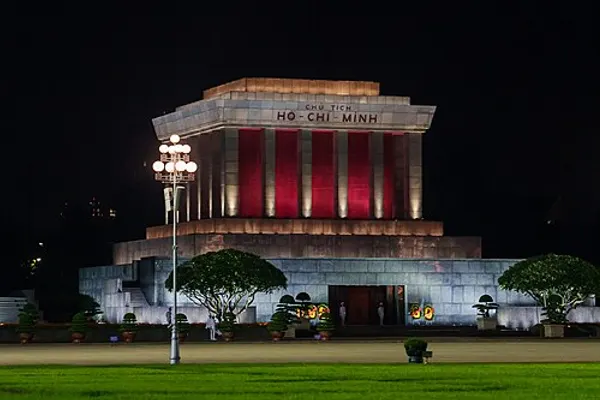
Hanoi (/hæˈnɔɪ/ han-OY; Vietnamese: Hà Nội, pronounced haː˨˩ noj˧˨ʔ) is the capital and second-most populous municipality of Vietnam. It encompasses an area of 3,358.6km (1,296.8mi), and as of 2025 has a population of 8,807,523. Hanoi had the second-highest gross regional domestic product of all Vietnamese provinces and municipalities at US$48 billion in 2023, behind Ho Chi Minh City. It hosts 78 foreign embassies, the headquarters of the Vietnam People's Army (VPA), its Vietnam National University system, and other governmental organizations. Hanoi has 18.7 million domestic and international visitors in 2022. It hosts the Imperial Citadel of Thăng Long, Ho Chi Minh Mausoleum, Hoàn Kiếm Lake, West Lake, and Ba Vì National Park near the outskirts of the municipality. Hanoi's urban area has architectural styles, including French colonial architecture, brutalist apartments and disorganized alleys and tube houses stemming from the city's growth in the 20th century.
In 1010, under the Lý dynasty, king Lý Thái Tổ established the capital of the imperial nation Đại Việt in what later is central Hanoi, naming the city Thăng Long tʰɐŋ loŋ, 'ascending dragon'). In 1428, King Lê Lợi renamed the city to Đông Kinh ɗoŋ kīŋ̟, 'eastern capital'), and it remained so until 1789. The Nguyễn dynasty in 1802 moved the national capital to Huế and the city was renamed Hanoi in 1831. Hanoi served as the capital of French Indochina from 1902 to 1945 and French protectorate of Tonkin from 1883 to 1949. After the August Revolution and the fall of the Nguyễn dynasty, the Democratic Republic of Vietnam (DRV) designated Hanoi as the capital of the newly independent country. From 1949 to 1954, Hanoi was part of the State of Vietnam. It was again part of the DRV ruling North Vietnam from 1954 to 1976. In 1976, Hanoi became the capital of the unified Socialist Republic of Vietnam.
Names
Hanoi was known as Long Biên (龍編, lit.'dragons interweaving'), then Tống Bình (宋平, lit.'Song pacification') and Long Đỗ (龍肚, lit.'dragon belly'). Long Biên later gave its name to the Long Biên Bridge, built during French colonial times. Some older names of Hanoi feature long (龍, transl.dragon), linked to the curved formation of the Red River around the city, which was symbolized as a dragon.
In 866, it was turned into a citadel and named Đại La (大羅, lit.'big net'). This gave it the nickname La Thành (羅城, lit.'La citadel'). When Lý Thái Tổ established the capital in the area in 1010, it was named Thăng Long (昇龍).
Arab manuscripts between the 9th and 12th century referred to Hanoi as Luqin (لوكين), a term derived from Longbian (Middle Chinese: Ljowng-pen), and was originally used by Muslim traders to mention the Vietnamese.
Environment
Hanoi sometimes ranks among the "most polluted cities", with days each year when it is the most air-polluted city in the world. According to the 2018 Global Air Quality Report, Hanoi's fine dust concentration was four times higher than the WHO's recommended limit (40.8 μg/m compared to the recommended 10 μg/m). A report by Vietnam's Ministry of Natural Resources and Environment stated that Hanoi is the most air-polluted city in the country. The rivers flowing through Hanoi (Nhuệ River, Tô Lịch River, Kim Ngưu River, Lừ River, and Sét River) and some lakes are polluted, as 78% of Hanoi's wastewater is discharged directly into rivers and lakes without treatment. Each of these rivers receives tens of thousands of cubic meters of wastewater daily.
Climate
When using the Köppen climate classification, Hanoi is categorized as having a monsoon-influenced humid subtropical climate (Köppen Cwa) with precipitation like other places in Northern Vietnam. The city experiences the typical climate of Northern Vietnam, with four distinct seasons. Summer, from May to September, is characterized by hot and humid weather with more rainfall, and fewer dry days. Hot, dry conditions caused by westerly winds during summer are rarer. From October to November comprise the fall season, characterized by a decrease in temperature and precipitation, this time in the year mostly are warm and mild. Winters, from December to February, are characterized as being cool by the northeast monsoon, giving Hanoi a dry winter. Spring, from March until the end of April, Hanoi is characterized with some amounts of drizzle and less sunshine due to the activity of the southeast monsoon blowing moisture from the sea inland.
The region has a positive water balance (i.e. the precipitation exceeds the potential evapotranspiration). Hanoi averages 1,612 millimetres (63.5in) of rainfall per year, the majority falling from May to October. There are an average of 114 days with rain. The average annual temperature is 23.6°C (74°F), with a mean relative humidity of more than 80%. The coldest month has a mean temperature of 16.4°C (61.5°F) and the hottest month has a mean temperature of 29.2°C (84.6°F). The highest recorded temperature was 42.8°C (109°F) in May 1926, while the lowest recorded temperature was 2.7°C (37°F) on 12 January 1955. During a January 2016 cold wave, snow was seen to appear on the nearby Ba Vì mountain range, where the temperature fell to 0°C (32°F) on 24 January 2016.
History
Pre-Thăng Long
Vestiges of human habitation from the Palaeolithic and Mesolithic ages can be found in Hanoi. Between 1971 and 1972, archaeologists in Ba Vì and Đông Anh discovered pebbles with traces of carving and processing by human hands that are relics of Sơn Vi Culture, dating from 10,000 to 20,000 years ago. In 1998–1999, the Museum of Vietnamese History (later is National Museum of Vietnamese History) carried out the archaeological studies in the north of Đồng Mô Lakevi (Sơn Tây, Hanoi), finding relics and objects belonging to the Sơn Vi Culture dating back to the Paleolithic age around 20,000 years ago. During the Holocene transgression, the sea level rose and immersed low-lying areas; geological data show the coastline was inundated and was located near Hanoi. Consequently, from about 10,000 to approximately 4,000 years ago, Hanoi in general was completely underwater. It is believed that the region has been continuously inhabited for the last 4,000 years.
Cổ Loa and Nanyue
In around third century BC, a fortified citadel, later named as Cổ Loa, is constructed in what later is Hanoi, and is the first political center of the Vietnamese civilization pre-Sinitic era, with an outer embankment covering 600 hectares. In 179 BC, the area was annexed by Nanyue. Zhao Tuo subsequently incorporated the regions into his Nanyue domain, and left the indigenous chiefs in control of the population. For the first time, the region formed part of a polity headed by a Chinese ruler.
Chinese rule
In 111 BC, the Han dynasty conquered Nanyue and ruled it. Han dynasty organized Nanyue into seven commanderies of the south (Lingnan) and included three in Vietnam alone: Giao Chỉ and Cửu Chân, and a newly established Nhật Nam.
In March of 40 AD, Trưng Trắc and Trưng Nhị, daughters of an aristocratic family of Lac ethnicity in Mê Linh district (Hanoi), led the locals to rise up in rebellion against the Han. It began at the Red River Delta, and spread south and north from Jiaozhi, stirring up all three Lạc Việt regions and most of Lingnan, gaining the support of about 65 towns and settlements. Trưng sisters then established their court upriver in Mê Linh. In 42 AD, the Han emperor commissioned general Ma Yuan to suppress the uprising with 32,000 men, including 20,000 regulars and 12,000 regional auxiliaries. The rebellion was defeated in the next year as Ma Yuan captured and decapitated Trưng Trắc and Trưng Nhị, then sent their heads to the Han court in Luoyang.
By the middle of the fifth century, in the center of what later was Hanoi, a fortified settlement was founded by the Chinese Liu Song dynasty as the seat of a new district called Tống Bình (Songping) within Giao Chỉ commandery. The name refers to its pacification by the dynasty. It was elevated to its own commandery at some point between AD454 and 464. The commandery included the districts of Yihuai (義懷) and Suining (綏寧) in the south of the Red River (later is Từ Liêm and Hoài Đức districts) with a metropolis in what later was inner Hanoi.
By the year 679, the Tang dynasty changed the region's name to Annan (Chinese: 安南Vietnamese: An Namlit. 'pacified south'), with Songping as its capital.
In the latter half of the eighth century, Zhang Boyi, a viceroy from the Tang dynasty, built Luocheng (Chinese: 羅城Vietnamese: La Thành) to suppress uprisings. Luocheng extended from Thu Le to Quan Ngua in what later was Ba Đình district. Over time, in the first half of the ninth century, this fortification was expanded and renamed as Jincheng (Vietnamese: Kim Thành). In 863, the kingdom of Nanzhao, and local rebels, laid siege of Jincheng and defeated the Chinese armies of 150,000. In 866, Chinese jiedushi Gao Pian recaptured the city and drove out the Nanzhao and rebels. He renamed the city to Daluocheng (Chinese: 大羅城Vietnamese: Đại La Thành). He built a wall around the city measuring 6,344 meters, with some sections reaching over eight meters in height. Đại La at the time had approximately 25,000 residents, including foreign communities of Persians, Arabs, Indian, Cham, Javanese, and Nestorian Christians. It became a trading center of the Tang dynasty due to the ransacking of Guangzhou by the Huang Chao Rebellion. By tenth century AD, what later was Hanoi was known to the Muslim traders as Luqin.
Thăng Long, Đông Đô, Đông Quan, Đông Kinh
In 1010, Lý Thái Tổ, the first ruler of the Lý dynasty, moved the capital of Đại Việt to the site of the Đại La Citadel. Claiming to have seen a dragon ascending the Red River, he renamed the site Thăng Long (昇龍). Thăng Long remained the capital of Đại Việt until 1397, when it was moved to Thanh Hóa, then known as Tây Đô (西都), the "Western Capital". Thăng Long then became Đông Đô (東都), the "Eastern Capital".
In 1408, the Chinese Ming dynasty attacked and occupied Vietnam, changing Đông Đô's name to Dongguan (Chinese: 東關Vietnamese: Đông Quanlit. 'eastern gate'). In 1428, the Lam Sơn uprising, under the leadership of Lê Lợi, overthrew the Chinese rule. Lê Lợi founded the Lê dynasty and renamed Đông Quan to Đông Kinh (東京) or Tonkin. During 17th century, the population of Đông Kinh was estimated by Western diplomats as about 100,000.
Nguyễn dynasty, and French colony
When the Nguyễn dynasty was established in 1802, Gia Long moved the capital to Huế. Thăng Long was no longer the capital, and its chữ Hán was changed from 昇龍 (lit.'ascending dragon') to the homophone 昇隆 (lit.'ascent and prosperity'), in order to reduce any loyalist sentiment towards the old Lê dynasty. In 1831, the Nguyễn king Minh Mạng renamed it Hà Nội (河內). Hanoi was conquered and occupied by the French military in 1873 and passed to them ten years later. As Hanoi, it was located in the protectorate of Tonkin and became the capital of French Indochina in 1902. Nominally it still belonged to the sovereignty of Vietnam (Nguyễn dynasty) under French protectorate in Tonkin, and since 1888 it had been a French concession and had directly been ruled by the French like Cochinchina.
WWII, First Indochina War, and Vietnam War
French Indochina including Hanoi was occupied by the Imperial Japanese Armed Forces in September 1940, after the Japanese invasion of French Indochina. Japan overthrew the French rule in Hanoi and formed the Empire of Vietnam in March 1945. After the fall of the Empire of Vietnam, it became the capital of the Democratic Republic of Vietnam (DRV) when Ho Chi Minh proclaimed the independence of Vietnam on 2 September 1945. The French returned and reoccupied the city in February 1947. After France recognized Vietnam's nominal and partial independence with the Élysée Accords on 14 June 1949, Hanoi became under the control of the State of Vietnam from 1949 to 1954, a unified associated state within the French Union. This state gained full independence with the Matignon Accords on 4 June 1954. In January 1953, Hanoi held the free municipal elections of the State of Vietnam. After eight years of fighting between the French and DRV forces, Hanoi became the capital of North Vietnam when this territory became a sovereign country and Vietnam became divided at 17th parallel on 21 July 1954. The army of the French Union withdrew to the South that year and the People's Army of Vietnam of the DRV and International Control Commission occupied the city on 10 October the same year under the terms of the 1954 Geneva Conference.
During the Vietnam War between North and South (1955–1975), North Vietnam (including Hanoi) was attacked by the United States and South Vietnamese Air Forces. Following the end of the war with the fall of Saigon in 1975, Hanoi became the capital of the Socialist Republic of Vietnam when North and South Vietnam were reunited on 2 July 1976.
Socialist Republic
After the Đổi Mới economic policies were approved in 1986, the Communist Party and national and municipal governments hoped to attract international investments for urban development projects in Hanoi. High-rise commercial buildings did not begin to appear until ten years later due to the international investment community being skeptical of the security of their investments in Vietnam. Urban development and rising costs displaced some residential areas in central Hanoi. Following a period of economic stagnation after the 1997 Asian financial crisis, Hanoi resumed its economic growth.
On 29 May 2008, it was decided that Hà Tây Province, Vĩnh Phúc Province's Mê Linh District and four communes in Lương Sơn District, Hòa Bình Province be merged into the metropolitan area of Hanoi from 1 August 2008. Hanoi's total area then increased to 334,470 hectares in 29 subdivisions with the new population being 6,232,940.
Public outcry in opposition to the redevelopment of culturally significant areas in Hanoi persuaded the national government to implement a low-rise policy surrounding Hoàn Kiếm Lake. The Ba Đình District is also protected from commercial redevelopment.
Demographics
Encyclopedic content adapted from the Wikipedia article on Old Quarter, used under CC BY-SA 4.0.