About the neighborhood
Urban district in Kyiv, Ukraine
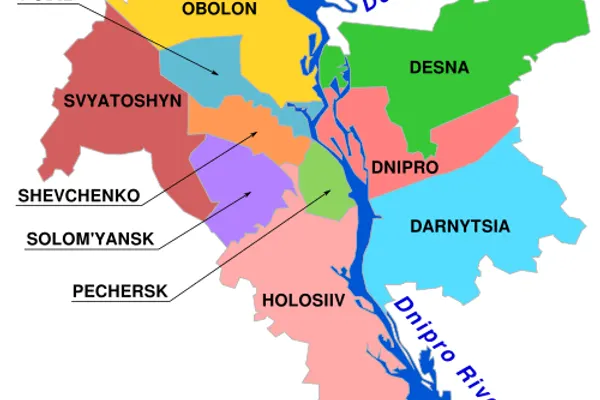
Obolonskyi District is an urban district of the Ukrainian capital Kyiv. Obolonskyi District encompasses territories far beyond of its historical neighborhood sharing the same name. It was formed on 3 March 1975 and initially called as Minskyi District. In 2001 it was renamed after its historical neighborhood. Its current population is 290,000 inhabitants.
Overview
The name of the district Obolon comes from the Old-Ukrainian word оболонь → болонь → болоньє (obolon' → bolon' → bolon'ye), which roughly translates as "flood plain" or an area that is being engulfed by water.
During Soviet rule of Ukraine, Kyiv had 14 administrative districts. In the early 21st century, a new law was passed, and the city's administrative division was reorganized into 10 districts with different borders and new names. Therefore, newer Obolonskyi District encompasses the territories of the former Minskyi District (based on Minskyi Masyv neirborhood) and is still sometimes referred to by that name. It also includes the former town of Pushcha-Vodytsia that used to be part of the Podilskyi District.
The district was built up in the 1970s as a microdistrict in Kyiv on the Obolon sands to satisfy the growth of the city. It was a northward expansion of the Kyiv city. Due to the composition of the soil at the time, the majority of the buildings were at most nine stories tall, and few trees were planted when compared to other parts of the city. That and few other reasons originally made the district not very prestigious. During the preparation to the 1980 Summer Olympics in Minskyi District of Kyiv was established a new brewery Obolon.
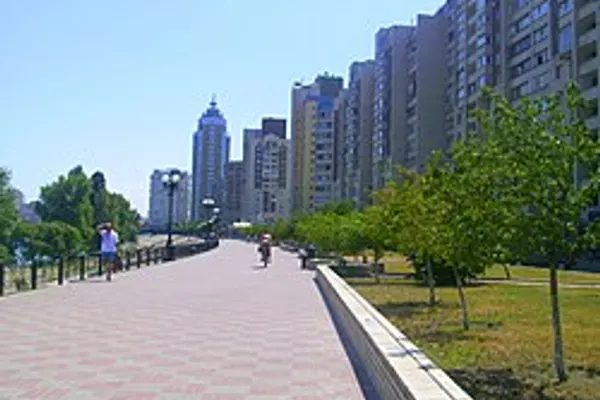
With the second construction period (2000–2005), the district has seen new, comfortable apartment buildings constructed closer to the Dnieper river and has become an attractive residential area. The new flats are also much more expensive, although still cheaper than in the central parts of Kyiv. The district was connected by metro in the 1980s, with a station Obolon opened on 5 November 1980.
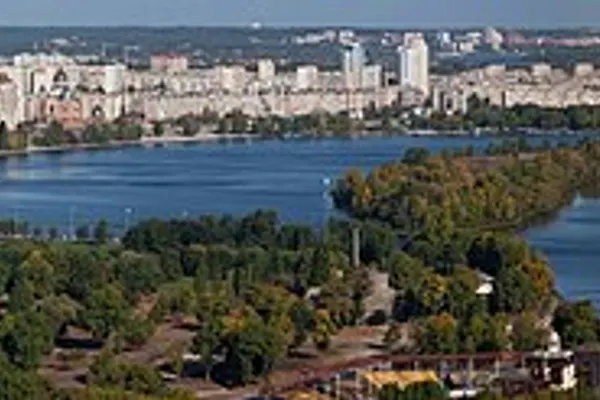
A yachting club for both kids and adults was opened in around 1990, and recently many of the Obolon lakes were cleaned up to make the area more attractive. The area closer to the Dnieper river is a popular relaxation place for Kyiv residents. The area is also well known for the beer factory Obolon CJSC.
Park Natalka is among the recreational spaces favoured by Kyiv residents. It is located along the Dnieper river.
Population
Language
Distribution of the population by native language according to the 2001 census:
Major neighborhoods
Obolon, a residential area (masyv) and an industrial zone of the Kyiv city. It is located between Dnieper river, Stepan Bandera Avenue, Verbova Street, and Dehtyarenko Street.
Kurenivka (1723–1833), an area towards the downtown of Kyiv. In the 17th century it used to be a suburb of the Kyiv city where the Kyiv Cossack Kosh was garrisoned. Its name is derived from one of the cossack's military formations, kurin (company). In the 18th century there was built the Petropavlivska Church that in the Soviet times was destroyed and rebuilt under one of the industrial buildings. Kurenivka also became famous for a massive tragedy of the Kurenivka mudslide in 1961.
Priorka (1629–1880), it is believed to be settled by monks (priors) of the Dominican Order on the road to Vyshhorod. Since 1834 the settlement was incorporated into the Kyiv-city.
Minsky masyv, a residential area (masyv) of Kyiv. It is located between Shevchenko Square, Minsk Parkway, Konradyuk Street, Maiorov Street, Panch Street, Polyarna Street. The area also contains "sub-neighborhood" Kyn-Grust.
Petrivka
Pushcha-Vodytsia (1798–2001)
Gallery
See also
Subdivisions of Kyiv
Notes
References
External links
Wikimedia Commons has media related to Obolon Raion.
Brief history of the Obolonskyi and Minskyi Districts Archived 5 March 2005 at the Wayback Machine
(in Ukrainian) obolonrda.gov.ua – Obolonskyi District administration website
(in Russian) Unofficial Kyiv Metro site – Information about the Obolon metro station
(in Ukrainian) Оболонь in Web Encyclopedia Kyiv
Unofficial designation
Category:Urban districts of Kyiv
Category:Neighbourhoods in Kyiv
50°30′19.9″N 30°29′57.4″E / 50.505528°N 30.499278°E / 50.505528; 30.499278
Encyclopedic content adapted from the Wikipedia article on Obolon, used under CC BY-SA 4.0.
What makes Obolon special
Obolon stands out among Kyiv’s neighborhoods for its distinctive character: riverside kyiv. Ranked #4 in Kyiv, it offers the kind of experience that defines a great city trip — a place where the streets themselves tell a story and every block rewards curiosity.
Best for
Our take on Obolon
Obolon occupies a distinctive place in Kyiv's neighborhood landscape. It is the kind of district that rewards travelers who venture beyond the obvious choices — quieter than the tourist-facing areas, richer in local character, and full of the small details that make a city trip memorable.
What makes Obolon worth the visit is the texture of daily life here. It is a neighborhood that functions for the people who live in it — not just for the visitors who pass through. The shops serve local needs, the restaurants feed local appetites, and the streets have a rhythm that reflects genuine community rather than tourism infrastructure. That is the quality our editors prize most, and Obolon has it in abundance.
Our editors recommend budgeting at least half a day here — enough time to walk the main streets, sit down for coffee, and discover the side streets where Obolon's real character lives.
Living in Obolon
Obolon is connected to the rest of Kyiv by public transit, and most visitors find it straightforward to reach from the city center or airport. Once you arrive, the neighborhood is best explored on foot — the scale is human and the streets reward wandering.
Day-to-day life in Obolon has the rhythm of a genuine residential neighborhood. You will find grocery stores, pharmacies, cafés with morning regulars, and the kind of small independent shops that only survive where locals support them. For visitors, this means the infrastructure you need — good coffee, a decent meal, a quiet place to sit — is always within a short walk.
Accommodation in Obolon ranges from boutique hotels to short-term rentals. We generally recommend staying within the neighborhood itself rather than commuting from a hotel elsewhere in Kyiv — the experience of waking up inside a great neighborhood is fundamentally different from visiting one as a day trip.
What locals say about Obolon
Long-term residents of Obolon tend to describe their neighborhood with a mix of pride and protectiveness. Like any district with genuine character, Obolon inspires loyalty — the kind of place people move to and never quite leave, or leave and spend years trying to get back to.
What locals appreciate most about Obolon is its consistency — the feeling that the neighborhood works the same way on a Tuesday morning as it does on a Saturday night. It is not a place that performs for visitors and then goes quiet. The rhythm is genuine, the community is real, and the daily experience of living here is what draws people and keeps them.
Compared to the more famous districts in Kyiv, Obolon has maintained a lower profile, which many residents consider an advantage. The neighborhood evolves gradually rather than being reshaped by sudden attention, and the result is a community that still feels organic rather than curated.
Visitor tips
- Obolon is located in Kyiv, Ukraine. The neighborhood is accessible by public transport, taxi, or rideshare from most parts of the city.
- Morning is often the best time to explore — the streets are quieter, the light is better for photography, and cafes are at their most welcoming.
- Wear comfortable walking shoes — the best way to experience Obolon is on foot, wandering the side streets and discovering what lies around each corner.
- Save the neighborhood's location on your phone before you arrive. Offline maps are especially useful for navigating the smaller side streets.