About the neighborhood
Area of London, England
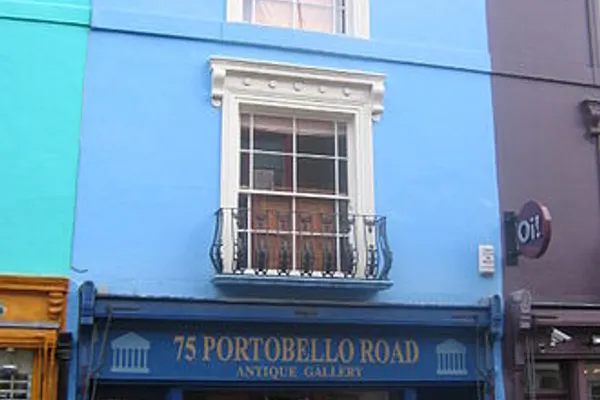
Notting Hill is a district of West London, England, in the Royal Borough of Kensington and Chelsea. Notting Hill is known for being a cosmopolitan and multicultural neighbourhood, hosting the annual Notting Hill Carnival and the Portobello Road Market. From around 1870, Notting Hill had an association with artists.
For much of the 20th century, the large houses were subdivided into multi-occupancy rentals. Continental Europeans, Caribbeans (African Caribbeans, Indian Caribbeans, and White Caribbeans), Africans, Indians, Arabs, Asians, Jewish, Central Americans, South Americans, Pacific Islanders, Irish, Northern Irish, Scottish, Welsh, and other immigrants were drawn to the area in the 1950s and 1960s, partly because of the cheap rents, but were exploited by slum landlords like Peter Rachman and also became the target of white Teddy Boys in the 1958 Notting Hill race riots.
By the early 21st century, after decades of gentrification, Notting Hill had gained a reputation as an affluent and fashionable area, known for attractive terraces of large Victorian townhouses and high-end shopping and restaurants (particularly around Westbourne Grove and Clarendon Cross). A Daily Telegraph article in 2004 used the phrase "the Notting Hill set" to refer to a group of emerging Conservative politicians, such as David Cameron and George Osborne, who would become respectively Prime Minister and Chancellor of the Exchequer and were once based in Notting Hill.
History
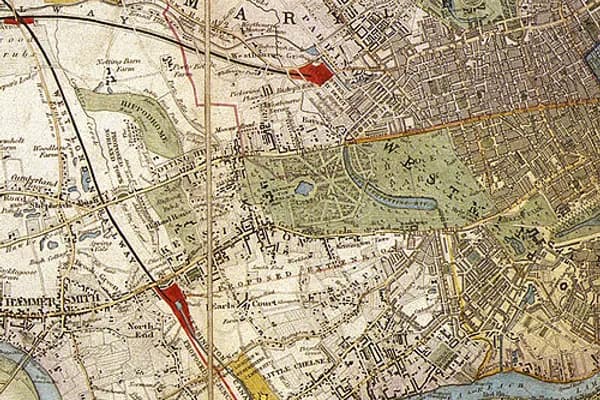
Notting Hill is in the ceremonial county of Greater London although it was formerly a hamlet on rural land until the expansion of urban London during the 19th century. As late as 1870, even after the hamlet had become a London suburb, Notting Hill was still popularly referred to as being in Middlesex rather than in London.
Origin of the name
The origin of the name "Notting Hill" is uncertain though an early version appears in the Patent Rolls of 1356 as Knottynghull, while an 1878 text, Old and New London, reports that the name derives from a manor in Kensington called "Knotting-Bernes", "Knutting-Barnes", or "Nutting-barns", and goes on to quote from a court record during Henry VIII's reign that "the manor called Notingbarons, alias Kensington, in the parish of Paddington, was held of the Abbot of Westminster." For years, it was thought to be a link with Canute, but it is now thought likely that the "Nott" section of the name is derived from the Saxon personal name Cnotta, with the "ing" part generally accepted as coming from the Saxon for a group or settlement of people.
Potteries and Piggeries
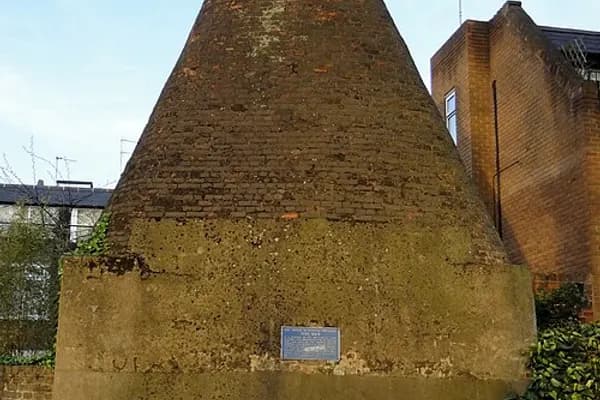
The area in the west around Pottery Lane was used in the early 19th century for making bricks and tiles out of the heavy clay dug in the area. The clay was shaped and fired in a series of brick and tile kilns. The only remaining 19th-century tile kiln in London is on Walmer Road. In the same area, pig farmers moved in after being forced out of the Marble Arch area. Avondale Park was created in 1892 out of a former area of pig slurry called "the Ocean". This was part of a general clean-up of the area which had become known as the Potteries and Piggeries.
19th-century development
The area remained rural until London's westward expansion reached Bayswater in the early 19th century. The Ladbroke family was Notting Hill's main landowner, and from the 1820s James Weller Ladbroke began to develop the Ladbroke Estate. Working with the architect and surveyor Thomas Allason, Ladbroke began to lay out streets and houses, with a view to turning the area into a fashionable suburb of the capital (although the development did not get seriously under way until the 1840s). Many of these streets bear the Ladbroke name, including Ladbroke Grove, the area's main north–south axis, and Ladbroke Square, London's largest private garden square.
The original idea was to call the district Kensington Park, and other roads (notably Kensington Park Road and Kensington Park Gardens) are reminders of this. The original local telephone prefix 020 7727 (originally 01-727) is based on the old telephone exchange name of PARk.
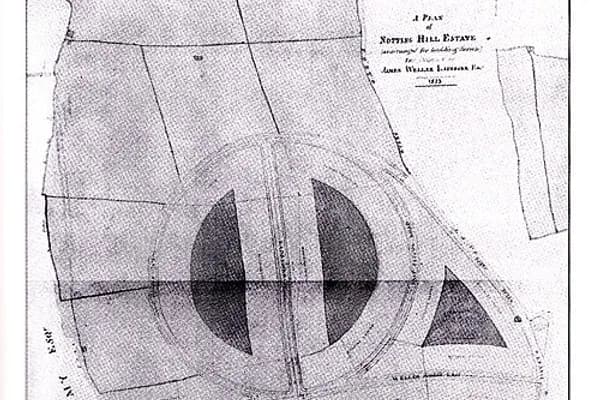
Ladbroke left the actual business of developing his land to the firm of City solicitors, Smith, Bayley (known as Bayley and Janson after 1836), who worked with Allason to develop the property. In 1823 Allason completed a plan for the layout of the main portion of the estate. This marks the genesis of his most enduring idea – the creation of large private communal gardens, originally known as "pleasure grounds", or "paddocks", enclosed by terraces and/or crescents of houses.
Instead of houses being set around a garden square, separated from it by a road, Allason's houses would have direct access to a secluded communal garden in the rear, to which people on the street did not have access and generally could not see. To this day these communal garden squares continue to provide the area with much of its attraction for the wealthiest householders.
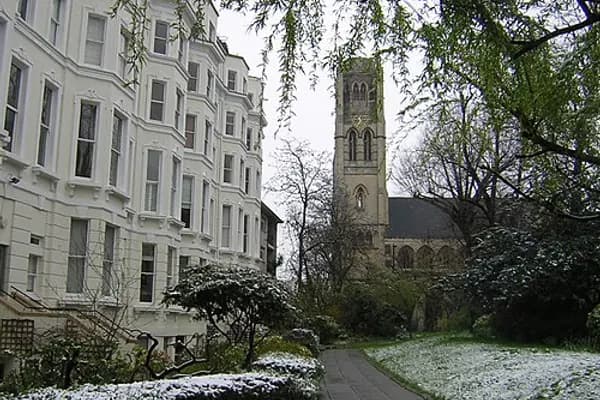
In 1837 the Hippodrome racecourse was laid out. The racecourse ran around the hill, and bystanders were expected to watch from the summit of the hill. However, the venture was not a success, in part due to a public right of way which traversed the course, and in part due to the heavy clay of the neighbourhood which caused it to become waterlogged. The Hippodrome closed in 1841, after which development resumed and houses were built on the site. The crescent-shaped roads that circumvent the hill, such as Blenheim Crescent, Elgin Crescent, Stanley Crescent, Cornwall Crescent and Landsdowne Crescent, were built over the circular racecourse tracks. At the summit of hill stands the elegant St John's church, built in 1845 in the early English style, and which formed the centrepiece of the Ladbroke Estate development.
The Notting Hill houses were large, but they did not immediately succeed in enticing the very richest Londoners, who tended to live closer to the centre of London in Mayfair or Belgravia. The houses appealed to the upper middle class, who could live there in Belgravia style at lower prices. In the opening chapter of John Galsworthy's Forsyte Saga novels, he housed the Nicholas Forsytes "in Ladbroke Grove, a spacious abode and a great bargain". In 1862 Thomas Hardy left Dorchester for London to work with architect Arthur Blomfield; during this period he lived in Westbourne Park Villas. He immersed himself in the city's literary and cultural life, studying art, visiting the National Gallery, attending the theatre and writing prose and poetry. His first published story, "How I Built Myself a House", appeared in Chamber's Journal in 1865. Here he wrote his first―but never published―novel, The Poor Man and the Lady, in 1867, and the poem "A Young Man's Exhortation", from which Graham Greene took an epigraph for his own novel The Comedians. Arthur Machen (1863–1947), the author of many supernatural and fantastic fictions, lived at 23 Clarendon Road, Notting Hill Gate, in the 1880s; he writes of his life here in his memoirs Far Off Things (1922) and Things Near and Far (1923). His mystical work The Hill of Dreams (1907, though written ten years earlier) has scenes set in Notting Hill; it is here that the protagonist Lucian Taylor encounters the beautiful bronze-haired prostitute who will later connive at his death.
Early to mid-20th century
The reputation of the district altered over the course of the 20th century. As middle-class households ceased to employ servants, the large Notting Hill houses lost their market and were increasingly split into multiple occupation. During the Blitz a number of buildings were damaged or destroyed by the Luftwaffe, including All Saints' Church, which was hit in 1940 and again in 1944. In the postwar period the name Notting Hill evoked a down-at-heel area of cheap lodgings, epitomised by the racketeering landlord Peter Rachman and the murders committed by John Christie in 10 Rillington Place, since demolished. The area to the north east, Golborne, was particularly known for being, in the words of Charles Booth, "one of the worst areas in London". Southam Street in Kensal Green had 2,400 people living in 140 nine-roomed houses in 1923, and the slum children from this street were documented in the 1950s photographs of Roger Mayne.
In late August and early September 1958, the Notting Hill race riots occurred. The series of disturbances are thought to have started on 30 August when a gang of white youths attacked a Swedish woman, Majbritt Morrison, who was married to a West Indian man (Raymond Morrison), following a previous incident in Latimer Road tube station. Later that night a mob of 300 to 400 white people, including many "Teddy Boys", were seen on Bramley Road attacking the houses of West Indian residents. The disturbances, racially-motivated rioting and attacks continued every night until they petered out by 5 September.
The dire housing conditions in Notting Hill led Bruce Kenrick to found the Notting Hill Housing Trust in 1963, helping to drive through new housing legislation in the 1960s and found the national housing organisation Shelter in 1966. Nos 1–9 Colville Gardens, now known as Pinehurst Court, had become so run down by 1969 that its owner, Robert Gubay of Cledro Developments, described conditions in the buildings as "truly terrible".
The slums were cleared during redevelopment in the 1960s and 1970s when the Westway Flyover and Trellick Tower were built. It is now home to a vibrant community, mainly Mediterranean Spanish and Moroccan, together with Portuguese.
Late 20th-century gentrification
By the 1980s, single-occupation houses began to return to favour with families who could afford to occupy them, and because of the open spaces and stylish architecture Notting Hill is today one of London's most desirable areas. Several parts of Notting Hill are characterised by handsome stucco-fronted pillar-porched houses, often with private gardens, notably around Pembridge Place and Dawson Place and streets radiating from the southern part of Ladbroke Grove, many of which lead onto substantial communal gardens. There are grand terraces, such as Kensington Park Gardens, and large villas as in Pembridge Square and around Holland Park. There is also new construction of modern houses tucked away on backland sites.
Since at least 2000, independent shops in Portobello such as Culture Shack have lost out to multinational standardised chains such as Starbucks. In 2009, Lipka's Arcade, a large indoor antiques market, was replaced by the high-street chain AllSaints. Reflecting the increasing demise of one of the most culturally vibrant parts of central London, the 2011 Census showed that in the borough of Kensington and Chelsea, in which Notting Hill is situated, the number of Black or Black British and White Irish residents, two of the traditionally largest ethnic minority groups in Notting Hill, declined by 46 and 28 percent respectively in ten years.
The district adjoins two large public parks, Holland Park and Kensington Gardens, with Hyde Park within 1 mile (1.6km) to the east. The gentrification has encompassed some streets that were among the 1980s' most decrepit, including the now expensive retail sections of Westbourne Grove and Ledbury Road, as well as Portobello Road's emergence as a top London tourist attraction and Chamberlayne Road as a local shopping street with its boutique independent shops. Notting Hill has a high concentration of restaurants, including the two Michelin-rated The Ledbury and Core by Clare Smyth.
Geography
The hill from which Notting Hill takes its name is still clearly visible, with its summit in the middle of Ladbroke Grove, at the junction with Kensington Park Gardens.
Notting Hill has no official boundaries, so definitions of which areas fall under Notting Hill vary. The postcode "W11", centred on the former site of the Post Office in Westbourne Grove, near the junction with Denbigh Road, is the one most closely associated with Notting Hill. It covers the central part of Notting Hill, and is situated between the A402 (Holland Park Avenue) to the south and the Westway to the north. Notting Hill is made up of four sub areas plus Notting Hill itself. In the north west is Kensal Green...North Kensington in the south west while to the north east is Kensal Town and South east of the area is Westbourne Park and Notting Hill. These areas are separated by the by westway(north–south axis) and Ladbroke Grove which runs through the area north–south. The local historian Florence Gladstone, in her much reprinted work "Notting Hill in Bygone Days" defines Notting Hill as the whole of that part of Kensington which is north of the road known as Notting Hill Gate.
North Kensington is considered the major neighbourhood of Notting Hill, but Kensal Green, Latimer Road and Westbourne Park are also part of Notting Hill; though estate agents differentiate North Kensington and Notting Hill as distinct areas with Westbourne considered part of Notting Hill and Kensal considered part of North Kensington. Locally the areas of Portobello, North Kensington, Kensal are referred to as Ladbroke Grove, the main thoroughfare and tube station at the heart of Notting Hill. That part of the Royal Borough of Kensington and Chelsea roughly encompassed by the electoral wards of Saint Charles, Golborne, Notting Barns, Colville, Norland, and Pembridge, which is bounded on the north by Harrow Road and on the south by Notting Hill Gate and Holland Park Avenue, includes all areas known as Notting Hill, including Notting Barns, the centre of the Notting Hill race riot. David Cameron, former leader of the Conservative Party, is known as part of the "Notting Hill Set", though he states he lives in North Kensington.
There are five tube stations in the area: Ladbroke Grove, Westbourne Park, Latimer Road, Notting Hill Gate and Kensal Green. Notting Hill is part of the parliamentary constituency of Kensington and Bayswater, represented by Labour Joe Powell since the 2024 general election.
Areas of Notting Hill
Ladbroke Grove
Ladbroke Grove is a road running down the west side of Notting Hill, stretching up to Kensal Green, straddling the W10 and W11 postal districts, and also the name of the immediate area surrounding the road. Ladbroke Grove tube station is on the road where it is crossed by the Westway.
Notting Hill Gate
Encyclopedic content adapted from the Wikipedia article on Notting Hill, used under CC BY-SA 4.0.
What makes Notting Hill special
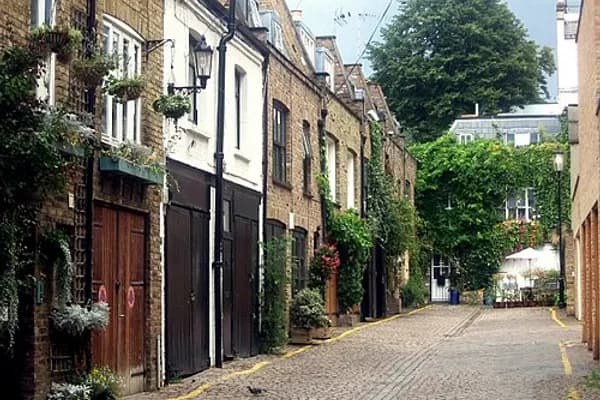
Notting Hill stands out among London’s neighborhoods for its distinctive character: pastel houses and portobello treasures. Ranked #2 in London, it offers the kind of experience that defines a great city trip — a place where the streets themselves tell a story and every block rewards curiosity.
Best for
Our take on Notting Hill
Notting Hill is one of the strongest neighborhoods in London, and it consistently appears in our editors' personal favorites lists. It may not always get the same attention as the city's most famous district, but among travelers who know London well, Notting Hill is often the first recommendation.
What makes Notting Hill worth the visit is the texture of daily life here. It is a neighborhood that functions for the people who live in it — not just for the visitors who pass through. The shops serve local needs, the restaurants feed local appetites, and the streets have a rhythm that reflects genuine community rather than tourism infrastructure. That is the quality our editors prize most, and Notting Hill has it in abundance.
Our editors recommend budgeting at least half a day here — enough time to walk the main streets, sit down for coffee, and discover the side streets where Notting Hill's real character lives.
Living in Notting Hill
Notting Hill is connected to the rest of London by public transit, and most visitors find it straightforward to reach from the city center or airport. Once you arrive, the neighborhood is best explored on foot — the scale is human and the streets reward wandering.
Day-to-day life in Notting Hill has the rhythm of a genuine residential neighborhood. You will find grocery stores, pharmacies, cafés with morning regulars, and the kind of small independent shops that only survive where locals support them. For visitors, this means the infrastructure you need — good coffee, a decent meal, a quiet place to sit — is always within a short walk.
Accommodation in Notting Hill ranges from boutique hotels to short-term rentals. We generally recommend staying within the neighborhood itself rather than commuting from a hotel elsewhere in London — the experience of waking up inside a great neighborhood is fundamentally different from visiting one as a day trip.
What locals say about Notting Hill
Long-term residents of Notting Hill tend to describe their neighborhood with a mix of pride and protectiveness. Like any district with genuine character, Notting Hill inspires loyalty — the kind of place people move to and never quite leave, or leave and spend years trying to get back to.
What locals appreciate most about Notting Hill is its consistency — the feeling that the neighborhood works the same way on a Tuesday morning as it does on a Saturday night. It is not a place that performs for visitors and then goes quiet. The rhythm is genuine, the community is real, and the daily experience of living here is what draws people and keeps them.
Like any neighborhood that has earned attention, Notting Hill is navigating the tension between popularity and preservation. Rents have risen, new businesses have arrived, and long-time residents occasionally grumble that the neighborhood is not what it was. But the fundamentals — the walkability, the food, the community — remain strong, and most locals we speak to believe the neighborhood is still gaining more than it is losing.
Visitor tips
- Notting Hill is located in London, United Kingdom. The neighborhood is accessible by public transport, taxi, or rideshare from most parts of the city.
- Morning is often the best time to explore — the streets are quieter, the light is better for photography, and cafes are at their most welcoming.
- Wear comfortable walking shoes — the best way to experience Notting Hill is on foot, wandering the side streets and discovering what lies around each corner.
- Save the neighborhood's location on your phone before you arrive. Offline maps are especially useful for navigating the smaller side streets.