About the neighborhood
Area of London, England
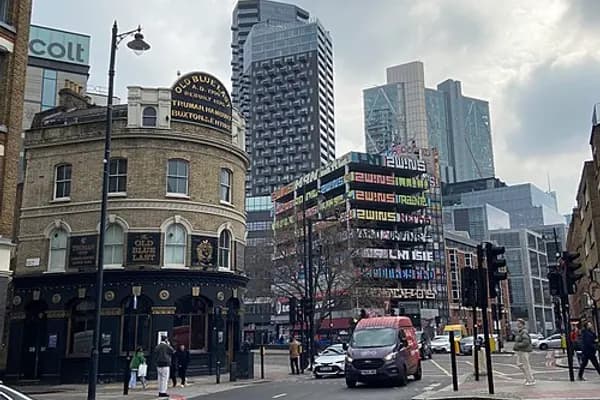
Shoreditch is an area in London, England and is located in the London Borough of Hackney alongside neighbouring parts of Tower Hamlets, which are also perceived as part of the area due to historic ecclesiastical links. Shoreditch lies just north-east of the border with the City of London and is considered to be a part of London's East End.
In the 16th century, Shoreditch was an important centre of the Elizabethan theatre, and it has been an important entertainment centre since that time. Today, it hosts many pubs, bars and nightclubs. The most commercial areas lie closest to the City of London and along the A10 Road, with the rest mostly residential.
Toponymy
Early spellings of the name include Soredich (c.1148), Soresdic (1183–4), Sordig (1204), Schoresdich (1220–21), and other variants. Toponymists are generally agreed that the name derives from Old English "scoradīc", i.e. "shore-ditch", the shore being a riverbank or prominent slope; but there is disagreement as to the identity of the "shore" in question. A suggestion made by Eilert Ekwall in 1936 that the "ditch" might have been one leading to the "shore" of the Thames continues to enjoy widespread currency. Other scholars, however, have challenged this interpretation on the grounds that the City of London lies between Shoreditch and the Thames. A variant spelling used by John Stow in 1598, Sewers Ditche, raises the possibility that the name might originally have referred to a drain or watercourse. Certainly the area was once boggy, and the name might bear some relation to the main branch of the Walbrook, which rose in Hoxton, ran along what is now Curtain Road, flowing past the former Curtain Theatre. The river was known in this area as the Deepditch, Flood Ditch or just The Ditch.
Folk etymology holds that the place was originally named "Shore's Ditch", after Jane Shore, the mistress of Edward IV, who is supposed to have died or been buried in a ditch in the area. This legend is commemorated today by a large painting, at Haggerston Branch Library, of the body of Shore being retrieved from the ditch, and by a design on glazed tiles in a shop in Shoreditch High Street showing her meeting Edward IV. However, the area was known as Shoreditch long before Jane Shore lived: the Survey of London, for example, lists some 26 deeds dating from between c.1148 and 1260 which use some version of the name.
In another theory, also now discredited, antiquarian John Weever claimed that the name was derived from Sir John de Soerdich, who was lord of the manor during the reign of Edward III (1327–77).
History
Origins
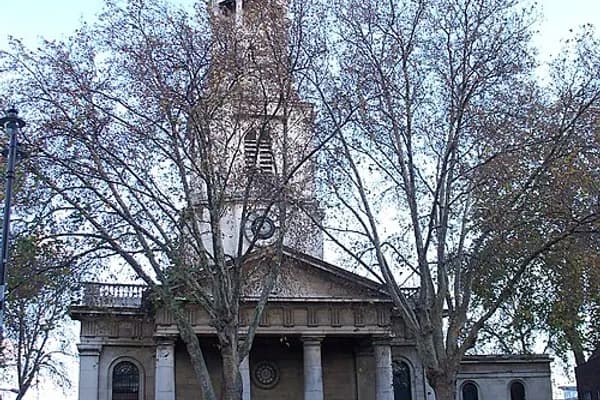
Though now part of Inner London, Shoreditch was previously an extramural suburb of the City of London, centred on Shoreditch Church at the old crossroads where Shoreditch High Street and Kingsland Road are crossed by Old Street and Hackney Road.
Shoreditch High Street and Kingsland Road are a small sector of the Roman Ermine Street and modern A10. Known also as the Old North Road, it was a major coaching route to the north, exiting the City at Bishopsgate. The east–west course of Old Street–Hackney Road was also probably originally a Roman Road, connecting Silchester with Colchester, bypassing the City of London to the south.
Shoreditch Church (officially known as St Leonard's, Shoreditch) is of ancient origin. It is featured in the famous line "when I grow rich say the bells of Shoreditch", from the English nursery rhyme "Oranges and Lemons".
Shoreditch was the site of a house of canonesses, the Augustinian Holywell Priory (named after a Holy Well on the site), from the 12th century until its dissolution in 1539. This priory was located between Shoreditch High Street and Curtain Road to east and west, and Batemans Row and Holywell Lane to north and south. Nothing remains of it today.
Shakespeare and the Elizabethan theatre
In 1574, the City authorities banned the building of playhouses in the City of London area. Consequently, theatres were built in the suburbs, beyond its jurisdiction.
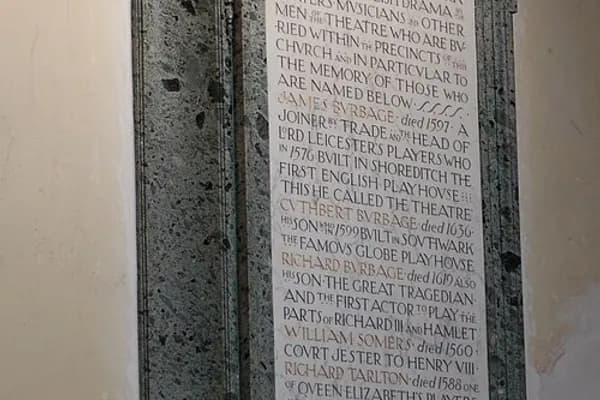
The first of these came in 1576, when James Burbage built the first playhouse in England, known as "The Theatre", on the site of the Priory (commemorated today by a plaque on Curtain Road, and excavated in 2008, by MoLAS).
William Shakespeare lived nearby in a property overlooking St Helen's churchyard in the Bishopsgate Within area of the City. His early plays were first performed in Shoreditch, at The Theatre and at the nearby Curtain Theatre, built the following year and 200 yards (183m) to the south (marked by a commemorative plaque in Hewett Street off Curtain Road). Romeo and Juliet was first performed here, gaining "Curtain plaudits", Henry V was performed within "this wooden O" and an early version of Hamlet was also first staged in Shoreditch.
Shakespeare's Company moved the timbers of "The Theatre" to Southwark at the expiration of the lease in 1599, in order to construct the Globe. The Curtain continued performing plays in Shoreditch until at least 1627.
The suburb of Shoreditch was attractive as a location for these early theatres because, like Southwark, it was outside the jurisdiction of the somewhat puritanical City fathers. Even so, they drew the wrath of contemporary moralists, as did the local "base tenements and houses of unlawful and disorderly resort" and the "great number of dissolute, loose, and insolent people harboured in such and the like noisome and disorderly houses, as namely poor cottages, and habitations of beggars and people without trade, stables, inns, alehouses, taverns, garden-houses converted to dwellings, ordinaries, dicing houses, bowling alleys, and brothel houses".
17th and 18th centuries
During the 17th century, wealthy traders and French Huguenot silkweavers moved to the area, establishing a textile industry in Shoreditch, Spitalfields and surrounding areas. This industry is now commemorated by the name of the Weaver line railway which serves the area. By the 19th century, Shoreditch was also the locus of the furniture industry, now commemorated in the Museum of the Home on Kingsland Road. These industries declined in the late 19th century.
19th century
In 1886, the parish of Holy Trinity, Shoreditch, was created to meet the needs of a growing population; the first vicar was the Anglo-Catholic priest, Arthur Osborne Montgomery Jay, son of William James Jay, chaplain to Duleep Singh. By 1889, Holy Trinity church, with a church hall and school, had opened on Old Nichol Street. Controversially, the church hosted a boxing club and gymnasium, which Father Jay saw as vital to reclaiming local men from street brawls. In 1894, the church opened a lodging house, Trinity Chambers.
In 1893, work began on building the Boundary Estate, as a slum clearance project.
Victorian entertainments
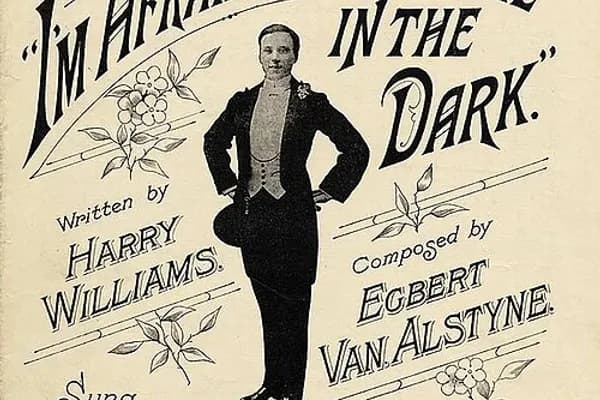
In the 19th and early 20th centuries, Shoreditch was a centre of entertainment to rival the West End and had many theatres and music halls:
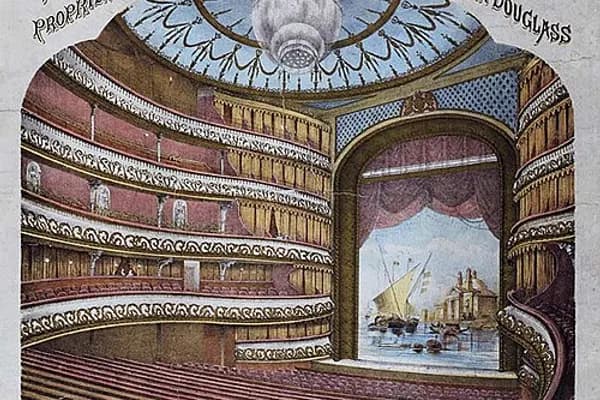
The National Standard Theatre, 2/3/4 Shoreditch High Street (1837–1940). In the late 19th century this was one of the largest theatres in London. In 1926, it was converted into a cinema called The New Olympia Picturedrome. The building was demolished in 1940. Sims Reeves, Mrs Marriott and James Anderson all appeared here; also performed were programmes of classical opera and even Shakespeare, with actors including Henry Irving. There was considerable rivalry with the West End theatres. John Douglass (the owner, from 1845) wrote a letter to The Era following a Drury Lane first night, in which he commented that "seeing that a hansom cab is used in the new drama at Drury Lane, I beg to state that a hansom cab, drawn by a live horse was used in my drama ... produced at the Standard Theatre ... with real rain, a real flood, and a real balloon."
The Shoreditch Empire, also known as The London Music Hall, 95–99 Shoreditch High Street (1856–1935). The theatre was rebuilt in 1894 by Frank Matcham, the architect of the Hackney Empire. Charlie Chaplin is recorded as performing here, in his early days, before he achieved fame in America. Purchased in 1934 by adjacent drapery business Jeremiah Rotherham & Co and rebuilt as a warehouse.
The Royal Cambridge Music Hall, 136 Commercial Street (1864–1936), was destroyed by fire in 1896, then rebuilt in 1897 by Finch Hill, architect of the Britannia Theatre, in nearby Hoxton. The Builder of 4 December 1897 said "The New Cambridge Music Hall in Commercial Street, Bishopsgate, is now nearing completion. The stage will be 41 feet [12.5m] wide by 30 feet [9.1m] deep. The premises will be heated throughout by hot water coils, and provision has been made for lighting the house by electric light."
None of these places of entertainment survives today. Music hall was revived for a brief time in Curtain Road by the temporary home of the Brick Lane Music Hall. This too has now moved on.
A number of playbills and posters from these music halls survive in the collections of both the Bishopsgate Institute and the Victoria and Albert Museum.
First World War
In the First World War, the Mayor, Henry Busby Bird, and Borough of Shoreditch raised a pals battalion of volunteers from around the borough who would serve together as the 20th (Service) Battalion, Middlesex Regiment (Shoreditch). The battalion was also known as the 'Boxers' Battalion' (the parent Middlesex Regiment was nicknamed the 'Die-hards'). The volunteers were enlisted at Shoreditch Town Hall and trained at Victoria Park and Columbia Market. The unit served on the Western Front from 1916 to 1918 as part of 121st Brigade of 40th Division, seeing action against the Hindenburg Line and at Bourlon Wood. After the huge casualties it suffered during the German spring offensive of March–April 1918, the battalion returned to England to be reconstituted from men of lower medical category. It then went back to Flanders as part of 14th (Light) Division, and served during the final victorious advance. The battalion's memorial is in St Leonard's Church in Shoreditch High Street.
Inter-war years
Syd's coffee stall was established in Calvert Avenue in 1919 and operated continuously until 2019.
In the 1930s, Shoreditch, Holy Trinity parish united with that of St Leonard.
Second World War
Shoreditch was heavily bombed during the Second World War, with around 495 of its civilian residents killed.
The area was hit by at least 279 high explosive bombs, 6 parachute mines 7 V-1 'doodlebugs', 2 V-2 rockets and many thousands of 1kg incendiary devices. The destruction of housing and industry caused by the two V-2s contributed to the opportunity to create Shoreditch Park and Haggerston Park.
Decline
Post-war, Shoreditch declined in conditions, as did both textile and furniture industries with competition elsewhere. This situation was exacerbated by the extensive devastation of the housing stock in the Blitz during the Second World War, and by insensitive redevelopment in the post-war period.
A south-west to north-east tube line called the Chelsea-Hackney line was proposed in 1970 by the then London Transport Board's London Rail Study as the next project after the completion of the Victoria line and the Fleet line (now the Jubilee line) but was not carried forward, it would have had a new tube station near Shoreditch Church if it was built.
Contemporary
Formerly a predominantly working-class area, since the 1990s Shoreditch has become a popular and fashionable part of London, particularly associated with the creative industries. Often conflated with its neighbouring sub-district of Hoxton, the area has been subject to considerable gentrification, with accompanying rises in land and property prices.
Former industrial buildings have been converted to offices and flats, while Curtain Road and Old Street are notable for their clubs and pubs which offer a variety of venues to rival those of the West End. Art galleries, bars, restaurants, media businesses and the building of the Hackney Community College campus are features of this transformation.
In the mid-1960s, the main streets of Shoreditch (Old Street, Shoreditch High Street and Curtain Road, Great Eastern Street) were formed into a one-mile-long (1.5-kilometre) one-way system, which became associated with traffic congestion, poor conditions for walking and cycling, high speeds, high collision rates, and delays for bus services. The gyratory system came to be seen as "the main factor holding back the cultural regeneration of South Shoreditch" and "a block to economic recovery". Following a lengthy campaign, the then newly formed Transport for London agreed to revert most of the streets to two-way working, a project which was completed in late 2002.
In 2005, funding was announced for the East London Line Extension, to extend the existing tube line from Whitechapel tube station bypassing Shoreditch tube station, and to create a new station named Shoreditch High Street closer to central Shoreditch. This is now served by London Overground services on part of the site of the old Bishopsgate Goods Yard, which was demolished in 2004. The station was built on a viaduct and is fully enclosed in a concrete box structure. This is so future building works on the remainder of the Bishopsgate site can be undertaken keeping the station operational.
Tower Hamlets Council made proposals to transfer the Boundary Estate to a housing association and upgrade the accommodation in 2006. A full refurbishment of one of the blocks, Iffley House was carried out by Sprunt Architects to demonstrate how this might be achieved but the proposal was rejected by a ballot of tenants in November of that year.
More recently, during the second "dot-com" boom, both the area and Old Street have become popular with London-based web technology companies who base their head offices around the East London Tech City district. These include Last.fm, Dopplr, Songkick, SocialGO and 7digital. These companies have tended to gravitate towards Old Street Roundabout, giving rise to the term "Silicon Roundabout" to describe the area, as used by Prime Minister David Cameron in a speech in November 2010.
As a result, the name of Shoreditch has become synonymous with the concept of contemporary "hipsterfication" of regenerated urban areas. As a pioneer among similar transformations across the UK, various phrases have been coined, from "Shoreditchification" to "Very Shoreditch".
In 2014, the Boundary Estate and the nearby area came under the East Shoreditch Neighbourhood Forum. Forum status ceased to have effect on 5 February 2019 but the Neighbourhood Area designation is unaffected by the expiry.
The Stag's Head public house was Grade II listed in 2015 by Historic England.
Encyclopedic content adapted from the Wikipedia article on Shoreditch, used under CC BY-SA 4.0.