About the neighborhood
Human settlement in England
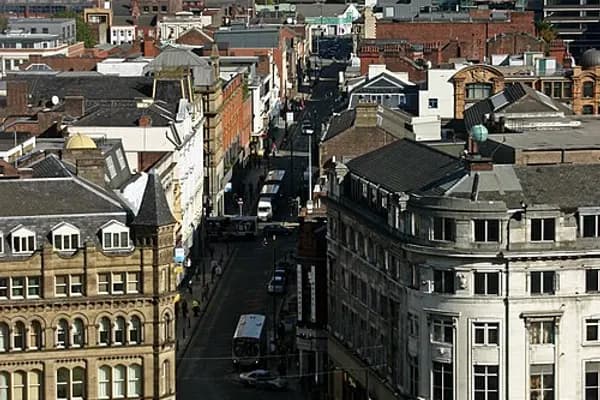
The Northern Quarter (N4 or NQ) is an area of Manchester city centre, England, between Piccadilly station, Victoria station and Ancoats, centred on Oldham Street, just off Piccadilly Gardens. It was defined and named in the 1990s as part of the regeneration and gentrification of Manchester.
A centre of alternative and bohemian culture, the area includes Newton Street (borders with Piccadilly Basin), Great Ancoats Street (borders with Ancoats), Back Piccadilly (borders with Piccadilly Gardens) and Swan Street/High Street (borders with Shudehill/Arndale). Popular streets include Oldham Street, Tib Street, Newton Street, Lever Street, Dale Street, Hilton Street and Thomas Street.
History
Early history
Although the town of Manchester existed from medieval times (and had previously been the site of a Roman settlement), the area now designated as the Northern Quarter was not fully developed until the late 18th century.
The area now between Shudehill and Victoria Station was first built upon in the 14th century, as the village of Manchester expanded as a local centre for the wool trade. The expansion of the area was gradual up to the mid-18th century, when Manchester markedly increased in size and significance with the onset of the Industrial Revolution.
During the Industrial Revolution
In the early 18th century, Oldham Street was apparently "an ill-kept muddy lane, held in place on one of its sides by wild hedgerows". The first town directory of Manchester, published in 1772, lists a number of buildings on Tib Street and Oldham Street. By the time of a map by William Green in 1794, the whole of the Northern Quarter is shown as a developed urban district.
It might be supposed that Oldham Street is so named because it links to Oldham Road but this is not the case as Oldham Street predates Oldham Road which was named Newton Lane in the 18th century. Oldham Street is probably so named because one of its first buildings was the house of Adam Oldham, a wealthy feltmaker and associate of John Wesley, who owned the land along which the street ran, and probably paid to have it surfaced for the first time.
John Wesley opened two Methodist chapels in the Northern Quarter. In 1751, a chapel was opened on Church Street (east of High Street at Birchin Lane, formerly Methodist Street). This was upgraded to a larger chapel on Adam Oldham's land in 1781, on the site that is now Methodist Central Hall. John Wesley performed the opening of the first chapel which stood until 1883.
In the 1780s the land owned by Sir Ashton Lever (bounded by Piccadilly, Port Street, Great Ancoats Street and Oldham Street) was sold to William Stevenson. Sir Ashton died by suicide in 1788 and Stevenson began selling off plots of land; according to Thomas Swindells the buyers' names were used to name the streets which were made at that time such as Hilton Street and Houldsworth Street and the new square was given the name of Stevenson. Manchester's first cotton mill was opened by Richard Arkwright in 1783, on Miller Street, near the junction with Shudehill. By 1816, there were 86 mills in the central area of Manchester, and by 1853 there were 108.
By the 1840s, the Northern Quarter was at the centre of one of the most significant economic changes in history, with the Industrial Revolution at full pace and Manchester taking its place as the world capital of the textile industry. In common with the town as a whole, the area became characterised by both wealth and poverty.
The area around Withy Grove and Shudehill is described by Friedrich Engels in The Condition of the Working Class in England as insanitary and down at heel, but markedly more ordered than the area around St Ann's Square, which is also described. Nevertheless, the houses are "dirty, old and tumble-down, and the construction of the side-streets utterly horrible". Engels also talks of "pigs walking about in the alleys, rooting in offal heaps".
The area around Oldham Street seems to have been more affluent, with warehouses and shops, many of whose merchants lived within their shop premises. This is described by Isabella Varley, Mrs. Linnaeus Banks, a resident of Oldham Street, in her book The Manchester Man.
One Oldham Street shopowner mentioned by a number of writers is Abel Heywood, who spearheaded the mass distribution of books, supplying the whole country not only with penny novels, but also with educational books and political pamphlets, according to an article in the Morning Chronicle in 1849. Heywood also produced a newspaper, on which he refused to pay duty — a radical gesture, since in those early days of the British Labour Movement, taxes were used to stifle free expression. Heywood went on to become Mayor of Manchester.
The Victorian era
Enterprise continued to be the focus of the area through the Victorian age. James Middleton notes that at this time "business was conducted on the old-fashioned lines by people who had been in the street for a long time". Middleton also describes Tib Street as "a perfectly adorable street, where natural history was taught by living examples...birds, dogs, rabbits, poultry displayed in the windows or outside the shops", a tradition which continued for at least a hundred years, having only recently died out with the closing of the last surviving pet shops.
Modern writer Dave Haslam notes something of the birth of the modern Saturday night in the Northern Quarter at this time with "crowds of shoppers and sightseers...most shops were open and the main streets were lit up and packed...there was the added incentive that at midnight the food became cheaper...on a single day in 1870 it was estimated that up to 20,000 people went to Shudehill".
Throughout the Victorian era, Stevenson Square and parts of Oldham Street were known for frequent political speeches and public debates. Haslam notes that a debate in the 1830s between one Dr Grinrod, a temperance activist, and Mr Youil, a brewer, attracted around three thousand spectators.
Early 20th century
The development of Smithfield Market and the continued growth of the cotton industry helped to foster economic activity in the Northern Quarter into the 20th century. Middleton describes an area buzzing with hawkers and processions.
Youth culture was the next development in the area that might be recognised today. A street dancing culture emerged in the early part of the 20th century, with "dozens of young people performing polkas, waltzes and schottisches to music provided by Italian organ-grinders".
The cotton trade reached its peak in 1912, when 8 billion square yards (6,700km) of fabric were manufactured and sold from Manchester. Following the First World War, the high cost of British cotton, and the increase in production elsewhere in the world, led to a slow decline of the British cotton industry. In the 1960s and 1970s, mills were closing in Manchester and the rest of Lancashire at a rate of almost one a week, and by the 1980s only specialised textile production remained, although clothing manufacture and the wholesale trade continue to form a strong part of Manchester's economy.
Later 20th century
Following the Second World War, attention focused away from the Northern Quarter as Manchester began to build itself a modern city centre in the ruins left by German bombers. As a commercial area, Oldham Street became quieter, particularly as nearby Market Street and the Arndale Centre grew in importance.
In the 1970s and 1980s the Smithfield Gardens housing estate was constructed to the west of Tib Street and the south of Foundry Lane. The estate consists of two-storey maisonettes in three-storey blocks - the middle storey is divided and provides the upper floor for the lower maisonette and the lower floor for the upper maisonette. This was the first modern residential development in the Northern Quarter.
Between the Second World War and the 1990s, the Northern Quarter was not considered to be a residential area, but since then, some of the old industrial and warehouse buildings in the area were converted into flats, as part of a wider trend for living in city centres. Although no official figures are kept (the Northern Quarter is not recognised for administrative purposes), it might be estimated that a little over 500 people now live in the area, which is split between the city centre and Ancoats and Clayton wards.
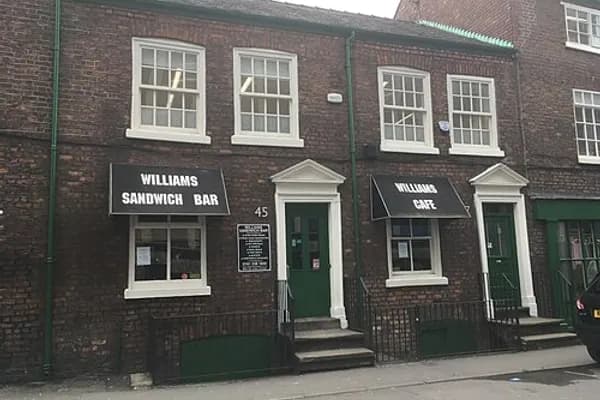
Over time, certain types of business were attracted to the area, which offered low rents and an alternative feel to the typical British high street. This became the main strength of the Northern Quarter— today it is known for hip, independent stores, cafes and bars, and for offering a distinct alternative to the shopping experiences to be found elsewhere in Manchester city centre.
For Dave Haslam, the Northern Quarter became the last refuge of the Manchester music scene in the 1990s: "A community, of sorts, had developed around music-makers wedded to experimentalism, from Andy Votel to Waiwan, nurtured at club nights such as Graham Massey's Toolshed and Mark Rae's Counter Culture ... In 1992, Frank Schofield and Martin Price (of 808 State) had lamented the fate of the independent record shop, yet within five years there were several new record shops in the Northern Quarter".
Present
The Northern Quarter is popular today for its numerous bars and cafes, as well as its mix of music and clothes shops. Amongst these is Affleck's Palace, a former department store which has been turned into a multi-storey bazaar for alternative clothing and knick-knacks.
Meanwhile, the area is something of a mecca for DJs, with shops such as Piccadilly Records, Vinyl Exchange, Vox Pop Records, Beatin' Rhythm, Vinyl Resting Place, Eastern Bloc Records (formerly owned by Martin Price of 808 State, then by Pete Waterman) and, until 2009, Fat City Records (formerly run by Mark Rae).
Nightlife in the Northern Quarter includes music venues. The area is also well known for its bar scene.
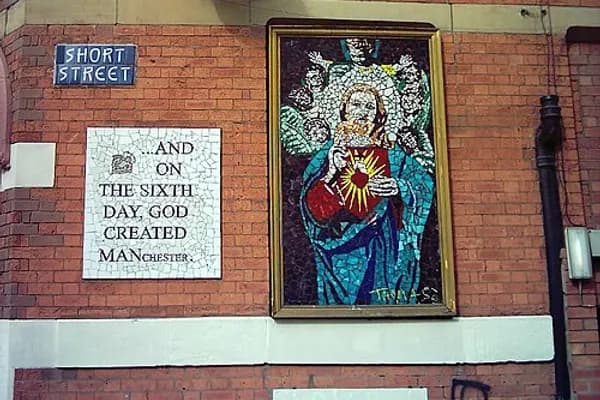
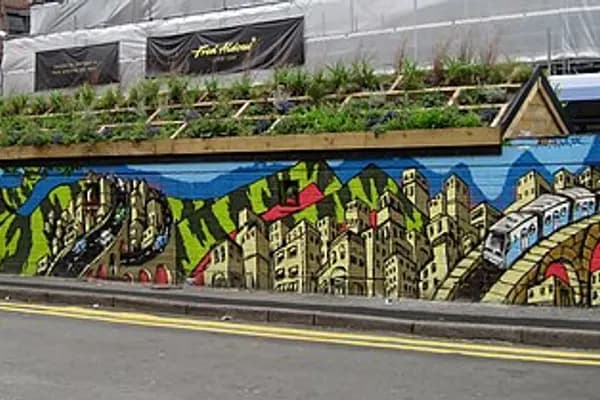
The area is also known as a home to the creative industries, and in particular fashion design, with various designers, agencies, and clothing wholesalers populating its back streets. There are also a number of commercial art galleries in the area and street art is on prominent display. In Stevenson Square, the street level remains of a former public convenience are used by the OuthouseMCR organisation for regularly changing examples of street and graffiti art. OuthouseMCR also manages the urban art which decorates an electrical sub-station on Tib Street. On one wall of the sub-station, protected by Perspex, is said to be a painting by the artist Banksy. The Northern Quarter also hosted the Big Horn sculpture, which was removed in 2017 to make way for the new SyNQ residential development, but is hoped to be erected again on nearby Afflecks Palace once work is completed.
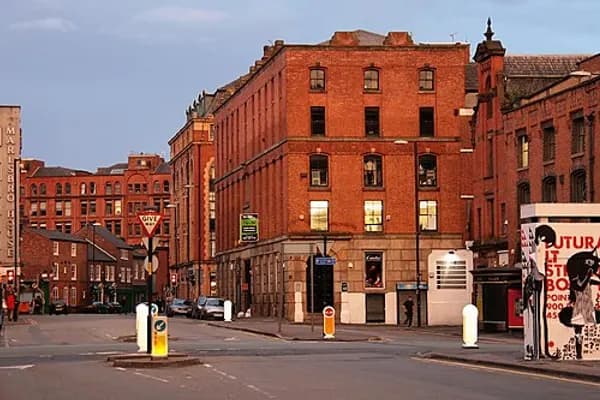
Additionally, due to the area's architecture, the Northern Quarter is regularly used as a film and TV location. The area is often used as a double for New York and has appeared as Manhattan in the 2004 film Alfie, and the 2019 production Morbius. While the area around Dale Street has been used as 1940s New York for the 2011 Hollywood superhero film Captain America: The First Avenger, the 2019 Sky TV production of Das Boot. and also for the Netflix TV show, Peaky Blinders, a British period crime drama. Additionally, various parts of Manchester, many in the Northern Quarter, were used in filming Guy Ritchie's 2009 film Sherlock Holmes.
Manchester City Council have recognised the unique nature of the Northern Quarter. A 2003 planning document stated:
The Northern Quarter (N4) is strategically placed between the main Manchester retail and commercial core, Piccadilly Gateway, Ancoats and Shudehill. It represents a key piece in the city centre jigsaw, an area different in character and function to any other part of the city centre and of great strategic importance to Manchester as a city of distinctive quarters.
In November 2010 the area was awarded the Great Neighbourhood of the Year Award 2011 for Britain and Ireland at the Academy of Urbanism Awards in London.
Piccadilly Basin
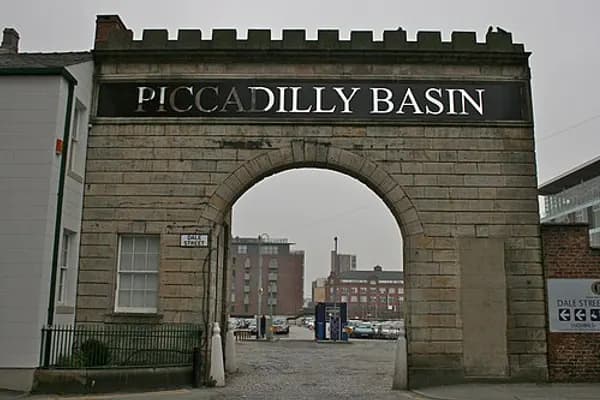
Piccadilly Basin, on the Rochdale Canal, is a redeveloped area between Manchester Piccadilly station and Great Ancoats Street. The area includes flats and offices as well as bars.
Shudehill redevelopment
Another area of redevelopment in the Northern Quarter is a mixed office and residential development centred on the old market on Shudehill near to the new Shudehill bus and tram interchange.
In popular culture
Manchester band Kid British released an EP in 2011 titled Northern Stories. Two of the tracks are "Northern Quarter" and "Tib Street".
The area doubled for New York City during filming for the film Morbius (2022) a film set in Sony's Spider-Man Universe based the Marvel comic book character Morbius, the Living Vampire.
In November 2023, fashion house Chanel hosted a runway show on the streets of the Northern Quarter. The event launched the winter 2024 collection, inspired by Manchester and the Northern Quarter.
Notable people
Abel Heywood, publisher and alderman of the City
John Owens, cotton merchant
See also
River Tib
Footnotes
Bibliography
Engels, Friedrich (1987) . The Condition of the Working Class in England in 1844. London: Penguin. ISBN0-14-044486-6.
Haslam, Dave (2000). Manchester, England: the story of the pop cult city. London: Fourth Estate. ISBN1-84115-146-7.
Middleton, James (1920). The Old Road: a book of recollections. Oldham: E. J. Wildgoose.
Taylor, Simon; Julian Holder (2008). Manchester's Northern Quarter. Swindon: English Heritage. ISBN978-1-873592-84-7.
Further reading
Goodall, Ian & Taylor, Simon (2001) The Shudehill and Northern Quarter Area of Manchester: 'an outgrowth of accident' and 'built according to a plan'. York: English Heritage
Collier, John (1757) Truth in a Mask: or, Shude-Hill Fight. Being A short Manchestrian chronicle of the present Times. Amsterdam [i.e. Manchester?]: printed in the year,
External links
Manchester City Council Northern Quarter Development Framework, 2003
Northern Quarter website by Manchester City Council
Manchester City Council's Regeneration Team
Geographic areas Ardwick
Ardwick Green
Baguley
Belle Vue
Benchill
Beswick
Blackley
Bradford
Burnage
Cheetham Hill
Chorlton-cum-Hardy
Chorlton-on-Medlock
Chorltonville
Clayton
Collyhurst
Crumpsall
Didsbury
Fallowfield
Gorton
Harpurhey
Heaton Park
Hulme
Levenshulme
Longsight
Lower Crumpsall
Manchester Airport
Miles Platting
Moss Side
Moston
Newall Green
New Moston
Newton Heath
Northenden
Northern Moor
Openshaw
Parrs Wood
Peel Hall
Ringway
Rusholme
Sharston
Victoria Park
Whalley Range
Withington
Woodhouse Park
Wythenshawe
Encyclopedic content adapted from the Wikipedia article on Northern Quarter, used under CC BY-SA 4.0.
What makes Northern Quarter special
Northern Quarter stands out among Manchester’s neighborhoods for its distinctive character: manchester's indie creative hub. It tops our ranking of the best neighborhoods in Manchester, it offers the kind of experience that defines a great city trip — a place where the streets themselves tell a story and every block rewards curiosity.
Best for
Our take on Northern Quarter
Northern Quarter is the neighborhood we send friends to first when they visit Manchester. It earns the top spot in our ranking not because it is the most famous district in the city, but because it delivers the most complete neighborhood experience — the kind of place where every block rewards curiosity and every return visit reveals something new.
What strikes us most about Northern Quarter is the depth of its food culture. This is not a neighborhood with a few good restaurants — it is a neighborhood where eating well is woven into daily life, where the corner places are as good as the destination spots, and where you could eat every meal for a week without repeating yourself or being disappointed.
Our editors recommend budgeting at least half a day here — enough time to walk the main streets, sit down for coffee, and discover the side streets where Northern Quarter's real character lives.
Living in Northern Quarter
Northern Quarter is connected to the rest of Manchester by public transit, and most visitors find it straightforward to reach from the city center or airport. Once you arrive, the neighborhood is best explored on foot — the scale is human and the streets reward wandering.
Day-to-day life in Northern Quarter has the rhythm of a genuine residential neighborhood. You will find grocery stores, pharmacies, cafés with morning regulars, and the kind of small independent shops that only survive where locals support them. For visitors, this means the infrastructure you need — good coffee, a decent meal, a quiet place to sit — is always within a short walk.
Accommodation in Northern Quarter ranges from boutique hotels to short-term rentals. We generally recommend staying within the neighborhood itself rather than commuting from a hotel elsewhere in Manchester — the experience of waking up inside a great neighborhood is fundamentally different from visiting one as a day trip.
What locals say about Northern Quarter
Long-term residents of Northern Quarter tend to describe their neighborhood with a mix of pride and protectiveness. Like any district with genuine character, Northern Quarter inspires loyalty — the kind of place people move to and never quite leave, or leave and spend years trying to get back to.
The creative community in Northern Quarter is genuine, not aspirational. Residents include working artists, writers, musicians, and designers who chose the neighborhood because it supported their work — affordable studio space, a community that values craft, and enough foot traffic to sustain independent galleries and shops.
Like any neighborhood that has earned attention, Northern Quarter is navigating the tension between popularity and preservation. Rents have risen, new businesses have arrived, and long-time residents occasionally grumble that the neighborhood is not what it was. But the fundamentals — the walkability, the food, the community — remain strong, and most locals we speak to believe the neighborhood is still gaining more than it is losing.
Visitor tips
- Northern Quarter is located in Manchester, United Kingdom. The neighborhood is accessible by public transport, taxi, or rideshare from most parts of the city.
- Morning is often the best time to explore — the streets are quieter, the light is better for photography, and cafes are at their most welcoming.
- Wear comfortable walking shoes — the best way to experience Northern Quarter is on foot, wandering the side streets and discovering what lies around each corner.
- Save the neighborhood's location on your phone before you arrive. Offline maps are especially useful for navigating the smaller side streets.