About the neighborhood
City in southern France
Marseille (Occitan: Marselha; see below) is a city in southern France, the prefecture of the department of Bouches-du-Rhône and of the Provence-Alpes-Côte d'Azur region. Situated in the Provence region, it is located on the coast of the Mediterranean Sea, near the mouth of the Rhône river. Marseille is the second-most populous city proper in France, after Paris, with 886,040 inhabitants in 2023 over a municipal territory of 241km (93sqmi). Together with its suburbs and exurbs, the Marseille metropolitan area, which extends over 3,972km (1,534sqmi), had a population of 1,900,957 at the January 2022 census. The cities of Marseille, Aix-en-Provence, and 90 suburban municipalities have formed since 2016 the Aix-Marseille-Provence Metropolis, an indirectly elected metropolitan authority now in charge of wider metropolitan issues, with a population of 1,922,626 at the January 2022 census.
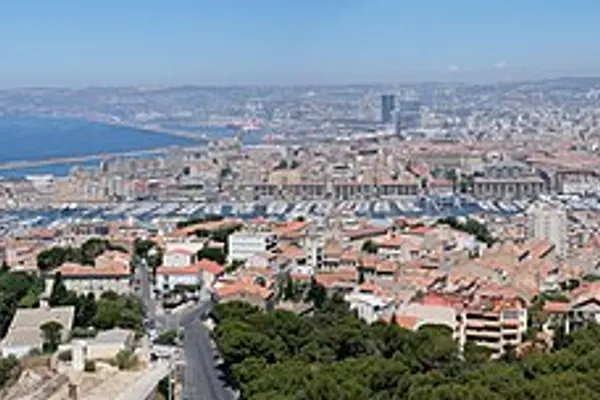
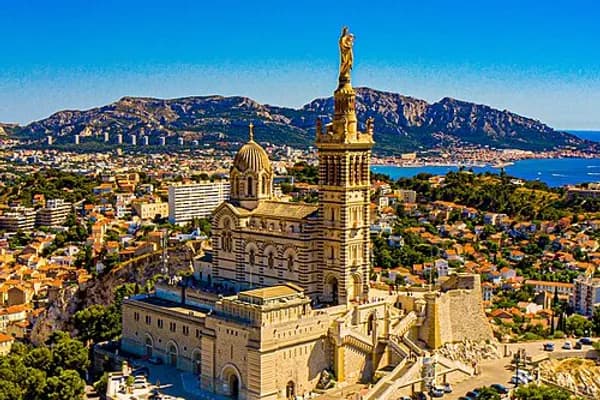
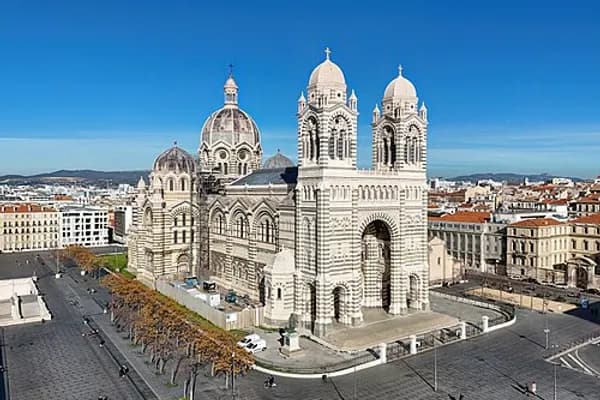
Founded c.600 BC by Greek settlers from Phocaea, Marseille is the oldest city in France, as well as one of Europe's oldest continuously inhabited settlements. It was known to the ancient Greeks as Massalia and to Romans as Massilia. Marseille has been a trading port since ancient times. In particular, it experienced a considerable commercial boom during the colonial period and especially during the 19th century, becoming a prosperous industrial and trading city. Nowadays the Old Port still lies at the heart of the city, where the manufacture of Marseille soap began some six centuries ago. Overlooking the port is the Basilica of Notre-Dame-de-la-Garde or "Bonne-mère" for the people of Marseille, a Romano-Byzantine church and the symbol of the city. Inherited from this past, the Grand Port Maritime de Marseille (GPMM) and the maritime economy are major poles of regional and national activity and Marseille remains the first French port, the second Mediterranean port and the fifth European port. Since its origins, Marseille's openness to the Mediterranean Sea has made it a cosmopolitan city marked by cultural and economic exchanges with Southern Europe, the Middle East, North Africa and Asia. In Europe, the city has the third largest Jewish community after London and Paris.
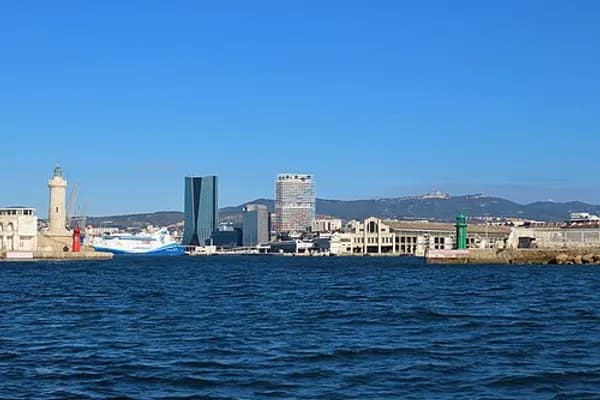
In the 1990s, the Euroméditerranée project for economic development and urban renewal was launched. New infrastructure projects and renovations were carried out in the 2000s and 2010s: the tramway, the renovation of the Hôtel-Dieu into a luxury hotel, the expansion of the Velodrome Stadium, the CMA CGM Tower, as well as other quayside museums such as the Museum of Civilisations of Europe and the Mediterranean (MuCEM). As a result, Marseille now has the most museums in France after Paris. The city was named European Capital of Culture in 2013 and European Capital of Sport in 2017. Home of the association football club Olympique de Marseille, one of the most successful and widely supported clubs in France, Marseille has also hosted matches at the 1998 World Cup and Euro 2016. It is also home to several higher education institutions in the region, including the University of Aix-Marseille. A resident of Marseille is a Marseillais.
Name
The name Marseille most likely comes from the name Massalia given to the ancient city initially founded by Greeks. Variations of the name include:
In English Marseille, or formerly Marseilles, both pronounced /mɑːrˈseɪ/ mar-SAY;
In French Marseille, which is pronounced maʁsɛj in Standard French and maχˈsɛjə in local French;
In Occitan (Provençal) Marselha according to the Classical orthographic norm, which may be written Marsiho according to the Mistralian norm, from the Medieval Occitan Marselha or Masselha;
In Latin Massilia, from the Greek Μασσαλία (Massalía), which is the oldest attestation of the name, since the city was founded by Greek settlers around 600 BC, and remained for a long time a Greek-speaking place even after it fell under Roman rule.
Geography
Marseille is the second-largest metropolitan area in France after Paris. To the east, starting in the small fishing village of Callelongue on the outskirts of Marseille and stretching as far as Cassis, are the Calanques, a rugged coastal area interspersed with small fjord-like inlets. Farther east still are the Sainte-Baume (a 1,147m (3,763ft) mountain ridge rising from a forest of deciduous trees), the city of Toulon and the French Riviera. To the north of Marseille, beyond the low Garlaban and Etoile mountain ranges, is the 1,011m (3,317ft) Mont Sainte Victoire. To the west of Marseille is the former artists' colony of l'Estaque; farther west are the Côte Bleue, the Gulf of Lion and the Camargue region in the Rhône delta. The airport lies to the north west of the city at Marignane on the Étang de Berre.
The city's main thoroughfare (the wide boulevard called the Canebière) stretches eastward from the Old Port to the Réformés quarter. Two large forts flank the entrance to the Old Port—Fort Saint-Nicolas on the south side and Fort Saint-Jean on the north. Farther out in the Bay of Marseille is the Frioul archipelago which comprises four islands, one of which, If, is the location of Château d'If, made famous by the Dumas novel The Count of Monte Cristo. The main commercial centre of the city intersects with the Canebière at Rue St Ferréol and the Centre Bourse (one of the city's main shopping malls). The centre of Marseille has several pedestrianised zones, most notably Rue St Ferréol, Cours Julien near the Music Conservatory, the Cours Honoré-d'Estienne-d'Orves off the Old Port and the area around the Hôtel de Ville. To the south east of central Marseille in the 6th arrondissement are the Prefecture and the monumental fountain of Place Castellane, an important bus and metro interchange. To the south west are the hills of the 7th and 8th arrondissements, dominated by the basilica of Notre-Dame de la Garde. Marseille's main railway station—Gare de Marseille Saint-Charles—is north of the Centre Bourse in the 1st arrondissement; it is linked by the Boulevard d'Athènes to the Canebière.
Climate
The city has a hot-summer mediterranean climate (Köppen: Csa) with cool-mild winters with moderate rainfall, because of the wet westerly winds, and hot, mostly dry summers. December, January, and February are the coldest months, averaging temperatures of around 12°C (54°F) during the day and 4°C (39°F) at night. July and August are the hottest months, averaging temperatures of around 28–30°C (82–86°F) during the day and 19°C (66°F) at night in the Marignane airport [35km (22mi) from Marseille] but in the city near the sea the average high temperature is 27°C (81°F) in July.
Marseille receives the most sunlight of any French city, 2,897.6 hours per year on average, while the average sunshine in the country is around 1,950 hours. It is also the driest major city with only 532.3mm (21in) of precipitation annually, mainly due to the mistral, a cold, dry wind originating in the Rhône Valley that occurs mostly in winter and spring and which generally brings clear skies and sunny weather to the region. Less frequent is the sirocco, a hot, sand-bearing wind, coming from the Sahara. Snowfalls are infrequent; over 50% of years do not experience a single snowfall.
The hottest temperature was 40.6°C (105.1°F) on 26 July 1983 during a great heat wave, the lowest temperature was −16.8°C (1.8°F) on 13 February 1929 during a strong cold wave.
History
Marseille was founded as the Greek colony of Massalia c.600 BC, and was populated by Greek settlers from Phocaea (modern Foça, Turkey). It became the preeminent Greek polis in the Hellenized region of southern Gaul. The city-state sided with the Roman Republic against Carthage during the Second Punic War (218–201 BC), retaining its independence and commercial empire throughout the western Mediterranean even as Rome expanded its empire into Western Europe and North Africa. However, the city lost its independence following the Roman Siege of Massilia in 49 BC, during Caesar's Civil War, in which Massalia sided with the exiled faction at war with Julius Caesar. Afterward, the Gallo-Roman culture was initiated.
The city maintained its position as a premier maritime trading hub even after its capture by the Visigoths in the fifth century AD, although the city went into decline following the sack of AD 739 by the forces of Charles Martel against the Umayyad Arabs. It became part of the County of Provence during the tenth century, although its renewed prosperity was curtailed by the Black Death of the 14th century and a sack of the city by the Crown of Aragon in 1423. The city's fortunes rebounded with the ambitious building projects of René of Anjou, Count of Provence, who strengthened the city's fortifications during the mid-15th century. During the 16th century, the city hosted a naval fleet with the combined forces of the Franco-Ottoman alliance, which threatened the ports and navies of the Genoese Republic.
Marseille lost a significant portion of its population during the Great Plague of Marseille in 1720, but the population had recovered by mid-century. In 1792, the city became a focal point of the French Revolution, and though France's national anthem was born in Strasbourg, it was first sung in Paris by volunteers from Marseille, hence the name the crowd gave it: La Marseillaise. The Industrial Revolution and establishment of the Second French colonial empire during the 19th century allowed for the further expansion of the city, although it was occupied by the German Wehrmacht in November 1942 and subsequently heavily damaged during World War II. The city has since become a major center for immigrant communities from former French colonies in Africa, such as French Algeria.
Economy
Marseille is a major French centre for trade and industry, with excellent transportation infrastructure (roads, sea port and airport). Marseille Provence Airport is the fourth largest in France. In May 2005, the French financial magazine L'Expansion named Marseille the most dynamic of France's large cities, citing figures showing that 7,200 companies had been created in the city since 2000. As of 2019, the Marseille metropolitan area had a GDP amounting to US$81.4 billion, or US$43,430 per capita (purchasing power parity).
Port
Historically, the economy of Marseille was dominated by its role as a port of the French Empire, linking the North African colonies of Algeria, Morocco and Tunisia with Metropolitan France. The Old Port was replaced as the main port for trade by the Port de la Joliette (now part of Marseille-Fos Port) during the Second Empire and now contains restaurants, offices, bars and hotels and functions mostly as a private marina. The majority of the port and docks, which experienced decline in the 1970s after the oil crisis, have been recently redeveloped with funds from the European Union. Fishing remains important in Marseille and the food economy of Marseille is fed by the local catch; a daily fish market is still held on the Quai des Belges of the Old Port.
The economy of Marseille and its region is still linked to its commercial port, the first French port and the fifth European port by cargo tonnage, which lies north of the Old Port and eastern in Fos-sur-Mer. Some 45,000 jobs are linked to the port activities and it represents €4billion of added value to the regional economy. 100million tons of freight pass annually through the port, 60% of which is petroleum, making it number one in France and the Mediterranean and number three in Europe. However, in the early 2000s, the growth in container traffic was being stifled by the constant strikes and social upheaval. The port is among the 20th firsts in Europe for container traffic with 1,062,408 TEU and new infrastructure has already raised the capacity to 2million TEU. Marseille is connected with the Rhône via a canal and thus has access to the extensive waterway network of France. Petroleum is shipped northward to the Paris basin by pipeline. The city also serves as France's leading centre of oil refining.
Companies, services and high technologies
In recent years, the city has also experienced a large growth in service sector employment and a switch from light manufacturing to a cultural, high-tech economy. The Marseille region is home to thousands of companies, 90% of which are small and medium enterprises with less than 500 employees. Among the most famous are CMA CGM, container-shipping giant; Compagnie maritime d'expertises (Comex), a leader in sub-sea engineering and hydraulic systems; Airbus Helicopters, an Airbus division; Azur Promotel, an active real estate development company; La Provence, the local daily newspaper; RTM, Marseille's public transport company; and Société Nationale Maritime Corse Méditerranée (SNCM), a major provider of passenger, vehicle and freight transportation in the Western Mediterranean. The urban operation Euroméditerranée has developed a large offer of offices and thus Marseille hosts one of the main business district in France.
Marseille is the home of three main technopoles: Château-Gombert (technological innovations), Luminy (biotechnology) and La Belle de Mai (17,000 sq.m. of offices dedicated to multimedia activities).
Tourism and attractions
The port is also an important arrival base for millions of people each year, with 2.4 million including 890,100 from cruise ships. With its beaches, history, architecture and culture (24 museums and 42 theatres), Marseille is one of the most visited cities in France, with 4.1 million visitors in 2012.
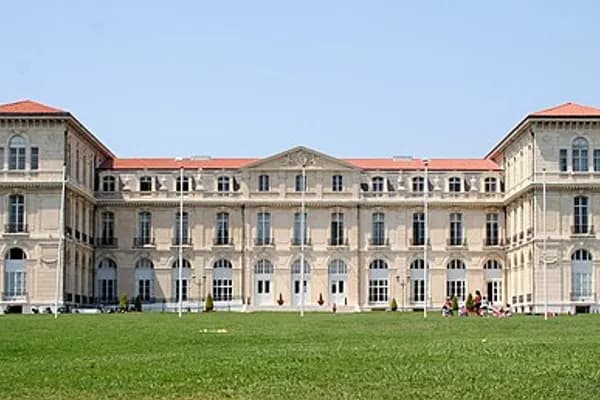
They take place in three main sites, the Palais du Pharo, Palais des Congrès et des Expositions (Parc Chanot) and World Trade Center. In 2012 Marseille hosted the World Water Forum. Several urban projects have been developed to make Marseille attractive. Thus new parks, museums, public spaces and real estate projects aim to improve the city's quality of life (Parc du 26e Centenaire, Old Port of Marseille, numerous places in Euroméditerranée) to attract firms and people. Marseille municipality acts to develop Marseille as a regional nexus for entertainment in the south of France with high concentration of museums, cinemas, theatres, clubs, bars, restaurants, fashion shops, hotels, and art galleries.
Employment
Unemployment in the economy fell from 20% in 1995 to 14% in 2004. However, Marseille unemployment rate remains higher than the national average. In some parts of Marseille, youth unemployment is reported to be as high as 40%.
Administration
Encyclopedic content adapted from the Wikipedia article on Noailles, used under CC BY-SA 4.0.