About the neighborhood
City in Marrakesh–Safi, Morocco
Marrakesh or Marrakech (/məˈrækɛʃ, ˌmærəˈkɛʃ/; Arabic: مراكش, romanized:murrākuš, pronounced murraːkuʃ) is the fourth-largest city in Morocco. It is one of the four imperial cities of Morocco and is the capital of the Marrakesh-Safi region. The city lies west of the foothills of the Atlas Mountains.
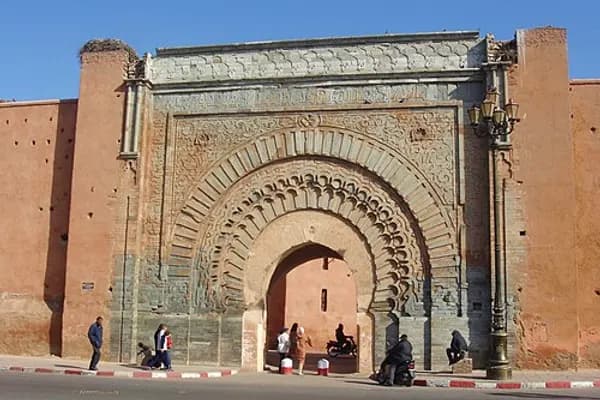
The city was founded circa 1070 by Abu Bakr ibn Umar as the capital of the Almoravid dynasty. The Almoravids established the first major structures in the city and shaped its layout for centuries to come. The red walls of the city, built by Ali ibn Yusuf in 1122–1123, and various buildings constructed in red sandstone afterwards, have given the city the nickname of the "Red City" or "Ochre City". Marrakesh grew rapidly and established itself as a cultural, religious, and trading centre for the Maghreb. After a period of decline, Marrakesh regained its status in the early 16th century as the capital of the Saadian dynasty, with sultans Abdallah al-Ghalib and Ahmad al-Mansur embellishing the city with an array of sumptuous monuments. Beginning in the 17th century, the city became popular among Sufi pilgrims for its seven patron saints who are buried here. In 1912, the French Protectorate in Morocco was established and T'hami El Glaoui became Pasha of Marrakesh and generally held this position until the independence of Morocco and the reestablishment of the monarchy in 1956.
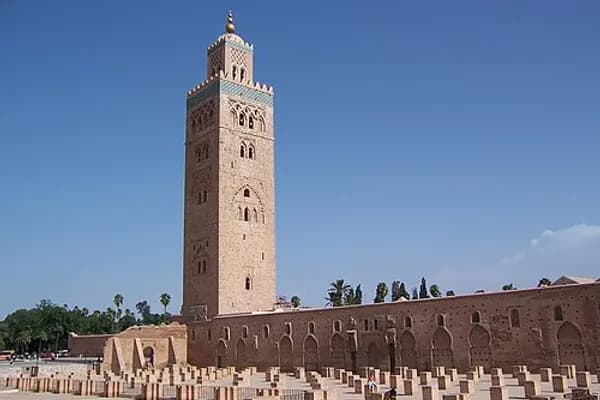
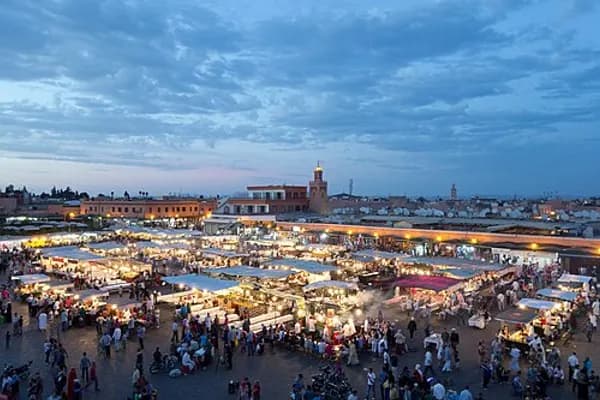
Marrakesh comprises an old fortified city packed with vendors and their stalls. This medina quarter is a UNESCO World Heritage Site and contains the Jemaa el-Fnaa square, a large number of souks (markets), the Kutubiyya Mosque, and many other historic and cultural sites. The city serves as a major economic centre and tourist destination. Property and hotel development in Marrakesh have grown dramatically in the 21st century. Marrakesh is particularly popular with the French, and numerous French celebrities own property in the city.
Marrakesh is served by Marrakesh Menara Airport and by Marrakesh railway station, which connects the city to Casablanca and northern Morocco. Marrakesh has several universities and schools, including Cadi Ayyad University. The city has become a major destination for tourism.
Etymology
The exact meaning of the name is debated. One possible origin of the name Marrakesh is from the Berber (Amazigh) words amur (n) akush, which means "Land of God". According to historian Susan Searight, however, the town's name was first documented in an 11th-century manuscript in the Qarawiyyin library in Fez, where its meaning was given as "country of the sons of Kush". The word mur is used now in Berber mostly in the feminine form tamurt. The same word "mur" appears in Mauretania, the North African kingdom from antiquity, although the link remains controversial as this name possibly originates from μαύρος mauros, the ancient Greek word for "dark". The common English spelling is "Marrakesh", although "Marrakech" (the French spelling) is also widely used. The name is spelled Mṛṛakc in the Berber Latin alphabet, Marraquexe in Portuguese, Marrakech in Spanish. A typical pronunciation in Moroccan Arabic is merrākesh (/mərra:kəʃ/) with stress on the second syllable.
From medieval times until around the beginning of the 20th century, the entire country of Morocco was known as the "Kingdom of Marrakesh", as the kingdom's historic capital city was often Marrakesh. The name for Morocco is still "Marrakesh" to this day in Persian and Urdu as well as many other South Asian languages. Various European names for Morocco (Marruecos, Marrocos, Maroc, Marokko, etc.) are directly derived from the name Murrākush. Conversely, the city itself was in earlier times simply called Marocco City (or similar) by travelers from abroad. The name of the city and the country diverged after the Treaty of Fez divided Morocco into a French protectorate in Morocco and Spanish protectorate in Morocco, and the old interchangeable usage lasted widely until about the interregnum of Mohammed Ben Aarafa (1953–1955). The latter episode set in motion the country's return to independence, when Morocco officially became المملكة المغربية (al-Mamlaka al-Maġribiyya, "The Maghreb Kingdom"), its name no longer referring to the city of Marrakesh. Marrakesh is known by a variety of nicknames, including the "Red City" (Arabic: المدينة الحمراء, romanized:Al-madīnat al-ḥamrā'), the "Ochre City" and "the Daughter of the Desert", and has been the focus of poetic analogies such as one comparing the city to "a drum that beats an African identity into the complex soul of Morocco."
History
The Marrakesh area was inhabited by Berber farmers from Neolithic times, and numerous stone implements have been unearthed in the area. Marrakesh was founded by Abu Bakr ibn Umar, chieftain and second cousin of the Almoravid king Yusuf ibn Tashfin (c. 1061–1106). Historical sources cite a variety of dates for this event ranging between 1062 (454 in the Hijri calendar), according to Ibn Abi Zar and Ibn Khaldun, and 1078 (470 AH), according to Muhammad al-Idrisi. The date most commonly used by modern historians is 1070, although 1062 is still cited by some writers.
Imperial capital
The Almoravids, a Berber dynasty seeking to reform Islamic society, ruled an emirate stretching from the edge of Senegal to the centre of Spain and from the Atlantic coast to Algiers. They used Marrakesh as their capital and established its first structures, including mosques and a fortified residence, the Ksar al-Hajjar, near the present-day Kutubiyya Mosque. These Almoravid foundations also influenced the layout and urban organization of the city for centuries to come. For example, the present-day Jemaa el-Fnaa originated from a public square in front of the Almoravid palace gates, the Rahbat al-Ksar, and the major souks (markets) of the city developed roughly in the area between this square and the city's main mosque, where they remain today. The city developed the community into a trading centre for the Maghreb and sub-Saharan Africa. It grew rapidly and established itself as a cultural and religious centre, supplanting Aghmat, which had long been the capital of Haouz. Andalusi craftsmen from Cordoba and Seville built and decorated numerous monuments, importing the Cordoban Umayyad style characterised by carved domes and cusped arches. This Andalusian influence merged with designs from the Sahara and West Africa, creating a unique style of architecture which was fully adapted to the Marrakesh environment. Yusuf ibn Tashfin built houses, minted coins, and brought gold and silver to the city in caravans. His son and successor, Ali Ibn Yusuf, built the Ben Youssef Mosque, the city's main mosque, between 1120 and 1132. He also fortified the city with city walls for the first time in 1126–1127 and expanded its water supply by creating the underground water system known as the khettara.
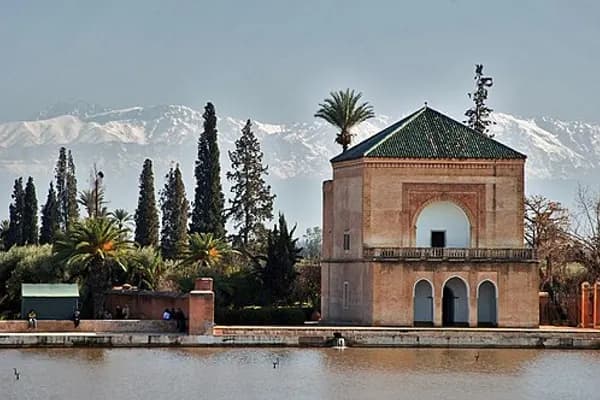
In 1125, the preacher Ibn Tumart settled in Tin Mal in the mountains to the south of Marrakesh, founding the Almohad movement. This new faction, composed mainly of Masmuda tribesmen, followed a doctrine of radical reform with Ibn Tumart as the mahdi, a messianic figure. He preached against the Almoravids and influenced a revolt which succeeded in bringing about the fall of nearby Aghmat, but stopped short of bringing down Marrakesh following an unsuccessful siege in 1130. Ibn Tumart died shortly after in the same year, but his successor Abd al-Mu'min took over the political leadership of the movement and captured Marrakesh in 1147 after a siege of several months. The Almohads purged the Almoravid population over three days and established the city as their new capital. They went on to take over much of the Almoravids' former territory in Africa and the Iberian Peninsula. In 1147, shortly after the city's conquest, Abd al-Mu'min founded the Kutubiyya Mosque (or Koutoubia Mosque), next to the former Almoravid palace, to serve as the city's new main mosque. The Almoravid mosques were either demolished or abandoned as the Almohads enacted their religious reforms. Abd al-Mu'min was also responsible for establishing the Menara Gardens in 1157, while his successor Abu Ya'qub Yusuf (r. 1163–1184) began the Agdal Gardens. Ya'qub al-Mansur (r. 1184–1199), possibly on the orders of his father Abu Ya'qub Yusuf, was responsible for building the Kasbah, a citadel and palace district on the south side of the city. The Kasbah housed the center of government and the residence of the caliph, a title borne by the Almohad rulers to rival the eastern Abbasid Caliphate. In part because of these various additions, the Almohads also improved the water supply system and created water reservoirs to irrigate their gardens. Thanks to its economic, political, and cultural importance, Marrakesh hosted many writers, artists, and intellectuals, many of them from Al-Andalus, including the famous philosopher Averroes of Cordoba.
The death of Yusuf II in 1224 began a period of instability. Marrakesh became the stronghold of the Almohad tribal sheikhs and the ahl ad-dar (descendants of Ibn Tumart), who sought to claw power back from the ruling Almohad family. Marrakesh was taken, lost and retaken by force multiple times by a stream of caliphs and pretenders, such as during the brutal seizure of Marrakesh by the Sevillan caliph Abd al-Wahid II al-Ma'mun in 1226, which was followed by a massacre of the Almohad tribal sheikhs and their families and a public denunciation of Ibn Tumart's doctrines by the caliph from the pulpit of the Kasbah Mosque. After al-Ma'mun's death in 1232, his widow attempted to forcibly install her son, acquiring the support of the Almohad army chiefs and Spanish mercenaries with the promise to hand Marrakesh over to them for the sack. Hearing of the terms, the people of Marrakesh sought to make an agreement with the military captains and saved the city from destruction with a sizable payoff of 500,000 dinars. In 1269, Marrakesh was conquered by the Marinids, a Zenata tribe who overran the Almohads in Morocco. While Marrakesh remained a major city, it lost its capital status to Fez and underwent a period of relative decline.
Saadi period
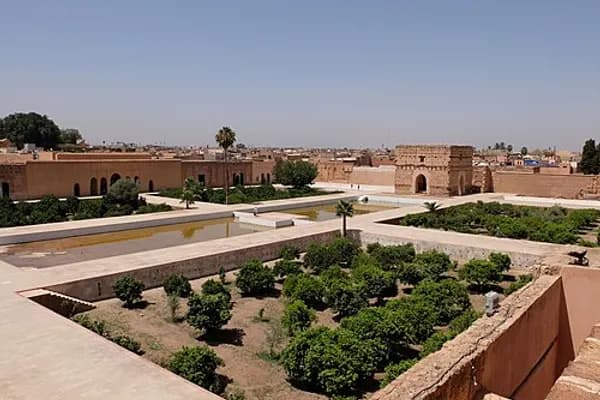
In the early 16th century, Marrakesh again became the capital of Morocco. After a period when it was the seat of the Hintata emirs, it reestablished its status during the reigns of the Saadian sultans Abdallah al-Ghalib and Ahmad al-Mansur. Under the Saadian dynasty, Marrakesh experienced a new golden age. Thanks to the wealth amassed by the sultans, it was embellished with sumptuous palaces while its ruined monuments were restored. El Badi Palace, begun by Ahmad al-Mansur in 1578, was made with costly materials including marble from Italy. The palace was intended primarily for hosting lavish receptions for ambassadors from Spain, England, and the Ottoman Empire, showcasing Saadian Morocco as a nation whose power and influence reached as far as the borders of Niger and Mali.
For centuries Marrakesh has been known as the location of the tombs of Morocco's seven patron saints (سبعة رجال sabʿatu rijāl). When sufism was at the height of its popularity during the late 17th-century reign of Moulay Ismail, the festival of these saints was founded by Abu Ali al-Hassan al-Yusi at the request of the sultan. The tombs of several renowned figures were moved to Marrakesh to attract pilgrims, and the pilgrimage associated with the seven saints is now a firmly established institution. Pilgrims visit the tombs of the saints in a specific order, as follows: Sidi Yusuf Ali Sanhaji (1196–97), a leper; Qadi Iyyad or qadi of Ceuta (1083–1149), a theologian and author of Ash-Shifa (treatises on the virtues of Muhammad); Sidi Bel Abbas (1130–1204), known as the patron saint of the city and most revered in the region; Sidi Muhammad al-Jazuli (1465), a well known Sufi who founded the Jazuli brotherhood; Abdelaziz al-Tebaa (1508), a student of al-Jazuli; Abdallah al-Ghazwani (1528), known as Moulay al-Ksour; and Sidi Abu al-Qasim Al-Suhayli, (1185), also known as Imam al-Suhayli. Until 1867, European Christians were not authorized to enter the city unless they acquired special permission from the sultan; east European Jews were permitted.
20th century
In the early 20th century, Marrakesh underwent several years of unrest as Morocco was plagued by anarchy, tribal revolts, the plotting of feudal lords, and European intrigues. After the death in 1900 of the grand vizier Ba Ahmed, who had been designated regent until the designated sultan Abd al-Aziz became of age, and the 1906 Algeciras Conference, which limited Moroccan sovereignty, southern aristocrats, including powerful Amazigh tribal leaders of the High Atlas, pledged their allegiance to the caliph of Marrakesh Moulay Abd al-Hafid as Sultan of Morocco over his brother Abd al-Aziz in 1907, which started the Hafidiya. It was also in 1907 that Émile Mauchamp, a French physician and informant, was murdered in Marrakesh, suspected of spying for his country. France used the event as a pretext for sending its troops from Algeria to the eastern Moroccan town of Oujda, marking the beginning of the French conquest of Morocco. As the French forces advanced, they encountered strong resistance from Ahmed al-Hiba, a son of Sheikh Ma al-'Aynayn, who arrived from the Sahara accompanied by his nomadic Reguibat tribal warriors. On 30 March 1912, the French Protectorate in Morocco was established. After the Battle of Sidi Bou Othman, which saw the victory of the French Mangin column over the al-Hiba forces in September 1912, the French seized Marrakesh. The conquest was facilitated by the rallying of the Imzwarn tribes and their leaders from the powerful Glaoui family, leading to a massacre of Marrakesh citizens in the resulting turmoil.
Encyclopedic content adapted from the Wikipedia article on Medina, used under CC BY-SA 4.0.