About the neighborhood
The history of Marrakesh, a city in southern Morocco, stretches back nearly a thousand years. The country of Morocco itself is named after it.
Founded c. 1070 by the Almoravids as the capital of their empire, Marrakesh went on to also serve as the imperial capital of the Almohad Caliphate from 1147. The Marinids, who captured Marrakesh in 1269, relocated the capital to Fez, leaving Marrakesh as a regional capital of the south. During this period, it often broke off in rebellion into a semi-autonomous state. Marrakesh was captured by the Saadian sharifs in 1525, and resumed its status as imperial capital for a unified Morocco after they captured Fez in 1549. Marrakesh reached its epic grandeur under the Saadians, who greatly embellished the city. The Alawi sharifs captured Marrakesh in 1669. Although it served frequently as the residence of the Alawi sultans, Marrakesh was not their definitive capital, as Alawi sultans moved their courts frequently between various cities.
In the course of its history, Marrakesh achieved periods of great splendor, interrupted by repeated political struggles, military disorders, famine, plagues and a couple of sacks. Much of it was rebuilt in the 19th century. It was conquered by French troops in 1912, and became part of the French protectorate of Morocco. It remained part of the Kingdom of Morocco after independence in 1956.
Throughout its history, Marrakesh has maintained a keen rivalry with Fez as the leading city in Morocco, and the country often fragmented politically into two halves, with Fez the capital of the north and Marrakesh the capital of the south. The choice of Rabat as the capital of modern Morocco can be seen as a compromise that afforded neither of the two rival cities primacy over the other.
Foundation
The region of Marrakesh, the plain south of the Tensift River in southern Morocco, was inhabited by Berber farmers since Neolithic times, and numerous stone implements have been unearthed in the area.
Before the advent of the Almoravids in the mid-11th century, the region was ruled by the Maghrawa from the city of Aghmat (which had served as a regional capital of southern Morocco since Idrisid times). The Almoravids conquered Aghmat in 1058, bringing their dominance over southern Morocco. However, the Almoravid emir Abu Bakr ibn Umar soon decided Aghmat was overcrowded and unsuitable as their capital. Being originally Sanhaja Lamtuna tribesmen from the Sahara Desert, the Almoravids searched for a new location in the region that was more consonant with their customary lifestyle. After consultation with allied local Masmuda tribes, it was finally decided that the Almoravids would set up their new base on neutral territory, between the Bani Haylana and the Bani Hazmira tribes. The Almoravids rode out of Aghmat and pitched their desert tents on the west bank of the small Issil river, which marked the boundary between them. The location was open and barren, it had "no living thing except gazelles and ostriches and nothing growing except lotus trees and colocynths". A few kilometres to the north was the Tensift River, to the south the vast sloping plain of Haouz, pastureland suitable for their great herds. About a day's ride to the west was the fertile Nfis river valley, which would serve as the city's breadbasket. Date palms, virtually non-existent in Morocco north of the desert line, were planted around the encampment to supply the staple of Lamtuna diets.
There is a dispute about the exact foundation date: chroniclers Ibn Abi Zar and Ibn Khaldun give it as c. 1061-62 while Ibn Idhari asserts that it was founded in 1070. A probable reconciliation is that Marrakesh started in the 1060s, when Abu Bakr and the Almoravid chieftains first pitched their tents there, and that it remained a desert-style military encampment until the first stone building, the Qasr al-Hajar ("castle of stone", the Almoravid treasury and armory fort), was erected in May, 1070. In early 1071, Abu Bakr was recalled to the Sahara to put down a rebellion, and it was his cousin (and eventual successor) Yusuf ibn Tashfin who erected the city's first brick mosque. More buildings were erected soon afterwards, mud-brick houses gradually replacing the tents. The red earth used for the bricks gave Marrakesh its distinctive red color, and its popular appellation Marrakush al-Hamra ("Marrakesh the Red"). The layout of the buildings was still along the lines of the original encampment, with the result that early Marrakesh was an unusual-looking city, a sprawling medieval urban center evocative of desert life, with occasional tents, planted palm trees and an oasis-like feel.
Sultan Ali ibn Yusuf ibn Tashfin laid the first bridge across the Tensift River to connect Marrakesh to northern Morocco, but the city's life was tied to and oriented towards the south. The High Atlas range south of the city was and has always been of vital concern to Marrakesh and a great determinant of its fate. Inimical control of the Atlas mountain passes could sever Marrakesh's communications with the Sous and Draa valleys, and seal off access to the Sahara Desert and the lucrative trans-Saharan trade in salt and gold with sub-Saharan Africa (al-sudan), upon which much of its early fortunes rested. The Almoravids are said to have deliberately put the wide plain of Haouz between Marrakesh and the Atlas foothills in order to make it more defensible by having a clear view of the distant dust clouds kicked up by any attackers coming from the Atlas, the city would have advance warning and time to prepare its defenses. Nonetheless, repeatedly through its history, whoever controlled the High Atlas often ended up controlling Marrakesh as well.
Imperial capital
Marrakesh served as the capital of the vast Almoravid empire, which stretched over all of Morocco, western Algeria and southern Spain (al-Andalus). Because of the barrenness of its surroundings, Marrakesh remained merely a political and administrative capital under the Almoravids, never quite displacing bustling Aghmat, just thirty kilometres away, as a commercial or scholarly center. This began to change under the Almoravid emir Ali ibn Yusuf (r.1106-1142) ("Ben Youssef"), who launched a construction program to give Marrakesh a grander feel. Ali ibn Yusuf erected a new magnificent palace, along Andalusian design, on the western side of the city, connected by a corridor to the old Qasr al-Hajar armory. More importantly, he introduced a new system of waterworks, via cisterns and khettaras (gravity-driven underground canals) designed by his engineer Abd Allah ibn Yunus al-Muhandis, that could supply the entire city with plenty of water and thus support a larger urban population. Ibn Yusuf also built several monumental ablution fountains and a grand new mosque, the Masjid al-Siqaya (the first Ben Youssef Mosque), the largest mosque built in the Almoravid empire. The new mosque and the surrounding markets (souqs), were set to form the center of urban life. The rest of the fledgling city was organized into neighborhoods, cut across by two grand street axes, connecting four monumental gates: Bab al-Khamis (north), Bab Aghmat (SE) and Bab Dukkala (NW) and the Bab al-Nfis (SW).
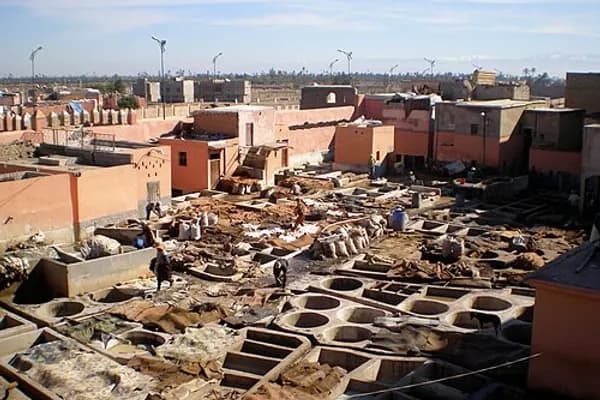
The new construction boom and availability of water began to finally attract merchants and craftsmen from elsewhere, gradually turning Marrakesh into a real city. The first to arrive were the tanners, arguably Marrakesh's most famous industry. (Goatskin tanned with sumac is still commonly referred to as "Moroccan leather" in English; books "bound in Moroccan leather" are synonymous with high luxury). The "dirty" industries - tanners, potters, tile-makers, dyers - were set up on the east part of town, on the other side of the Issil river, partly because of the stench, partly because of their need for the river's water. Ali's irrigation system allowed a surfeit of new planted orchards, vineyards and olive gardens, which attracted oil presses and related businesses, set up on the north side of town. Wealthy merchants and courtiers would go on to erect stately city homes, with Andalusian-style inner fountained garden courtyards, the riads for which Marrakesh is famous, and splendid colonnaded villas outside of it.
Although the bulk of Almoravid coinage was still struck by the mints of Sijilmassa and Aghmat, gold dinars were struck in Marrakesh already in 1092, announcing its debut as a city. Unlike other Moroccan cities, Jews were not allowed to live within Marrakesh by decree of the Almoravid emir, but Jewish merchants from Aghmat visited Marrakesh routinely, usually via the Bab Aylan gate and a makeshift Jewish quarter was erected outside the city limits. Intellectual life was more tentative. Although Malikite jurists and theologians closely connected to the Almoravid court moved to Marrakesh, there were no madrasas outside the palace, thus scholars were naturally more attracted to the vibrant intellectual centers of Fez and Cordoba, and even nearby Aghmat and Sijilmassa. A leper colony, the walled village of El Hara, was established then or sometime after, to the northwest of the city. The city's earliest Sufi saint, Yusuf ibn Ali al-Sanhaji ("Sidi Yussef Ben Ali", d.1197) was a leper.
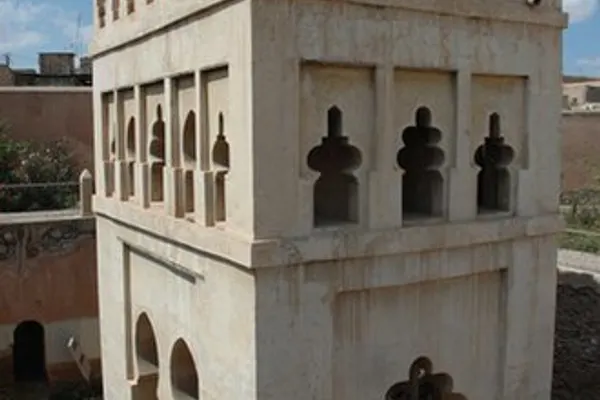
Curiously, Marrakesh was originally unenclosed, and the first walls were erected only in the 1120s. Heeding the advice of Abu Walid Ibn Rushd (grandfather of Averroes), Ali invested 70,000 gold dinars into bolstering the city's fortifications as Ibn Tumart and the Almohad movement became more influential. 6 metres (20ft) tall, with twelve gates and numerous towers, the walls were finished just on time for the first attack on the city by the Almohads. The Almohads were a new religious movement erected by preacher and self-proclaimed Mahdi Ibn Tumart among the highland Masmuda of the High Atlas. They descended from the mountains in early 1130 and besieged newly fortified Marrakesh for over a month, until they were defeated by the Almoravids in the great Battle of al-Buhayra (al-buhayra means 'lake', referring to the irrigatated orchard gardens east of the city, where the battle took place). Nonetheless, the Almoravid victory was short-lived, and the Almohads would reorganize and capture the rest of Morocco, eventually returning to take the final piece, Marrakesh, in 1146. After an eleven-month siege, and a series of inconclusive battles outside the city, in April 1147, the Almohads scaled the walls with ladders, opening the gates of Bab Dukkala and Bab Aylan, seizing the city and hunting down the last Almoravid emir in his palace. The Almohad Caliph Abd al-Mu'min refused to enter the city because (he claimed) the mosques were oriented incorrectly. The Almohads promptly demolished and razed all the Almoravid mosques so Abd al-Mu'min could make his entry. Only the ablution fountain of Koubba Ba'adiyin remains of Almoravid architecture today, in addition to city's main walls and gates (though the latter have been modified many times).
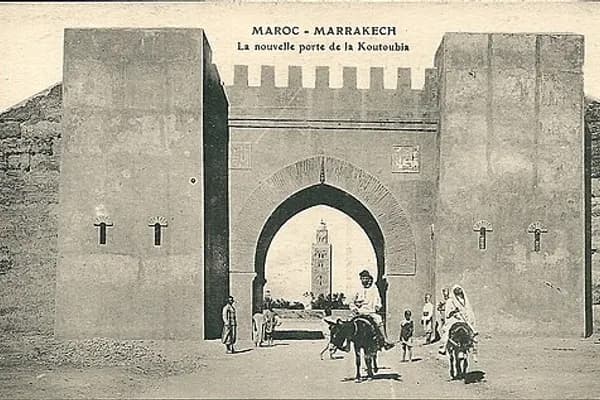
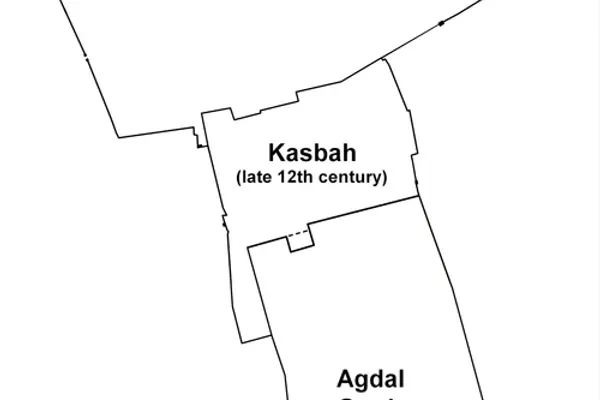
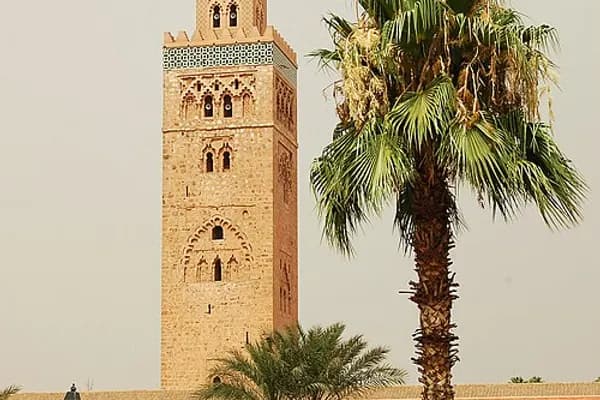
Although the Almohads maintained their spiritual capital at Tinmel, in the High Atlas, they made Marrakesh the new administrative capital of their empire, and erected much monumental architecture. On top of ruins of the Almoravid palace to the west, Abd al-Mu'min erected the (first) Koutoubia Mosque, although he promptly had it torn down shortly after its completion c. 1157 because of an orientation error. The second Koutoubia mosque was probably finished by his son Abu Yusuf Yaqub al-Mansur c. 1195, with a grandiose and elaborately adorned minaret that dominated the city's skyline. Al-Mansur also built the fortified citadel, the Kasbah (qasba), just south of the city (medina) of Marrakesh, with the Bab Agnaou gate connecting them. The Kasbah would serve as the government center of Marrakesh for centuries to come, enclosing the royal palaces, harems, treasuries, armories and barracks. It also included the a main mosque known as the Kasbah Mosque or El Mansouria Mosque (named after its founder) near Bab Agnaou. Nothing, however, remains of the original Almohad palaces or al-Mansur's great hospital.
The Almohads also expanded the waterworks with a wider irrigation system, introducing open-air canals (seguias), bringing water down from the High Atlas mountains through the Haouz plain. These new canals allowed them to establish the magnificent Menara Garden and Agdal Gardens to the west and south of the city respectively.
Much of the Almohad architecture in Marrakesh had counterparts in the cities of Seville (which the Almohads chose as their regional capital in al-Andalus) and Rabat (which they raised from scratch). Artisans who worked on these edifices were drawn from both sides of the straits, and follow similar designs and decorative themes, e.g. the Giralda of Seville and the (unfinished) Hassan Tower of Rabat are usually twinned with Koutobuia. It was also under the Almohads that Marrakesh temporarily surged as an intellectual center, attracting scholars from afar, like Ibn Tufayl, Ibn Zuhr, Ibn Rushd, etc.
It was during Almoravid and Almohad times that Morocco received its name in foreign sources. Marrakesh was known in western Europe in its Latinized form "Maroch" or "Marrochio", and the Almohad caliphate was usually referred to in Latin sources as the "Kingdom of Marrakesh" (Regnum Marrochiorum). Down to the 19th century, Marrakesh was often called "Morocco city" in foreign sources.
The death of Yusuf II in 1224 began a period of instability. Marrakesh became the stronghold of the Almohad tribal sheikhs and the ahl ad-dar (descendants of Ibn Tumart), who sought to claw power back from the ruling Almohad family (the descendants of Abd al-Mu'min, who had their power base in Seville). Marrakesh was taken, lost and retaken by force multiple times by a stream of caliphs and pretenders. Among the notable events was the brutal seizure of Marrakesh by the Sevillan caliph Abd al-Wahid II al-Ma'mun in 1226, which was followed up by a massacre of the Almohad tribal sheikhs and their families and a public denunciation of Ibn Tumart's doctrines by the caliph from the pulpit of the Kasbah mosque. After al-Ma'mun's death in 1232, his widow tried to install her son, acquiring the support of the Almohad army chiefs and Spanish mercenaries with the promise to hand Marrakesh over to them for the sack. Hearing of the terms, the people of Marrakesh hurried to strike their own deal with the military captains and saved the city from destruction with a hefty cash payoff of 500,000 dinars.
Regional capital
Encyclopedic content adapted from the Wikipedia article on Gueliz, used under CC BY-SA 4.0.