About the neighborhood
Neighborhood of Prague, Czechia
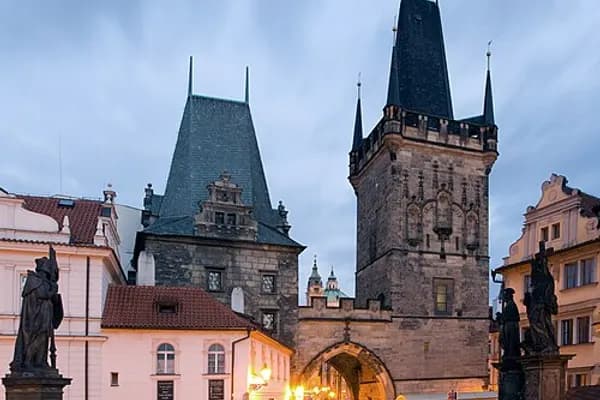
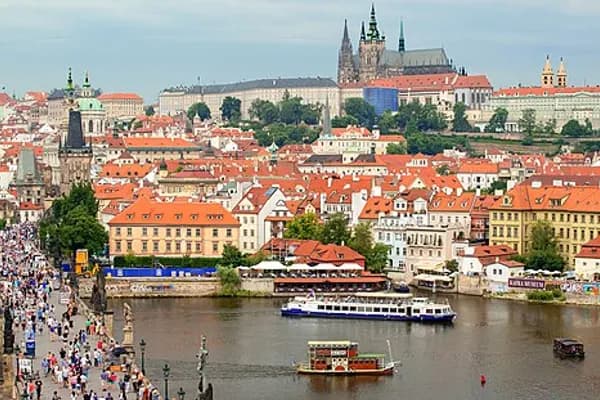
Malá Strana (Czech for "Little Side (of the River)", German: Prager Kleinseite) or historically Menší Město pražské (English: Lesser Town of Prague) is a district of the city of Prague, Czech Republic, and one of its most historic neighbourhoods.
In the Middle Ages, it was a dominant center of the ethnic German (and since 16th century also Italian) citizens of Prague. It also housed many noble palaces while the right-bank towns were comparatively more bourgeois and more Bohemian Czech.
Name
The name Malá Strana literally means "Little Side", though it is frequently referred to as "Lesser Town", "Lesser Quarter", or "Lesser Side". It is on the left (west) bank of the river Vltava, on the slopes just below Prague Castle. The name distinguishes it from the larger districts of Prague on the right bank, with which it is linked by the Charles Bridge.
Originally, when it was founded in 1257, the district was called the New Town beneath Prague Castle (Czech: Nové Město pod Pražským hradem). When Charles IV founded the New Town of Prague in 1348, Malá Strana was renamed the Lesser Town of Prague (Czech: Menší Město pražské). In the 17th century, the unofficial name Little Quarter (Czech: Malá Strana) was used.
History
Malá Strana was founded by the King Ottokar II of Bohemia in 1257. As a royal town (a town founded by the king) it got many privileges. It was created by amalgamating a number of settlements beneath the Prague Castle into a single administrative unit. The original residents were expelled and mostly German craftsmen and merchants were invited by the king. Even though the city was royal, the king did not master the city as a whole.
In the second half of the 14th century the Lesser Town of Prague was extended by the King and Holy Roman Emperor Charles IV who built a new defensive wall called Hunger Wall.
In 1419–1420 the Lesser Town was burnt down by Hussites. In 1541 the town was strongly damaged again by a fire which killed fifty people. After this fire the town was rebuilt in the Renaissance style and many palaces of nobility were built there.
The market place, now known as Malostranské náměstí (Lesser Town Square), was the center of the town. This square is divided into the upper and lower parts with the St. Nicholas Church in the middle.
Demographics
Source: Censuses Architecture
Baroque architecture predominates in Malá Strana, but the history of the district dates back to far before the Baroque era. Baroque architecture eventually dominated when the style was implanted on Malá Strana after the destructive fires in 1541.
Points of interest
The most extensive building of the Baroque Era on Malá Strana is the Wallenstein Palace. Albrecht von Wallenstein was a military general-in-chief of Emperor Ferdinand II. Under his order 26 new houses and old gates were built on the freed place. The extensive palace complex with five courtyards and the garden, which is set as a French Park.
The churches are the most frequent and interesting developments on Malá Strana. The finest one and the most prominent is the St. Nicholas Church. This is a masterpiece of Christoph and Kilian Ignaz Dientzenhofer, father and son. The finest painting in the church is an apotheosis of Saint Nicholas, the defender of children, seamen, and wayfollowers. This painting is set in the dome. It depicts an apotheosis of Saint Trinity.
The famous statue of the Holy Infant Jesus of Prague is in the Church of Our Lady Victorious in Malá Strana. The devotion and the church drew millions of Roman Catholic faithful to Malá Strana throughout the years.
In 1989, the Prague Embassy of West Germany, in the Palais Lobkowicz, was the site of a drama involving thousands of East German refugees. Their cars were left behind in the quarter.
The famous Czech novelist Jan Neruda was born, lived in and wrote about Malá Strana; Nerudova Street is named after him.
The Petřín lookout tower is located in Malá Strana.
The Czech composer Bohuslav Martinu lived in an apartment near Kampa Island in the Malá Strana while a conservatory student, and a plaque now commemorates his stay.
References
Bibliography
Wikivoyage has a travel guide for Castle and Lesser Town.
Wikimedia Commons has media related to Malá Strana.
Prague, the wayguide. By ARTFOTO printing house, Russian Language Edition.
Encyclopedic content adapted from the Wikipedia article on Malá Strana, used under CC BY-SA 4.0.
What makes Malá Strana special
Malá Strana stands out among Prague’s neighborhoods for its distinctive character: baroque prague under the castle. Ranked #3 in Prague, it offers the kind of experience that defines a great city trip — a place where the streets themselves tell a story and every block rewards curiosity.
Best for
Our take on Malá Strana
Malá Strana is one of the strongest neighborhoods in Prague, and it consistently appears in our editors' personal favorites lists. It may not always get the same attention as the city's most famous district, but among travelers who know Prague well, Malá Strana is often the first recommendation.
The energy of Malá Strana builds as the day goes on, peaking in the evening when the streets fill with locals heading to their regular spots. This is a neighborhood where the nightlife feels organic rather than manufactured — bars that have regulars, music venues where the crowd actually listens, late-night spots where the kitchen stays open because the community demands it.
Our editors recommend budgeting at least half a day here — enough time to walk the main streets, sit down for coffee, and discover the side streets where Malá Strana's real character lives.
Living in Malá Strana
Malá Strana is connected to the rest of Prague by public transit, and most visitors find it straightforward to reach from the city center or airport. Once you arrive, the neighborhood is best explored on foot — the scale is human and the streets reward wandering.
The neighborhood transitions through distinct phases during the day. Mornings are quiet — coffee shops and bakeries set the pace. Afternoons bring more energy as the retail and café scene picks up. Evenings are when Malá Strana truly comes alive, with restaurants and bars filling steadily from around 7 PM onward. If you are staying in the neighborhood, embrace the rhythm rather than fighting it.
Accommodation in Malá Strana ranges from boutique hotels to short-term rentals. We generally recommend staying within the neighborhood itself rather than commuting from a hotel elsewhere in Prague — the experience of waking up inside a great neighborhood is fundamentally different from visiting one as a day trip.
What locals say about Malá Strana
Long-term residents of Malá Strana tend to describe their neighborhood with a mix of pride and protectiveness. Like any district with genuine character, Malá Strana inspires loyalty — the kind of place people move to and never quite leave, or leave and spend years trying to get back to.
Residents value the neighborhood's evening energy but will quickly tell you that Malá Strana is more than its bars. The nightlife is an expression of the community, not a tourist attraction — locals know the bartenders by name, have their preferred corners, and treat the neighborhood's bars and restaurants as extensions of their living rooms.
Compared to the more famous districts in Prague, Malá Strana has maintained a lower profile, which many residents consider an advantage. The neighborhood evolves gradually rather than being reshaped by sudden attention, and the result is a community that still feels organic rather than curated.
Visitor tips
- Malá Strana is located in Prague, Czechia. The neighborhood is accessible by public transport, taxi, or rideshare from most parts of the city.
- The neighborhood comes alive in the evening. Plan to arrive after sunset to experience the best of the local bar and dining scene.
- Wear comfortable walking shoes — the best way to experience Malá Strana is on foot, wandering the side streets and discovering what lies around each corner.
- Save the neighborhood's location on your phone before you arrive. Offline maps are especially useful for navigating the smaller side streets.