About the neighborhood
Neighbourhood in Oslo, Norway
Majorstuen or Majorstua is a particularly affluent neighbourhood in the Frogner borough in the inner part of Oslo, Norway.
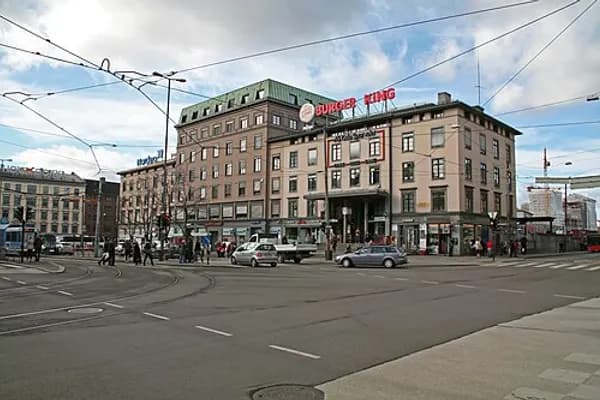
Majorstuen is known for its vibrant downtown and especially its shopping area. The area has several elegant townhouses c. 1880–1890. The area is also an important public transport junction in Oslo, where all metro lines, three tram lines and five bus lines operate. It is served by Majorstuen station.
The name
The neighborhood was named after a well-known public house that was located on the east side of Sørkedalsveien. Dating from the 1700s, the house was named for Captain Michael Wilhelm von Sundt (1679–1753). The last element is the finite form of stue 'cabin, house with a single room'. There has long been a disagreement about the forms Majorstuen and Majorstua: stuen is the articulated form when stue is treated as a masculine, and stua is the articulated form when it is treated as a feminine noun. The original pronunciation was -stua (Norwegian feminine inflection) but, because Danish was the only written language in Norway well into the 19th century, the name was written -stuen (Danish common gender inflection). The locals say either, but the local borough council has also adopted Majorstuen as the official name of the area. (For a similar disagreement, see Akerselva.)
Majorstuen Church
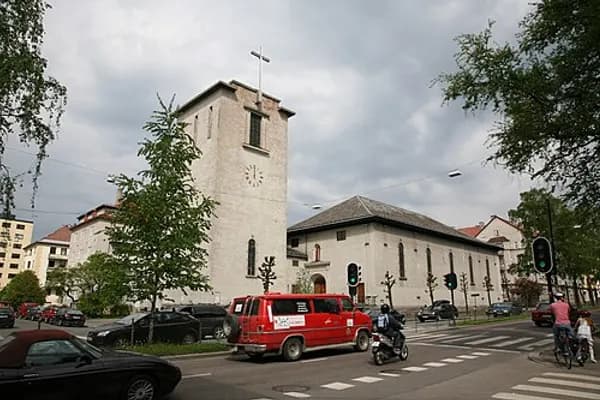
Majorstuen Church (Majorstuen kirke) was consecrated on 26 March 1926 as Priest's Church (Prestenes kirke) when it was built for the funds collected among Norwegian clergymen. Oslo Municipality took over the church in the 1960s and changed its name to Majorstuen Church. Majorstuen Church was designed by architects August Nielsen (1877–1956) and Harald Sund (1876–1940) in the style of Classicism with influences of art deco and neo-baroque. The main church has 400 seats and was built of brick. The chapel, Cappella Johannea, is decorated with frescos with themes from the Book of Revelation, executed by the artist Per Vigeland (1904–1968) in 1932. The altar picture is titled: The Christian Hope (Det kristne håp). The tapestry is by designer and textile artist, Else Marie Jakobsen.
Majorstuen School
Majorstuen school is the primary and secondary school in Majorstuen. The school was designed by architect Bredo Henrik Berntsen (1877–1957). The first phase was completed in 1908.
Majorstuen Station
Majorstuen station (Majorstuen stasjon) is the last common point for all subway lines on the western side of Oslo. The station was opened in 1898 as the terminus for Holmenkollbanen. It remained so until Smestadbanen was completed in 1912. In 1928 the tunnel to the National Theatre station (called the Underground Railway) was built. The original station building was built in 1916, when Tryvandsbanen was completed. It was designed by Erik Glosimodt who also designed a number of shelters and station buildings along Holmenkollbanen. It had two entrances, one for Holmenkollbanen, and one for Smestadbanen. When the work of underground track started, the station was destroyed. The current Majorstuen station dates to 1930 and was designed by Kristoffer Lange.
References
Wikimedia Commons has media related to Majorstua.
Wikimedia Commons has media related to Majorstuen kirke.
Wikimedia Commons has media related to Majorstuen stasjon.
Other sources
Sandnes, Jørn; Ola Stemshaug (1997, 3rd edition 2007) Norsk Stadnamnleksikon (4th edition) (Det Norske Samlaget) ISBN978-82-521-4905-0
External links
Majorstuen Archived 2010-10-29 at the Wayback Machine
Majorstuen Church
Majorstuen School
Oslo/West travel guide from Wikivoyage
59°55′45″N 10°42′59″E / 59.92917°N 10.71639°E / 59.92917; 10.71639
Encyclopedic content adapted from the Wikipedia article on Majorstuen, used under CC BY-SA 4.0.
What makes Majorstuen special
Majorstuen stands out among Oslo’s neighborhoods for its distinctive character: cafés, shopping and trams. Ranked #4 in Oslo, it offers the kind of experience that defines a great city trip — a place where the streets themselves tell a story and every block rewards curiosity.
Best for
Our take on Majorstuen
Majorstuen occupies a distinctive place in Oslo's neighborhood landscape. It is the kind of district that rewards travelers who venture beyond the obvious choices — quieter than the tourist-facing areas, richer in local character, and full of the small details that make a city trip memorable.
What makes Majorstuen worth the visit is the texture of daily life here. It is a neighborhood that functions for the people who live in it — not just for the visitors who pass through. The shops serve local needs, the restaurants feed local appetites, and the streets have a rhythm that reflects genuine community rather than tourism infrastructure. That is the quality our editors prize most, and Majorstuen has it in abundance.
Our editors recommend budgeting at least half a day here — enough time to walk the main streets, sit down for coffee, and discover the side streets where Majorstuen's real character lives.
Living in Majorstuen
Majorstuen is connected to the rest of Oslo by public transit, and most visitors find it straightforward to reach from the city center or airport. Once you arrive, the neighborhood is best explored on foot — the scale is human and the streets reward wandering.
Day-to-day life in Majorstuen has the rhythm of a genuine residential neighborhood. You will find grocery stores, pharmacies, cafés with morning regulars, and the kind of small independent shops that only survive where locals support them. For visitors, this means the infrastructure you need — good coffee, a decent meal, a quiet place to sit — is always within a short walk.
Accommodation in Majorstuen ranges from boutique hotels to short-term rentals. We generally recommend staying within the neighborhood itself rather than commuting from a hotel elsewhere in Oslo — the experience of waking up inside a great neighborhood is fundamentally different from visiting one as a day trip.
What locals say about Majorstuen
Long-term residents of Majorstuen tend to describe their neighborhood with a mix of pride and protectiveness. Like any district with genuine character, Majorstuen inspires loyalty — the kind of place people move to and never quite leave, or leave and spend years trying to get back to.
What locals appreciate most about Majorstuen is its consistency — the feeling that the neighborhood works the same way on a Tuesday morning as it does on a Saturday night. It is not a place that performs for visitors and then goes quiet. The rhythm is genuine, the community is real, and the daily experience of living here is what draws people and keeps them.
Compared to the more famous districts in Oslo, Majorstuen has maintained a lower profile, which many residents consider an advantage. The neighborhood evolves gradually rather than being reshaped by sudden attention, and the result is a community that still feels organic rather than curated.
Visitor tips
- Majorstuen is located in Oslo, Norway. The neighborhood is accessible by public transport, taxi, or rideshare from most parts of the city.
- Morning is often the best time to explore — the streets are quieter, the light is better for photography, and cafes are at their most welcoming.
- Wear comfortable walking shoes — the best way to experience Majorstuen is on foot, wandering the side streets and discovering what lies around each corner.
- Save the neighborhood's location on your phone before you arrive. Offline maps are especially useful for navigating the smaller side streets.