About the neighborhood
Urban district in Gothenburg, Sweden
Majorna (pronunciation) is a residential area in Gothenburg, Sweden. It is a part of the borough Majorna-Linné. It is located west of the city just outside the city centre, with Göta älv in the north, Masthugget and Slottsskogen in the east, Högsbo in the south and Älvsborg in the west.
History
Majorna is an old area, originating from the times of the Älvsborg fortress before the foundation of Gothenburg in 1621. After the foundation of the city of Gothenburg, Majorna housed wharfs and other harbour-related business. It became a part of the city in 1868, prior to this it had been owned by the city's police authority, but it belonged to Örgryte parish. After including Majorna in Gothenburg, the population of the city exceeded 50,000.
In the beginning of the 1900s, Majorna got its first tram line. It went over a hill known as Stigbergsliden, continued along Karl Johansgatan, all the way to the end station at Slottskogsgatan. This meant that the population of Majorna became less isolated, they could now take the tram to work in the factories in Gamlestaden, and later at SKF.
Architecture
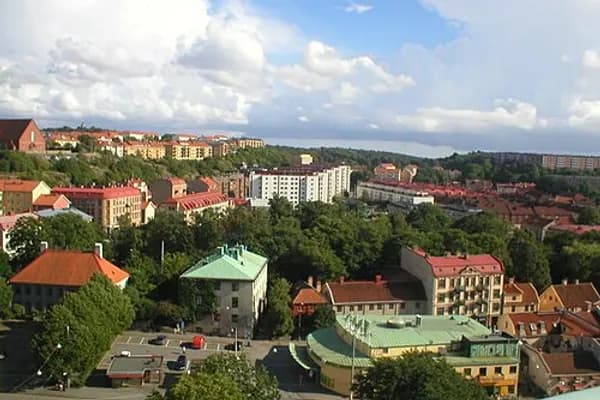
The buildings significant to Majorna are the three storey buildings where the first storey is built in stone and the topmost two are built of wood, called Landshövdingehus. They were frequently built in Gothenburg during the late 1800s and early 1900s. In Majorna they represent a flat, urban neighborhood, with tree lined avenues, courtyards, small shops in the ground floor of the buildings, and details that testify of the fine craftsmanship put into the bay windows, brick arches and the forged steel railings. A large number of the buildings still remains, but in some areas they have been replaced by newer constructions. The upper parts of the hills in Gothenburg were not built-up, with the exception for some shacks, until the mid 20th century; there are mostly buildings from the 1960s and 1970s, some of them in a Functionalistic style.
Population
Majorna has traditionally been a typical working class area, with a population of industrial workers and dockers. According to Agnes Arpi, the area still has a strong working-class identity. She claims that the working class heritage has characterized how the people living in Majorna see themselves, and that people considering themselves as radical and politically aware with an Alternative lifestyle, has moved there over the years because of this. This statement is supported by the results in the 2010 Swedish election. In the electoral area of Mariaplan (1 of the 13 in Majorna) 25.3 percent of the votes went to the Green Party, 23.9 to the Left Party and 18.6 to the Social Democratic Party. The Moderate Party only received 15.1 percent of the votes (compared to the country average of 30.1). The numbers are more or less the same in the whole of Majorna.
Majorna is one of the areas of Gothenburg that has been described as undergoing gentrification, at least symbolically.
References
57°41′36″N 11°55′25″E / 57.69333°N 11.92361°E / 57.69333; 11.92361
Wikimedia Commons has media related to Majorna.
Encyclopedic content adapted from the Wikipedia article on Majorna, used under CC BY-SA 4.0.
What makes Majorna special
Majorna stands out among Gothenburg’s neighborhoods for its distinctive character: gothenburg's leftist working-class quarter. Ranked #3 in Gothenburg, it offers the kind of experience that defines a great city trip — a place where the streets themselves tell a story and every block rewards curiosity.
Best for
Our take on Majorna
Majorna is one of the strongest neighborhoods in Gothenburg, and it consistently appears in our editors' personal favorites lists. It may not always get the same attention as the city's most famous district, but among travelers who know Gothenburg well, Majorna is often the first recommendation.
What makes Majorna exceptional is the density of its cultural life. Art galleries, independent bookshops, small theaters, and creative studios are woven into the fabric of the neighborhood rather than clustered in a single zone. You encounter culture here by accident, which is how the best cultural experiences always happen.
Our editors recommend budgeting at least half a day here — enough time to walk the main streets, sit down for coffee, and discover the side streets where Majorna's real character lives.
Living in Majorna
Majorna is connected to the rest of Gothenburg by public transit, and most visitors find it straightforward to reach from the city center or airport. Once you arrive, the neighborhood is best explored on foot — the scale is human and the streets reward wandering.
Day-to-day life in Majorna has the rhythm of a genuine residential neighborhood. You will find grocery stores, pharmacies, cafés with morning regulars, and the kind of small independent shops that only survive where locals support them. For visitors, this means the infrastructure you need — good coffee, a decent meal, a quiet place to sit — is always within a short walk.
Accommodation in Majorna ranges from boutique hotels to short-term rentals. We generally recommend staying within the neighborhood itself rather than commuting from a hotel elsewhere in Gothenburg — the experience of waking up inside a great neighborhood is fundamentally different from visiting one as a day trip.
What locals say about Majorna
Long-term residents of Majorna tend to describe their neighborhood with a mix of pride and protectiveness. Like any district with genuine character, Majorna inspires loyalty — the kind of place people move to and never quite leave, or leave and spend years trying to get back to.
The creative community in Majorna is genuine, not aspirational. Residents include working artists, writers, musicians, and designers who chose the neighborhood because it supported their work — affordable studio space, a community that values craft, and enough foot traffic to sustain independent galleries and shops.
Compared to the more famous districts in Gothenburg, Majorna has maintained a lower profile, which many residents consider an advantage. The neighborhood evolves gradually rather than being reshaped by sudden attention, and the result is a community that still feels organic rather than curated.
Visitor tips
- Majorna is located in Gothenburg, Sweden. The neighborhood is accessible by public transport, taxi, or rideshare from most parts of the city.
- Morning is often the best time to explore — the streets are quieter, the light is better for photography, and cafes are at their most welcoming.
- Wear comfortable walking shoes — the best way to experience Majorna is on foot, wandering the side streets and discovering what lies around each corner.
- Save the neighborhood's location on your phone before you arrive. Offline maps are especially useful for navigating the smaller side streets.