About the neighborhood
Urban district in Sweden
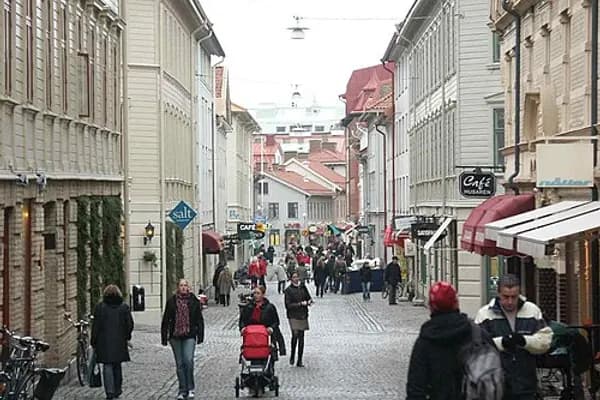
Haga is a city district in Gothenburg, Sweden, renowned for its picturesque wooden houses, 19th century-atmosphere and cafés. Originally a working class suburb of the city with a rather bad reputation, it was gradually transformed into a popular visiting place for tourists and Gothenburgers. A major renovation of the area was made in the 1980s, houses were either renovated or torn down and replaced by post-modernistic replicas.
Today, Haga has a population of about 4,000 people (4,093 at 2006), a much smaller population compared to 15,000 people one hundred years ago – an indication of the gentrification the district has gone through.
Haga is also a parish with the same borders as the city district. It is, areawise, the smallest parish in Sweden.
History
The district was first established in the mid-17th century by Queen Kristina, making it Gothenburg's first suburb. Originally, it was decreed that, since the district was outside the city walls, the area could be demolished in the event that the land was needed by the crown or in case of a threatening siege. In the 1690s, this rule was applied and 34 houses of the district were demolished in order to build a covered causeway, caponier, from the city walls to the fortress of Skansen Crown.
It was not until the 1840s that new industries were established in Gothenburg, which led to an influx of workers into Haga, creating the first worker's district in the area. This led to a housing shortage during the 1870s and the establishment of additional worker's districts to accommodate the rapid growth of the city. In the 1920s, after extensive expansion of the district, the population of the area began a decline. Many public works in the area were closed and it became a primarily residential area.
A redevelopment plan drawn up in 1962 for Gothenburg, which again included the demolition of buildings in the district. This led to the founding of the Haga Group, in 1970, which strove to preserve the original architecture of the area. Between 1973 and 1977, demolition work decreased due to the pressure of the locals. This also moved the authorities to help restore some of the buildings which were already in disrepair.
In popular culture
Haga is the main setting of the television sitcom Albert & Herbert. The series, which ran from 1974 to 1982, is about two scrap-dealers who live in a dilapidated house in the district.
Notes
Wikimedia Commons has media related to Haga, Göteborg.
57°41′55″N 11°57′23″E / 57.69861°N 11.95639°E / 57.69861; 11.95639
w:sv:Wikipedia:KML/Haga, GöteborgKML is from Wikidata
Encyclopedic content adapted from the Wikipedia article on Linnéstaden, used under CC BY-SA 4.0.
What makes Linnéstaden special
Linnéstaden stands out among Gothenburg’s neighborhoods for its distinctive character: gothenburg's stylish central district. Ranked #2 in Gothenburg, it offers the kind of experience that defines a great city trip — a place where the streets themselves tell a story and every block rewards curiosity.
Best for
Our take on Linnéstaden
Linnéstaden is one of the strongest neighborhoods in Gothenburg, and it consistently appears in our editors' personal favorites lists. It may not always get the same attention as the city's most famous district, but among travelers who know Gothenburg well, Linnéstaden is often the first recommendation.
What makes Linnéstaden worth the visit is the texture of daily life here. It is a neighborhood that functions for the people who live in it — not just for the visitors who pass through. The shops serve local needs, the restaurants feed local appetites, and the streets have a rhythm that reflects genuine community rather than tourism infrastructure. That is the quality our editors prize most, and Linnéstaden has it in abundance.
Our editors recommend budgeting at least half a day here — enough time to walk the main streets, sit down for coffee, and discover the side streets where Linnéstaden's real character lives.
Living in Linnéstaden
Linnéstaden is connected to the rest of Gothenburg by public transit, and most visitors find it straightforward to reach from the city center or airport. Once you arrive, the neighborhood is best explored on foot — the scale is human and the streets reward wandering.
Day-to-day life in Linnéstaden has the rhythm of a genuine residential neighborhood. You will find grocery stores, pharmacies, cafés with morning regulars, and the kind of small independent shops that only survive where locals support them. For visitors, this means the infrastructure you need — good coffee, a decent meal, a quiet place to sit — is always within a short walk.
Accommodation in Linnéstaden ranges from boutique hotels to short-term rentals. We generally recommend staying within the neighborhood itself rather than commuting from a hotel elsewhere in Gothenburg — the experience of waking up inside a great neighborhood is fundamentally different from visiting one as a day trip.
What locals say about Linnéstaden
Long-term residents of Linnéstaden tend to describe their neighborhood with a mix of pride and protectiveness. Like any district with genuine character, Linnéstaden inspires loyalty — the kind of place people move to and never quite leave, or leave and spend years trying to get back to.
What locals appreciate most about Linnéstaden is its consistency — the feeling that the neighborhood works the same way on a Tuesday morning as it does on a Saturday night. It is not a place that performs for visitors and then goes quiet. The rhythm is genuine, the community is real, and the daily experience of living here is what draws people and keeps them.
Like any neighborhood that has earned attention, Linnéstaden is navigating the tension between popularity and preservation. Rents have risen, new businesses have arrived, and long-time residents occasionally grumble that the neighborhood is not what it was. But the fundamentals — the walkability, the food, the community — remain strong, and most locals we speak to believe the neighborhood is still gaining more than it is losing.
Visitor tips
- Linnéstaden is located in Gothenburg, Sweden. The neighborhood is accessible by public transport, taxi, or rideshare from most parts of the city.
- Morning is often the best time to explore — the streets are quieter, the light is better for photography, and cafes are at their most welcoming.
- Wear comfortable walking shoes — the best way to experience Linnéstaden is on foot, wandering the side streets and discovering what lies around each corner.
- Save the neighborhood's location on your phone before you arrive. Offline maps are especially useful for navigating the smaller side streets.